Agrobacterium mediated Gene
Transfer
Agrobacterium
Agrobacterium is a genus of Gram-negative bacteria
established by H. J. Conn that uses horizontal gene transfer to
cause tumors in plants.
Agrobacterium tumefaciens is the most commonly
studied species in this genus.
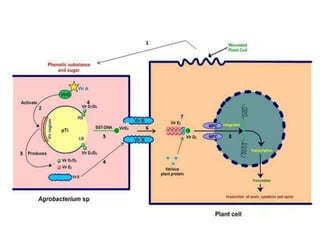
Agrobacterium is well known for its ability to transfer DNA
between itself and plants, and for this reason it has become an
important tool for genetic engineering.
The genus Agrobacterium has been divided into a number of species.
However, this division has reflected, for the most part, disease symptomology
and host range.
Thus, A. radiobacter is an “avirulent” species, A. tumefaciens causes crown
gall disease, A. rhizogenes causes hairy root disease, and A. rubi causes cane
gall disease.
 More recently, a new species has been proposed, A. vitis, which causes galls
on grape and a few other plant species
Different Species of Bacteria
 Most common method of engineering dicots
 Soil borne, gram negative, rod shaped, motile found in
rhizosphere
 Causative agents of “Crown gall” disease of dicoltyledones
 Have ability transfer bacterial genes to plant genome
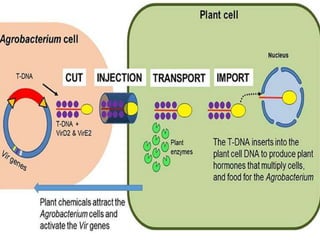
 Attracted to wound site via chemotaxis in response to chemicals
(sugar and Phenolic molecules: acetosyringone) released from
damaged plant cells
 Contains Ti plasmid which can transfer its T-DNA region into
genome of host plants
Ti-plasmid features
Two strains of Ti-plasmid:
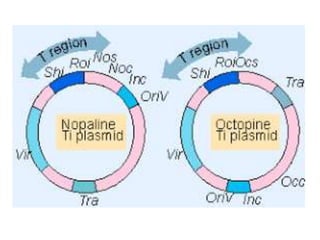
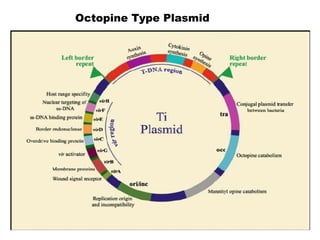
Octopine strains- contains two T-DNA region: TL (14 kb) and TR ( 7 kb)
Nopaline strains- contain one T-DNA region(20 kb)
Size is about 200 kb
Has a central role in Crown-gall formation
Contains one or more T-DNA region that is integrated into the genome of
host plants
Contain a vir region ~ 40 kb at least 8~11 vir genes
Has origin of replication
Contains a region enabling conjugative transfer
Has genes for the catabolism of opines
Octopine Type Plasmid
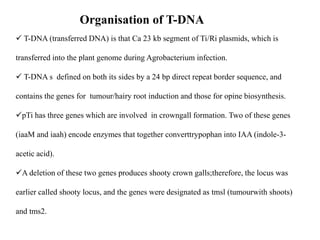
Organisation of T-DNA
 T-DNA (transferred DNA) is that Ca 23 kb segment of Ti/Ri plasmids, which is
transferred into the plant genome during Agrobacterium infection.
 T-DNA s defined on both its sides by a 24 bp direct repeat border sequence, and
contains the genes for tumour/hairy root induction and those for opine biosynthesis.
pTi has three genes which are involved in crowngall formation. Two of these genes
(iaaM and iaah) encode enzymes that together converttrypophan into IAA (indole-3-
acetic acid).
A deletion of these two genes produces shooty crown galls;therefore, the locus was
earlier called shooty locus, and the genes were designated as tmsl (tumourwith shoots)
and tms2.
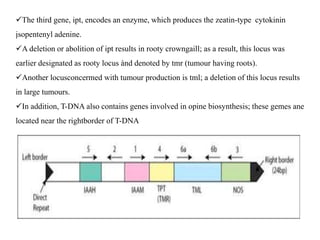
The third gene, ipt, encodes an enzyme, which produces the zeatin-type cytokinin
įsopentenyl adenine.
A deletion or abolition of ipt results in rooty crowngaill; as a result, this locus was
earlier designated as rooty locus ànd denoted by tmr (tumour having roots).
Another locusconcermed with tumour production is tml; a deletion of this locus results
in large tumours.
In addition, T-DNA also contains genes involved in opine biosynthesis; these gemes ane
located near the rightborder of T-DNA
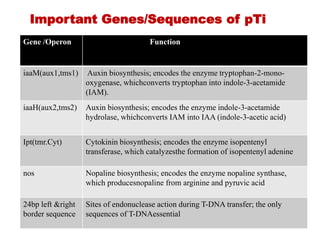
Important Genes/Sequences of pTi
Gene /Operon Function
iaaM(aux1,tms1) Auxin biosynthesis; encodes the enzyme tryptophan-2-mono-
oxygenase, whichconverts tryptophan into indole-3-acetamide
(IAM).
iaaH(aux2,tms2) Auxin biosynthesis; encodes the enzyme indole-3-acetamide
hydrolase, whichconverts IAM into IAA (indole-3-acetic acid)
Ipt(tmr.Cyt) Cytokinin biosynthesis; encodes the enzyme isopentenyl
transferase, which catalyzesthe formation of isopentenyl adenine
nos Nopaline biosynthesis; encodes the enzyme nopaline synthase,
which producesnopaline from arginine and pyruvic acid
24bp left &right
border sequence
Sites of endonuclease action during T-DNA transfer; the only
sequences of T-DNAessential
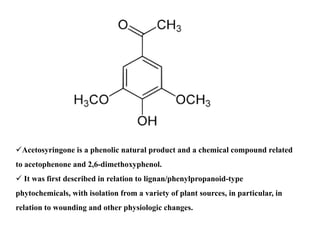
Acetosyringone is a phenolic natural product and a chemical compound related
to acetophenone and 2,6-dimethoxyphenol.
 It was first described in relation to lignan/phenylpropanoid-type
phytochemicals, with isolation from a variety of plant sources, in particular, in
relation to wounding and other physiologic changes.
Infection and tumor genesis
 Infection occurs at wound sites.
 Involves recognition and chemotaxis of the bacterium toward
wounded cells.
 galls are “real tumours”, can be removed and will grow
indefinitely without hormones.
 genetic information must be transferred to plant cells.
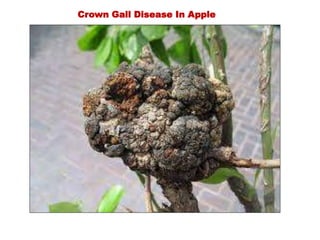
Crown Gall Disease In Apple
Tumor characteristics
1. Synthesize a unique amino acid, called “opine”
octopine and nopaline - derived from arginine
agropine - derived from glutamate
2. Opine depends on the strain of A. tumefaciens.
3. Opines are catabolized by the bacteria, which
can use only the specific opine that it causes
the plant to produce.
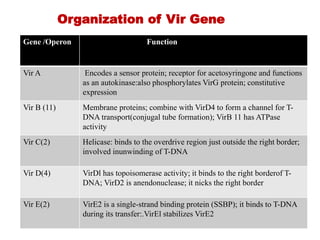
Organization of Vir Gene
Gene /Operon Function
Vir A Encodes a sensor protein; receptor for acetosyringone and functions
as an autokinase:also phosphorylates VirG protein; constitutive
expression
Vir B (11) Membrane proteins; combine with VirD4 to form a channel for T-
DNA transport(conjugal tube formation); VirB 11 has ATPase
activity
Vir C(2) Helicase: binds to the overdrive region just outside the right border;
involved inunwinding of T-DNA
Vir D(4) VirDl has topoisomerase activity; it binds to the right borderof T-
DNA; VirD2 is anendonuclease; it nicks the right border
Vir E(2) VirE2 is a single-strand binding protein (SSBP); it binds to T-DNA
during its transfer:.VirEl stabilizes VirE2
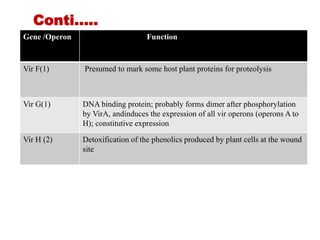
Gene /Operon Function
Vir F(1) Presumed to mark some host plant proteins for proteolysis
Vir G(1) DNA binding protein; probably forms dimer after phosphorylation
by VirA, andinduces the expression of all vir operons (operons A to
H); constitutive expression
Vir H (2) Detoxification of the phenolics produced by plant cells at the wound
site
Conti…..
Limitations
 T-DNA size is too large.
 Presence of oncogenes.
 Lack of MCS & selectable marker gene.
Agrobacterium -MGT.pptx

Agrobacterium -MGT.pptx

  • 1.
  • 2.
    Agrobacterium Agrobacterium is agenus of Gram-negative bacteria established by H. J. Conn that uses horizontal gene transfer to cause tumors in plants. Agrobacterium tumefaciens is the most commonly studied species in this genus. Agrobacterium is well known for its ability to transfer DNA between itself and plants, and for this reason it has become an important tool for genetic engineering.
  • 3.
    The genus Agrobacteriumhas been divided into a number of species. However, this division has reflected, for the most part, disease symptomology and host range. Thus, A. radiobacter is an “avirulent” species, A. tumefaciens causes crown gall disease, A. rhizogenes causes hairy root disease, and A. rubi causes cane gall disease.  More recently, a new species has been proposed, A. vitis, which causes galls on grape and a few other plant species Different Species of Bacteria
  • 4.
     Most commonmethod of engineering dicots  Soil borne, gram negative, rod shaped, motile found in rhizosphere  Causative agents of “Crown gall” disease of dicoltyledones  Have ability transfer bacterial genes to plant genome  Attracted to wound site via chemotaxis in response to chemicals (sugar and Phenolic molecules: acetosyringone) released from damaged plant cells  Contains Ti plasmid which can transfer its T-DNA region into genome of host plants
  • 5.
    Ti-plasmid features Two strainsof Ti-plasmid: Octopine strains- contains two T-DNA region: TL (14 kb) and TR ( 7 kb) Nopaline strains- contain one T-DNA region(20 kb) Size is about 200 kb Has a central role in Crown-gall formation Contains one or more T-DNA region that is integrated into the genome of host plants Contain a vir region ~ 40 kb at least 8~11 vir genes Has origin of replication Contains a region enabling conjugative transfer Has genes for the catabolism of opines
  • 7.
  • 8.
    Organisation of T-DNA T-DNA (transferred DNA) is that Ca 23 kb segment of Ti/Ri plasmids, which is transferred into the plant genome during Agrobacterium infection.  T-DNA s defined on both its sides by a 24 bp direct repeat border sequence, and contains the genes for tumour/hairy root induction and those for opine biosynthesis. pTi has three genes which are involved in crowngall formation. Two of these genes (iaaM and iaah) encode enzymes that together converttrypophan into IAA (indole-3- acetic acid). A deletion of these two genes produces shooty crown galls;therefore, the locus was earlier called shooty locus, and the genes were designated as tmsl (tumourwith shoots) and tms2.
  • 9.
    The third gene,ipt, encodes an enzyme, which produces the zeatin-type cytokinin įsopentenyl adenine. A deletion or abolition of ipt results in rooty crowngaill; as a result, this locus was earlier designated as rooty locus ànd denoted by tmr (tumour having roots). Another locusconcermed with tumour production is tml; a deletion of this locus results in large tumours. In addition, T-DNA also contains genes involved in opine biosynthesis; these gemes ane located near the rightborder of T-DNA
  • 10.
    Important Genes/Sequences ofpTi Gene /Operon Function iaaM(aux1,tms1) Auxin biosynthesis; encodes the enzyme tryptophan-2-mono- oxygenase, whichconverts tryptophan into indole-3-acetamide (IAM). iaaH(aux2,tms2) Auxin biosynthesis; encodes the enzyme indole-3-acetamide hydrolase, whichconverts IAM into IAA (indole-3-acetic acid) Ipt(tmr.Cyt) Cytokinin biosynthesis; encodes the enzyme isopentenyl transferase, which catalyzesthe formation of isopentenyl adenine nos Nopaline biosynthesis; encodes the enzyme nopaline synthase, which producesnopaline from arginine and pyruvic acid 24bp left &right border sequence Sites of endonuclease action during T-DNA transfer; the only sequences of T-DNAessential
  • 11.
    Acetosyringone is aphenolic natural product and a chemical compound related to acetophenone and 2,6-dimethoxyphenol.  It was first described in relation to lignan/phenylpropanoid-type phytochemicals, with isolation from a variety of plant sources, in particular, in relation to wounding and other physiologic changes.
  • 12.
    Infection and tumorgenesis  Infection occurs at wound sites.  Involves recognition and chemotaxis of the bacterium toward wounded cells.  galls are “real tumours”, can be removed and will grow indefinitely without hormones.  genetic information must be transferred to plant cells.
  • 13.
  • 14.
    Tumor characteristics 1. Synthesizea unique amino acid, called “opine” octopine and nopaline - derived from arginine agropine - derived from glutamate 2. Opine depends on the strain of A. tumefaciens. 3. Opines are catabolized by the bacteria, which can use only the specific opine that it causes the plant to produce.
  • 15.
    Organization of VirGene Gene /Operon Function Vir A Encodes a sensor protein; receptor for acetosyringone and functions as an autokinase:also phosphorylates VirG protein; constitutive expression Vir B (11) Membrane proteins; combine with VirD4 to form a channel for T- DNA transport(conjugal tube formation); VirB 11 has ATPase activity Vir C(2) Helicase: binds to the overdrive region just outside the right border; involved inunwinding of T-DNA Vir D(4) VirDl has topoisomerase activity; it binds to the right borderof T- DNA; VirD2 is anendonuclease; it nicks the right border Vir E(2) VirE2 is a single-strand binding protein (SSBP); it binds to T-DNA during its transfer:.VirEl stabilizes VirE2
  • 16.
    Gene /Operon Function VirF(1) Presumed to mark some host plant proteins for proteolysis Vir G(1) DNA binding protein; probably forms dimer after phosphorylation by VirA, andinduces the expression of all vir operons (operons A to H); constitutive expression Vir H (2) Detoxification of the phenolics produced by plant cells at the wound site Conti…..
  • 19.
    Limitations  T-DNA sizeis too large.  Presence of oncogenes.  Lack of MCS & selectable marker gene.