Molecular Genetics
     PREPARED BY:
    DIAZ, FRANCINE
DNA Structure

 Watson and Crick determined that DNA is a polymer
 of nucleotides arranged in adouble helix. Each
 nucleotide is composed of a phosphate group, a
 sugar (deoxyribose), and a base. There are a total of
 four bases: adenine, thymine,cytosine, and guanine.
 Adenine and guanine are purines while cytosine and
 thymine are pyrimidines. Base-pairing occurs
 between adenine and thymine and between guanine
 and cytosine.
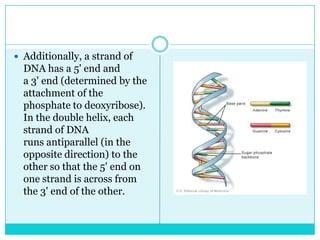
 Additionally, a strand of
  DNA has a 5' end and
  a 3' end (determined by the
  attachment of the
  phosphate to deoxyribose).
  In the double helix, each
  strand of DNA
  runs antiparallel (in the
  opposite direction) to the
  other so that the 5' end on
  one strand is across from
  the 3' end of the other.
RNA Structure

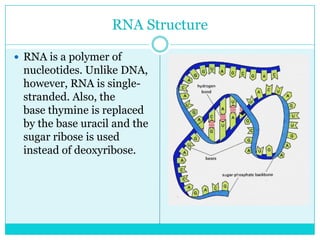
 RNA is a polymer of
 nucleotides. Unlike DNA,
 however, RNA is single-
 stranded. Also, the
 base thymine is replaced
 by the base uracil and the
 sugar ribose is used
 instead of deoxyribose.
There are three kinds of RNA.
 Messenger RNA (mRNA) carries a copy of the
  DNA code to theribosomes during protein sythesis.
 Transfer RNA (tRNA) transports amino acids
  (used to form proteins) to their proper place on the
  mRNA template.
 Ribosomal RNA (rRNA) are the building blocks
  of ribosomes. They are created in the nucleolus.
DNA Replication

 Promoter proteins are produced and bind to DNA at
 several sites.

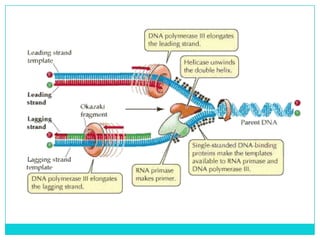
 Helicases attach to promoter proteins and break
 the hydrogen bondslinking the bases together to open the
 helix up.

 RNA polymerase reads the exposed nucleotides and
 produces an RNA primer (approximately 10
 nucleotides in length).

 DNA polymerase replicates the DNA (base-pairing)
 forming the new strand in the 5' to 3' direction.
 Because DNA polymerase only reads in the 3' to 5'
 direction, and forms the new strand in the opposite
 direction, there is a directional problem. Therefore one
 molecule of DNA produces a continuous leading
 strand in one direction. On the lagging strand, new
 primers have to form at many sites and the DNA is
 broken up into many small fragments called Okazaki
 fragments.

 The process of DNA replication occurs at many sites,
 called replication bubbles, along the entire DNA
 strand.
 When DNA polymerase reaches the 5' end of the RNA
 primer, it is released and other enzymes remove the RNA
 primers and replace them with the proper nucleotides.

 DNA ligase joins together all of the large leading
 fragments and the many small Okazaki fragments.

 DNA polymerase also checks and corrects any mistakes
 in base pairing.

 Topoisomerases prevent kinks as the parent DNA is
 unzipped.
Mutation

 Mistakes in base-pairing are corrected by DNA
  polymerase and other mismatch repair enzymes.
 Radiation and various reactive chemicals can
  cause thymine dimers where
  adjacent nucleotides bind to each other instead of to
  the complimentary strand. Such errors are usually
  fixed by splicing out the affected nucleotides and
  replacing them (excision repair).
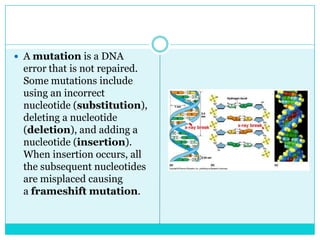
 A mutation is a DNA
 error that is not repaired.
 Some mutations include
 using an incorrect
 nucleotide (substitution),
 deleting a nucleotide
 (deletion), and adding a
 nucleotide (insertion).
 When insertion occurs, all
 the subsequent nucleotides
 are misplaced causing
 a frameshift mutation.
Protein Synthesis

 Protein synthesis is divided into two phases:
  transcription and translation.
 In transcription, RNA polymerase unzips DNA
  and reads it in the 3' to 5' direction. Free RNA
  nucleotides are base paired with the exposed DNA
  nucleotides and assembled into mRNA. The mRNA
  then leaves the nucleus and moves to the ribosomes
  in the cytoplasm. Transcription ends and translation
  begins.
Translation has four stages.

1. In the amino acid          2. In the initiation
    activation                    stage the ribosome
    stage amino acids are         moves along the mRNA
    attached to the               strand until it reaches
    appropriate tRNA mole         the code for formyl
    cules. A molecule of          methione (AUG).
    ATP is used to activate
    the tRNA.
3. In the elongation            4. In the termination
  stage the tRNA matches          stage a nonsense code is
  its anti-codon (three           reached and the protein is
  nucleotides) with the           released.
  mRNA codon (three
  nucleotides). The amino
  acid on the previous tRNA
  is transferred to the newly
  arrived tRNA and the
  empty tRNA leaves. This is
  repeated over and over as
  the ribosome moves along
  the mRNA strand.

Molecular genetics ppt

  • 1.
    Molecular Genetics PREPARED BY: DIAZ, FRANCINE
  • 2.
    DNA Structure  Watsonand Crick determined that DNA is a polymer of nucleotides arranged in adouble helix. Each nucleotide is composed of a phosphate group, a sugar (deoxyribose), and a base. There are a total of four bases: adenine, thymine,cytosine, and guanine. Adenine and guanine are purines while cytosine and thymine are pyrimidines. Base-pairing occurs between adenine and thymine and between guanine and cytosine.
  • 3.
     Additionally, astrand of DNA has a 5' end and a 3' end (determined by the attachment of the phosphate to deoxyribose). In the double helix, each strand of DNA runs antiparallel (in the opposite direction) to the other so that the 5' end on one strand is across from the 3' end of the other.
  • 4.
    RNA Structure  RNAis a polymer of nucleotides. Unlike DNA, however, RNA is single- stranded. Also, the base thymine is replaced by the base uracil and the sugar ribose is used instead of deoxyribose.
  • 5.
    There are threekinds of RNA.  Messenger RNA (mRNA) carries a copy of the DNA code to theribosomes during protein sythesis.  Transfer RNA (tRNA) transports amino acids (used to form proteins) to their proper place on the mRNA template.  Ribosomal RNA (rRNA) are the building blocks of ribosomes. They are created in the nucleolus.
  • 6.
    DNA Replication  Promoterproteins are produced and bind to DNA at several sites.  Helicases attach to promoter proteins and break the hydrogen bondslinking the bases together to open the helix up.  RNA polymerase reads the exposed nucleotides and produces an RNA primer (approximately 10 nucleotides in length).  DNA polymerase replicates the DNA (base-pairing) forming the new strand in the 5' to 3' direction.
  • 7.
     Because DNApolymerase only reads in the 3' to 5' direction, and forms the new strand in the opposite direction, there is a directional problem. Therefore one molecule of DNA produces a continuous leading strand in one direction. On the lagging strand, new primers have to form at many sites and the DNA is broken up into many small fragments called Okazaki fragments.  The process of DNA replication occurs at many sites, called replication bubbles, along the entire DNA strand.
  • 8.
     When DNApolymerase reaches the 5' end of the RNA primer, it is released and other enzymes remove the RNA primers and replace them with the proper nucleotides.  DNA ligase joins together all of the large leading fragments and the many small Okazaki fragments.  DNA polymerase also checks and corrects any mistakes in base pairing.  Topoisomerases prevent kinks as the parent DNA is unzipped.
  • 10.
    Mutation  Mistakes inbase-pairing are corrected by DNA polymerase and other mismatch repair enzymes.  Radiation and various reactive chemicals can cause thymine dimers where adjacent nucleotides bind to each other instead of to the complimentary strand. Such errors are usually fixed by splicing out the affected nucleotides and replacing them (excision repair).
  • 11.
     A mutationis a DNA error that is not repaired. Some mutations include using an incorrect nucleotide (substitution), deleting a nucleotide (deletion), and adding a nucleotide (insertion). When insertion occurs, all the subsequent nucleotides are misplaced causing a frameshift mutation.
  • 12.
    Protein Synthesis  Proteinsynthesis is divided into two phases: transcription and translation.  In transcription, RNA polymerase unzips DNA and reads it in the 3' to 5' direction. Free RNA nucleotides are base paired with the exposed DNA nucleotides and assembled into mRNA. The mRNA then leaves the nucleus and moves to the ribosomes in the cytoplasm. Transcription ends and translation begins.
  • 13.
    Translation has fourstages. 1. In the amino acid 2. In the initiation activation stage the ribosome stage amino acids are moves along the mRNA attached to the strand until it reaches appropriate tRNA mole the code for formyl cules. A molecule of methione (AUG). ATP is used to activate the tRNA.
  • 14.
    3. In theelongation 4. In the termination stage the tRNA matches stage a nonsense code is its anti-codon (three reached and the protein is nucleotides) with the released. mRNA codon (three nucleotides). The amino acid on the previous tRNA is transferred to the newly arrived tRNA and the empty tRNA leaves. This is repeated over and over as the ribosome moves along the mRNA strand.