Chapter six
Speciation
05/16/21 By Asmamaw Menelih 1
Outlines
Introduction
Speciation
Patterns of speciation
Species concepts
Modes of speciation
Rates of species
Isolating mechanism of speciation
Types of evolution
05/16/21 By Asmamaw Menelih 2
Introduction
 Species - a group of organisms with the ability to interbreed
and produce fertile offspring in the natural environment.
 A species is a single lineage of organisms that maintains its
identity from other such lineages and has its own
evolutionary tendencies and historical fate (Wiley 1978)
 A species is a group of organisms that maintains a
distinctive set of attributes in nature.
05/16/21 By Asmamaw Menelih 3
Speciation
 Speciation is the evolution of one or more species from a single
ancestor species.
 It can occur when members of a population become isolated from each
other.
 Once two populations are reproductively isolated, they are considered
separate species.
 Speciation is the process whereby new species are formed.
 Speciation leads to macroevolution
 Macroevolution refers to the evolutionary changes that create new
species and groups of species.
05/16/21 By Asmamaw Menelih 4
Speciation
 Creates multiple “daughter” species from
one ancestor
05/16/21 By Asmamaw Menelih 5
Cont…
 The process by which one genetically-cohesive
population splits into two or more reproductively-
isolated populations.
 Requires the disruption of gene flow and the evolution
of reproductive isolating mechanisms (RIMs).
05/16/21 By Asmamaw Menelih 6
Speciation involves barriers to reproduction
05/16/21 By Asmamaw Menelih 7
Patterns of speciation
 There are two patterns of speciation as evidenced by the fossil record
• Anagenesis
 It is the accumulation of changes associated with the transformation of one
species into another.
 Evolution taking place in a single group (a lineage) with the passage of
time.
 Does not promote biological diversity
• Cladogenesis
 The splitting of one lineage into two new species arise through
cladogenesis.
 It is also called branching evolution, is the budding of one or more new
species from a parent species.
 promotes biological diversity by increasing the number of species.
05/16/21 By Asmamaw Menelih 8
05/16/21 By Asmamaw Menelih 9
Cont…
Anagenesis
05/16/21 By Asmamaw Menelih 10
Cladogenesis
Species concept
 Biological species concept:
 The biological species concept defines a species as members of
populations that actually or potentially interbreed in nature not
according to similarity of appearance.
 Species are groups of actually or potentially interbreeding
natural populations, which are reproductively isolated from other
such groups (Mayer, 1940).
 A species is a reproductive community of populations (
reproductively isolated from others) that occupies a specific
niche in nature (Mayer, 1982)
05/16/21 By Asmamaw Menelih 11
Cont…
 Species are the members in aggregate of a group of
populations that breed or potentially interbreed with each
other under natural conditions (Futuyma).
05/16/21 By Asmamaw Menelih 12
Cont…
 Ecological Species Concept:
 A species is a lineage that occupies a niche minimally
different from that of any other lineage in its range and
which evolves separately from all lineages outside its
range.
 Evolutionary species concept:
 A species is a single lineage of ancestor-descendant
populations which maintain its identity from other such
lineages and which has it own evolutionary tendencies
and historical fate.
05/16/21 By Asmamaw Menelih 13
Cont…
 Phenetic species concept:
 A species is a set of organisms that look similar to each
other and distinct from other sets.
 Phenotypic similarity is all that matters in recognizing
separate species.
 Phylogenetic species concept:
 A species is the smallest diagnosable cluster of individual
organisms within which there is a parental pattern of
ancestry and descent.
05/16/21 By Asmamaw Menelih 14
What causes speciation?
 Speciation, or the evolution of reproductive isolation,
occurs as a by-product of genetic changes that accumulate
between two previously interbreeding populations of the
same species.
05/16/21 By Asmamaw Menelih 15
How does speciation occur?
 There are several different ways in which the evolution of
reproductive isolation is thought to occur.
 These can be generalized into a series of events, or steps.
 The “Steps” in a speciation event:
 Step 1: gene flow between two populations is interrupted
(populations become genetically isolated from each other)
 Step 2: genetic differences gradually accumulate between the
two populations (populations diverge genetically)
 Step 3: reproductive isolation evolves as a consequence of
this divergence (a reproductive isolating mechanism evolves
05/16/21 By Asmamaw Menelih 16
The Rate of Speciation
 A comparison of gradualism and punctuated equilibrium.
 Gradual speciation is the gradual divergence of populations
until they have reached the levels of specific distinctness.
 During punctuated equilibrium, long periods of equilibrium
in which species exist essentially unchanged are;
 punctuated by relatively short periods of evolutionary
change during which phenotypic characteristics may change
rapidly.
05/16/21 By Asmamaw Menelih 17
Cont…
Comparison between gradualism and punctuated equilibrium
05/16/21 By Asmamaw Menelih 18
05/16/21 By Asmamaw Menelih 19
Modes of Speciation
 Speciation means the formation of species.
 The alternative methods of speciation have been proposed
as follow:
Allopatric speciation,
Sympatric speciation,
Parapatric speciation, and
 Peripatric speciation (altational speciation).
05/16/21 By Asmamaw Menelih 20
Modes of Speciation
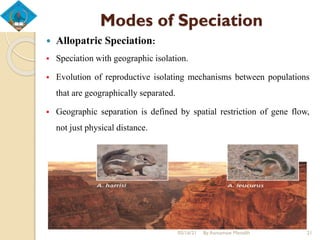
 Allopatric Speciation:
 Speciation with geographic isolation.
 Evolution of reproductive isolating mechanisms between populations
that are geographically separated.
 Geographic separation is defined by spatial restriction of gene flow,
not just physical distance.
05/16/21 By Asmamaw Menelih 21
MODEL OF ALLOPATRIC SPECIATION
ANCESTRAL
POPULATION
GEOGRAPHIC
BARRIER
05/16/21 By Asmamaw Menelih 22
.
05/16/21 By Asmamaw Menelih 23
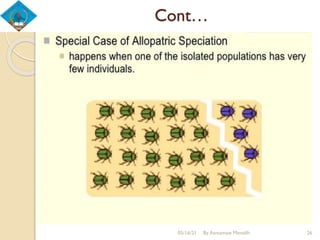
Cont…
05/16/21 By Asmamaw Menelih 24
Peripatric Speciation:
 Speciation in a peripheral isolate.
 Due to rare dispersal or colonization events.
 Also referred to as Founder Effect speciation.
 In small populations DRIFT and NATURAL SELECTION
may cause rapid divergence from the parental population
05/16/21 By Asmamaw Menelih 25
ANCESTRAL
POPULATION
PERIPHERAL ISOLATE
Cont…
.
05/16/21 By Asmamaw Menelih 26
Sympatric speciation
 Sympatric speciation involves the formation of different
species that are not geographically isolated from one
another.
 Pattern in which speciation occurs in the absence of a
physical barrier
 Adaptation to local environments, and sexual selection
are mechanisms that can promote sympatric speciation.
 A species achieves reproductive isolation and evolves in
the same geographic location as its ancestral species
05/16/21 By Asmamaw Menelih 27
Cont…
 polyploidy (extra sets of chromosomes) is a major
factor in sympatric speciation in plants
 autopolypoidy – multiple sets from one parent
species; example – plants around Agent Orange sites
05/16/21 By Asmamaw Menelih 28
 Primula kewensis arose via
allopolyploidy in an interbreeding even
of P. floribunda and P. verticiliata in
1898 at the Royal Botanic Gardens in
Kew, England
 Each of the parental stocks have a 2n =
18.
 P. kewensis is 2n = 36 because of
chromosomal duplication events after
the hybrid cross – was observed 3 times
 P. kewensis now a popular garden plant.
Example, Primrose Speciation
05/16/21 By Asmamaw Menelih 29
05/16/21 By Asmamaw Menelih 30
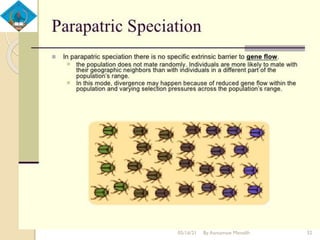
Parapatric speciation
 It occurs when populations are separated not by a
geographical barrier, such as a body of water, but by an
extreme change in habitat.
 While populations in these areas may interbreed, they
often develop distinct characteristics and lifestyles.
 It is extremely rare.
05/16/21 By Asmamaw Menelih 31
05/16/21 By Asmamaw Menelih 32
Summery
05/16/21 By Asmamaw Menelih 33
Isolation Mechanisms
 Isolation is an important factor contributing to the
process of evolution.
 It is the segregation of the population of a particular
species into smaller units which prevent interbreeding
between them.
 Isolation aids in splitting of the species into separate
groups.
 In consequence of being separated from one another,
organisms have developed different characteristics, due to
which they have become separate species.
05/16/21 By Asmamaw Menelih 34
Types of Isolation
 Evolutionary biologists have recognized the following
types of isolations which cause speciation.
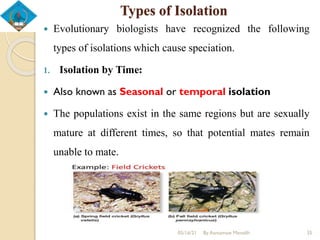
1. Isolation by Time:
 Also known as Seasonal or temporal isolation
 The populations exist in the same regions but are sexually
mature at different times, so that potential mates remain
unable to mate.
05/16/21 By Asmamaw Menelih 35
2. Isolation by Distance (Spatial Isolation)
 Sheer distance apart may also act as an isolating factor for a
species which occupies a great range of area, which is
unbroken by effective barriers.
 Its example is wrens (birds) of South America.
 Wrens are found all over the continent but the wrens of one
region differ from those of the other in colour patterns, size,
proportions and habits.
 It shows that without any barrier, sheer distance apart tends
to produce local races (subspecies).
05/16/21 By Asmamaw Menelih 36
Cont…
. Variation among wrens due to Spatial Isolation
05/16/21 By Asmamaw Menelih 37
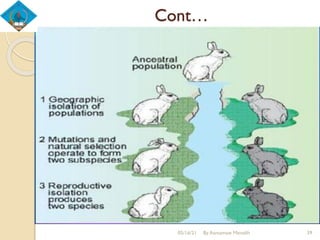
3. Geographical Isolation
 It is the most common type of isolation and occurs when an
original population is divided into two or more groups by
geographical barriers such as a river, desert, glacier, mountain or
ocean.
 All of which prevent interbreeding between them, then in the
course of time different mutations may become incorporated in
the gene pools of the different groups.
 Certain additional kinds of geographical barriers are the volcanic
formation of a mountain on land, mountain ranges with deep
valleys between and land masses as islands in sea.
05/16/21 By Asmamaw Menelih 38
Cont…
.
05/16/21 By Asmamaw Menelih 39
Cont…
.
05/16/21 By Asmamaw Menelih 40
Cont….

05/16/21 By Asmamaw Menelih 41
4. Reproductive Isolation
 In sexually reproducing organisms species can be defined as
Mendelian populations between which the gene exchange is prevented
by reproductive isolation. .
 In simple terms isolating mechanisms are those which prevent
successful reproduction between members of two or more populations
(viz., closely related species) that have descended from the same
original population.
 Evolution of reproductive isolating mechanisms prevents nascent
species from interbreeding.
05/16/21 By Asmamaw Menelih 42
Types of reproductive isolating mechanisms
 Most modern evolutionists such as Mecham (1961), Mayr
(1948, 1970), Stebbins (1966,1971), etc., have classified
the reproductive isolating mechanisms into two classes.
 These are:
premating or prezygotic isolating mechanisms and
Postmating or postzygotic isolating mechanisms.
 Prezygotic Mechanisms prevent mating formation of
viable or zygotes.
 Postzygotic Mechanisms prevent hybrids from passing on
their genes.
05/16/21 By Asmamaw Menelih 43
Cont…
 premating or prezygotic isolating mechanisms prevent
wastage of gametes (germ cells) and so are highly
susceptible to improvement by natural selection;
 postmating or postzygotic isolating mechanisms do not
prevent wastage of gametes and their improvement by
natural selection is indirect
05/16/21 By Asmamaw Menelih 44
A. Premating or prezygotic isolating mechanisms
 Mechanisms that prevent interspecific crosses (i.e.,
fertilization and zygote formation).
 Causes of prezygotic isolating mechanism:
 1. Habitat isolation :
 Two closely related species may occupy different ecosystems
within a geographical region.
 The populations live in the same regions but occupy different
habitats, so that potential mates do not meet.
05/16/21 By Asmamaw Menelih 45
Cont…
 Example 1: Central California populations of Rana spp.
◦ The Red-legged Frog (Rana draytonii) tends to breed in large
ponds.
◦ The Yellow-legged Frog (Rana boylii) breeds almost exclusively in
fast-moving streams.
 Their habitat preferences contribute to their reproductive isolation.
05/16/21 By Asmamaw Menelih 46
Cont…
 Example 2: European populations of Turdus spp.
The Common Blackbird (Turdus merula) lives and breeds in forest.
The Ring Ouzel (Turdus torquatus), a close cousin, lives and breeds on
moors.
Even when forest and moor abut, the two species do not interbreed.
05/16/21 By Asmamaw Menelih 47
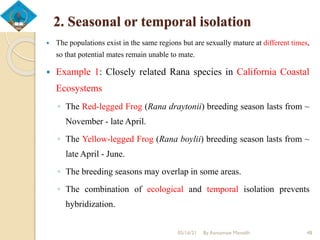
2. Seasonal or temporal isolation
 The populations exist in the same regions but are sexually mature at different times,
so that potential mates remain unable to mate.
 Example 1: Closely related Rana species in California Coastal
Ecosystems
◦ The Red-legged Frog (Rana draytonii) breeding season lasts from ~
November - late April.
◦ The Yellow-legged Frog (Rana boylii) breeding season lasts from ~
late April - June.
◦ The breeding seasons may overlap in some areas.
◦ The combination of ecological and temporal isolation prevents
hybridization.
05/16/21 By Asmamaw Menelih 48
Cont…
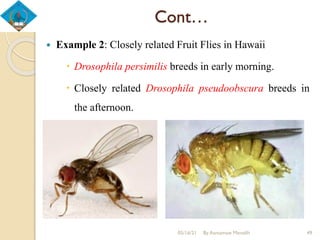
 Example 2: Closely related Fruit Flies in Hawaii
 Drosophila persimilis breeds in early morning.
 Closely related Drosophila pseudoobscura breeds in
the afternoon.
05/16/21 By Asmamaw Menelih 49
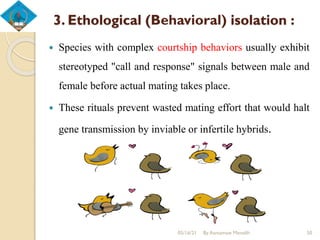
3. Ethological (Behavioral) isolation :
 Species with complex courtship behaviors usually exhibit
stereotyped "call and response" signals between male and
female before actual mating takes place.
 These rituals prevent wasted mating effort that would halt
gene transmission by inviable or infertile hybrids.
05/16/21 By Asmamaw Menelih 50
Cont…
05/16/21 By Asmamaw Menelih 51
4. Mechanical Isolation
 Cross fertilization or pollination is prevented or restricted
by differences in structure of reproductive organs
(genitalia in animals, flowers in plants).
 So that, copulation is attempted but no transfer of sperm
takes place.
 Morphological differences between species prevent
hybridization.
05/16/21 By Asmamaw Menelih 52
Cont…
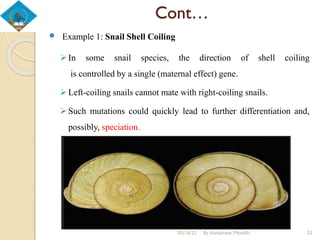
 Example 1: Snail Shell Coiling
In some snail species, the direction of shell coiling
is controlled by a single (maternal effect) gene.
Left-coiling snails cannot mate with right-coiling snails.
Such mutations could quickly lead to further differentiation and,
possibly, speciation.
05/16/21 By Asmamaw Menelih 53
5. Gametic Isolation
 In this case, sperm and ova of the two species are
chemically incompatible, and will not join to form a
zygote.
05/16/21 By Asmamaw Menelih 54
B. Postmating or postzygotic isolating
mechanisms
 Fertilization takes place, hybrid zygotes are formed, but
these are inviable, or give rise to weak or sterile hybrids.
1. Hybrid inviability or weakness:
 Sperm and egg from the two species may combine, but the
genetic information is insufficient to carry the organism
through normal development.
 The embryo dies after a few cleavages, or some time
before birth/hatching.
05/16/21 By Asmamaw Menelih 55
Cont…
 Example: Drosophila spp.
◦ Despite their superficially similar appearance, D.
melanogaster and D. simulans have incompatible alleles
for nuclear pore proteins.
◦ Dysfunction of this vital gene results in inviable hybrids.
05/16/21 By Asmamaw Menelih 56
2. Developmental hybrid sterility:
 Hybrids are sterile because gonads develop abnormally, or
meiosis breaks down before it is completed.
 Example 1: Tigers (Panthera tigris) and Lions (Panthera leo)
◦ Tigers and Lions are sister taxa, but separate for millions of
years.
◦ Their hybrid offspring are viable and robust, but sterile.
◦ Chromosomes are not homologous, so do not migrate
normally at meiosis.
05/16/21 By Asmamaw Menelih 57
Cont…
 male tiger x lioness --> tigon
 male lion x tigress --> liger
 reciprocal cross offspring are somewhat different
◦ maternal mitochondria input.
05/16/21 By Asmamaw Menelih 58
Cont…
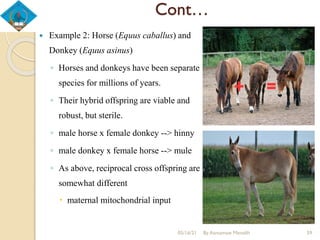
 Example 2: Horse (Equus caballus) and
Donkey (Equus asinus)
◦ Horses and donkeys have been separate
species for millions of years.
◦ Their hybrid offspring are viable and
robust, but sterile.
◦ male horse x female donkey --> hinny
◦ male donkey x female horse --> mule
◦ As above, reciprocal cross offspring are
somewhat different
 maternal mitochondrial input
05/16/21 By Asmamaw Menelih 59
3. Hybrid Breakdown
05/16/21 By Asmamaw Menelih 60
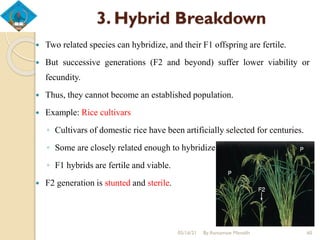
 Two related species can hybridize, and their F1 offspring are fertile.
 But successive generations (F2 and beyond) suffer lower viability or
fecundity.
 Thus, they cannot become an established population.
 Example: Rice cultivars
◦ Cultivars of domestic rice have been artificially selected for centuries.
◦ Some are closely related enough to hybridize.
◦ F1 hybrids are fertile and viable.
 F2 generation is stunted and sterile.
Cont…
 Hybridization between closely related species can have one of several
possible outcomes.
◦ Species Reinforcement
 Hybrids have lower fitness than either parent species.
 Reproductive isolation is maintained due to lack of hybrid
survival/reproduction.
◦ Species Fusion
 Two species in a hybrid zone may have weak reproductive isolating
barriers.
 The two species may, over time, eventually share a common gene
pool.
05/16/21 By Asmamaw Menelih 61
Cont…
◦ Species Stability/Hybrid Equilibrium
 Hybrids are continually produced by the two parent
populations in a hybrid zone.
 A narrow hybrid zone can foster constant hybridization with
reduced hybrid survival..
◦ Hybrid Speciation
 Hybrids may be reproductively superior to parent
populations.
 Positive assortative mating among hybrids can lead to hybrid
speciation.
05/16/21 By Asmamaw Menelih 62
Patterns of Evolution
 Evolution over time can follow several
different patterns.
 Factors such as environment and predation pressures can
have different effects on the ways in which species
exposed to evolve.
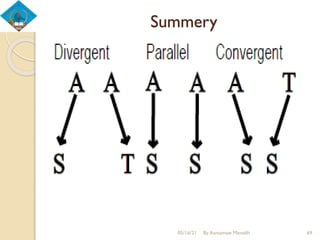
 As a result there are three main types of evolution:
1. Divergent evolution,
2. Convergent evolution, and
3. Parallel evolution.
05/16/21 By Asmamaw Menelih 63
1. Divergent evolution
 process where species become increasingly different over time.
 adaptive radiation is a form of divergent evolution where a number
of diverse species form from a single ancestral one.
 eg. Galapagos finches observed by Darwin
05/16/21 By Asmamaw Menelih 64
Cont…
 Homologous structures also shows that divergent
evolution
05/16/21 By Asmamaw Menelih 65
2. Convergent evolution
 The appearance of apparently similar structures in
organisms of different lines of descent.
 The development through evolution of similar features by
organisms with distinctly different ancestors.
 A common example of this is the evolution of wings in
insects and birds.
05/16/21 By Asmamaw Menelih 66
Cont…
05/16/21 By Asmamaw Menelih 67
3. Parallel Evolution
 is the independent evolution of similar traits, starting
from a similar ancestral condition.
 Frequently this is the situation in more closely related
lineages, where several species respond to similar
challenges in a similar way.
05/16/21 By Asmamaw Menelih 68
Summery
,
05/16/21 By Asmamaw Menelih 69

Speciation

  • 1.
  • 2.
    Outlines Introduction Speciation Patterns of speciation Speciesconcepts Modes of speciation Rates of species Isolating mechanism of speciation Types of evolution 05/16/21 By Asmamaw Menelih 2
  • 3.
    Introduction  Species -a group of organisms with the ability to interbreed and produce fertile offspring in the natural environment.  A species is a single lineage of organisms that maintains its identity from other such lineages and has its own evolutionary tendencies and historical fate (Wiley 1978)  A species is a group of organisms that maintains a distinctive set of attributes in nature. 05/16/21 By Asmamaw Menelih 3
  • 4.
    Speciation  Speciation isthe evolution of one or more species from a single ancestor species.  It can occur when members of a population become isolated from each other.  Once two populations are reproductively isolated, they are considered separate species.  Speciation is the process whereby new species are formed.  Speciation leads to macroevolution  Macroevolution refers to the evolutionary changes that create new species and groups of species. 05/16/21 By Asmamaw Menelih 4
  • 5.
    Speciation  Creates multiple“daughter” species from one ancestor 05/16/21 By Asmamaw Menelih 5
  • 6.
    Cont…  The processby which one genetically-cohesive population splits into two or more reproductively- isolated populations.  Requires the disruption of gene flow and the evolution of reproductive isolating mechanisms (RIMs). 05/16/21 By Asmamaw Menelih 6
  • 7.
    Speciation involves barriersto reproduction 05/16/21 By Asmamaw Menelih 7
  • 8.
    Patterns of speciation There are two patterns of speciation as evidenced by the fossil record • Anagenesis  It is the accumulation of changes associated with the transformation of one species into another.  Evolution taking place in a single group (a lineage) with the passage of time.  Does not promote biological diversity • Cladogenesis  The splitting of one lineage into two new species arise through cladogenesis.  It is also called branching evolution, is the budding of one or more new species from a parent species.  promotes biological diversity by increasing the number of species. 05/16/21 By Asmamaw Menelih 8
  • 9.
  • 10.
  • 11.
    Species concept  Biologicalspecies concept:  The biological species concept defines a species as members of populations that actually or potentially interbreed in nature not according to similarity of appearance.  Species are groups of actually or potentially interbreeding natural populations, which are reproductively isolated from other such groups (Mayer, 1940).  A species is a reproductive community of populations ( reproductively isolated from others) that occupies a specific niche in nature (Mayer, 1982) 05/16/21 By Asmamaw Menelih 11
  • 12.
    Cont…  Species arethe members in aggregate of a group of populations that breed or potentially interbreed with each other under natural conditions (Futuyma). 05/16/21 By Asmamaw Menelih 12
  • 13.
    Cont…  Ecological SpeciesConcept:  A species is a lineage that occupies a niche minimally different from that of any other lineage in its range and which evolves separately from all lineages outside its range.  Evolutionary species concept:  A species is a single lineage of ancestor-descendant populations which maintain its identity from other such lineages and which has it own evolutionary tendencies and historical fate. 05/16/21 By Asmamaw Menelih 13
  • 14.
    Cont…  Phenetic speciesconcept:  A species is a set of organisms that look similar to each other and distinct from other sets.  Phenotypic similarity is all that matters in recognizing separate species.  Phylogenetic species concept:  A species is the smallest diagnosable cluster of individual organisms within which there is a parental pattern of ancestry and descent. 05/16/21 By Asmamaw Menelih 14
  • 15.
    What causes speciation? Speciation, or the evolution of reproductive isolation, occurs as a by-product of genetic changes that accumulate between two previously interbreeding populations of the same species. 05/16/21 By Asmamaw Menelih 15
  • 16.
    How does speciationoccur?  There are several different ways in which the evolution of reproductive isolation is thought to occur.  These can be generalized into a series of events, or steps.  The “Steps” in a speciation event:  Step 1: gene flow between two populations is interrupted (populations become genetically isolated from each other)  Step 2: genetic differences gradually accumulate between the two populations (populations diverge genetically)  Step 3: reproductive isolation evolves as a consequence of this divergence (a reproductive isolating mechanism evolves 05/16/21 By Asmamaw Menelih 16
  • 17.
    The Rate ofSpeciation  A comparison of gradualism and punctuated equilibrium.  Gradual speciation is the gradual divergence of populations until they have reached the levels of specific distinctness.  During punctuated equilibrium, long periods of equilibrium in which species exist essentially unchanged are;  punctuated by relatively short periods of evolutionary change during which phenotypic characteristics may change rapidly. 05/16/21 By Asmamaw Menelih 17
  • 18.
    Cont… Comparison between gradualismand punctuated equilibrium 05/16/21 By Asmamaw Menelih 18
  • 19.
  • 20.
    Modes of Speciation Speciation means the formation of species.  The alternative methods of speciation have been proposed as follow: Allopatric speciation, Sympatric speciation, Parapatric speciation, and  Peripatric speciation (altational speciation). 05/16/21 By Asmamaw Menelih 20
  • 21.
    Modes of Speciation Allopatric Speciation:  Speciation with geographic isolation.  Evolution of reproductive isolating mechanisms between populations that are geographically separated.  Geographic separation is defined by spatial restriction of gene flow, not just physical distance. 05/16/21 By Asmamaw Menelih 21
  • 22.
    MODEL OF ALLOPATRICSPECIATION ANCESTRAL POPULATION GEOGRAPHIC BARRIER 05/16/21 By Asmamaw Menelih 22
  • 23.
  • 24.
  • 25.
    Peripatric Speciation:  Speciationin a peripheral isolate.  Due to rare dispersal or colonization events.  Also referred to as Founder Effect speciation.  In small populations DRIFT and NATURAL SELECTION may cause rapid divergence from the parental population 05/16/21 By Asmamaw Menelih 25 ANCESTRAL POPULATION PERIPHERAL ISOLATE
  • 26.
  • 27.
    Sympatric speciation  Sympatricspeciation involves the formation of different species that are not geographically isolated from one another.  Pattern in which speciation occurs in the absence of a physical barrier  Adaptation to local environments, and sexual selection are mechanisms that can promote sympatric speciation.  A species achieves reproductive isolation and evolves in the same geographic location as its ancestral species 05/16/21 By Asmamaw Menelih 27
  • 28.
    Cont…  polyploidy (extrasets of chromosomes) is a major factor in sympatric speciation in plants  autopolypoidy – multiple sets from one parent species; example – plants around Agent Orange sites 05/16/21 By Asmamaw Menelih 28
  • 29.
     Primula kewensisarose via allopolyploidy in an interbreeding even of P. floribunda and P. verticiliata in 1898 at the Royal Botanic Gardens in Kew, England  Each of the parental stocks have a 2n = 18.  P. kewensis is 2n = 36 because of chromosomal duplication events after the hybrid cross – was observed 3 times  P. kewensis now a popular garden plant. Example, Primrose Speciation 05/16/21 By Asmamaw Menelih 29
  • 30.
  • 31.
    Parapatric speciation  Itoccurs when populations are separated not by a geographical barrier, such as a body of water, but by an extreme change in habitat.  While populations in these areas may interbreed, they often develop distinct characteristics and lifestyles.  It is extremely rare. 05/16/21 By Asmamaw Menelih 31
  • 32.
  • 33.
  • 34.
    Isolation Mechanisms  Isolationis an important factor contributing to the process of evolution.  It is the segregation of the population of a particular species into smaller units which prevent interbreeding between them.  Isolation aids in splitting of the species into separate groups.  In consequence of being separated from one another, organisms have developed different characteristics, due to which they have become separate species. 05/16/21 By Asmamaw Menelih 34
  • 35.
    Types of Isolation Evolutionary biologists have recognized the following types of isolations which cause speciation. 1. Isolation by Time:  Also known as Seasonal or temporal isolation  The populations exist in the same regions but are sexually mature at different times, so that potential mates remain unable to mate. 05/16/21 By Asmamaw Menelih 35
  • 36.
    2. Isolation byDistance (Spatial Isolation)  Sheer distance apart may also act as an isolating factor for a species which occupies a great range of area, which is unbroken by effective barriers.  Its example is wrens (birds) of South America.  Wrens are found all over the continent but the wrens of one region differ from those of the other in colour patterns, size, proportions and habits.  It shows that without any barrier, sheer distance apart tends to produce local races (subspecies). 05/16/21 By Asmamaw Menelih 36
  • 37.
    Cont… . Variation amongwrens due to Spatial Isolation 05/16/21 By Asmamaw Menelih 37
  • 38.
    3. Geographical Isolation It is the most common type of isolation and occurs when an original population is divided into two or more groups by geographical barriers such as a river, desert, glacier, mountain or ocean.  All of which prevent interbreeding between them, then in the course of time different mutations may become incorporated in the gene pools of the different groups.  Certain additional kinds of geographical barriers are the volcanic formation of a mountain on land, mountain ranges with deep valleys between and land masses as islands in sea. 05/16/21 By Asmamaw Menelih 38
  • 39.
  • 40.
  • 41.
  • 42.
    4. Reproductive Isolation In sexually reproducing organisms species can be defined as Mendelian populations between which the gene exchange is prevented by reproductive isolation. .  In simple terms isolating mechanisms are those which prevent successful reproduction between members of two or more populations (viz., closely related species) that have descended from the same original population.  Evolution of reproductive isolating mechanisms prevents nascent species from interbreeding. 05/16/21 By Asmamaw Menelih 42
  • 43.
    Types of reproductiveisolating mechanisms  Most modern evolutionists such as Mecham (1961), Mayr (1948, 1970), Stebbins (1966,1971), etc., have classified the reproductive isolating mechanisms into two classes.  These are: premating or prezygotic isolating mechanisms and Postmating or postzygotic isolating mechanisms.  Prezygotic Mechanisms prevent mating formation of viable or zygotes.  Postzygotic Mechanisms prevent hybrids from passing on their genes. 05/16/21 By Asmamaw Menelih 43
  • 44.
    Cont…  premating orprezygotic isolating mechanisms prevent wastage of gametes (germ cells) and so are highly susceptible to improvement by natural selection;  postmating or postzygotic isolating mechanisms do not prevent wastage of gametes and their improvement by natural selection is indirect 05/16/21 By Asmamaw Menelih 44
  • 45.
    A. Premating orprezygotic isolating mechanisms  Mechanisms that prevent interspecific crosses (i.e., fertilization and zygote formation).  Causes of prezygotic isolating mechanism:  1. Habitat isolation :  Two closely related species may occupy different ecosystems within a geographical region.  The populations live in the same regions but occupy different habitats, so that potential mates do not meet. 05/16/21 By Asmamaw Menelih 45
  • 46.
    Cont…  Example 1:Central California populations of Rana spp. ◦ The Red-legged Frog (Rana draytonii) tends to breed in large ponds. ◦ The Yellow-legged Frog (Rana boylii) breeds almost exclusively in fast-moving streams.  Their habitat preferences contribute to their reproductive isolation. 05/16/21 By Asmamaw Menelih 46
  • 47.
    Cont…  Example 2:European populations of Turdus spp. The Common Blackbird (Turdus merula) lives and breeds in forest. The Ring Ouzel (Turdus torquatus), a close cousin, lives and breeds on moors. Even when forest and moor abut, the two species do not interbreed. 05/16/21 By Asmamaw Menelih 47
  • 48.
    2. Seasonal ortemporal isolation  The populations exist in the same regions but are sexually mature at different times, so that potential mates remain unable to mate.  Example 1: Closely related Rana species in California Coastal Ecosystems ◦ The Red-legged Frog (Rana draytonii) breeding season lasts from ~ November - late April. ◦ The Yellow-legged Frog (Rana boylii) breeding season lasts from ~ late April - June. ◦ The breeding seasons may overlap in some areas. ◦ The combination of ecological and temporal isolation prevents hybridization. 05/16/21 By Asmamaw Menelih 48
  • 49.
    Cont…  Example 2:Closely related Fruit Flies in Hawaii  Drosophila persimilis breeds in early morning.  Closely related Drosophila pseudoobscura breeds in the afternoon. 05/16/21 By Asmamaw Menelih 49
  • 50.
    3. Ethological (Behavioral)isolation :  Species with complex courtship behaviors usually exhibit stereotyped "call and response" signals between male and female before actual mating takes place.  These rituals prevent wasted mating effort that would halt gene transmission by inviable or infertile hybrids. 05/16/21 By Asmamaw Menelih 50
  • 51.
  • 52.
    4. Mechanical Isolation Cross fertilization or pollination is prevented or restricted by differences in structure of reproductive organs (genitalia in animals, flowers in plants).  So that, copulation is attempted but no transfer of sperm takes place.  Morphological differences between species prevent hybridization. 05/16/21 By Asmamaw Menelih 52
  • 53.
    Cont…  Example 1:Snail Shell Coiling In some snail species, the direction of shell coiling is controlled by a single (maternal effect) gene. Left-coiling snails cannot mate with right-coiling snails. Such mutations could quickly lead to further differentiation and, possibly, speciation. 05/16/21 By Asmamaw Menelih 53
  • 54.
    5. Gametic Isolation In this case, sperm and ova of the two species are chemically incompatible, and will not join to form a zygote. 05/16/21 By Asmamaw Menelih 54
  • 55.
    B. Postmating orpostzygotic isolating mechanisms  Fertilization takes place, hybrid zygotes are formed, but these are inviable, or give rise to weak or sterile hybrids. 1. Hybrid inviability or weakness:  Sperm and egg from the two species may combine, but the genetic information is insufficient to carry the organism through normal development.  The embryo dies after a few cleavages, or some time before birth/hatching. 05/16/21 By Asmamaw Menelih 55
  • 56.
    Cont…  Example: Drosophilaspp. ◦ Despite their superficially similar appearance, D. melanogaster and D. simulans have incompatible alleles for nuclear pore proteins. ◦ Dysfunction of this vital gene results in inviable hybrids. 05/16/21 By Asmamaw Menelih 56
  • 57.
    2. Developmental hybridsterility:  Hybrids are sterile because gonads develop abnormally, or meiosis breaks down before it is completed.  Example 1: Tigers (Panthera tigris) and Lions (Panthera leo) ◦ Tigers and Lions are sister taxa, but separate for millions of years. ◦ Their hybrid offspring are viable and robust, but sterile. ◦ Chromosomes are not homologous, so do not migrate normally at meiosis. 05/16/21 By Asmamaw Menelih 57
  • 58.
    Cont…  male tigerx lioness --> tigon  male lion x tigress --> liger  reciprocal cross offspring are somewhat different ◦ maternal mitochondria input. 05/16/21 By Asmamaw Menelih 58
  • 59.
    Cont…  Example 2:Horse (Equus caballus) and Donkey (Equus asinus) ◦ Horses and donkeys have been separate species for millions of years. ◦ Their hybrid offspring are viable and robust, but sterile. ◦ male horse x female donkey --> hinny ◦ male donkey x female horse --> mule ◦ As above, reciprocal cross offspring are somewhat different  maternal mitochondrial input 05/16/21 By Asmamaw Menelih 59
  • 60.
    3. Hybrid Breakdown 05/16/21By Asmamaw Menelih 60  Two related species can hybridize, and their F1 offspring are fertile.  But successive generations (F2 and beyond) suffer lower viability or fecundity.  Thus, they cannot become an established population.  Example: Rice cultivars ◦ Cultivars of domestic rice have been artificially selected for centuries. ◦ Some are closely related enough to hybridize. ◦ F1 hybrids are fertile and viable.  F2 generation is stunted and sterile.
  • 61.
    Cont…  Hybridization betweenclosely related species can have one of several possible outcomes. ◦ Species Reinforcement  Hybrids have lower fitness than either parent species.  Reproductive isolation is maintained due to lack of hybrid survival/reproduction. ◦ Species Fusion  Two species in a hybrid zone may have weak reproductive isolating barriers.  The two species may, over time, eventually share a common gene pool. 05/16/21 By Asmamaw Menelih 61
  • 62.
    Cont… ◦ Species Stability/HybridEquilibrium  Hybrids are continually produced by the two parent populations in a hybrid zone.  A narrow hybrid zone can foster constant hybridization with reduced hybrid survival.. ◦ Hybrid Speciation  Hybrids may be reproductively superior to parent populations.  Positive assortative mating among hybrids can lead to hybrid speciation. 05/16/21 By Asmamaw Menelih 62
  • 63.
    Patterns of Evolution Evolution over time can follow several different patterns.  Factors such as environment and predation pressures can have different effects on the ways in which species exposed to evolve.  As a result there are three main types of evolution: 1. Divergent evolution, 2. Convergent evolution, and 3. Parallel evolution. 05/16/21 By Asmamaw Menelih 63
  • 64.
    1. Divergent evolution process where species become increasingly different over time.  adaptive radiation is a form of divergent evolution where a number of diverse species form from a single ancestral one.  eg. Galapagos finches observed by Darwin 05/16/21 By Asmamaw Menelih 64
  • 65.
    Cont…  Homologous structuresalso shows that divergent evolution 05/16/21 By Asmamaw Menelih 65
  • 66.
    2. Convergent evolution The appearance of apparently similar structures in organisms of different lines of descent.  The development through evolution of similar features by organisms with distinctly different ancestors.  A common example of this is the evolution of wings in insects and birds. 05/16/21 By Asmamaw Menelih 66
  • 67.
  • 68.
    3. Parallel Evolution is the independent evolution of similar traits, starting from a similar ancestral condition.  Frequently this is the situation in more closely related lineages, where several species respond to similar challenges in a similar way. 05/16/21 By Asmamaw Menelih 68
  • 69.