Special Stains
Special Stains Classification
Stains for the detection of:
• Connective tissues and lipids
• Microorganisms
• Carbohydrates
• Amyloid
• Minerals, pigments and
miscellaneous
2
Special StainsStains for the detection of Microorganisms
Gram Staining
Used to stain both bacilli and cocci
• Gram Positive -Bacteria with large
deposits of peptidoglycan in their
cell walls retain methyl violet
• Gram Negative -Bacteria with large
deposits of lipids
and lipopolysacharrides
4
Giemsa Stain
Used to stain bacteria and protozoa like
H. pylori, rickettsia and chlamydiae
• Bacteria stains blue
• Protozoa cytoplasm stains from
pink to rose and nuclei blue
• Eisonophils are also easily
detected
5
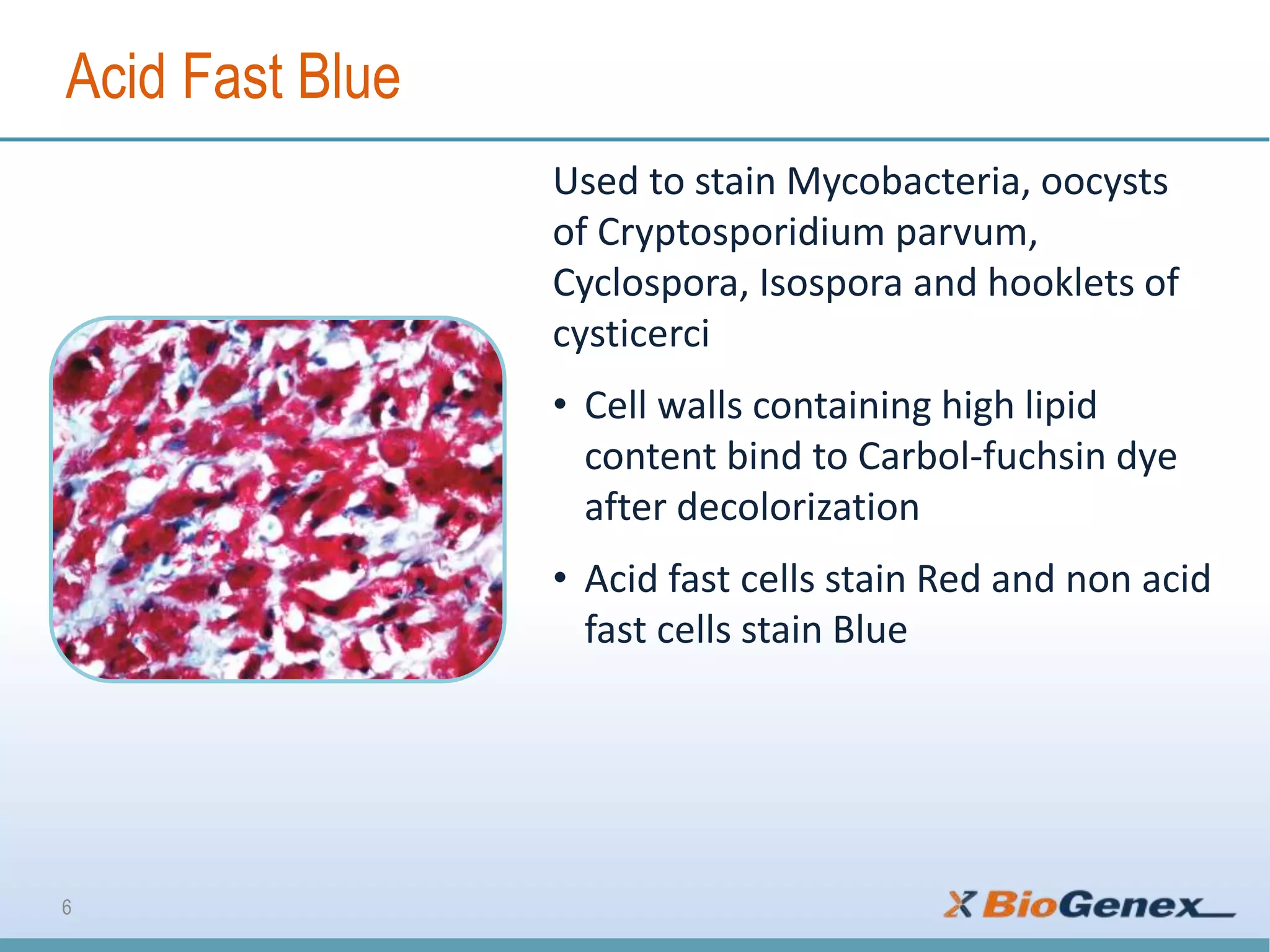
Acid Fast Blue
Used to stain Mycobacteria, oocysts
of Cryptosporidium parvum,
Cyclospora, Isospora and hooklets of
cysticerci
• Cell walls containing high lipid
content bind to Carbol-fuchsin dye
after decolorization
• Acid fast cells stain Red and non acid
fast cells stain Blue
6
Acid Fast Green
Used for the detection of Mycobacterium
• Stains Acid fast bacteria red while the
background Stains green
7
Grocott’s Methenamine Silver (GMS)
Used for the detection of fungi
• Mucin stains dark grey, background
pale green
• Stains Pneumocystis carnii, histoplasma
spp Black, inner parts of mycelia and
hyphae old rose, leishmania spp,
toxoplasma spp negative
8
Special StainsStains for the detection of Connective Tissue
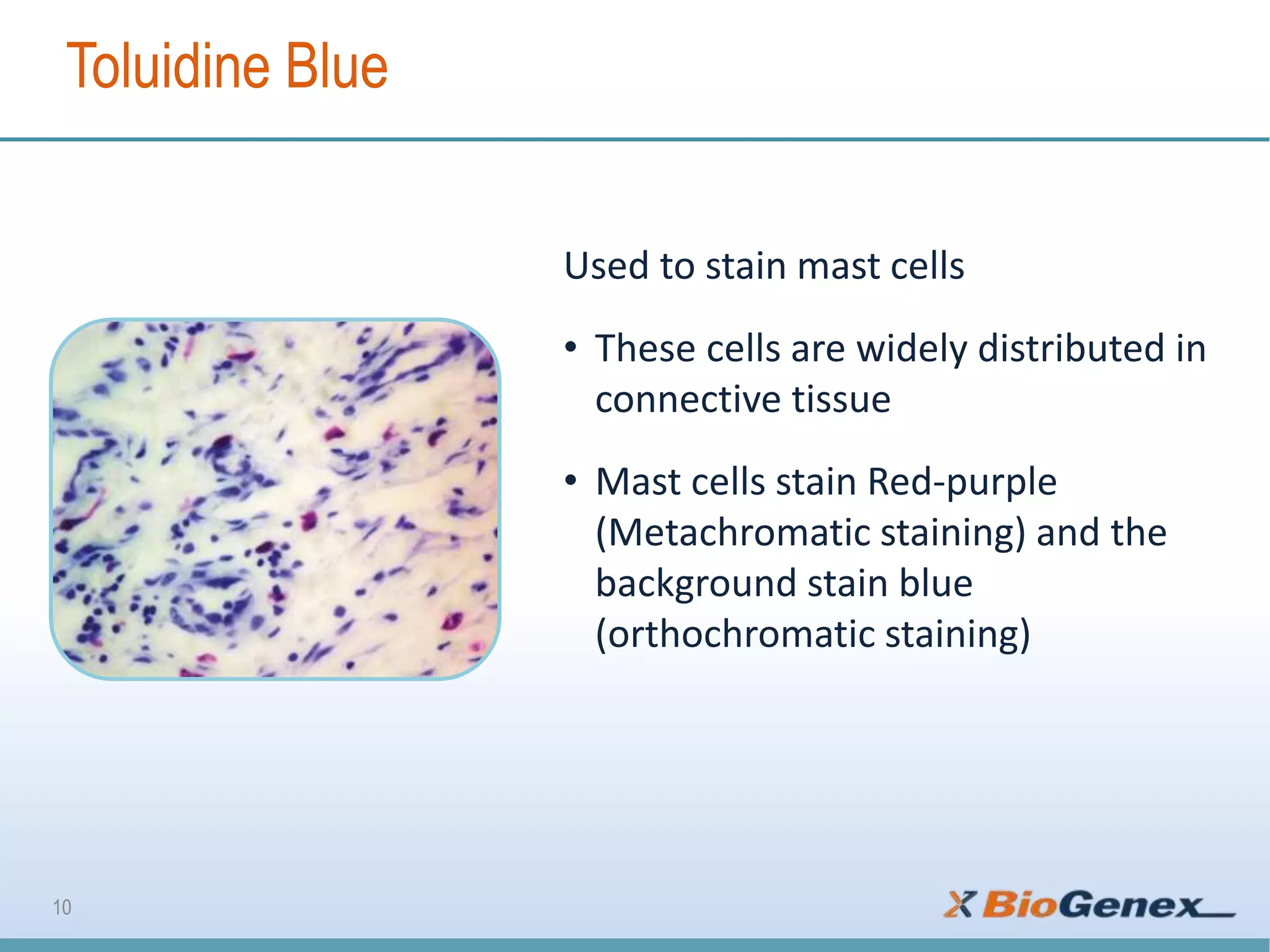
Toluidine Blue
Used to stain mast cells
• These cells are widely distributed in
connective tissue
• Mast cells stain Red-purple
(Metachromatic staining) and the
background stain blue
(orthochromatic staining)
10
Elastic Stain
Used to stain elastic fibers
• Based on the affinity of elastin for
hematoxylin complex
• Elastin stains dark brown/ black where
as nucleus stains black
11
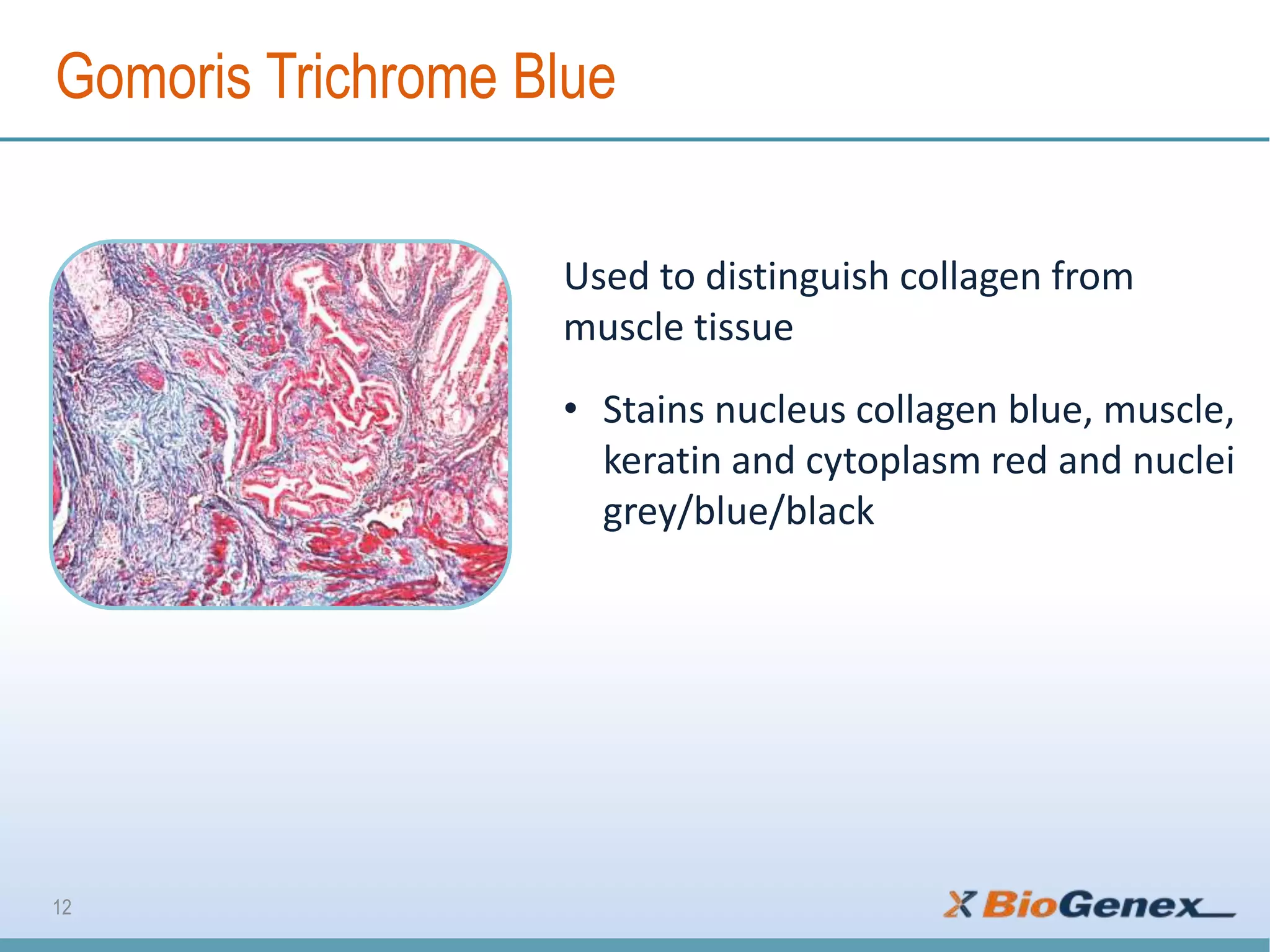
Gomoris Trichrome Blue
Used to distinguish collagen from
muscle tissue
• Stains nucleus collagen blue, muscle,
keratin and cytoplasm red and nuclei
grey/blue/black
12
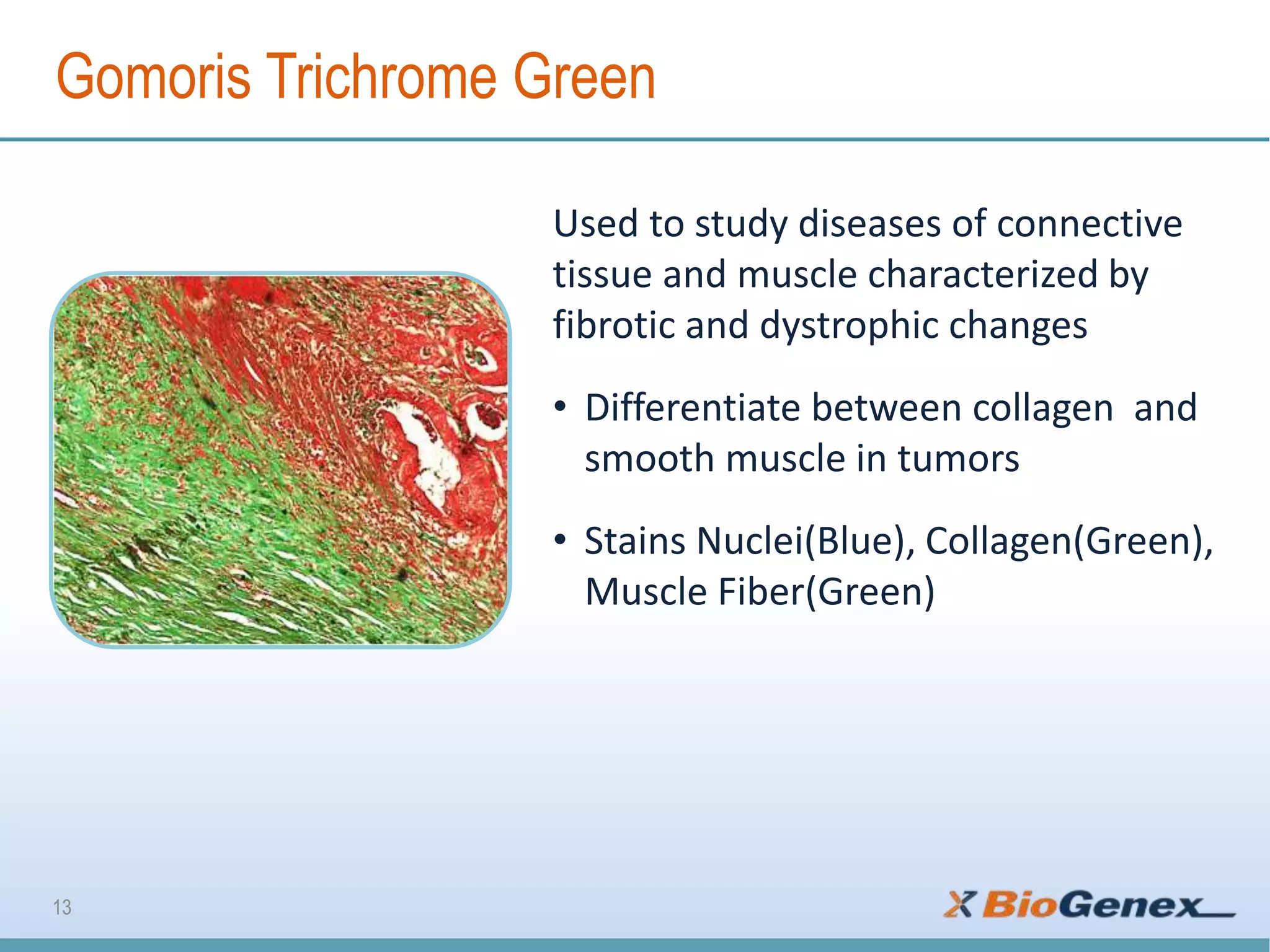
Gomoris Trichrome Green
13
Used to study diseases of connective
tissue and muscle characterized by
fibrotic and dystrophic changes
• Differentiate between collagen and
smooth muscle in tumors
• Stains Nuclei(Blue), Collagen(Green),
Muscle Fiber(Green)
Reticulin / No Counter Stain
Used for the identification of
Reticular fibers
• Useful for the diagnosis of
carcinomas, Sarcomas,
lymphosarcomas
• Reticulin stains black
14
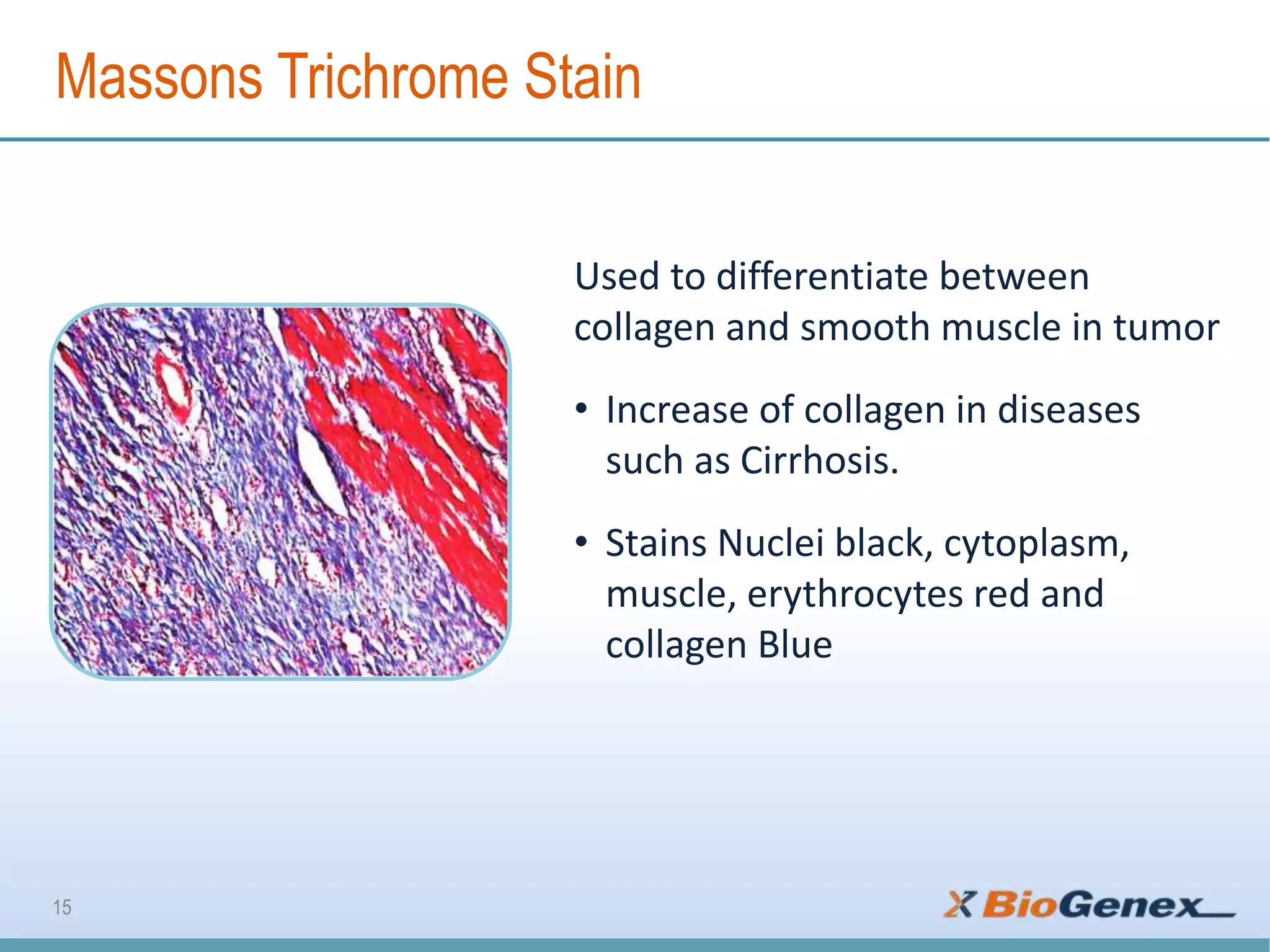
Massons Trichrome Stain
Used to differentiate between
collagen and smooth muscle in tumor
• Increase of collagen in diseases
such as Cirrhosis.
• Stains Nuclei black, cytoplasm,
muscle, erythrocytes red and
collagen Blue
15
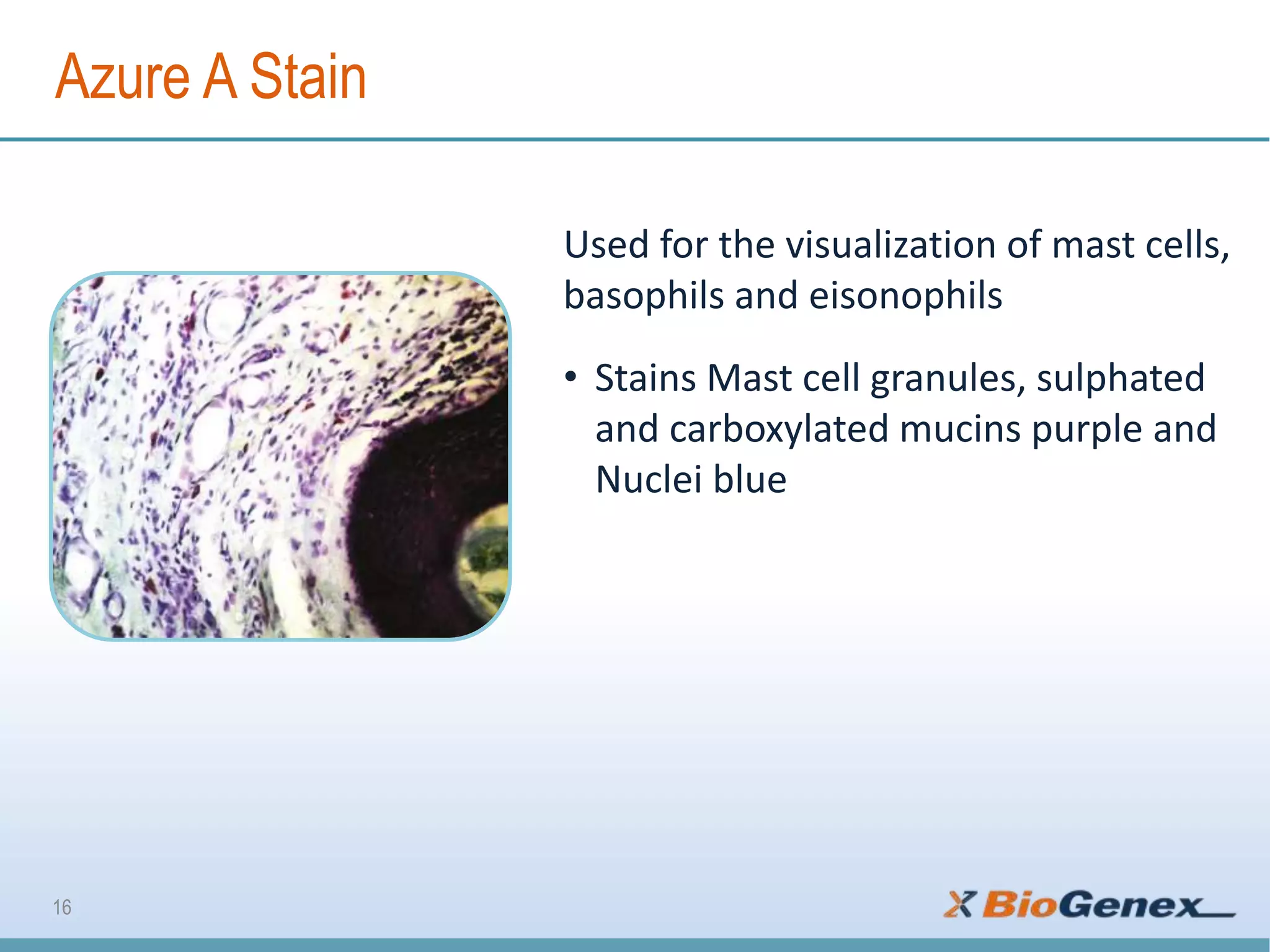
Azure A Stain
Used for the visualization of mast cells,
basophils and eisonophils
• Stains Mast cell granules, sulphated
and carboxylated mucins purple and
Nuclei blue
16
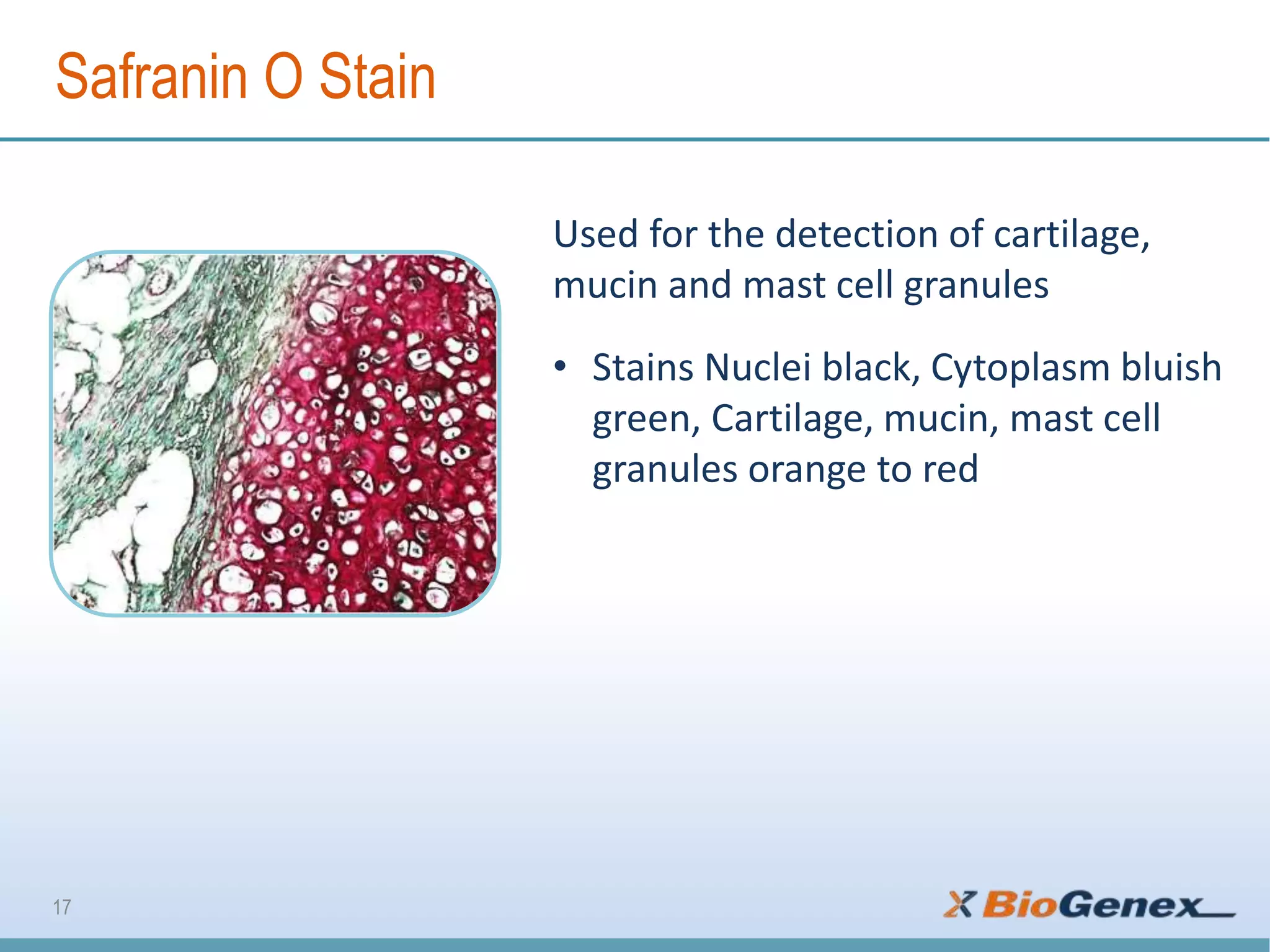
Safranin O Stain
Used for the detection of cartilage,
mucin and mast cell granules
• Stains Nuclei black, Cytoplasm bluish
green, Cartilage, mucin, mast cell
granules orange to red
17
Van Gieson Stain
Used to differentiate collagen and
smooth muscle
• Can be used to demonstrate the
presence of collagen in pathological
conditions
• Stains nuclei blue, Collagen bright
red, Cytoplasm, muscle, fibrin and
red blood cells yellow
18
Reticulin Nuclear Fast Red
Used to identify reticulin fibers
• Can be used for differential diagnosis
of tumors such as carcinomas,
sarcomas and lymphosarcomas
• Stains reticulin black with a pink to
rose background
19
Special StainsStains for the detection of Carbohydrates
Mucicarmine Stain
Used to detect epithelial mucin
• Exhibits strong staining of epithelial
mucins where as fibroblastic mucin
show a poor staining
• Stains mucin in shades of red
21
Alcian Blue
Stains acid mucins & mucopolysaccharides
• Copper in the stain is responsible for the
blue stain
• Strongly acidic muco substances stain
blue, nuclei pink to red and cytoplasm
pale pink
22
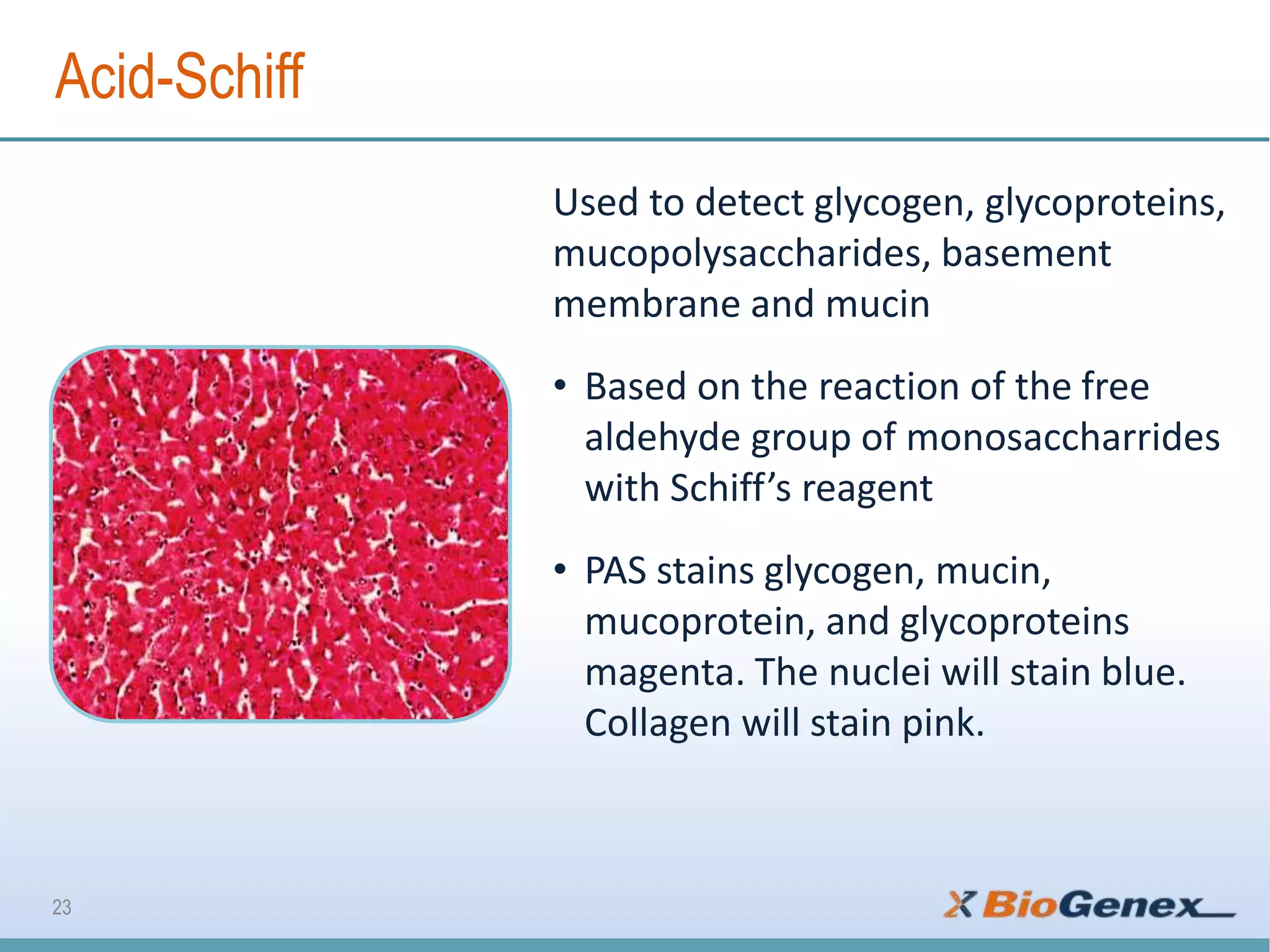
Acid-Schiff
Used to detect glycogen, glycoproteins,
mucopolysaccharides, basement
membrane and mucin
• Based on the reaction of the free
aldehyde group of monosaccharrides
with Schiff’s reagent
• PAS stains glycogen, mucin,
mucoprotein, and glycoproteins
magenta. The nuclei will stain blue.
Collagen will stain pink.
23
Alcian Blue PAS
Combination of Alcian Blue and PAS
technique
• Demonstrates both acidic- neutral and
mixtures of acidic and neutral mucins
• Stains acid mucopolysaccharides blue
and Neutral polysaccharides magenta
24
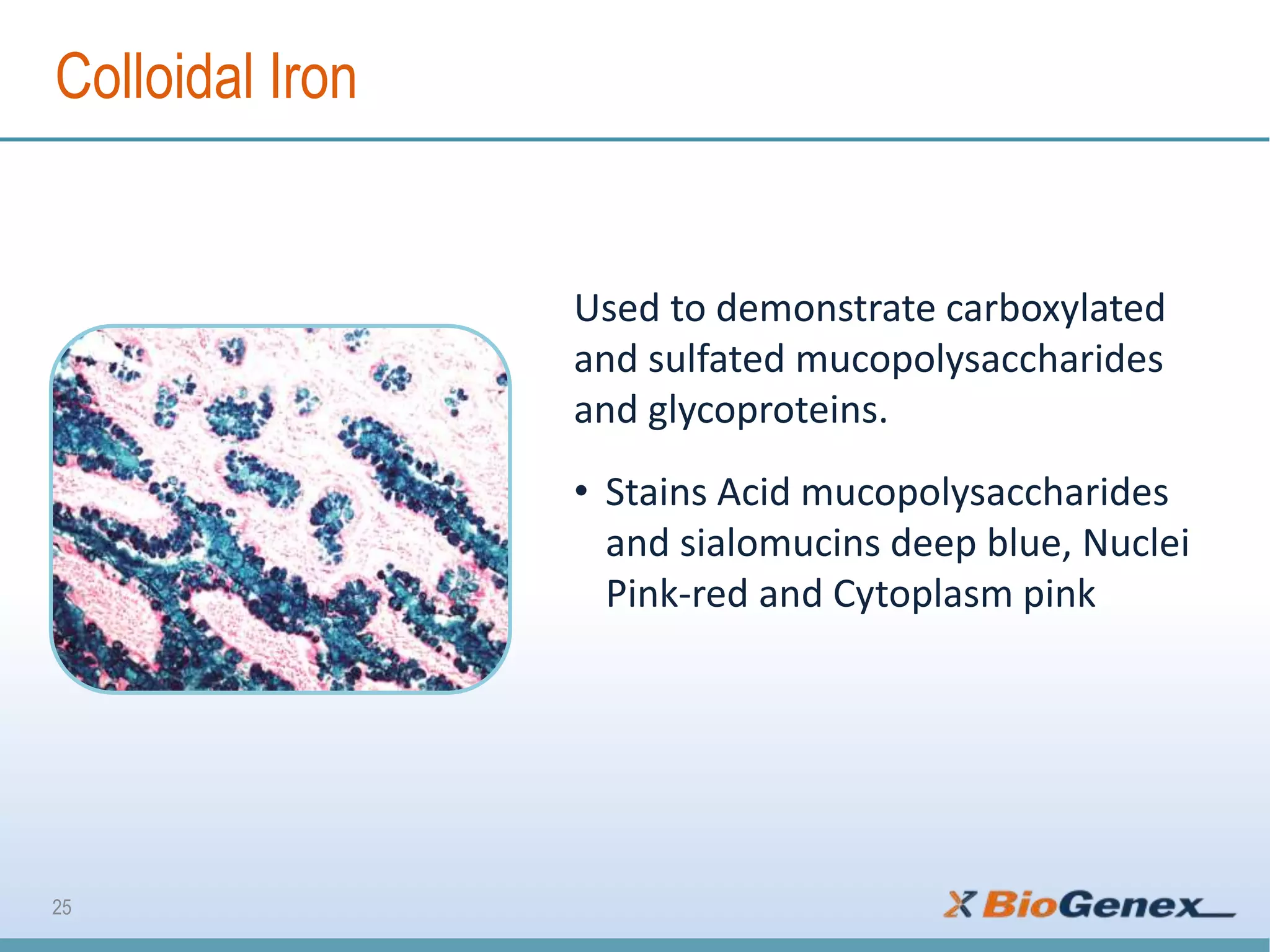
Colloidal Iron
Used to demonstrate carboxylated
and sulfated mucopolysaccharides
and glycoproteins.
• Stains Acid mucopolysaccharides
and sialomucins deep blue, Nuclei
Pink-red and Cytoplasm pink
25
Special StainsStains for the detection of Minerals
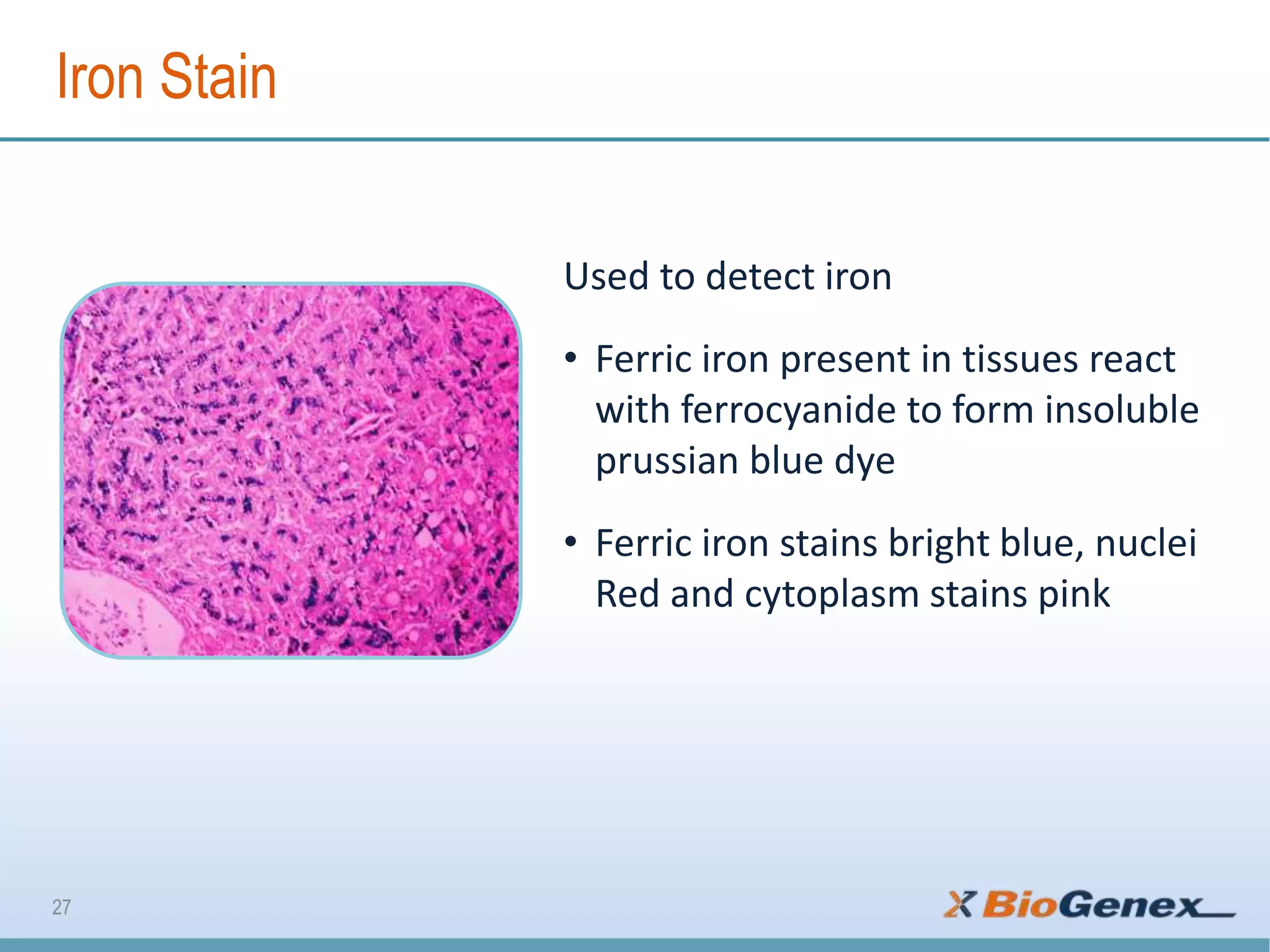
Iron Stain
Used to detect iron
• Ferric iron present in tissues react
with ferrocyanide to form insoluble
prussian blue dye
• Ferric iron stains bright blue, nuclei
Red and cytoplasm stains pink
27
Von-Kossa Stain
Used for demonstrating calcium or its
Salts and is not specific for calcium
• Tissue sections are treated with
silver nitrate solution, the calcium is
reduced by light and replaced with
silver deposits, visualized as
metallic silver
• Stains Calcium salts black, Nuclei
red, Cytoplasm pink
28
29
Now Offering 30+ Different Special Stains
Please visit www.BioGenex.com
for more details

Pathology Special Stains for FFPE Tissue Staining

  • 1.
  • 2.
    Special Stains Classification Stainsfor the detection of: • Connective tissues and lipids • Microorganisms • Carbohydrates • Amyloid • Minerals, pigments and miscellaneous 2
  • 3.
    Special StainsStains forthe detection of Microorganisms
  • 4.
    Gram Staining Used tostain both bacilli and cocci • Gram Positive -Bacteria with large deposits of peptidoglycan in their cell walls retain methyl violet • Gram Negative -Bacteria with large deposits of lipids and lipopolysacharrides 4
  • 5.
    Giemsa Stain Used tostain bacteria and protozoa like H. pylori, rickettsia and chlamydiae • Bacteria stains blue • Protozoa cytoplasm stains from pink to rose and nuclei blue • Eisonophils are also easily detected 5
  • 6.
    Acid Fast Blue Usedto stain Mycobacteria, oocysts of Cryptosporidium parvum, Cyclospora, Isospora and hooklets of cysticerci • Cell walls containing high lipid content bind to Carbol-fuchsin dye after decolorization • Acid fast cells stain Red and non acid fast cells stain Blue 6
  • 7.
    Acid Fast Green Usedfor the detection of Mycobacterium • Stains Acid fast bacteria red while the background Stains green 7
  • 8.
    Grocott’s Methenamine Silver(GMS) Used for the detection of fungi • Mucin stains dark grey, background pale green • Stains Pneumocystis carnii, histoplasma spp Black, inner parts of mycelia and hyphae old rose, leishmania spp, toxoplasma spp negative 8
  • 9.
    Special StainsStains forthe detection of Connective Tissue
  • 10.
    Toluidine Blue Used tostain mast cells • These cells are widely distributed in connective tissue • Mast cells stain Red-purple (Metachromatic staining) and the background stain blue (orthochromatic staining) 10
  • 11.
    Elastic Stain Used tostain elastic fibers • Based on the affinity of elastin for hematoxylin complex • Elastin stains dark brown/ black where as nucleus stains black 11
  • 12.
    Gomoris Trichrome Blue Usedto distinguish collagen from muscle tissue • Stains nucleus collagen blue, muscle, keratin and cytoplasm red and nuclei grey/blue/black 12
  • 13.
    Gomoris Trichrome Green 13 Usedto study diseases of connective tissue and muscle characterized by fibrotic and dystrophic changes • Differentiate between collagen and smooth muscle in tumors • Stains Nuclei(Blue), Collagen(Green), Muscle Fiber(Green)
  • 14.
    Reticulin / NoCounter Stain Used for the identification of Reticular fibers • Useful for the diagnosis of carcinomas, Sarcomas, lymphosarcomas • Reticulin stains black 14
  • 15.
    Massons Trichrome Stain Usedto differentiate between collagen and smooth muscle in tumor • Increase of collagen in diseases such as Cirrhosis. • Stains Nuclei black, cytoplasm, muscle, erythrocytes red and collagen Blue 15
  • 16.
    Azure A Stain Usedfor the visualization of mast cells, basophils and eisonophils • Stains Mast cell granules, sulphated and carboxylated mucins purple and Nuclei blue 16
  • 17.
    Safranin O Stain Usedfor the detection of cartilage, mucin and mast cell granules • Stains Nuclei black, Cytoplasm bluish green, Cartilage, mucin, mast cell granules orange to red 17
  • 18.
    Van Gieson Stain Usedto differentiate collagen and smooth muscle • Can be used to demonstrate the presence of collagen in pathological conditions • Stains nuclei blue, Collagen bright red, Cytoplasm, muscle, fibrin and red blood cells yellow 18
  • 19.
    Reticulin Nuclear FastRed Used to identify reticulin fibers • Can be used for differential diagnosis of tumors such as carcinomas, sarcomas and lymphosarcomas • Stains reticulin black with a pink to rose background 19
  • 20.
    Special StainsStains forthe detection of Carbohydrates
  • 21.
    Mucicarmine Stain Used todetect epithelial mucin • Exhibits strong staining of epithelial mucins where as fibroblastic mucin show a poor staining • Stains mucin in shades of red 21
  • 22.
    Alcian Blue Stains acidmucins & mucopolysaccharides • Copper in the stain is responsible for the blue stain • Strongly acidic muco substances stain blue, nuclei pink to red and cytoplasm pale pink 22
  • 23.
    Acid-Schiff Used to detectglycogen, glycoproteins, mucopolysaccharides, basement membrane and mucin • Based on the reaction of the free aldehyde group of monosaccharrides with Schiff’s reagent • PAS stains glycogen, mucin, mucoprotein, and glycoproteins magenta. The nuclei will stain blue. Collagen will stain pink. 23
  • 24.
    Alcian Blue PAS Combinationof Alcian Blue and PAS technique • Demonstrates both acidic- neutral and mixtures of acidic and neutral mucins • Stains acid mucopolysaccharides blue and Neutral polysaccharides magenta 24
  • 25.
    Colloidal Iron Used todemonstrate carboxylated and sulfated mucopolysaccharides and glycoproteins. • Stains Acid mucopolysaccharides and sialomucins deep blue, Nuclei Pink-red and Cytoplasm pink 25
  • 26.
    Special StainsStains forthe detection of Minerals
  • 27.
    Iron Stain Used todetect iron • Ferric iron present in tissues react with ferrocyanide to form insoluble prussian blue dye • Ferric iron stains bright blue, nuclei Red and cytoplasm stains pink 27
  • 28.
    Von-Kossa Stain Used fordemonstrating calcium or its Salts and is not specific for calcium • Tissue sections are treated with silver nitrate solution, the calcium is reduced by light and replaced with silver deposits, visualized as metallic silver • Stains Calcium salts black, Nuclei red, Cytoplasm pink 28
  • 29.
    29 Now Offering 30+Different Special Stains Please visit www.BioGenex.com for more details