









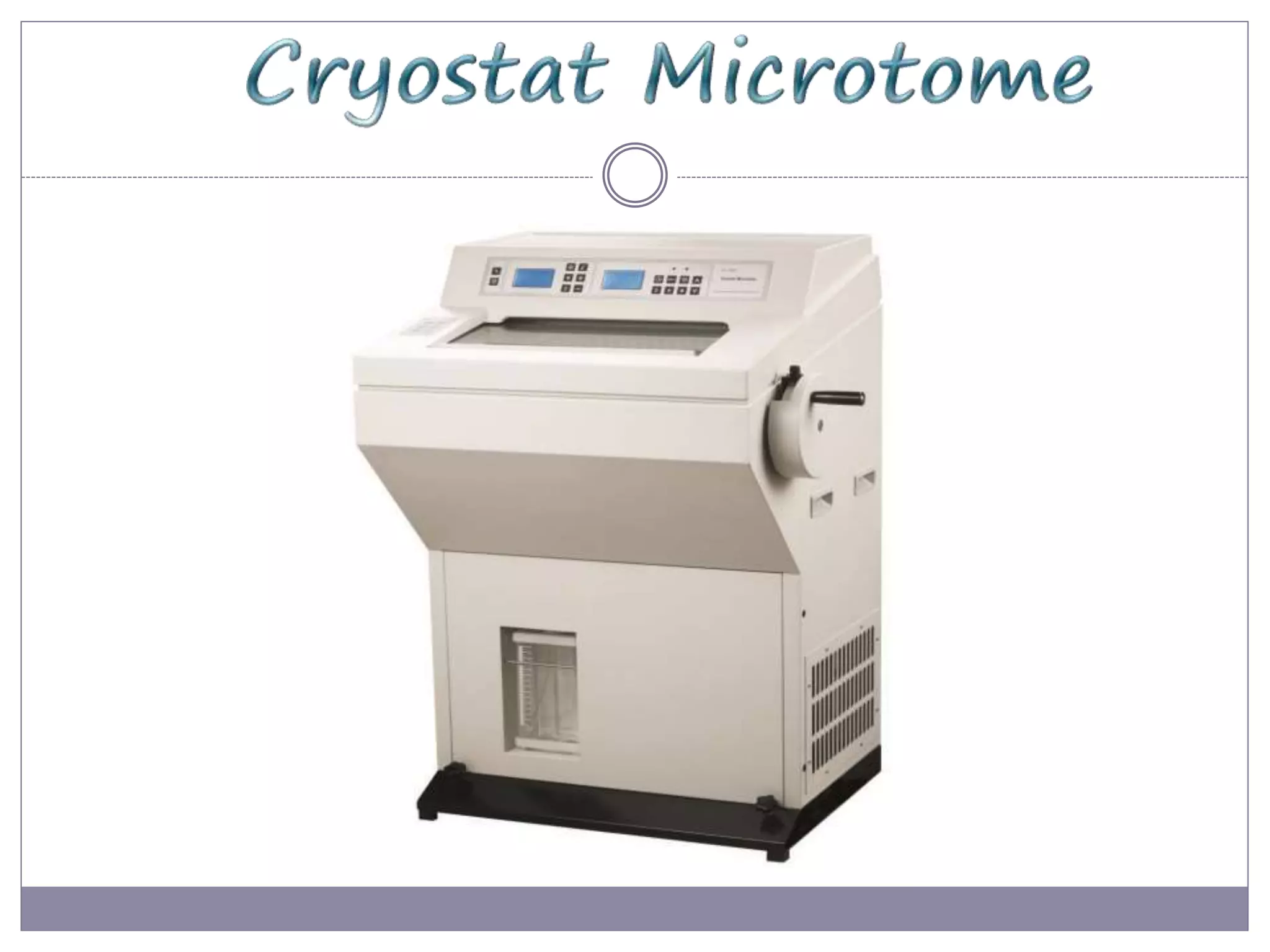
 Cryostat is a device by which temperature can
be maintained in a low level.
 In pathology and histology it is known as
chamber containing a microtome for sectioning
frozen tissue.
 Cryostat is designed for the optimal
production of from the tissues to
examine.
 Most frequent use is by
, but also many
require a cryostat.
 This automated cryotome has a
which is used for to
off-cuts.
 Another special feature is it facilitates
sectioning and especially
by using a
lower temperature on surrounding parts.
 The cryostat is essentially an ultrafine
called a microtome, placed in a freezer.
 The temperature can be depending on the
tissue being cut - usually
 The freezer is either powered by or by a
refrigerant like . Small portable
cryostats are available and can run off generators
or vehicle inverters.
 To minimize all necessary
mechanical movements of the microtome can be
achieved
 The Newer microtomes have electric push button
advancement of the tissue.
 Tissue are sectioned as thin as
 Once frozen, the specimen on the chuck is mounted on
the microtome.
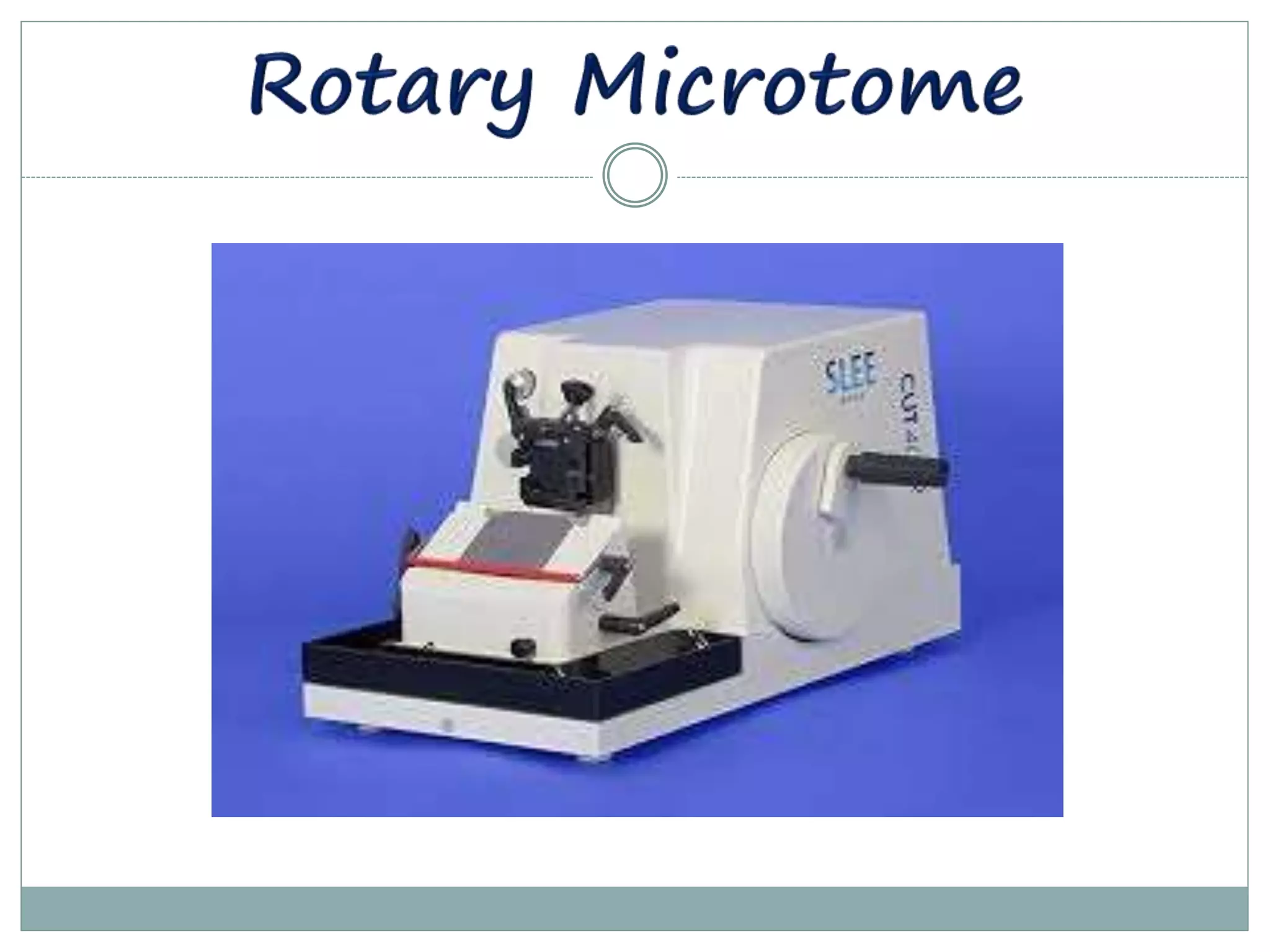
 The crank is rotated and the specimen advances
toward the cutting blade.
 Once the specimen is cut to a satisfactory quality, it is
mounted on a warm (room temperature) clear glass
slide,
 where it will instantaneously melt and adhere.
 The glass slide and specimen are air dried, and
stained.
 The entire process from mounting to reading the slide
takes from 10 to 20 minutes, allowing rapid diagnosis
in the operating room, for the surgical excision of
cancer.
 The cryostat section quality is poorer as compared to
fixed tissue sections.
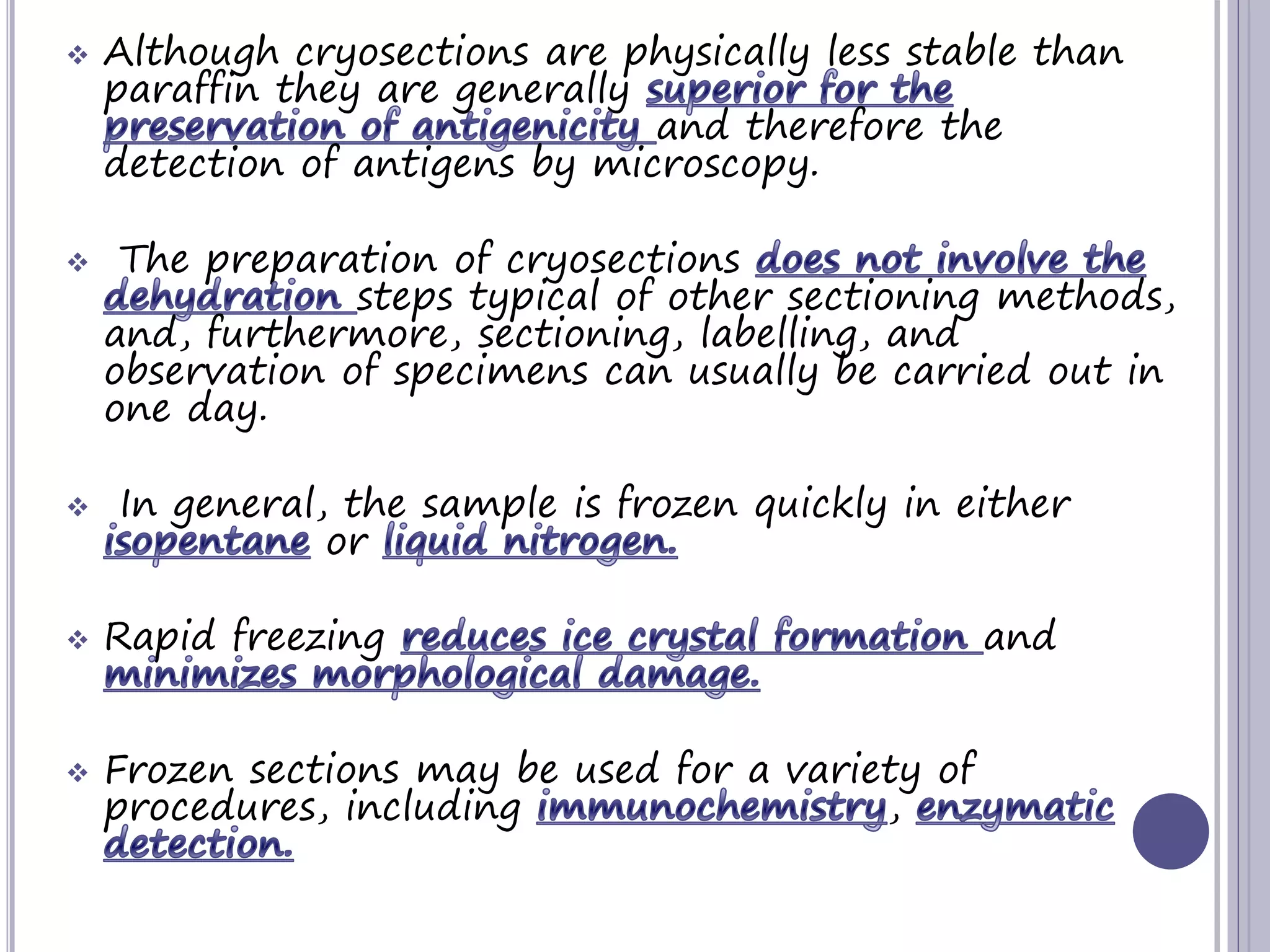
 Although cryosections are physically less stable than
paraffin they are generally
and therefore the
detection of antigens by microscopy.
 The preparation of cryosections
steps typical of other sectioning methods,
and, furthermore, sectioning, labelling, and
observation of specimens can usually be carried out in
one day.
 In general, the sample is frozen quickly in either
or
 Rapid freezing and
 Frozen sections may be used for a variety of
procedures, including ,
The equipment contains the
following main components:
o Some of the panels are under
showing
and
o The middle of the unit contains to
the unit for
and
o The lower part of the unit holds the
refrigeration
o Behind the low-temperature unit
holds the and
.
Automatic temperature is computer-
controlled. The LCD displays three temperatures.
Shown are
• The working conditions of all hardware,
• Compressor A
• Compressor B
• Lighting
• UV
• Defrost and advance and withdrawal of the motor
• Freezing of the table and the knife.
The instrument has a count-down display
when the compressor is started.
the dual-compressor control
system has four thermostat control points –
 the head,
 knife,
 table and
 box.
The head can be set to different sectioning
temperatures.
there is no need to pre-cool, the
instrument can get into freezing mode after only
10 min from start up. It can be switched off
after finishing work to save power.
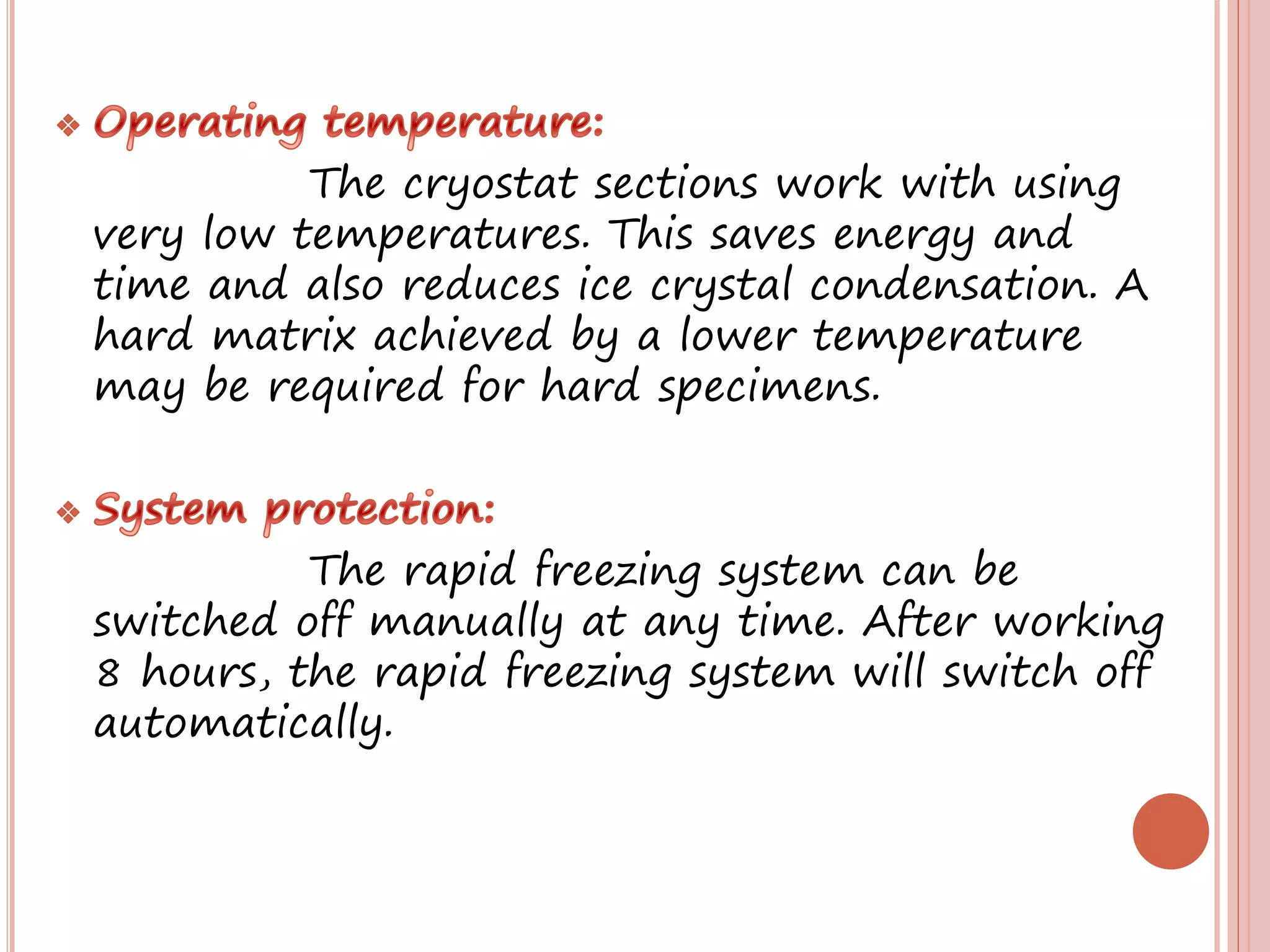
The cryostat sections work with using
very low temperatures. This saves energy and
time and also reduces ice crystal condensation. A
hard matrix achieved by a lower temperature
may be required for hard specimens.
The rapid freezing system can be
switched off manually at any time. After working
8 hours, the rapid freezing system will switch off
automatically.
It has automatic and manual defrosting functions.
 1) defrosting time interval;
 2) defrosting time;
 3) manual defrosting may be set.
These settings may be varied according to ambient
temperature. The defrosting function can be switched
off any time; the instrument will change to freezing
mode after the defrosting function is switched off.
The instrument's mechanical construction is
superlative . The use of roller bearings makes the
instrument very stable in the vertical plane. The
mechanism is enclosed and maintenance-free.
Mechanical performance is excellent for the production
of uniform flat and stable section; a fine anti-curling
function is provided.
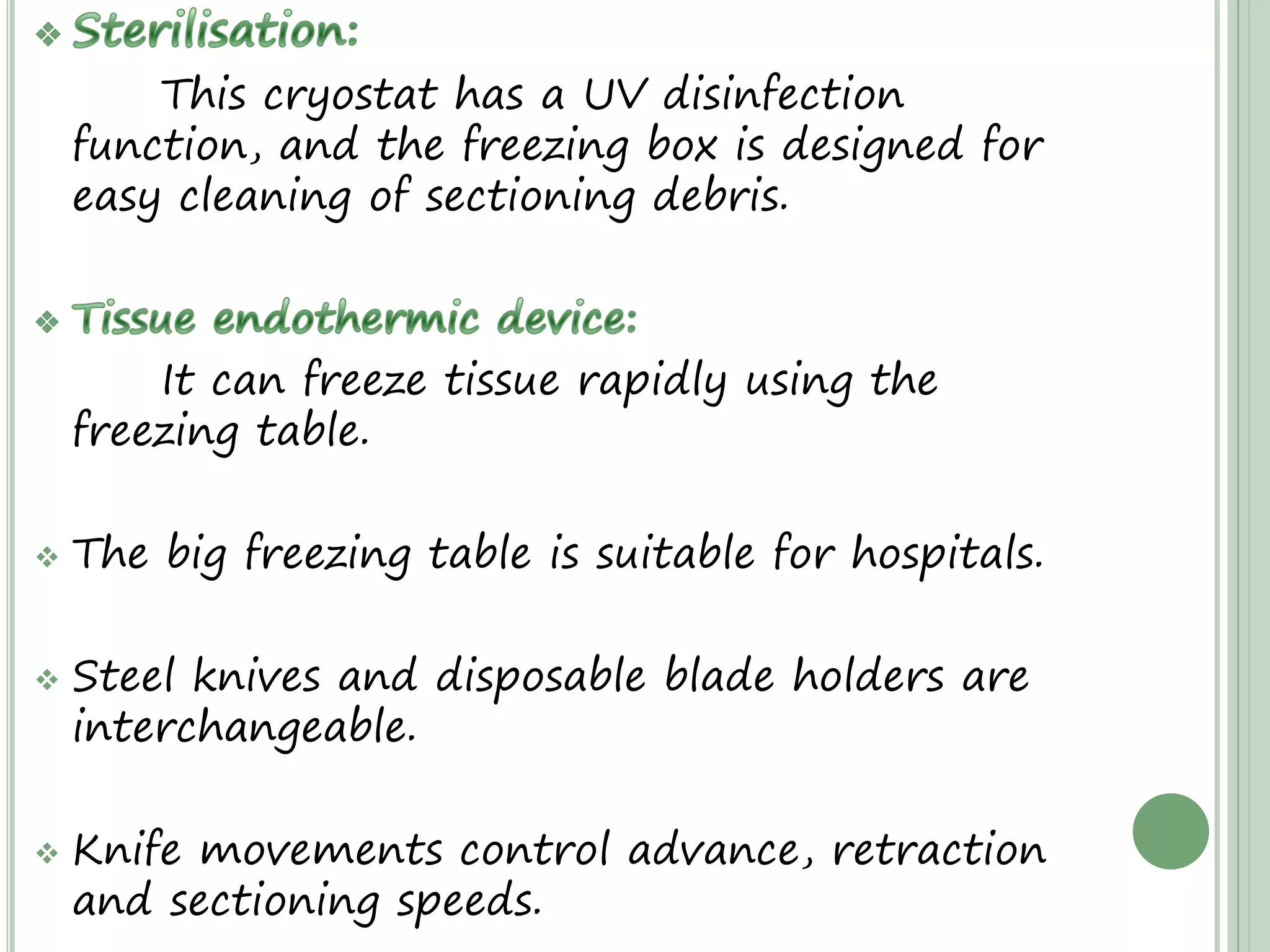
This cryostat has a UV disinfection
function, and the freezing box is designed for
easy cleaning of sectioning debris.
It can freeze tissue rapidly using the
freezing table.
 The big freezing table is suitable for hospitals.
 Steel knives and disposable blade holders are
interchangeable.
 Knife movements control advance, retraction
and sectioning speeds.
 Section thickness range:
 Increments of 1μm from 1μm to 20μm
 Increments of 2μm from 20μm to 40μm
 Increments of 5μm from 40μm to 80μm
 Trimming thickness range
adjustable
 Increments of 5μm from 10μm to 50μm
 Increments of 10μm from 50μm to 100μm
 Increments of 50μm from 100μm to 400μm
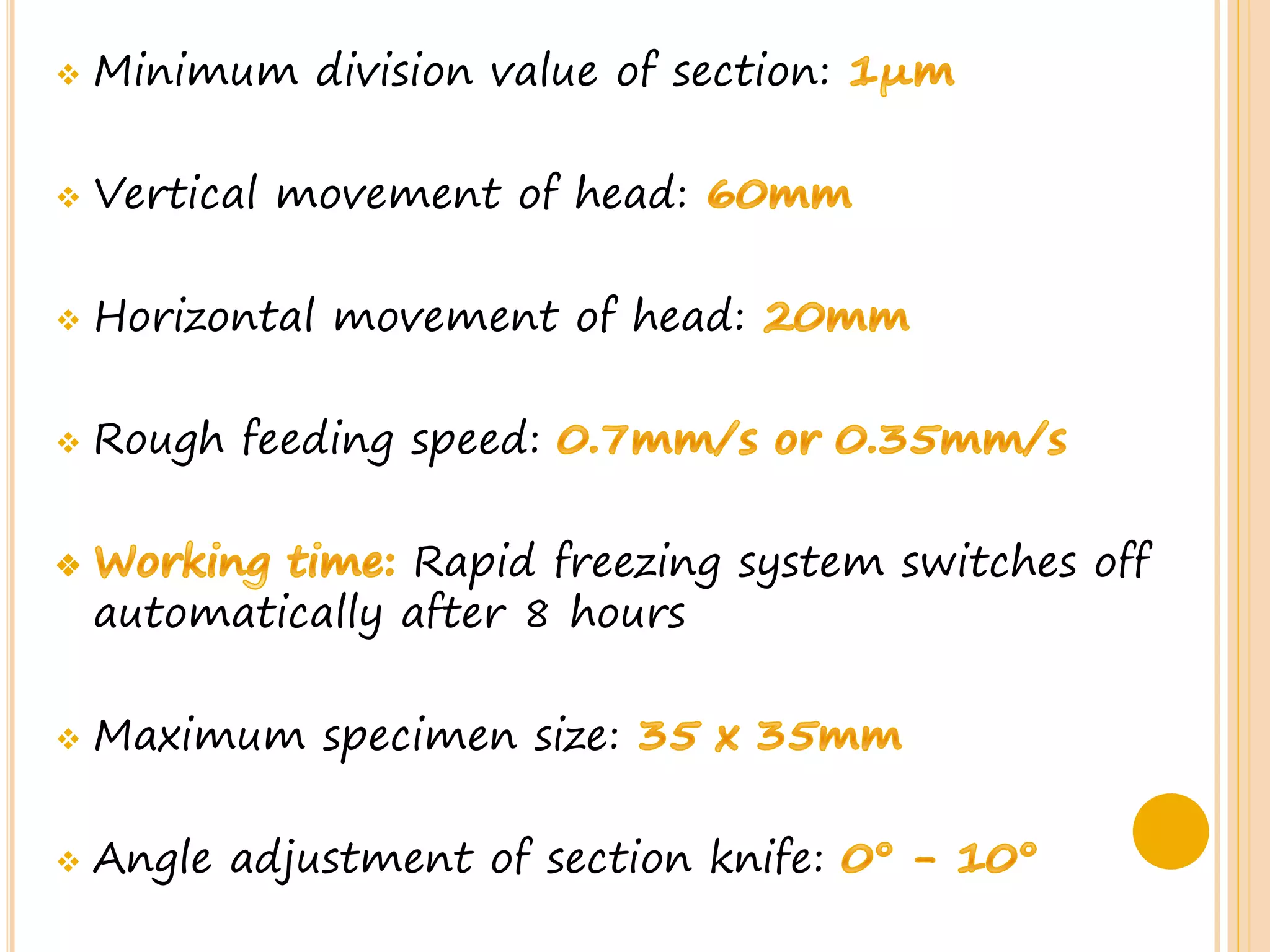
 Minimum division value of section:
 Vertical movement of head:
 Horizontal movement of head:
 Rough feeding speed:
Rapid freezing system switches off
automatically after 8 hours
 Maximum specimen size:
 Angle adjustment of section knife:
 Freezing chamber:
 Time freezing shelf to reach -30°C:
 Freezing shelf minimum temperature:
 Minimum temperature of heat extractor on freezing
shelf:
 Heat extractor working time
230VAC 50Hz 650W
660 x 640 x 1130mm
125 kg
65dB (A)
METHOD:
 Freeze a fresh, unfixed tissue sample, up to 2.0
cm in diameter, in OCT in a suitable tissue mold.
Freeze the OCT containing the tissue onto the
specialized metal grids that fit onto the cryostat.
(OCT is viscous at room temperature and miscible with
H2O, but freezes into a solid support at −20°C.Certain
soft tissues, such as brain, are optimally frozen in M-1
medium at −3°C.)
 Cut sections 5-15 μm thick in the cryostat at
−20°C. If necessary, adjust the temperature of the
cutting chamber ±5°C, according to the tissue
under study. (A camel hair brush is useful to help
guide the emerging section over the knife blade.)
 Within 1 min of cutting a tissue section, transfer
the section to a room temperature microscope
slide by touching the slide to the tissue.
(The tissue section will melt onto the slide. This must
be accomplished within 1 min of cutting the section to
avoid freeze-drying of the tissue.Poly-L-lysine-coated
or silanized slides improve the adherence of the
section.)
 To evaluate tissue preservation and orientation,
stain the first slide of each set with toluidine blue
(1%-2% w/v in H2O), haematoxylin, and eosin,
or any aqueous stain.
 Immediately immerse the slide into an
appropriate fixative
 To maximize the adherence of the section to the
slide, some researchers allow the section to air-
dry onto the slide at room temperature before
fixing the sample. The disadvantage of this is that
surface tension forces distort the cells, causing loss
of high-resolution detail. Air-drying may also
cause some changes in immunostaining results.
 Cover any unused tissue with a layer of OCT to
prevent freeze-drying and store the rest of the
sample at −70°C.
(For long-term storage, a moistened tissue should be added
to the container with the block to prevent desiccation)
 A Microtome is used to cut very thin sections at
room temperature, on the other hand a Cryostat
is used to cut frozen sections at sub zero
temperatures (generally -30 deg C).
 A cryostat is used in situations where rapid
analysis of tissues is required. The water rich tissue
is frozen on a quick freezing shelf inside the
cryostat, this makes it very hard and it is then
ready to be cut into thin sections in a microtome,
also placed inside the cryostat chamber.
 On the other hand to be cut in a simple
microtome, the tissue needs to be first
dehydrated and fixed in paraffin before it can
be sectioned. It is a long procedure compared to
quick sectioning in a cryostat.
 The quality of sections cut in a cryostat is
inferior compared to those cut in a microtome
because dehydrated and paraffin embedded
tissues give better sections but when it comes to
quick sectioning, Cryostat is the choice.
 1. To avoid drying, the tissue should be kept
in ......................
 2. Tissues can be fixed with ......................
 3. ...................... or ...................... is used as
embedding media
 4. ...................... gas is most commonly used
with freezing microtome
 10% Formalin.
 Saline
 Optimum cooling temperature or 20%
sucrose
 Carbon dioxide, Liquid Nitrogen.

Histopathology - CRYOSTAT

  • 2.
  • 13.
     Cryostat isa device by which temperature can be maintained in a low level.  In pathology and histology it is known as chamber containing a microtome for sectioning frozen tissue.
  • 14.
     Cryostat isdesigned for the optimal production of from the tissues to examine.  Most frequent use is by , but also many require a cryostat.  This automated cryotome has a which is used for to off-cuts.  Another special feature is it facilitates sectioning and especially by using a lower temperature on surrounding parts.
  • 15.
     The cryostatis essentially an ultrafine called a microtome, placed in a freezer.  The temperature can be depending on the tissue being cut - usually  The freezer is either powered by or by a refrigerant like . Small portable cryostats are available and can run off generators or vehicle inverters.  To minimize all necessary mechanical movements of the microtome can be achieved
  • 16.
     The Newermicrotomes have electric push button advancement of the tissue.  Tissue are sectioned as thin as  Once frozen, the specimen on the chuck is mounted on the microtome.  The crank is rotated and the specimen advances toward the cutting blade.  Once the specimen is cut to a satisfactory quality, it is mounted on a warm (room temperature) clear glass slide,  where it will instantaneously melt and adhere.  The glass slide and specimen are air dried, and stained.  The entire process from mounting to reading the slide takes from 10 to 20 minutes, allowing rapid diagnosis in the operating room, for the surgical excision of cancer.  The cryostat section quality is poorer as compared to fixed tissue sections.
  • 17.
     Although cryosectionsare physically less stable than paraffin they are generally and therefore the detection of antigens by microscopy.  The preparation of cryosections steps typical of other sectioning methods, and, furthermore, sectioning, labelling, and observation of specimens can usually be carried out in one day.  In general, the sample is frozen quickly in either or  Rapid freezing and  Frozen sections may be used for a variety of procedures, including ,
  • 18.
    The equipment containsthe following main components: o Some of the panels are under showing and o The middle of the unit contains to the unit for and o The lower part of the unit holds the refrigeration o Behind the low-temperature unit holds the and .
  • 20.
    Automatic temperature iscomputer- controlled. The LCD displays three temperatures. Shown are • The working conditions of all hardware, • Compressor A • Compressor B • Lighting • UV • Defrost and advance and withdrawal of the motor • Freezing of the table and the knife. The instrument has a count-down display when the compressor is started.
  • 21.
    the dual-compressor control systemhas four thermostat control points –  the head,  knife,  table and  box. The head can be set to different sectioning temperatures. there is no need to pre-cool, the instrument can get into freezing mode after only 10 min from start up. It can be switched off after finishing work to save power.
  • 22.
    The cryostat sectionswork with using very low temperatures. This saves energy and time and also reduces ice crystal condensation. A hard matrix achieved by a lower temperature may be required for hard specimens. The rapid freezing system can be switched off manually at any time. After working 8 hours, the rapid freezing system will switch off automatically.
  • 23.
    It has automaticand manual defrosting functions.  1) defrosting time interval;  2) defrosting time;  3) manual defrosting may be set. These settings may be varied according to ambient temperature. The defrosting function can be switched off any time; the instrument will change to freezing mode after the defrosting function is switched off. The instrument's mechanical construction is superlative . The use of roller bearings makes the instrument very stable in the vertical plane. The mechanism is enclosed and maintenance-free. Mechanical performance is excellent for the production of uniform flat and stable section; a fine anti-curling function is provided.
  • 24.
    This cryostat hasa UV disinfection function, and the freezing box is designed for easy cleaning of sectioning debris. It can freeze tissue rapidly using the freezing table.  The big freezing table is suitable for hospitals.  Steel knives and disposable blade holders are interchangeable.  Knife movements control advance, retraction and sectioning speeds.
  • 25.
     Section thicknessrange:  Increments of 1μm from 1μm to 20μm  Increments of 2μm from 20μm to 40μm  Increments of 5μm from 40μm to 80μm  Trimming thickness range adjustable  Increments of 5μm from 10μm to 50μm  Increments of 10μm from 50μm to 100μm  Increments of 50μm from 100μm to 400μm
  • 26.
     Minimum divisionvalue of section:  Vertical movement of head:  Horizontal movement of head:  Rough feeding speed: Rapid freezing system switches off automatically after 8 hours  Maximum specimen size:  Angle adjustment of section knife:
  • 27.
     Freezing chamber: Time freezing shelf to reach -30°C:  Freezing shelf minimum temperature:  Minimum temperature of heat extractor on freezing shelf:  Heat extractor working time 230VAC 50Hz 650W 660 x 640 x 1130mm 125 kg 65dB (A)
  • 29.
    METHOD:  Freeze afresh, unfixed tissue sample, up to 2.0 cm in diameter, in OCT in a suitable tissue mold. Freeze the OCT containing the tissue onto the specialized metal grids that fit onto the cryostat. (OCT is viscous at room temperature and miscible with H2O, but freezes into a solid support at −20°C.Certain soft tissues, such as brain, are optimally frozen in M-1 medium at −3°C.)  Cut sections 5-15 μm thick in the cryostat at −20°C. If necessary, adjust the temperature of the cutting chamber ±5°C, according to the tissue under study. (A camel hair brush is useful to help guide the emerging section over the knife blade.)
  • 30.
     Within 1min of cutting a tissue section, transfer the section to a room temperature microscope slide by touching the slide to the tissue. (The tissue section will melt onto the slide. This must be accomplished within 1 min of cutting the section to avoid freeze-drying of the tissue.Poly-L-lysine-coated or silanized slides improve the adherence of the section.)  To evaluate tissue preservation and orientation, stain the first slide of each set with toluidine blue (1%-2% w/v in H2O), haematoxylin, and eosin, or any aqueous stain.  Immediately immerse the slide into an appropriate fixative
  • 31.
     To maximizethe adherence of the section to the slide, some researchers allow the section to air- dry onto the slide at room temperature before fixing the sample. The disadvantage of this is that surface tension forces distort the cells, causing loss of high-resolution detail. Air-drying may also cause some changes in immunostaining results.  Cover any unused tissue with a layer of OCT to prevent freeze-drying and store the rest of the sample at −70°C. (For long-term storage, a moistened tissue should be added to the container with the block to prevent desiccation)
  • 32.
     A Microtomeis used to cut very thin sections at room temperature, on the other hand a Cryostat is used to cut frozen sections at sub zero temperatures (generally -30 deg C).  A cryostat is used in situations where rapid analysis of tissues is required. The water rich tissue is frozen on a quick freezing shelf inside the cryostat, this makes it very hard and it is then ready to be cut into thin sections in a microtome, also placed inside the cryostat chamber.
  • 33.
     On theother hand to be cut in a simple microtome, the tissue needs to be first dehydrated and fixed in paraffin before it can be sectioned. It is a long procedure compared to quick sectioning in a cryostat.  The quality of sections cut in a cryostat is inferior compared to those cut in a microtome because dehydrated and paraffin embedded tissues give better sections but when it comes to quick sectioning, Cryostat is the choice.
  • 34.
     1. Toavoid drying, the tissue should be kept in ......................  2. Tissues can be fixed with ......................  3. ...................... or ...................... is used as embedding media  4. ...................... gas is most commonly used with freezing microtome
  • 35.
     10% Formalin. Saline  Optimum cooling temperature or 20% sucrose  Carbon dioxide, Liquid Nitrogen.