SPECIAL STAINS
IN
DERMATOLOGY
WHAT IS STAIN?
 Staining is an auxiliary technique used in microscopy to enhance contrast in the microscopic
images.
 Stains may be used to define and examine the bulk tissue
1. Cell population
2. Muscle fibers
3. Connective tissues
4. Organelles
SPECIAL STAINS
 Used in addition to H & E staining to selectively
 Stain cells & cellular components
Gives information on:
 Presence of certain class of molecules
 Their localization
 Number of molecules
STAINS FOR
MUCOPOLYSACCARIDES
1. PAS
2. ALCIAN BLUE
3. MUCICARMINE
4. COLLOIDAL IRON
PAS
 Most commonly used special stain
 Stains neutral mucopolysaccharides (Glycogen)
 Basement membranes (e.g SLE)
 Fungi, Parasides
 Fibrin, Inclusion bodies
ALCIAN BLUE
 Best stain for mucin
 Alcian blue (pH 2.5)
- Acid mucopolysaccharides (glycosaminoglycain’s)
- Light blue
 Alcian blue (pH 0.5)
- Sulfated mucopolysaccharides (heparin sulfate)
- Blue
 Does NOT stain neutral mucins
RESULTS
 Acid mucin & proteoglycans : BLUE
 Nuclei : RED
MUCICARMINE
 To demonstrate acid & neutral mucopolysaccharides
- Epithelial mucin
- Capsule of cryptococcus neoformans
Results
 Acid epithelial mucins : Deep rose to red
 Nuclei : Black
 Others tissue elements : Light yellow
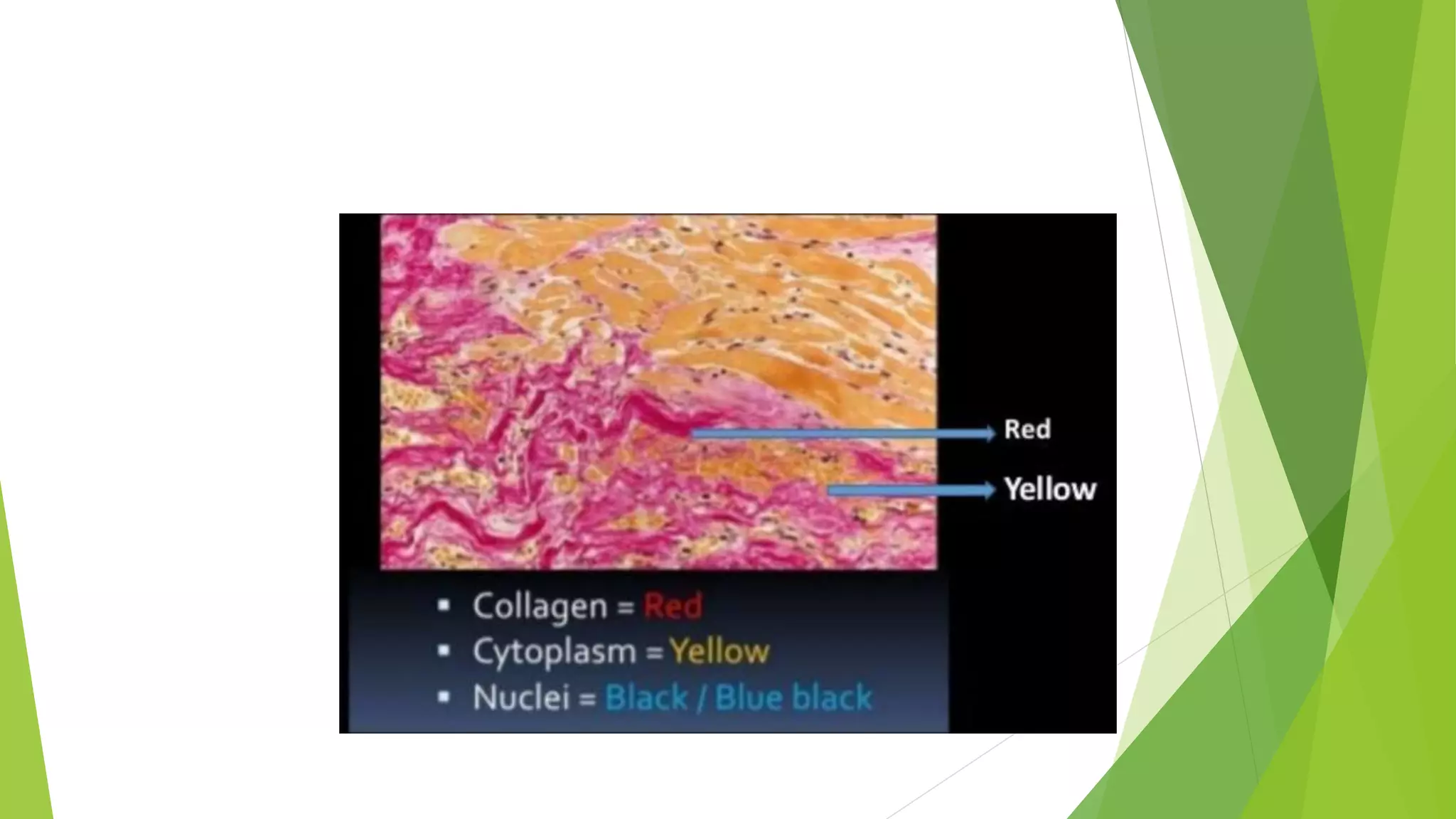
COLLOIDAL IRON
 A mucin stain for dermal/connective tissue mucin
 Stains acid mucopolysaccharides
RESULTS
 Proteoglycans , Acid mucins : BRIGHT BLUE
 Collagen : RED
 Muscle & cytoplasm : YELLOW
STAINS FOR PIGMENTS &
MINERALS
1. Fontana-Masson
2. Von-kossa
3. Alzarin red S
4. Prussian blue stain
FONTANA-MASSON
 Stains melanin & argentaffin granules – BLACK (nuclei will be red)
 Useful for quantifying melanocytes (e.g. in vitiligo) & in cases of minocycline pigmentary
alteration
 Also stains cryptococcus
RESULTS
 Melanin , Argentaffin, Chromaffin : BLACK
 Nuclei : RED
USES
 To identify melanin & argentaffin granules
 In diagnosis of malignant melanoma
 Argentaffin granules are found in carcinoid tumors
VON-KOSSA
 Stains calcium salts – BLACK
 Calcification of vessel walls & elastic tissue
( Calcinonis cutis, pseudoxanthoma elasticum, calciphylaxis, elastosis
& elastofibroma)
PRUSSIAN BLUE STAIN (PERLS IRON)
 Hemosiderin and ferric ions
 Useful for identifying iron as the source of pigment
 Stains iron – BLUE
RESULT
 Ferric iron : Blue
 Nuclei : Red
ALIZARIN RED
 Stain for calcium salts
RESULTS
 Calcium : ORANGE RED
 Background : GREEN
STAINS FOR CONNECTIVE
TISSUE
 Trichrome-Masson
 Verhoeff-Van Gieson
TRICHROME-MASSON
 Smooth muscle , cytoplasm, keratin – Red
 Useful for distinguishing leiomyoma’s from dermatofibromas & neural tumors
 Collagen – Blue/green
 Useful in evaluating the characteristics of dermal collagen
 Nucleus - Black
USES
 It is used to differentiate b/w collagen & smooth muscle in tumor
 To identified the increased collagen deposition : Keloid
RESULT
 Nuclei : Blue/Black
 Cytoplasm, Muscle, & Erythrocytes : Red
 Collagen : Blue
VERHOEFF-VAN GIESON OR WEIGERT
 Used to differentiate collagen and smooth muscle
 Can be used to demonstrate the presence of collagen in pathological conditions( DLE, EN, RA,
SLE, MORPHOEA)
 Stains nuclei : Blue
 Cytoplasm, muscle, fibrin : Yellow
 Collagen : Bright
 Elastic fibers : Black
STAINS FOR AMYLOID
 Congo red
 Thioflavin T
 Crystal violet
CONGO RED
 Stains amyloid : PINKISH-RED
 Gives apple-green birefringence to amyloid
 The most specific method for amyloid
THIOFLAVIN T
 Amyloid shows yellow fluorescence
RESULT
 UV light source : Silver-blue
 Blue light fluorescence : Yellow
CRYSTAL
VIOLET
• Stain Amyloid purple-violet
STAINS FOR FAT
 Sudan black B
 Sudan orange
 Oil red O
SUDAN BLACK B
 Most sensitive of all fat dyes
 Stains neutral fats – Blue-Black
 Stains phospholipid – Grey
OIL RED O
 Stains fat red
 Frozen/Fresh tissue ( once tissue is fixed &processed into paraffin blocks, this method does not
work)
 This may be very helpful in seeing the fat globules in sebaceous carcinoma
RESULT
Fat : Brilliant Red
Nuclei : Blue FAT
NUCLEI
STAINS FOR MAST CELLS
 Giemsa
 Toluidine blue
 Chloroacetate esterase ( Leder stain)
GIEMSA
Metachromatically purple
Urticaria
Mastocytosis MAST CELL
TOLUIDINE
BLUE
Mast cells stain – Purple
(Metachromatic staining)
Background stain – Blue
(orthochromatic staining)
Mastocytosis
MAST CELL
STAINS FOR MICROORGANISMS
 H&E
 Gram
 Giemsa
 Gomori methenamine silver (GMS)
 PAS
 Fontana-Masson
 Warthin-Starry
 Ziehl-Neelson stain
H&E
May demonstrate fungi, bacteria
GRAM STAINING
 Differentiates bacteria by the chemical & physical properties of their cell well by detecting
peptidoglycan
 Gram +ve bacteria retain the crystal violet dye & thus are stained violet : BLUE
 Gram –ve bacteria : PINK
GOMORI METHENAMINE SILVER (GMS)
 Fungal cell walls
 Stains fungi & parasites brown or black with a green background
 Pneumocystis carnii, histoplasma , leshmania
GIEMSA STAIN
 Used to stain bacteria & protozoa
 H. pylori, rickettsia & chlamydia
 Bacteria stains : BLUE
 Cytoplasm stains from : Pink to rose
 Nuclei : BLUE
 Eosinophils are also easily detected
WARTHIN-STARRY
 A silver nitrate stain
 Spirochetes – BLACK
 Background – Golden yellow
ZIEHL-NEELSEN
 Acid fast refers to cell walls containing high lipid content
 Used to stain Mycobacteria, oocysts of Cryptosporidium parvum, Cyclospora, Isospora
 Acid fast cells stain : RED
 Non acid fast cells stain : BLUE
ACID FAST STAINING
TECHNIQUES
 Ziehl-Neelsen stain ( classic type)
 Kinyoun
 Auramine-rhodamine (fluorescent dyes)
 Fite : for leprosy bacillus which is less acid fast
THANK YOU

Stains in dermatology .pptx

  • 1.
  • 2.
    WHAT IS STAIN? Staining is an auxiliary technique used in microscopy to enhance contrast in the microscopic images.  Stains may be used to define and examine the bulk tissue 1. Cell population 2. Muscle fibers 3. Connective tissues 4. Organelles
  • 3.
    SPECIAL STAINS  Usedin addition to H & E staining to selectively  Stain cells & cellular components Gives information on:  Presence of certain class of molecules  Their localization  Number of molecules
  • 4.
    STAINS FOR MUCOPOLYSACCARIDES 1. PAS 2.ALCIAN BLUE 3. MUCICARMINE 4. COLLOIDAL IRON
  • 5.
    PAS  Most commonlyused special stain  Stains neutral mucopolysaccharides (Glycogen)  Basement membranes (e.g SLE)  Fungi, Parasides  Fibrin, Inclusion bodies
  • 9.
    ALCIAN BLUE  Beststain for mucin  Alcian blue (pH 2.5) - Acid mucopolysaccharides (glycosaminoglycain’s) - Light blue  Alcian blue (pH 0.5) - Sulfated mucopolysaccharides (heparin sulfate) - Blue  Does NOT stain neutral mucins
  • 10.
    RESULTS  Acid mucin& proteoglycans : BLUE  Nuclei : RED
  • 12.
    MUCICARMINE  To demonstrateacid & neutral mucopolysaccharides - Epithelial mucin - Capsule of cryptococcus neoformans Results  Acid epithelial mucins : Deep rose to red  Nuclei : Black  Others tissue elements : Light yellow
  • 14.
    COLLOIDAL IRON  Amucin stain for dermal/connective tissue mucin  Stains acid mucopolysaccharides RESULTS  Proteoglycans , Acid mucins : BRIGHT BLUE  Collagen : RED  Muscle & cytoplasm : YELLOW
  • 16.
    STAINS FOR PIGMENTS& MINERALS 1. Fontana-Masson 2. Von-kossa 3. Alzarin red S 4. Prussian blue stain
  • 17.
    FONTANA-MASSON  Stains melanin& argentaffin granules – BLACK (nuclei will be red)  Useful for quantifying melanocytes (e.g. in vitiligo) & in cases of minocycline pigmentary alteration  Also stains cryptococcus RESULTS  Melanin , Argentaffin, Chromaffin : BLACK  Nuclei : RED
  • 18.
    USES  To identifymelanin & argentaffin granules  In diagnosis of malignant melanoma  Argentaffin granules are found in carcinoid tumors
  • 21.
    VON-KOSSA  Stains calciumsalts – BLACK  Calcification of vessel walls & elastic tissue ( Calcinonis cutis, pseudoxanthoma elasticum, calciphylaxis, elastosis & elastofibroma)
  • 24.
    PRUSSIAN BLUE STAIN(PERLS IRON)  Hemosiderin and ferric ions  Useful for identifying iron as the source of pigment  Stains iron – BLUE RESULT  Ferric iron : Blue  Nuclei : Red
  • 26.
    ALIZARIN RED  Stainfor calcium salts RESULTS  Calcium : ORANGE RED  Background : GREEN
  • 28.
    STAINS FOR CONNECTIVE TISSUE Trichrome-Masson  Verhoeff-Van Gieson
  • 29.
    TRICHROME-MASSON  Smooth muscle, cytoplasm, keratin – Red  Useful for distinguishing leiomyoma’s from dermatofibromas & neural tumors  Collagen – Blue/green  Useful in evaluating the characteristics of dermal collagen  Nucleus - Black
  • 30.
    USES  It isused to differentiate b/w collagen & smooth muscle in tumor  To identified the increased collagen deposition : Keloid RESULT  Nuclei : Blue/Black  Cytoplasm, Muscle, & Erythrocytes : Red  Collagen : Blue
  • 32.
    VERHOEFF-VAN GIESON ORWEIGERT  Used to differentiate collagen and smooth muscle  Can be used to demonstrate the presence of collagen in pathological conditions( DLE, EN, RA, SLE, MORPHOEA)  Stains nuclei : Blue  Cytoplasm, muscle, fibrin : Yellow  Collagen : Bright  Elastic fibers : Black
  • 34.
    STAINS FOR AMYLOID Congo red  Thioflavin T  Crystal violet
  • 35.
    CONGO RED  Stainsamyloid : PINKISH-RED  Gives apple-green birefringence to amyloid  The most specific method for amyloid
  • 38.
    THIOFLAVIN T  Amyloidshows yellow fluorescence RESULT  UV light source : Silver-blue  Blue light fluorescence : Yellow
  • 40.
  • 41.
    STAINS FOR FAT Sudan black B  Sudan orange  Oil red O
  • 42.
    SUDAN BLACK B Most sensitive of all fat dyes  Stains neutral fats – Blue-Black  Stains phospholipid – Grey
  • 44.
    OIL RED O Stains fat red  Frozen/Fresh tissue ( once tissue is fixed &processed into paraffin blocks, this method does not work)  This may be very helpful in seeing the fat globules in sebaceous carcinoma
  • 45.
    RESULT Fat : BrilliantRed Nuclei : Blue FAT NUCLEI
  • 46.
    STAINS FOR MASTCELLS  Giemsa  Toluidine blue  Chloroacetate esterase ( Leder stain)
  • 47.
  • 48.
    TOLUIDINE BLUE Mast cells stain– Purple (Metachromatic staining) Background stain – Blue (orthochromatic staining) Mastocytosis MAST CELL
  • 49.
    STAINS FOR MICROORGANISMS H&E  Gram  Giemsa  Gomori methenamine silver (GMS)  PAS  Fontana-Masson  Warthin-Starry  Ziehl-Neelson stain
  • 50.
  • 51.
    GRAM STAINING  Differentiatesbacteria by the chemical & physical properties of their cell well by detecting peptidoglycan  Gram +ve bacteria retain the crystal violet dye & thus are stained violet : BLUE  Gram –ve bacteria : PINK
  • 53.
    GOMORI METHENAMINE SILVER(GMS)  Fungal cell walls  Stains fungi & parasites brown or black with a green background  Pneumocystis carnii, histoplasma , leshmania
  • 56.
    GIEMSA STAIN  Usedto stain bacteria & protozoa  H. pylori, rickettsia & chlamydia  Bacteria stains : BLUE  Cytoplasm stains from : Pink to rose  Nuclei : BLUE  Eosinophils are also easily detected
  • 58.
    WARTHIN-STARRY  A silvernitrate stain  Spirochetes – BLACK  Background – Golden yellow
  • 60.
    ZIEHL-NEELSEN  Acid fastrefers to cell walls containing high lipid content  Used to stain Mycobacteria, oocysts of Cryptosporidium parvum, Cyclospora, Isospora  Acid fast cells stain : RED  Non acid fast cells stain : BLUE
  • 62.
    ACID FAST STAINING TECHNIQUES Ziehl-Neelsen stain ( classic type)  Kinyoun  Auramine-rhodamine (fluorescent dyes)  Fite : for leprosy bacillus which is less acid fast
  • 64.