IRUM RAFIQ SHAIKH
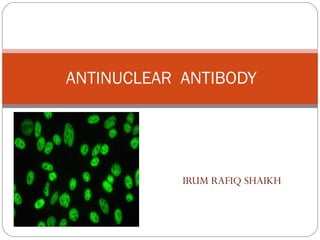
ANTINUCLEAR ANTIBODY
Anti-nuclear antibodies (ANAs, also known as
anti-nuclear factor or ANF) are autoantibodies
that bind to contents of the cell nucleus. In
normal individuals, the immune system produces
antibodies to foreign proteins (antigens) but not
to human proteins (autoantigens). In some
individuals, antibodies to human antigens are
produced
Subtypes Of ANAs
There are many subtypes of ANAs such as,
 anti-Ro antibodies
 anti-La antibodies
 anti-Sm antibodies
 anti-nRNP antibodies
 anti-Scl-70 antibodies
 anti-dsDNA antibodies
anti-histone antibodies
 antibodies to nuclear pore complexes
 anti-centromere antibodies
 anti-sp100 antibodies
Subtypes Of ANAs
Each of these antibody subtypes binds to
different proteins or protein complexes
within the nucleus. They are found in many
disorders including autoimmunity, cancer
and infection, with different prevalence of
antibodies depending on the condition.
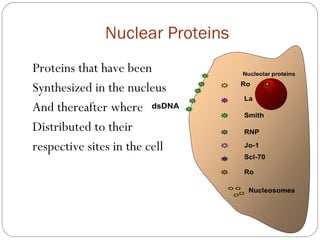
Nuclear Proteins
Proteins that have been
Synthesized in the nucleus
And thereafter where
Distributed to their
respective sites in the cell
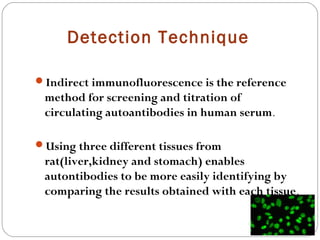
Detection Technique
Indirect immunofluorescence is the reference
method for screening and titration of
circulating autoantibodies in human serum.
Using three different tissues from
rat(liver,kidney and stomach) enables
autontibodies to be more easily identifying by
comparing the results obtained with each tissue.
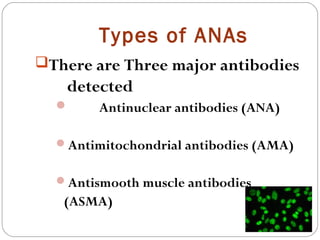
Types of ANAs
There are Three major antibodies
detected
 Antinuclear antibodies (ANA)
Antimitochondrial antibodies (AMA)
Antismooth muscle antibodies
(ASMA)
Principle
An indirect immunofluorescence technique is
utilized where patient samples and appropriate
controls are incubated with the substrate slides.
The unreacted antibodies are washed off and an
appropriate fluorescence labeled conjugate is
applied.
Unbound conjugate is washed off, and slides are
viewed with a fluorescence microscope.
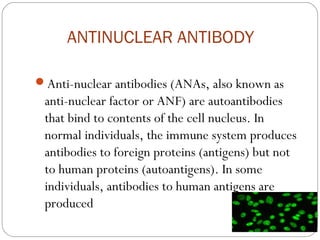
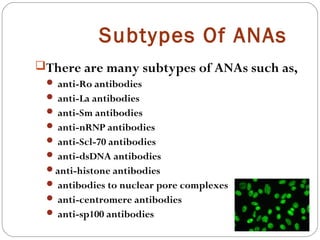
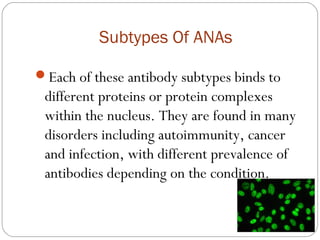
Positive samples produce apple-green
fluorescence.
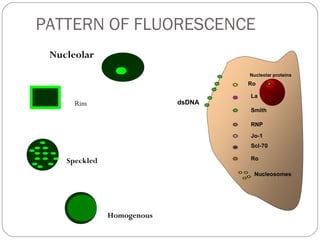
PATTERN OF FLUORESCENCE
Speckled
Homogenous
Rim
Nucleolar
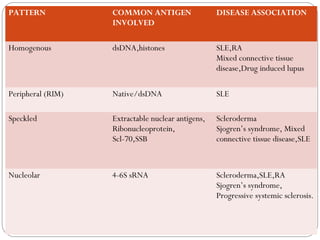
PATTERN COMMON ANTIGEN
INVOLVED
DISEASE ASSOCIATION
Homogenous dsDNA,histones SLE,RA
Mixed connective tissue
disease,Drug induced lupus
Peripheral (RIM) Native/dsDNA SLE
Speckled Extractable nuclear antigens,
Ribonucleoprotein,
Scl-70,SSB
Scleroderma
Sjogren’s syndrome, Mixed
connective tissue disease,SLE
Nucleolar 4-6S sRNA Scleroderma,SLE,RA
Sjogren’s syndrome,
Progressive systemic sclerosis.
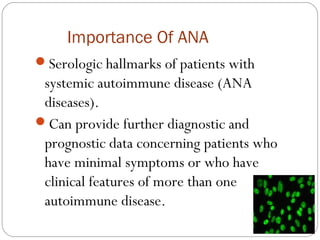
Importance Of ANA
Serologic hallmarks of patients with
systemic autoimmune disease (ANA
diseases).
Can provide further diagnostic and
prognostic data concerning patients who
have minimal symptoms or who have
clinical features of more than one
autoimmune disease.
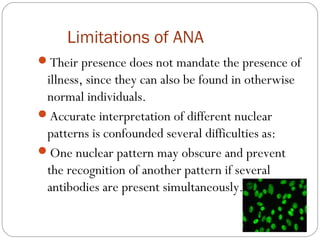
Limitations of ANA
Their presence does not mandate the presence of
illness, since they can also be found in otherwise
normal individuals.
Accurate interpretation of different nuclear
patterns is confounded several difficulties as:
One nuclear pattern may obscure and prevent
the recognition of another pattern if several
antibodies are present simultaneously.
ANTINUCLEAR  ANTIBODY

ANTINUCLEAR ANTIBODY

  • 1.
  • 2.
    ANTINUCLEAR ANTIBODY Anti-nuclear antibodies(ANAs, also known as anti-nuclear factor or ANF) are autoantibodies that bind to contents of the cell nucleus. In normal individuals, the immune system produces antibodies to foreign proteins (antigens) but not to human proteins (autoantigens). In some individuals, antibodies to human antigens are produced
  • 3.
    Subtypes Of ANAs Thereare many subtypes of ANAs such as,  anti-Ro antibodies  anti-La antibodies  anti-Sm antibodies  anti-nRNP antibodies  anti-Scl-70 antibodies  anti-dsDNA antibodies anti-histone antibodies  antibodies to nuclear pore complexes  anti-centromere antibodies  anti-sp100 antibodies
  • 4.
    Subtypes Of ANAs Eachof these antibody subtypes binds to different proteins or protein complexes within the nucleus. They are found in many disorders including autoimmunity, cancer and infection, with different prevalence of antibodies depending on the condition.
  • 5.
    Nuclear Proteins Proteins thathave been Synthesized in the nucleus And thereafter where Distributed to their respective sites in the cell
  • 6.
    Detection Technique Indirect immunofluorescenceis the reference method for screening and titration of circulating autoantibodies in human serum. Using three different tissues from rat(liver,kidney and stomach) enables autontibodies to be more easily identifying by comparing the results obtained with each tissue.
  • 7.
    Types of ANAs Thereare Three major antibodies detected  Antinuclear antibodies (ANA) Antimitochondrial antibodies (AMA) Antismooth muscle antibodies (ASMA)
  • 8.
    Principle An indirect immunofluorescencetechnique is utilized where patient samples and appropriate controls are incubated with the substrate slides. The unreacted antibodies are washed off and an appropriate fluorescence labeled conjugate is applied. Unbound conjugate is washed off, and slides are viewed with a fluorescence microscope. Positive samples produce apple-green fluorescence.
  • 9.
  • 10.
    PATTERN COMMON ANTIGEN INVOLVED DISEASEASSOCIATION Homogenous dsDNA,histones SLE,RA Mixed connective tissue disease,Drug induced lupus Peripheral (RIM) Native/dsDNA SLE Speckled Extractable nuclear antigens, Ribonucleoprotein, Scl-70,SSB Scleroderma Sjogren’s syndrome, Mixed connective tissue disease,SLE Nucleolar 4-6S sRNA Scleroderma,SLE,RA Sjogren’s syndrome, Progressive systemic sclerosis.
  • 11.
    Importance Of ANA Serologichallmarks of patients with systemic autoimmune disease (ANA diseases). Can provide further diagnostic and prognostic data concerning patients who have minimal symptoms or who have clinical features of more than one autoimmune disease.
  • 12.
    Limitations of ANA Theirpresence does not mandate the presence of illness, since they can also be found in otherwise normal individuals. Accurate interpretation of different nuclear patterns is confounded several difficulties as: One nuclear pattern may obscure and prevent the recognition of another pattern if several antibodies are present simultaneously.