CESTODES
General Characteristics
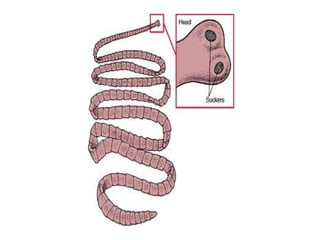
• Long, segmented and tape-like are called tapeworms
• Dorso-ventrally flattened
• Size varies from a few mm to several meters
• Adult worms are found in the human intestines
• There are 3 regions in an adult worm:
• Head: scolex
• Neck
• Strobila (body or trunk)
» Consist of a series of segment called proglottids
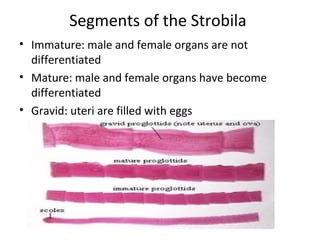
Segments of the Strobila
• Immature: male and female organs are not
differentiated
• Mature: male and female organs have become
differentiated
• Gravid: uteri are filled with eggs
Other Characteristics
• Sexes are not separate
• Body cavity is absent
• Alimentary canal is entirely absent
• Excretory and nervous systems are rudimentary
• Reproductive system is present and complete in each
segment
I. Pseudophyllidean cestodes
• Possess false or slit-like grooves called bothria
• Adult worms in Intestine
» Diphyllobothrium latum: Fish Tapeworm
• Larval stages: Plerocercoid in Man
» Sparganum mansoni
» Sparganum proliferum
Classification of Cestodes
Infecting Man
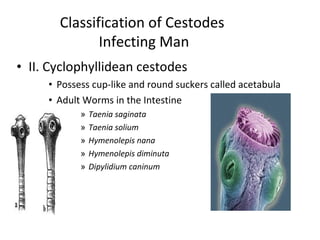
• II. Cyclophyllidean cestodes
• Possess cup-like and round suckers called acetabula
• Adult Worms in the Intestine
» Taenia saginata
» Taenia solium
» Hymenolepis nana
» Hymenolepis diminuta
» Dipylidium caninum
Classification of Cestodes
Infecting Man
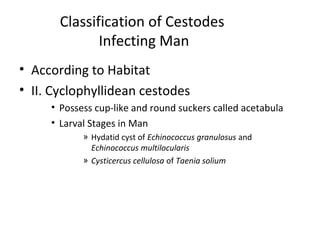
• According to Habitat
• II. Cyclophyllidean cestodes
• Possess cup-like and round suckers called acetabula
• Larval Stages in Man
» Hydatid cyst of Echinococcus granulosus and
Echinococcus multilocularis
» Cysticercus cellulosa of Taenia solium
Classification of Cestodes
Infecting Man
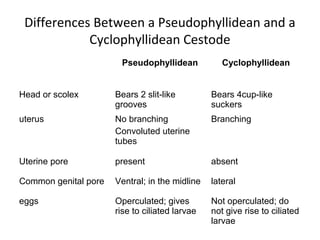
Differences Between a Pseudophyllidean and a
Cyclophyllidean Cestode
Pseudophyllidean Cyclophyllidean
Head or scolex Bears 2 slit-like
grooves
Bears 4cup-like
suckers
uterus No branching
Convoluted uterine
tubes
Branching
Uterine pore present absent
Common genital pore Ventral; in the midline lateral
eggs Operculated; gives
rise to ciliated larvae
Not operculated; do
not give rise to ciliated
larvae
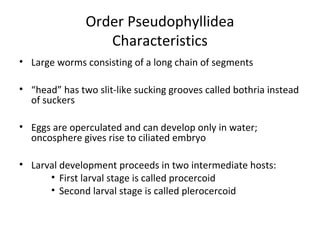
Order Pseudophyllidea
Characteristics
• Large worms consisting of a long chain of segments
• “head” has two slit-like sucking grooves called bothria instead
of suckers
• Eggs are operculated and can develop only in water;
oncosphere gives rise to ciliated embryo
• Larval development proceeds in two intermediate hosts:
• First larval stage is called procercoid
• Second larval stage is called plerocercoid
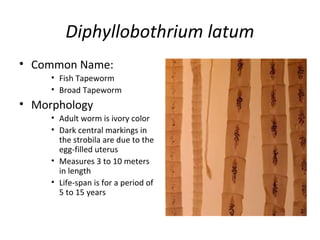
Diphyllobothrium latum
• Common Name:
• Fish Tapeworm
• Broad Tapeworm
• Morphology
• Adult worm is ivory color
• Dark central markings in
the strobila are due to the
egg-filled uterus
• Measures 3 to 10 meters
in length
• Life-span is for a period of
5 to 15 years
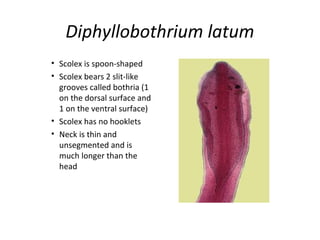
Diphyllobothrium latum
• Scolex is spoon-shaped
• Scolex bears 2 slit-like
grooves called bothria (1
on the dorsal surface and
1 on the ventral surface)
• Scolex has no hooklets
• Neck is thin and
unsegmented and is
much longer than the
head
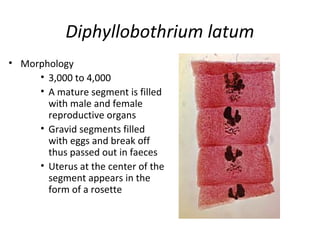
Diphyllobothrium latum
• Morphology
• 3,000 to 4,000
• A mature segment is filled
with male and female
reproductive organs
• Gravid segments filled
with eggs and break off
thus passed out in faeces
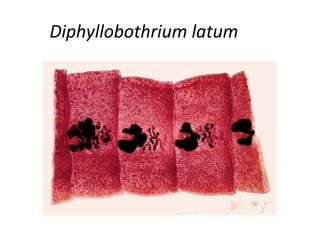
• Uterus at the center of the
segment appears in the
form of a rosette
Diphyllobothrium latum
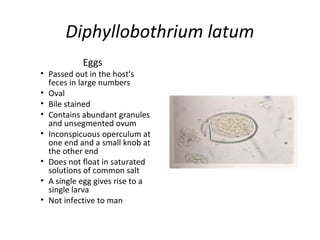
Eggs
• Passed out in the host’s
feces in large numbers
• Oval
• Bile stained
• Contains abundant granules
and unsegmented ovum
• Inconspicuous operculum at
one end and a small knob at
the other end
• Does not float in saturated
solutions of common salt
• A single egg gives rise to a
single larva
• Not infective to man
Diphyllobothrium latum
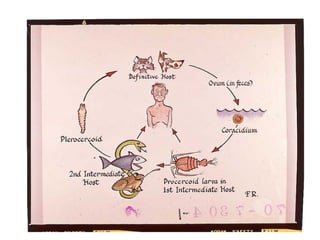
• larva
• Passed first in water and then in the respective intermediate hosts
• 3 stage
– First stage larva
» Coracidium
» Ciliated oncosphere that develops from egg in water
– Second stage larva
» Procercoid
» Spindle-like solid body with cephalic invagination
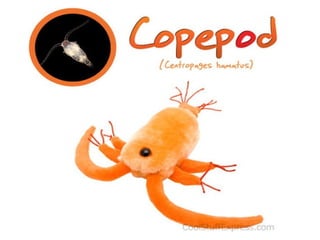
» Found inside the cyclops (the first intermediate host)
– Third stage larva
» Plerocercoid
» Head is invaginated in the neck
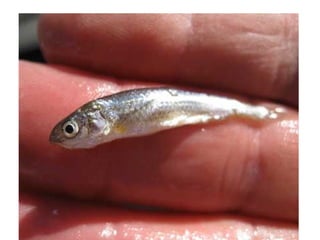
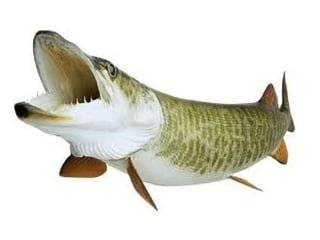
» Found in the fresh water fish, the second intermediate host
Lab Diagnosis
• Diagnosis
• Wet mount Examination of faeces
• Identifying the characteristic proglottids and operculated eggs
• Treatment
• Praziquantel: 5-10 mg/kg single dose for children and adults
• Niclosamide not available locally
Sparganosis
• The disease caused by pleurocercoid larva of
spirometra is called as sparganosis
Clinical Features
• Migrating spargana cause various symptoms
depending on location in the host.
• Spargana may locate anywhere
• Migration in subcutaneous tissues is painless
• In brain or spine can cause weakness, headache,
seizure, and abnormal skin sensations, such as
numbness or tingling
• If Inner ear is involved, vertigo or deafness.
• Sparganum proliferum can cause proliferative
lesions in the infected tissue, with multiple
plerocercoids present in a single site.
Laboratory Diagnosis
• Recovery of a sparganum from infected
tissue.
• To identify the species by infecting definitive
host with a living sparganum and identify the
adult after maturation.
Treatment
• Surgical removal is the treatment of choice for
sparganosis.

Classification of cestodes

  • 1.
  • 2.
    General Characteristics • Long,segmented and tape-like are called tapeworms • Dorso-ventrally flattened • Size varies from a few mm to several meters • Adult worms are found in the human intestines • There are 3 regions in an adult worm: • Head: scolex • Neck • Strobila (body or trunk) » Consist of a series of segment called proglottids
  • 4.
    Segments of theStrobila • Immature: male and female organs are not differentiated • Mature: male and female organs have become differentiated • Gravid: uteri are filled with eggs
  • 5.
    Other Characteristics • Sexesare not separate • Body cavity is absent • Alimentary canal is entirely absent • Excretory and nervous systems are rudimentary • Reproductive system is present and complete in each segment
  • 6.
    I. Pseudophyllidean cestodes •Possess false or slit-like grooves called bothria • Adult worms in Intestine » Diphyllobothrium latum: Fish Tapeworm • Larval stages: Plerocercoid in Man » Sparganum mansoni » Sparganum proliferum Classification of Cestodes Infecting Man
  • 7.
    • II. Cyclophyllideancestodes • Possess cup-like and round suckers called acetabula • Adult Worms in the Intestine » Taenia saginata » Taenia solium » Hymenolepis nana » Hymenolepis diminuta » Dipylidium caninum Classification of Cestodes Infecting Man
  • 8.
    • According toHabitat • II. Cyclophyllidean cestodes • Possess cup-like and round suckers called acetabula • Larval Stages in Man » Hydatid cyst of Echinococcus granulosus and Echinococcus multilocularis » Cysticercus cellulosa of Taenia solium Classification of Cestodes Infecting Man
  • 9.
    Differences Between aPseudophyllidean and a Cyclophyllidean Cestode Pseudophyllidean Cyclophyllidean Head or scolex Bears 2 slit-like grooves Bears 4cup-like suckers uterus No branching Convoluted uterine tubes Branching Uterine pore present absent Common genital pore Ventral; in the midline lateral eggs Operculated; gives rise to ciliated larvae Not operculated; do not give rise to ciliated larvae
  • 10.
    Order Pseudophyllidea Characteristics • Largeworms consisting of a long chain of segments • “head” has two slit-like sucking grooves called bothria instead of suckers • Eggs are operculated and can develop only in water; oncosphere gives rise to ciliated embryo • Larval development proceeds in two intermediate hosts: • First larval stage is called procercoid • Second larval stage is called plerocercoid
  • 11.
    Diphyllobothrium latum • CommonName: • Fish Tapeworm • Broad Tapeworm • Morphology • Adult worm is ivory color • Dark central markings in the strobila are due to the egg-filled uterus • Measures 3 to 10 meters in length • Life-span is for a period of 5 to 15 years
  • 12.
    Diphyllobothrium latum • Scolexis spoon-shaped • Scolex bears 2 slit-like grooves called bothria (1 on the dorsal surface and 1 on the ventral surface) • Scolex has no hooklets • Neck is thin and unsegmented and is much longer than the head
  • 13.
    Diphyllobothrium latum • Morphology •3,000 to 4,000 • A mature segment is filled with male and female reproductive organs • Gravid segments filled with eggs and break off thus passed out in faeces • Uterus at the center of the segment appears in the form of a rosette
  • 14.
  • 15.
    Diphyllobothrium latum Eggs • Passedout in the host’s feces in large numbers • Oval • Bile stained • Contains abundant granules and unsegmented ovum • Inconspicuous operculum at one end and a small knob at the other end • Does not float in saturated solutions of common salt • A single egg gives rise to a single larva • Not infective to man
  • 20.
    Diphyllobothrium latum • larva •Passed first in water and then in the respective intermediate hosts • 3 stage – First stage larva » Coracidium » Ciliated oncosphere that develops from egg in water – Second stage larva » Procercoid » Spindle-like solid body with cephalic invagination » Found inside the cyclops (the first intermediate host) – Third stage larva » Plerocercoid » Head is invaginated in the neck » Found in the fresh water fish, the second intermediate host
  • 21.
    Lab Diagnosis • Diagnosis •Wet mount Examination of faeces • Identifying the characteristic proglottids and operculated eggs • Treatment • Praziquantel: 5-10 mg/kg single dose for children and adults • Niclosamide not available locally
  • 22.
    Sparganosis • The diseasecaused by pleurocercoid larva of spirometra is called as sparganosis
  • 25.
    Clinical Features • Migratingspargana cause various symptoms depending on location in the host. • Spargana may locate anywhere • Migration in subcutaneous tissues is painless • In brain or spine can cause weakness, headache, seizure, and abnormal skin sensations, such as numbness or tingling • If Inner ear is involved, vertigo or deafness. • Sparganum proliferum can cause proliferative lesions in the infected tissue, with multiple plerocercoids present in a single site.
  • 27.
    Laboratory Diagnosis • Recoveryof a sparganum from infected tissue. • To identify the species by infecting definitive host with a living sparganum and identify the adult after maturation.
  • 28.
    Treatment • Surgical removalis the treatment of choice for sparganosis.