 Varied collection of protozoal diseases
 Named after Leishman - First identified the organisms
in 1901
 Smears taken from a man who had died of “Dum
Dum” fever
 Annually - Two million cases worldwide
 Has emerged as an AIDS - associated opportunistic
infection
1. Cutaneous
2. Diffuse cutaneous
3. Mucocutaneous
4. Visceral Leishmaniasis (Kala Azar)
 Endemic in 88 countries on five continents
 Cutaneous Leishmaniasis cases occur in Iran,
Afghanistan, Syria, Saudi Arabia, Brazil and Peru
 Visceral Leishmaniasis cases occur in
Bangladesh, Brazil, India and Sudan
 World Health Organization estimates that 350
million people are at risk
 2.4 million disability - adjusted life years
 Around 7,00,000 deaths per year
 WHO South East Asia Region - 200 million
people in the Region are “at risk”
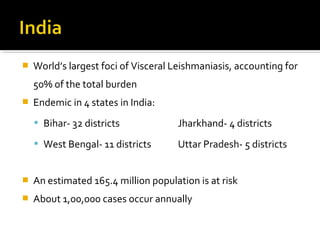
 World’s largest foci of Visceral Leishmaniasis, accounting for
50% of the total burden
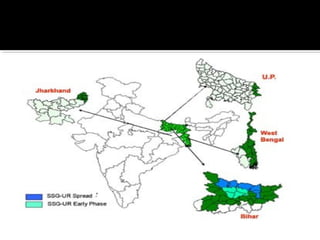
 Endemic in 4 states in India:
 Bihar- 32 districts Jharkhand- 4 districts
 West Bengal- 11 districts Uttar Pradesh- 5 districts
 An estimated 165.4 million population is at risk
 About 1,00,000 cases occur annually

 19 protozoan species
 Genus Leishmania
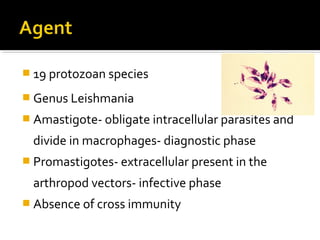
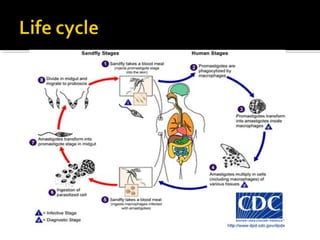
 Amastigote- obligate intracellular parasites and
divide in macrophages- diagnostic phase
 Promastigotes- extracellular present in the
arthropod vectors- infective phase
 Absence of cross immunity
 Leishmania donovani complex
 Leishmania donovani, L. infantum and L. chagasi
 Leishmania mexicana complex
 L. mexicana, L. amazonensis and L. venezuelensis
 Leishmania tropica
 Leishmania major
 Leishmania aethiopica
 In India: Leishmania donovani
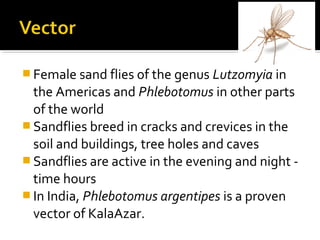
 Female sand flies of the genus Lutzomyia in
the Americas and Phlebotomus in other parts
of the world
 Sandflies breed in cracks and crevices in the
soil and buildings, tree holes and caves
 Sandflies are active in the evening and night -
time hours
 In India, Phlebotomus argentipes is a proven
vector of KalaAzar.
 Cutaneous form mainly zoonotic,
- humans are accidentally exposed
 Indian Kala - Azar is anthroponotic with humans
being the only known reservoir of infection
 Peak age of infection is 5 to 9 years
 Males
 Poor socio-economic background
 Common in various farming practices, forestry,
mining and fishing
 Mostly confined to the plains
 Overcrowding,
 Poor ventilation
 High relative humidity, warm temperature
 Accumulation of organic matter in the
environment facilitates transmission
 Transmitted by the bite of infected female
sandflies
 Rarely: initiated by amastigotes via blood
(shared needles, transfusion, transplacental
spread) or organ transplantation
 Incubation period:
 Extremely variable (10 days - 3 to 8 months – 2
yrs)
 Varied presentation:
 Ulcerative skin lesions
 Destructive mucosal inflammation
 Disseminated visceral infection
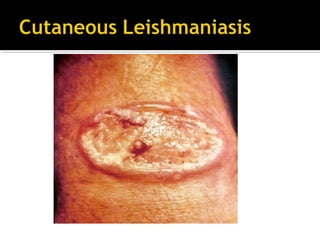
 Typical lesion :
 Develops at the site where promastigotes are
injected by the vector
 A papule - papule enlarges – ulcerates
 Multiple lesions may be present
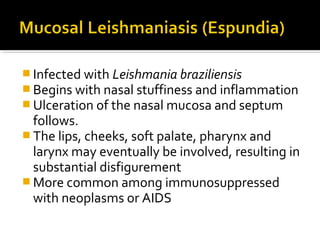
 Infected with Leishmania braziliensis
 Begins with nasal stuffiness and inflammation
 Ulceration of the nasal mucosa and septum
follows.
 The lips, cheeks, soft palate, pharynx and
larynx may eventually be involved, resulting in
substantial disfigurement
 More common among immunosuppressed
with neoplasms or AIDS
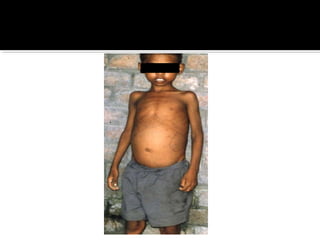
 Recurrent fever
 Loss of appetite, pallor and weight loss with
progressive emaciation
 Weakness
 Splenomegaly - spleen enlarges rapidly to massive
enlargement, usually soft and non-tender
 Liver - enlargement not to the extent of spleen, soft,
smooth surface, sharp edge
 Death often occurs due to a secondary bacterial
infection, such as
 Pneumonia, Septicemia,
 Dysentery, Tuberculosis,
 Measles Other viral infections
 Anaemia, Neutropenia, Thrombocytopenia and
pronounced hypergammaglobulinemia.
 The anaemia is usually normocytic, normochromic,
unless there is concomitant iron deficiency
 Leukopenia can be profound with white blood cell
counts below 1000/mL
 The globulin level can reach 9 or 10 g/dl.
 Some patients in India and Africa develop skin lesions
following treatment, ranging from hyperpigmented macules
to frank nodules
 Skin lesions typically appear 1 or 2 years after treatment and
may persist for as long as 20 years.
 Persistence of lesions beyond one year is associated with high
anti - leishmanial antibody titers and negative leishmanial skin
test responses
 Anti - leishmanial treatment is indicated in Indian PKDL
 Immunocompromised individuals progress to develop the
disease far more often than immunocompetent people
 It quickly accelerates the onset of AIDS and shortens the
life expectancy of HIV - infected people.
 Visceral Leishmaniasis is considered a major contributor
to a fatal outcome HIV in co - infected patients
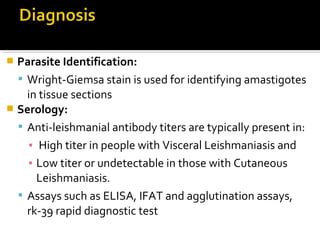
 Parasite Identification:
 Wright-Giemsa stain is used for identifying amastigotes
in tissue sections
 Serology:
 Anti-leishmanial antibody titers are typically present in:
▪ High titer in people with Visceral Leishmaniasis and
▪ Low titer or undetectable in those with Cutaneous
Leishmaniasis.
 Assays such as ELISA, IFAT and agglutination assays,
rk-39 rapid diagnostic test
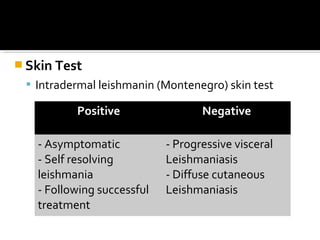
 Skin Test
 Intradermal leishmanin (Montenegro) skin test
Positive Negative
- Asymptomatic
- Self resolving
leishmania
- Following successful
treatment
- Progressive visceral
Leishmaniasis
- Diffuse cutaneous
Leishmaniasis
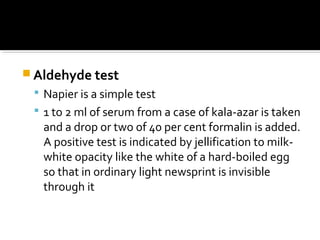
 Aldehyde test
 Napier is a simple test
 1 to 2 ml of serum from a case of kala-azar is taken
and a drop or two of 40 per cent formalin is added.
A positive test is indicated by jellification to milk-
white opacity like the white of a hard-boiled egg
so that in ordinary light newsprint is invisible
through it
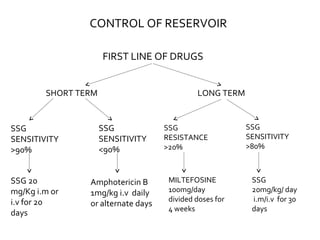
FIRST LINE OF DRUGS
SHORT TERM LONG TERM
SSG
SENSITIVITY
>90%
SSG
SENSITIVITY
<90%
SSG 20
mg/Kg i.m or
i.v for 20
days
Amphotericin B
1mg/kg i.v daily
or alternate days
SSG
RESISTANCE
>20%
SSG
SENSITIVITY
>80%
MILTEFOSINE
100mg/day
divided doses for
4 weeks
SSG
20mg/kg/ day
i.m/i.v for 30
days
CONTROL OF RESERVOIR
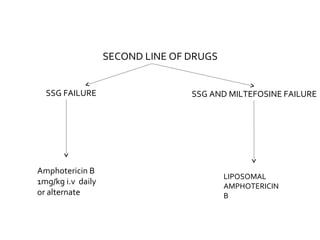
SECOND LINE OF DRUGS
SSG FAILURE SSG AND MILTEFOSINE FAILURE
Amphotericin B
1mg/kg i.v daily
or alternate
LIPOSOMAL
AMPHOTERICIN
B
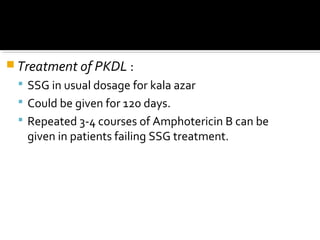
 Treatment of PKDL :
 SSG in usual dosage for kala azar
 Could be given for 120 days.
 Repeated 3-4 courses of Amphotericin B can be
given in patients failing SSG treatment.
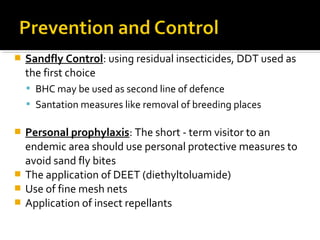
 Sandfly Control: using residual insecticides, DDT used as
the first choice
 BHC may be used as second line of defence
 Santation measures like removal of breeding places
 Personal prophylaxis: The short - term visitor to an
endemic area should use personal protective measures to
avoid sand fly bites
 The application of DEET (diethyltoluamide)
 Use of fine mesh nets
 Application of insect repellants
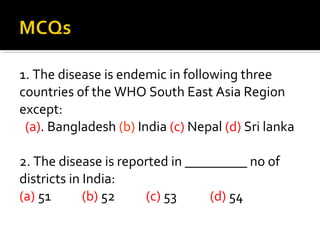
1. The disease is endemic in following three
countries of the WHO South East Asia Region
except:
(a). Bangladesh (b) India (c) Nepal (d) Sri lanka
2. The disease is reported in _________ no of
districts in India:
(a) 51 (b) 52 (c) 53 (d) 54
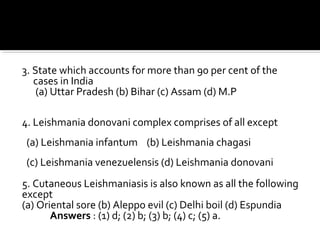
3. State which accounts for more than 90 per cent of the
cases in India
(a) Uttar Pradesh (b) Bihar (c) Assam (d) M.P
4. Leishmania donovani complex comprises of all except
(a) Leishmania infantum (b) Leishmania chagasi
(c) Leishmania venezuelensis (d) Leishmania donovani
5. Cutaneous Leishmaniasis is also known as all the following
except
(a) Oriental sore (b) Aleppo evil (c) Delhi boil (d) Espundia
Answers : (1) d; (2) b; (3) b; (4) c; (5) a.
Leishmaniasis

Leishmaniasis

  • 2.
     Varied collectionof protozoal diseases  Named after Leishman - First identified the organisms in 1901  Smears taken from a man who had died of “Dum Dum” fever  Annually - Two million cases worldwide  Has emerged as an AIDS - associated opportunistic infection
  • 3.
    1. Cutaneous 2. Diffusecutaneous 3. Mucocutaneous 4. Visceral Leishmaniasis (Kala Azar)
  • 4.
     Endemic in88 countries on five continents  Cutaneous Leishmaniasis cases occur in Iran, Afghanistan, Syria, Saudi Arabia, Brazil and Peru  Visceral Leishmaniasis cases occur in Bangladesh, Brazil, India and Sudan  World Health Organization estimates that 350 million people are at risk
  • 5.
     2.4 milliondisability - adjusted life years  Around 7,00,000 deaths per year  WHO South East Asia Region - 200 million people in the Region are “at risk”
  • 6.
     World’s largestfoci of Visceral Leishmaniasis, accounting for 50% of the total burden  Endemic in 4 states in India:  Bihar- 32 districts Jharkhand- 4 districts  West Bengal- 11 districts Uttar Pradesh- 5 districts  An estimated 165.4 million population is at risk  About 1,00,000 cases occur annually
  • 7.
  • 8.
     19 protozoanspecies  Genus Leishmania  Amastigote- obligate intracellular parasites and divide in macrophages- diagnostic phase  Promastigotes- extracellular present in the arthropod vectors- infective phase  Absence of cross immunity
  • 9.
     Leishmania donovanicomplex  Leishmania donovani, L. infantum and L. chagasi  Leishmania mexicana complex  L. mexicana, L. amazonensis and L. venezuelensis  Leishmania tropica  Leishmania major  Leishmania aethiopica  In India: Leishmania donovani
  • 11.
     Female sandflies of the genus Lutzomyia in the Americas and Phlebotomus in other parts of the world  Sandflies breed in cracks and crevices in the soil and buildings, tree holes and caves  Sandflies are active in the evening and night - time hours  In India, Phlebotomus argentipes is a proven vector of KalaAzar.
  • 12.
     Cutaneous formmainly zoonotic, - humans are accidentally exposed  Indian Kala - Azar is anthroponotic with humans being the only known reservoir of infection  Peak age of infection is 5 to 9 years  Males  Poor socio-economic background  Common in various farming practices, forestry, mining and fishing
  • 13.
     Mostly confinedto the plains  Overcrowding,  Poor ventilation  High relative humidity, warm temperature  Accumulation of organic matter in the environment facilitates transmission
  • 14.
     Transmitted bythe bite of infected female sandflies  Rarely: initiated by amastigotes via blood (shared needles, transfusion, transplacental spread) or organ transplantation
  • 15.
     Incubation period: Extremely variable (10 days - 3 to 8 months – 2 yrs)  Varied presentation:  Ulcerative skin lesions  Destructive mucosal inflammation  Disseminated visceral infection
  • 16.
     Typical lesion:  Develops at the site where promastigotes are injected by the vector  A papule - papule enlarges – ulcerates  Multiple lesions may be present
  • 18.
     Infected withLeishmania braziliensis  Begins with nasal stuffiness and inflammation  Ulceration of the nasal mucosa and septum follows.  The lips, cheeks, soft palate, pharynx and larynx may eventually be involved, resulting in substantial disfigurement  More common among immunosuppressed with neoplasms or AIDS
  • 19.
     Recurrent fever Loss of appetite, pallor and weight loss with progressive emaciation  Weakness  Splenomegaly - spleen enlarges rapidly to massive enlargement, usually soft and non-tender  Liver - enlargement not to the extent of spleen, soft, smooth surface, sharp edge
  • 21.
     Death oftenoccurs due to a secondary bacterial infection, such as  Pneumonia, Septicemia,  Dysentery, Tuberculosis,  Measles Other viral infections
  • 22.
     Anaemia, Neutropenia,Thrombocytopenia and pronounced hypergammaglobulinemia.  The anaemia is usually normocytic, normochromic, unless there is concomitant iron deficiency  Leukopenia can be profound with white blood cell counts below 1000/mL  The globulin level can reach 9 or 10 g/dl.
  • 23.
     Some patientsin India and Africa develop skin lesions following treatment, ranging from hyperpigmented macules to frank nodules  Skin lesions typically appear 1 or 2 years after treatment and may persist for as long as 20 years.  Persistence of lesions beyond one year is associated with high anti - leishmanial antibody titers and negative leishmanial skin test responses  Anti - leishmanial treatment is indicated in Indian PKDL
  • 24.
     Immunocompromised individualsprogress to develop the disease far more often than immunocompetent people  It quickly accelerates the onset of AIDS and shortens the life expectancy of HIV - infected people.  Visceral Leishmaniasis is considered a major contributor to a fatal outcome HIV in co - infected patients
  • 25.
     Parasite Identification: Wright-Giemsa stain is used for identifying amastigotes in tissue sections  Serology:  Anti-leishmanial antibody titers are typically present in: ▪ High titer in people with Visceral Leishmaniasis and ▪ Low titer or undetectable in those with Cutaneous Leishmaniasis.  Assays such as ELISA, IFAT and agglutination assays, rk-39 rapid diagnostic test
  • 26.
     Skin Test Intradermal leishmanin (Montenegro) skin test Positive Negative - Asymptomatic - Self resolving leishmania - Following successful treatment - Progressive visceral Leishmaniasis - Diffuse cutaneous Leishmaniasis
  • 27.
     Aldehyde test Napier is a simple test  1 to 2 ml of serum from a case of kala-azar is taken and a drop or two of 40 per cent formalin is added. A positive test is indicated by jellification to milk- white opacity like the white of a hard-boiled egg so that in ordinary light newsprint is invisible through it
  • 28.
    FIRST LINE OFDRUGS SHORT TERM LONG TERM SSG SENSITIVITY >90% SSG SENSITIVITY <90% SSG 20 mg/Kg i.m or i.v for 20 days Amphotericin B 1mg/kg i.v daily or alternate days SSG RESISTANCE >20% SSG SENSITIVITY >80% MILTEFOSINE 100mg/day divided doses for 4 weeks SSG 20mg/kg/ day i.m/i.v for 30 days CONTROL OF RESERVOIR
  • 29.
    SECOND LINE OFDRUGS SSG FAILURE SSG AND MILTEFOSINE FAILURE Amphotericin B 1mg/kg i.v daily or alternate LIPOSOMAL AMPHOTERICIN B
  • 30.
     Treatment ofPKDL :  SSG in usual dosage for kala azar  Could be given for 120 days.  Repeated 3-4 courses of Amphotericin B can be given in patients failing SSG treatment.
  • 31.
     Sandfly Control:using residual insecticides, DDT used as the first choice  BHC may be used as second line of defence  Santation measures like removal of breeding places  Personal prophylaxis: The short - term visitor to an endemic area should use personal protective measures to avoid sand fly bites  The application of DEET (diethyltoluamide)  Use of fine mesh nets  Application of insect repellants
  • 32.
    1. The diseaseis endemic in following three countries of the WHO South East Asia Region except: (a). Bangladesh (b) India (c) Nepal (d) Sri lanka 2. The disease is reported in _________ no of districts in India: (a) 51 (b) 52 (c) 53 (d) 54
  • 33.
    3. State whichaccounts for more than 90 per cent of the cases in India (a) Uttar Pradesh (b) Bihar (c) Assam (d) M.P 4. Leishmania donovani complex comprises of all except (a) Leishmania infantum (b) Leishmania chagasi (c) Leishmania venezuelensis (d) Leishmania donovani 5. Cutaneous Leishmaniasis is also known as all the following except (a) Oriental sore (b) Aleppo evil (c) Delhi boil (d) Espundia Answers : (1) d; (2) b; (3) b; (4) c; (5) a.

Editor's Notes

  • #3 spontaneously healing skin ulcer to overwhelming visceral disease
  • #25 Similarly AIDS increases the risk of Visceral Leishmaniasis by 100 - 1000 times in endemic areas
  • #32 containing insect repellents to exposed skin and under pant and shirt cuffs, the use of fine – mesh screens or insect nets, and the application of insecticide (usually permethrin or other pyrethroids) to clothing and bed nets - decrease the risk of transmission