Particle Physics in a Nutshell
(or “the things we do at CERN”)
Raquel G´omez Ambrosio
Universit`a & INFN @Torino & CMS @CERN
Introduction at Maplesoft
June 13, 2016
Raquel Gomez Ambrosio Particle Physics in a Nutshell June 13, 2016 1 / 53
HiggsTools
HiggsTools is one of the many training networks from the Marie Sklodowska-Curie Actions.
13 European Universities
4 Research Institutes (DESY, MPI, PSI, CERN)
3 Private Partners (Maplesoft, Wolfram, Shell)



20 students & several senior physicists
Raquel Gomez Ambrosio Particle Physics in a Nutshell June 13, 2016 2 / 53
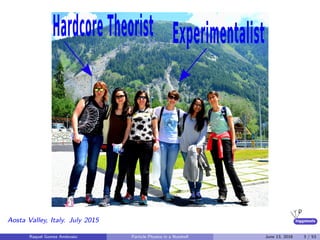
higgstoolsAosta Valley, Italy. July 2015
Raquel Gomez Ambrosio Particle Physics in a Nutshell June 13, 2016 3 / 53
higgstools
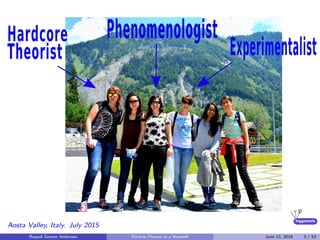
Aosta Valley, Italy. July 2015
Raquel Gomez Ambrosio Particle Physics in a Nutshell June 13, 2016 3 / 53
higgstools
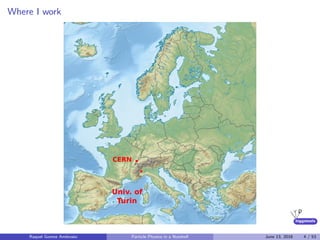
Where I work
Raquel Gomez Ambrosio Particle Physics in a Nutshell June 13, 2016 4 / 53
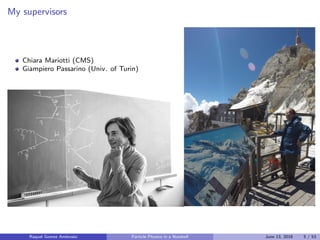
My supervisors
Chiara Mariotti (CMS)
Giampiero Passarino (Univ. of Turin)
Raquel Gomez Ambrosio Particle Physics in a Nutshell June 13, 2016 5 / 53
higgstools
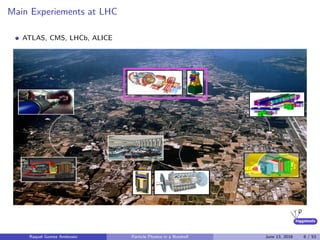
Main Experiements at LHC
ATLAS, CMS, LHCb, ALICE
Raquel Gomez Ambrosio Particle Physics in a Nutshell June 13, 2016 6 / 53
higgstools
Disclaimer
Summarized and incomplete history of the
Standard Model
Raquel Gomez Ambrosio Particle Physics in a Nutshell June 13, 2016 7 / 53
higgstools
Historical Introduction: The Greek
Until the XIX century, humans didn’t think too much about the constituents of matter, but rather
about their properties. Studying them through alchemy and chemistry.
In the IV century B.C. some greek thinkers (Δημόκριτος, Επίκουρος) proposed the idea of the
atom as the smallest component of matter.
But the idea was thrown down by ᾿Αριστοτέλης and his school, alleging that if matter would
be discrete instead of continuous, that would imply some kind of vacuum inside it, which is an
uncomfortable concept.
Philosophy and Physics have always been closely related.
Raquel Gomez Ambrosio Particle Physics in a Nutshell June 13, 2016 8 / 53
higgstools
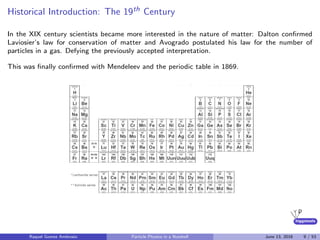
Historical Introduction: The 19th Century
In the XIX century scientists became more interested in the nature of matter: Dalton confirmed
Laviosier’s law for conservation of matter and Avogrado postulated his law for the number of
particles in a gas. Defying the previously accepted interpretation.
This was finally confirmed with Mendeleev and the periodic table in 1869.
Raquel Gomez Ambrosio Particle Physics in a Nutshell June 13, 2016 9 / 53
higgstools
The 20th century: The Golden Years for particle physics
By the beginning of the XX century everyone had their own atomic model: Thomson, Rutherford,
Bohr, Sommerfeld, Schr¨odinger, Dirac . . .
And the foundations of particle physics where established:
1897: Discovery of the electron (J.J. Thomson)
1911: Discovery of the proton (Rutherford)
1932: Discovery of the neutron (Chadwick)
Raquel Gomez Ambrosio Particle Physics in a Nutshell June 13, 2016 10 / 53
higgstools
The 20th Century: The Golden Years for particle physics
Things seemed to finally make sense, but that wouldn’t last long. In the following years, particle-
detecting techniques (and technologies) improved and dozens of new particles were found.
Raquel Gomez Ambrosio Particle Physics in a Nutshell June 13, 2016 11 / 53
higgstools
The 20th Century: The Golden Years for particle physics
Things seemed to finally make sense, but that wouldn’t last long. In the following years, particle-
detecting techniques (and technologies) improved and dozens of new particles were found.
Some had been predicted by the theorists: pions (π0, π+, π−), positron (e+), neutrinos (ν) . . .
Raquel Gomez Ambrosio Particle Physics in a Nutshell June 13, 2016 11 / 53
higgstools
The 20th Century: The Golden Years for particle physics
Things seemed to finally make sense, but that wouldn’t last long. In the following years, particle-
detecting techniques (and technologies) improved and dozens of new particles were found.
Some had been predicted by the theorists: pions (π0, π+, π−), positron (e+), neutrinos (ν) . . .
But other were completely gratuitous: µ, K0, K+, K−, Λ, Ξ−, Ξ0, Ω0 , . . .
The lightest of these particles were called leptons, the intermediate ones were called mesons, and
the heaviest were called baryons
Raquel Gomez Ambrosio Particle Physics in a Nutshell June 13, 2016 11 / 53
higgstools
Murray Gell-Mann: The Eightfold way
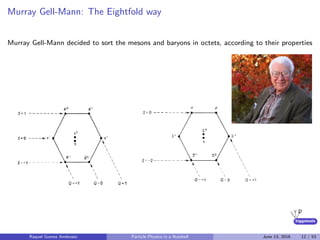
Murray Gell-Mann decided to sort the mesons and baryons in octets, according to their properties
Raquel Gomez Ambrosio Particle Physics in a Nutshell June 13, 2016 12 / 53
higgstools
Murray Gell-Mann: The Eightfold way
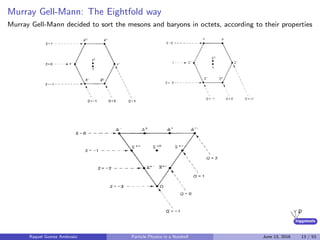
Murray Gell-Mann decided to sort the mesons and baryons in octets, according to their properties
Raquel Gomez Ambrosio Particle Physics in a Nutshell June 13, 2016 13 / 53
higgstools
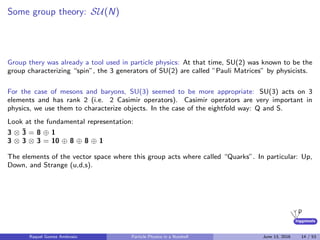
Some group theory: SU(N)
Group thery was already a tool used in particle physics: At that time, SU(2) was known to be the
group characterizing “spin”, the 3 generators of SU(2) are called ”Pauli Matrices” by physicists.
For the case of mesons and baryons, SU(3) seemed to be more appropriate: SU(3) acts on 3
elements and has rank 2 (i.e. 2 Casimir operators). Casimir operators are very important in
physics, we use them to characterize objects. In the case of the eightfold way: Q and S.
Look at the fundamental representation:
3 ⊗ ¯3 = 8 ⊕ 1
3 ⊗ 3 ⊗ 3 = 10 ⊕ 8 ⊕ 8 ⊕ 1
The elements of the vector space where this group acts where called “Quarks”. In particular: Up,
Down, and Strange (u,d,s).
Raquel Gomez Ambrosio Particle Physics in a Nutshell June 13, 2016 14 / 53
higgstools
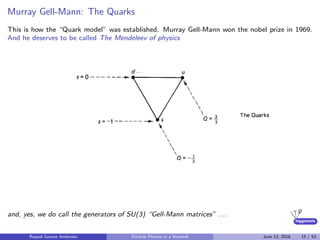
Murray Gell-Mann: The Quarks
This is how the “Quark model” was established. Murray Gell-Mann won the nobel prize in 1969.
And he deserves to be called The Mendeleev of physics
and, yes, we do call the generators of SU(3) “Gell-Mann matrices” . . .
Raquel Gomez Ambrosio Particle Physics in a Nutshell June 13, 2016 15 / 53
higgstools
J/Ψ
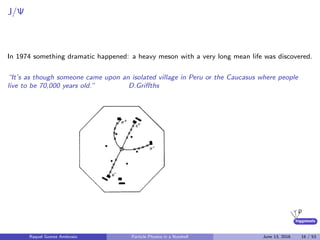
In 1974 something dramatic happened: a heavy meson with a very long mean life was discovered.
“It’s as though someone came upon an isolated village in Peru or the Caucasus where people
live to be 70,000 years old.” D.Griffths
Raquel Gomez Ambrosio Particle Physics in a Nutshell June 13, 2016 16 / 53
higgstools
J/Ψ
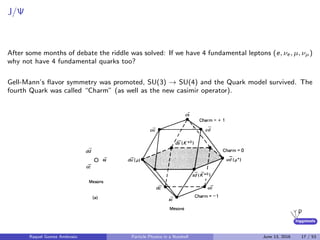
After some months of debate the riddle was solved: If we have 4 fundamental leptons (e, νe , µ, νµ)
why not have 4 fundamental quarks too?
Gell-Mann’s flavor symmetry was promoted, SU(3) → SU(4) and the Quark model survived. The
fourth Quark was called “Charm” (as well as the new casimir operator).
Raquel Gomez Ambrosio Particle Physics in a Nutshell June 13, 2016 17 / 53
higgstools
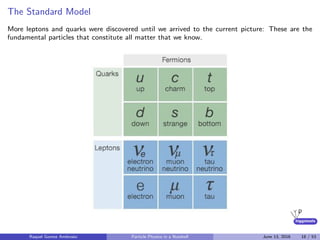
The Standard Model
More leptons and quarks were discovered until we arrived to the current picture: These are the
fundamental particles that constitute all matter that we know.
Raquel Gomez Ambrosio Particle Physics in a Nutshell June 13, 2016 18 / 53
higgstools
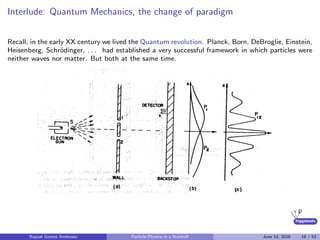
Interlude: Quantum Mechanics, the change of paradigm
Recall, in the early XX century we lived the Quantum revolution. Planck, Born, DeBroglie, Einstein,
Heisenberg, Schr¨odinger, . . . had established a very successful framework in which particles were
neither waves nor matter. But both at the same time.
Raquel Gomez Ambrosio Particle Physics in a Nutshell June 13, 2016 19 / 53
higgstools
Interlude: Quantum Mechanics, the change of paradigm
Quantum Coffee, Toronto
Raquel Gomez Ambrosio Particle Physics in a Nutshell June 13, 2016 20 / 53
higgstools
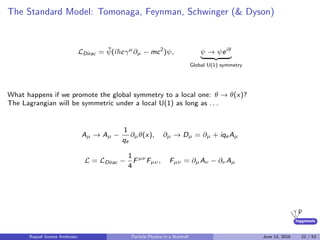
The Standard Model: Tomonaga, Feynman, Schwinger (& Dyson)
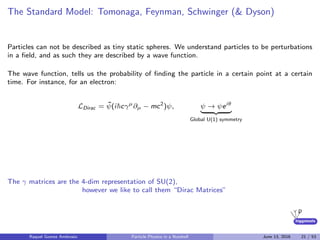
Particles can not be described as tiny static spheres. We understand particles to be perturbations
in a field, and as such they are described by a wave function.
The wave function, tells us the probability of finding the particle in a certain point at a certain
time. For instance, for an electron:
LDirac = ¯ψ(i cγµ
∂µ − mc2
)ψ, ψ → ψeiθ
Global U(1) symmetry
The γ matrices are the 4-dim representation of SU(2),
however we like to call them “Dirac Matrices”
Raquel Gomez Ambrosio Particle Physics in a Nutshell June 13, 2016 21 / 53
higgstools
The Standard Model: Tomonaga, Feynman, Schwinger (& Dyson)
LDirac = ¯ψ(i cγµ
∂µ − mc2
)ψ, ψ → ψeiθ
Global U(1) symmetry
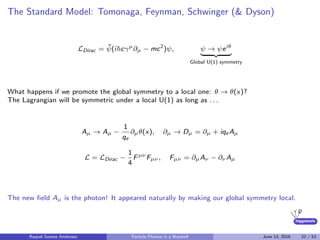
What happens if we promote the global symmetry to a local one: θ → θ(x)?
The Lagrangian will be symmetric under a local U(1) as long as . . .
Aµ → Aµ −
1
qe
∂µθ(x), ∂µ → Dµ = ∂µ + iqe Aµ
L = LDirac −
1
4
Fµν
Fµν , Fµν = ∂µAν − ∂ν Aµ
Raquel Gomez Ambrosio Particle Physics in a Nutshell June 13, 2016 22 / 53
higgstools
The Standard Model: Tomonaga, Feynman, Schwinger (& Dyson)
LDirac = ¯ψ(i cγµ
∂µ − mc2
)ψ, ψ → ψeiθ
Global U(1) symmetry
What happens if we promote the global symmetry to a local one: θ → θ(x)?
The Lagrangian will be symmetric under a local U(1) as long as . . .
Aµ → Aµ −
1
qe
∂µθ(x), ∂µ → Dµ = ∂µ + iqe Aµ
L = LDirac −
1
4
Fµν
Fµν , Fµν = ∂µAν − ∂ν Aµ
The new field Aµ is the photon! It appeared naturally by making our global symmetry local.
Raquel Gomez Ambrosio Particle Physics in a Nutshell June 13, 2016 22 / 53
higgstools
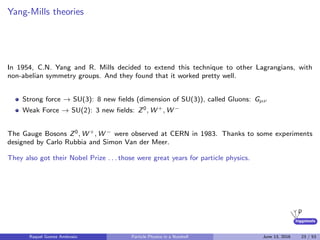
Yang-Mills theories
In 1954, C.N. Yang and R. Mills decided to extend this technique to other Lagrangians, with
non-abelian symmetry groups. And they found that it worked pretty well.
Strong force → SU(3): 8 new fields (dimension of SU(3)), called Gluons: Gµν
Weak Force → SU(2): 3 new fields: Z0, W +, W −
The Gauge Bosons Z0, W +, W − were observed at CERN in 1983. Thanks to some experiments
designed by Carlo Rubbia and Simon Van der Meer.
They also got their Nobel Prize . . . those were great years for particle physics.
Raquel Gomez Ambrosio Particle Physics in a Nutshell June 13, 2016 23 / 53
higgstools
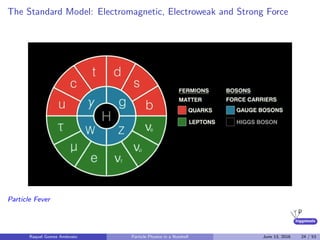
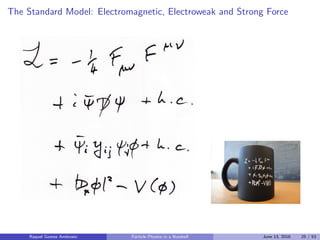
The Standard Model: Electromagnetic, Electroweak and Strong Force
Particle Fever
Raquel Gomez Ambrosio Particle Physics in a Nutshell June 13, 2016 24 / 53
The Standard Model: Electromagnetic, Electroweak and Strong Force
Raquel Gomez Ambrosio Particle Physics in a Nutshell June 13, 2016 25 / 53
higgstools
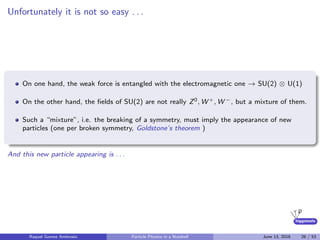
Unfortunately it is not so easy . . .
On one hand, the weak force is entangled with the electromagnetic one → SU(2) ⊗ U(1)
On the other hand, the fields of SU(2) are not really Z0, W +, W −, but a mixture of them.
Such a “mixture”, i.e. the breaking of a symmetry, must imply the appearance of new
particles (one per broken symmetry, Goldstone’s theorem )
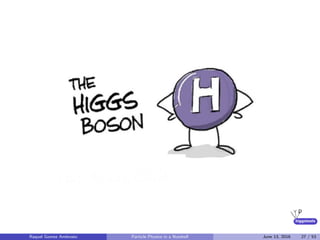
And this new particle appearing is . . .
Raquel Gomez Ambrosio Particle Physics in a Nutshell June 13, 2016 26 / 53
higgstools
Raquel Gomez Ambrosio Particle Physics in a Nutshell June 13, 2016 27 / 53
higgstools
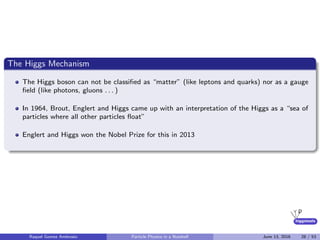
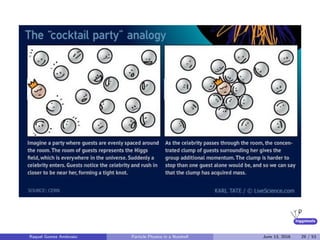
The Higgs Mechanism
The Higgs boson can not be classified as “matter” (like leptons and quarks) nor as a gauge
field (like photons, gluons . . . )
In 1964, Brout, Englert and Higgs came up with an interpretation of the Higgs as a “sea of
particles where all other particles float”
Englert and Higgs won the Nobel Prize for this in 2013
Raquel Gomez Ambrosio Particle Physics in a Nutshell June 13, 2016 28 / 53
higgstools
Raquel Gomez Ambrosio Particle Physics in a Nutshell June 13, 2016 29 / 53
higgstools
Long Story Short:
The Higgs boson messes up everything
Raquel Gomez Ambrosio Particle Physics in a Nutshell June 13, 2016 30 / 53
higgstools
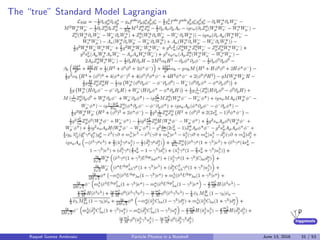
The “true” Standard Model Lagrangian
Raquel Gomez Ambrosio Particle Physics in a Nutshell June 13, 2016 31 / 53
higgstools
Higgs Boson searches
Finally, you are ready to hear about my work . . .
Raquel Gomez Ambrosio Particle Physics in a Nutshell June 13, 2016 32 / 53
higgstools
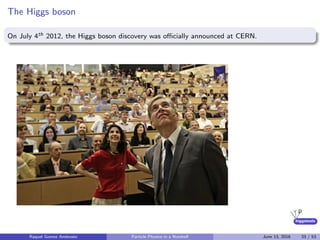
The Higgs boson
On July 4th 2012, the Higgs boson discovery was officially announced at CERN.
Raquel Gomez Ambrosio Particle Physics in a Nutshell June 13, 2016 33 / 53
higgstools
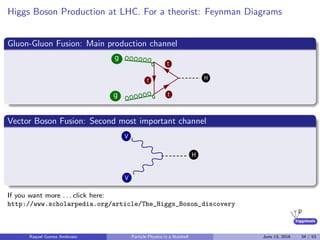
Higgs Boson Production at LHC. For a theorist: Feynman Diagrams
Gluon-Gluon Fusion: Main production channel
Vector Boson Fusion: Second most important channel
If you want more . . . click here:
http://www.scholarpedia.org/article/The_Higgs_Boson_discovery
Raquel Gomez Ambrosio Particle Physics in a Nutshell June 13, 2016 34 / 53
higgstools
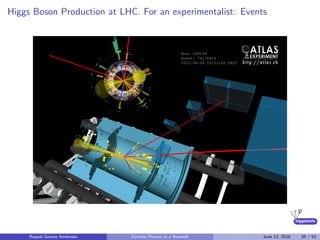
Higgs Boson Production at LHC. For an experimentalist: Events
Raquel Gomez Ambrosio Particle Physics in a Nutshell June 13, 2016 35 / 53
higgstools
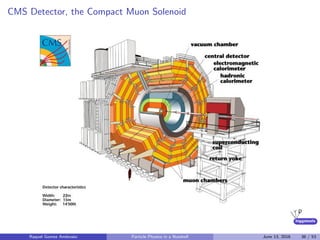
CMS Detector, the Compact Muon Solenoid
Raquel Gomez Ambrosio Particle Physics in a Nutshell June 13, 2016 36 / 53
higgstools
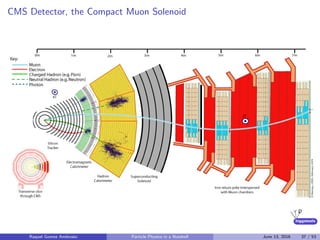
CMS Detector, the Compact Muon Solenoid
Raquel Gomez Ambrosio Particle Physics in a Nutshell June 13, 2016 37 / 53
higgstools
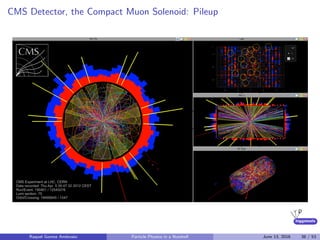
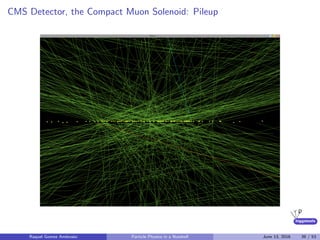
CMS Detector, the Compact Muon Solenoid: Pileup
Raquel Gomez Ambrosio Particle Physics in a Nutshell June 13, 2016 38 / 53
higgstools
CMS Detector, the Compact Muon Solenoid: Pileup
Raquel Gomez Ambrosio Particle Physics in a Nutshell June 13, 2016 39 / 53
higgstools
The interface between theorists and experimentalists: The analysis
A big part of our work is to find a common framework for
theorists and experimentalists to work together
Raquel Gomez Ambrosio Particle Physics in a Nutshell June 13, 2016 40 / 53
higgstools
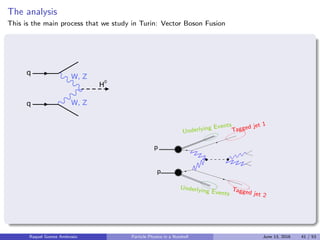
The analysis
This is the main process that we study in Turin: Vector Boson Fusion
p
p
Tagged jet 1
Tagged jet 2
Underlying Events
Underlying Events
Raquel Gomez Ambrosio Particle Physics in a Nutshell June 13, 2016 41 / 53
higgstools
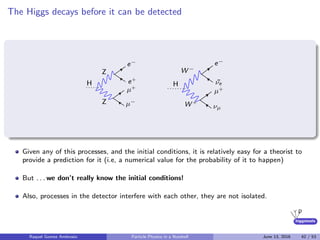
The Higgs decays before it can be detected
H
Z
Z
e−
e+
µ+
µ−
H
W −
W +
e−
¯νe
µ+
νµ
Given any of this processes, and the initial conditions, it is relatively easy for a theorist to
provide a prediction for it (i.e, a numerical value for the probability of it to happen)
But . . . we don’t really know the initial conditions!
Also, processes in the detector interfere with each other, they are not isolated.
Raquel Gomez Ambrosio Particle Physics in a Nutshell June 13, 2016 42 / 53
higgstools
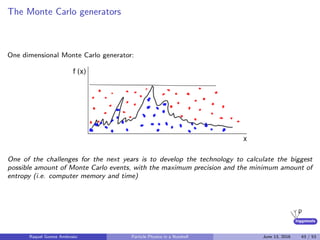
The Monte Carlo generators
One dimensional Monte Carlo generator:
One of the challenges for the next years is to develop the technology to calculate the biggest
possible amount of Monte Carlo events, with the maximum precision and the minimum amount of
entropy (i.e. computer memory and time)
Raquel Gomez Ambrosio Particle Physics in a Nutshell June 13, 2016 43 / 53
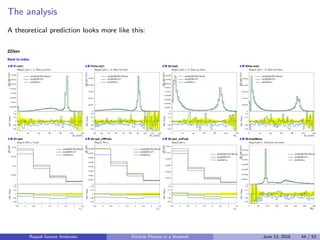
The analysis
A theoretical prediction looks more like this:
Raquel Gomez Ambrosio Particle Physics in a Nutshell June 13, 2016 44 / 53
higgstools
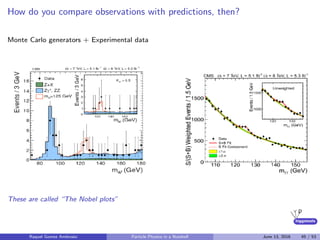
How do you compare observations with predictions, then?
Monte Carlo generators + Experimental data
These are called “The Nobel plots”
Raquel Gomez Ambrosio Particle Physics in a Nutshell June 13, 2016 45 / 53
higgstools
New physics?
Since this is a historical talk, I have to tell you about a
might-be historical event
Raquel Gomez Ambrosio Particle Physics in a Nutshell June 13, 2016 46 / 53
higgstools
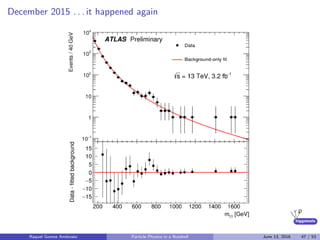
December 2015 . . . it happened again
Raquel Gomez Ambrosio Particle Physics in a Nutshell June 13, 2016 47 / 53
higgstools
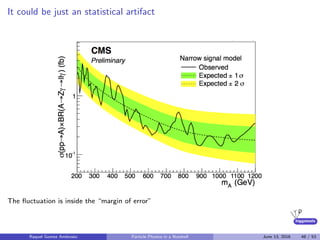
It could be just an statistical artifact
The fluctuation is inside the “margin of error”
Raquel Gomez Ambrosio Particle Physics in a Nutshell June 13, 2016 48 / 53
higgstools
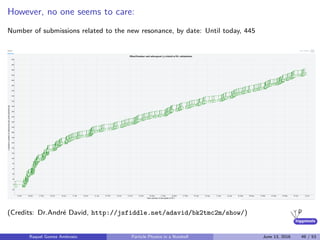
However, no one seems to care:
Number of submissions related to the new resonance, by date: Until today, 445
(Credits: Dr.Andr´e David, http://jsfiddle.net/adavid/bk2tmc2m/show/)
Raquel Gomez Ambrosio Particle Physics in a Nutshell June 13, 2016 49 / 53
higgstools
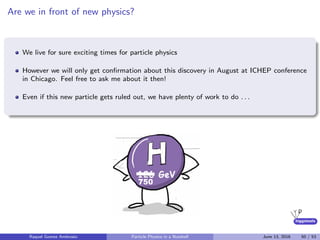
Are we in front of new physics?
We live for sure exciting times for particle physics
However we will only get confirmation about this discovery in August at ICHEP conference
in Chicago. Feel free to ask me about it then!
Even if this new particle gets ruled out, we have plenty of work to do . . .
Raquel Gomez Ambrosio Particle Physics in a Nutshell June 13, 2016 50 / 53
higgstools
Open questions in particle physics
Main question now is: How can we incorporate gravity to the SM
In principle it is possible to formulate gravity as a Yang-Mills theory, with symmetry group SO(3,1),
or “Lorenz group” for physicists.
SO(3,1) is isomorphic to SU(2)⊗SU(2) and would correspond to a gauge boson with Spin 2.
However, after doing this one encounters fundamental problems, mainly:
How to quantize this theory (i.e., make it compatible with quantum physics)
How to renormalize this theory (i.e., make it convergent at very high energies)
Is the 750 particle “the” Graviton?
Raquel Gomez Ambrosio Particle Physics in a Nutshell June 13, 2016 51 / 53
higgstools
Raquel Gomez Ambrosio Particle Physics in a Nutshell June 13, 2016 52 / 53
higgstools
Recommended reading:
“Introduction to Elementary Particles ”, D. Griffiths (very easy)
“Diagrammatica: The Path to Feynman Diagrams”, M. Veltman (advanced)
“Simple Introduction to Particle Physics” (mathematical)
( click here: http://arxiv.org/pdf/0810.3328v1.pdf)
Raquel Gomez Ambrosio Particle Physics in a Nutshell June 13, 2016 53 / 53

Particle Physics in a nutshell

  • 1.
    Particle Physics ina Nutshell (or “the things we do at CERN”) Raquel G´omez Ambrosio Universit`a & INFN @Torino & CMS @CERN Introduction at Maplesoft June 13, 2016 Raquel Gomez Ambrosio Particle Physics in a Nutshell June 13, 2016 1 / 53
  • 2.
    HiggsTools HiggsTools is oneof the many training networks from the Marie Sklodowska-Curie Actions. 13 European Universities 4 Research Institutes (DESY, MPI, PSI, CERN) 3 Private Partners (Maplesoft, Wolfram, Shell)    20 students & several senior physicists Raquel Gomez Ambrosio Particle Physics in a Nutshell June 13, 2016 2 / 53
  • 3.
    higgstoolsAosta Valley, Italy.July 2015 Raquel Gomez Ambrosio Particle Physics in a Nutshell June 13, 2016 3 / 53
  • 4.
    higgstools Aosta Valley, Italy.July 2015 Raquel Gomez Ambrosio Particle Physics in a Nutshell June 13, 2016 3 / 53
  • 5.
    higgstools Where I work RaquelGomez Ambrosio Particle Physics in a Nutshell June 13, 2016 4 / 53
  • 6.
    My supervisors Chiara Mariotti(CMS) Giampiero Passarino (Univ. of Turin) Raquel Gomez Ambrosio Particle Physics in a Nutshell June 13, 2016 5 / 53
  • 7.
    higgstools Main Experiements atLHC ATLAS, CMS, LHCb, ALICE Raquel Gomez Ambrosio Particle Physics in a Nutshell June 13, 2016 6 / 53
  • 8.
    higgstools Disclaimer Summarized and incompletehistory of the Standard Model Raquel Gomez Ambrosio Particle Physics in a Nutshell June 13, 2016 7 / 53
  • 9.
    higgstools Historical Introduction: TheGreek Until the XIX century, humans didn’t think too much about the constituents of matter, but rather about their properties. Studying them through alchemy and chemistry. In the IV century B.C. some greek thinkers (Δημόκριτος, Επίκουρος) proposed the idea of the atom as the smallest component of matter. But the idea was thrown down by ᾿Αριστοτέλης and his school, alleging that if matter would be discrete instead of continuous, that would imply some kind of vacuum inside it, which is an uncomfortable concept. Philosophy and Physics have always been closely related. Raquel Gomez Ambrosio Particle Physics in a Nutshell June 13, 2016 8 / 53
  • 10.
    higgstools Historical Introduction: The19th Century In the XIX century scientists became more interested in the nature of matter: Dalton confirmed Laviosier’s law for conservation of matter and Avogrado postulated his law for the number of particles in a gas. Defying the previously accepted interpretation. This was finally confirmed with Mendeleev and the periodic table in 1869. Raquel Gomez Ambrosio Particle Physics in a Nutshell June 13, 2016 9 / 53
  • 11.
    higgstools The 20th century:The Golden Years for particle physics By the beginning of the XX century everyone had their own atomic model: Thomson, Rutherford, Bohr, Sommerfeld, Schr¨odinger, Dirac . . . And the foundations of particle physics where established: 1897: Discovery of the electron (J.J. Thomson) 1911: Discovery of the proton (Rutherford) 1932: Discovery of the neutron (Chadwick) Raquel Gomez Ambrosio Particle Physics in a Nutshell June 13, 2016 10 / 53
  • 12.
    higgstools The 20th Century:The Golden Years for particle physics Things seemed to finally make sense, but that wouldn’t last long. In the following years, particle- detecting techniques (and technologies) improved and dozens of new particles were found. Raquel Gomez Ambrosio Particle Physics in a Nutshell June 13, 2016 11 / 53
  • 13.
    higgstools The 20th Century:The Golden Years for particle physics Things seemed to finally make sense, but that wouldn’t last long. In the following years, particle- detecting techniques (and technologies) improved and dozens of new particles were found. Some had been predicted by the theorists: pions (π0, π+, π−), positron (e+), neutrinos (ν) . . . Raquel Gomez Ambrosio Particle Physics in a Nutshell June 13, 2016 11 / 53
  • 14.
    higgstools The 20th Century:The Golden Years for particle physics Things seemed to finally make sense, but that wouldn’t last long. In the following years, particle- detecting techniques (and technologies) improved and dozens of new particles were found. Some had been predicted by the theorists: pions (π0, π+, π−), positron (e+), neutrinos (ν) . . . But other were completely gratuitous: µ, K0, K+, K−, Λ, Ξ−, Ξ0, Ω0 , . . . The lightest of these particles were called leptons, the intermediate ones were called mesons, and the heaviest were called baryons Raquel Gomez Ambrosio Particle Physics in a Nutshell June 13, 2016 11 / 53
  • 15.
    higgstools Murray Gell-Mann: TheEightfold way Murray Gell-Mann decided to sort the mesons and baryons in octets, according to their properties Raquel Gomez Ambrosio Particle Physics in a Nutshell June 13, 2016 12 / 53
  • 16.
    higgstools Murray Gell-Mann: TheEightfold way Murray Gell-Mann decided to sort the mesons and baryons in octets, according to their properties Raquel Gomez Ambrosio Particle Physics in a Nutshell June 13, 2016 13 / 53
  • 17.
    higgstools Some group theory:SU(N) Group thery was already a tool used in particle physics: At that time, SU(2) was known to be the group characterizing “spin”, the 3 generators of SU(2) are called ”Pauli Matrices” by physicists. For the case of mesons and baryons, SU(3) seemed to be more appropriate: SU(3) acts on 3 elements and has rank 2 (i.e. 2 Casimir operators). Casimir operators are very important in physics, we use them to characterize objects. In the case of the eightfold way: Q and S. Look at the fundamental representation: 3 ⊗ ¯3 = 8 ⊕ 1 3 ⊗ 3 ⊗ 3 = 10 ⊕ 8 ⊕ 8 ⊕ 1 The elements of the vector space where this group acts where called “Quarks”. In particular: Up, Down, and Strange (u,d,s). Raquel Gomez Ambrosio Particle Physics in a Nutshell June 13, 2016 14 / 53
  • 18.
    higgstools Murray Gell-Mann: TheQuarks This is how the “Quark model” was established. Murray Gell-Mann won the nobel prize in 1969. And he deserves to be called The Mendeleev of physics and, yes, we do call the generators of SU(3) “Gell-Mann matrices” . . . Raquel Gomez Ambrosio Particle Physics in a Nutshell June 13, 2016 15 / 53
  • 19.
    higgstools J/Ψ In 1974 somethingdramatic happened: a heavy meson with a very long mean life was discovered. “It’s as though someone came upon an isolated village in Peru or the Caucasus where people live to be 70,000 years old.” D.Griffths Raquel Gomez Ambrosio Particle Physics in a Nutshell June 13, 2016 16 / 53
  • 20.
    higgstools J/Ψ After some monthsof debate the riddle was solved: If we have 4 fundamental leptons (e, νe , µ, νµ) why not have 4 fundamental quarks too? Gell-Mann’s flavor symmetry was promoted, SU(3) → SU(4) and the Quark model survived. The fourth Quark was called “Charm” (as well as the new casimir operator). Raquel Gomez Ambrosio Particle Physics in a Nutshell June 13, 2016 17 / 53
  • 21.
    higgstools The Standard Model Moreleptons and quarks were discovered until we arrived to the current picture: These are the fundamental particles that constitute all matter that we know. Raquel Gomez Ambrosio Particle Physics in a Nutshell June 13, 2016 18 / 53
  • 22.
    higgstools Interlude: Quantum Mechanics,the change of paradigm Recall, in the early XX century we lived the Quantum revolution. Planck, Born, DeBroglie, Einstein, Heisenberg, Schr¨odinger, . . . had established a very successful framework in which particles were neither waves nor matter. But both at the same time. Raquel Gomez Ambrosio Particle Physics in a Nutshell June 13, 2016 19 / 53
  • 23.
    higgstools Interlude: Quantum Mechanics,the change of paradigm Quantum Coffee, Toronto Raquel Gomez Ambrosio Particle Physics in a Nutshell June 13, 2016 20 / 53
  • 24.
    higgstools The Standard Model:Tomonaga, Feynman, Schwinger (& Dyson) Particles can not be described as tiny static spheres. We understand particles to be perturbations in a field, and as such they are described by a wave function. The wave function, tells us the probability of finding the particle in a certain point at a certain time. For instance, for an electron: LDirac = ¯ψ(i cγµ ∂µ − mc2 )ψ, ψ → ψeiθ Global U(1) symmetry The γ matrices are the 4-dim representation of SU(2), however we like to call them “Dirac Matrices” Raquel Gomez Ambrosio Particle Physics in a Nutshell June 13, 2016 21 / 53
  • 25.
    higgstools The Standard Model:Tomonaga, Feynman, Schwinger (& Dyson) LDirac = ¯ψ(i cγµ ∂µ − mc2 )ψ, ψ → ψeiθ Global U(1) symmetry What happens if we promote the global symmetry to a local one: θ → θ(x)? The Lagrangian will be symmetric under a local U(1) as long as . . . Aµ → Aµ − 1 qe ∂µθ(x), ∂µ → Dµ = ∂µ + iqe Aµ L = LDirac − 1 4 Fµν Fµν , Fµν = ∂µAν − ∂ν Aµ Raquel Gomez Ambrosio Particle Physics in a Nutshell June 13, 2016 22 / 53
  • 26.
    higgstools The Standard Model:Tomonaga, Feynman, Schwinger (& Dyson) LDirac = ¯ψ(i cγµ ∂µ − mc2 )ψ, ψ → ψeiθ Global U(1) symmetry What happens if we promote the global symmetry to a local one: θ → θ(x)? The Lagrangian will be symmetric under a local U(1) as long as . . . Aµ → Aµ − 1 qe ∂µθ(x), ∂µ → Dµ = ∂µ + iqe Aµ L = LDirac − 1 4 Fµν Fµν , Fµν = ∂µAν − ∂ν Aµ The new field Aµ is the photon! It appeared naturally by making our global symmetry local. Raquel Gomez Ambrosio Particle Physics in a Nutshell June 13, 2016 22 / 53
  • 27.
    higgstools Yang-Mills theories In 1954,C.N. Yang and R. Mills decided to extend this technique to other Lagrangians, with non-abelian symmetry groups. And they found that it worked pretty well. Strong force → SU(3): 8 new fields (dimension of SU(3)), called Gluons: Gµν Weak Force → SU(2): 3 new fields: Z0, W +, W − The Gauge Bosons Z0, W +, W − were observed at CERN in 1983. Thanks to some experiments designed by Carlo Rubbia and Simon Van der Meer. They also got their Nobel Prize . . . those were great years for particle physics. Raquel Gomez Ambrosio Particle Physics in a Nutshell June 13, 2016 23 / 53
  • 28.
    higgstools The Standard Model:Electromagnetic, Electroweak and Strong Force Particle Fever Raquel Gomez Ambrosio Particle Physics in a Nutshell June 13, 2016 24 / 53
  • 29.
    The Standard Model:Electromagnetic, Electroweak and Strong Force Raquel Gomez Ambrosio Particle Physics in a Nutshell June 13, 2016 25 / 53
  • 30.
    higgstools Unfortunately it isnot so easy . . . On one hand, the weak force is entangled with the electromagnetic one → SU(2) ⊗ U(1) On the other hand, the fields of SU(2) are not really Z0, W +, W −, but a mixture of them. Such a “mixture”, i.e. the breaking of a symmetry, must imply the appearance of new particles (one per broken symmetry, Goldstone’s theorem ) And this new particle appearing is . . . Raquel Gomez Ambrosio Particle Physics in a Nutshell June 13, 2016 26 / 53
  • 31.
    higgstools Raquel Gomez AmbrosioParticle Physics in a Nutshell June 13, 2016 27 / 53
  • 32.
    higgstools The Higgs Mechanism TheHiggs boson can not be classified as “matter” (like leptons and quarks) nor as a gauge field (like photons, gluons . . . ) In 1964, Brout, Englert and Higgs came up with an interpretation of the Higgs as a “sea of particles where all other particles float” Englert and Higgs won the Nobel Prize for this in 2013 Raquel Gomez Ambrosio Particle Physics in a Nutshell June 13, 2016 28 / 53
  • 33.
    higgstools Raquel Gomez AmbrosioParticle Physics in a Nutshell June 13, 2016 29 / 53
  • 34.
    higgstools Long Story Short: TheHiggs boson messes up everything Raquel Gomez Ambrosio Particle Physics in a Nutshell June 13, 2016 30 / 53
  • 35.
    higgstools The “true” StandardModel Lagrangian Raquel Gomez Ambrosio Particle Physics in a Nutshell June 13, 2016 31 / 53
  • 36.
    higgstools Higgs Boson searches Finally,you are ready to hear about my work . . . Raquel Gomez Ambrosio Particle Physics in a Nutshell June 13, 2016 32 / 53
  • 37.
    higgstools The Higgs boson OnJuly 4th 2012, the Higgs boson discovery was officially announced at CERN. Raquel Gomez Ambrosio Particle Physics in a Nutshell June 13, 2016 33 / 53
  • 38.
    higgstools Higgs Boson Productionat LHC. For a theorist: Feynman Diagrams Gluon-Gluon Fusion: Main production channel Vector Boson Fusion: Second most important channel If you want more . . . click here: http://www.scholarpedia.org/article/The_Higgs_Boson_discovery Raquel Gomez Ambrosio Particle Physics in a Nutshell June 13, 2016 34 / 53
  • 39.
    higgstools Higgs Boson Productionat LHC. For an experimentalist: Events Raquel Gomez Ambrosio Particle Physics in a Nutshell June 13, 2016 35 / 53
  • 40.
    higgstools CMS Detector, theCompact Muon Solenoid Raquel Gomez Ambrosio Particle Physics in a Nutshell June 13, 2016 36 / 53
  • 41.
    higgstools CMS Detector, theCompact Muon Solenoid Raquel Gomez Ambrosio Particle Physics in a Nutshell June 13, 2016 37 / 53
  • 42.
    higgstools CMS Detector, theCompact Muon Solenoid: Pileup Raquel Gomez Ambrosio Particle Physics in a Nutshell June 13, 2016 38 / 53
  • 43.
    higgstools CMS Detector, theCompact Muon Solenoid: Pileup Raquel Gomez Ambrosio Particle Physics in a Nutshell June 13, 2016 39 / 53
  • 44.
    higgstools The interface betweentheorists and experimentalists: The analysis A big part of our work is to find a common framework for theorists and experimentalists to work together Raquel Gomez Ambrosio Particle Physics in a Nutshell June 13, 2016 40 / 53
  • 45.
    higgstools The analysis This isthe main process that we study in Turin: Vector Boson Fusion p p Tagged jet 1 Tagged jet 2 Underlying Events Underlying Events Raquel Gomez Ambrosio Particle Physics in a Nutshell June 13, 2016 41 / 53
  • 46.
    higgstools The Higgs decaysbefore it can be detected H Z Z e− e+ µ+ µ− H W − W + e− ¯νe µ+ νµ Given any of this processes, and the initial conditions, it is relatively easy for a theorist to provide a prediction for it (i.e, a numerical value for the probability of it to happen) But . . . we don’t really know the initial conditions! Also, processes in the detector interfere with each other, they are not isolated. Raquel Gomez Ambrosio Particle Physics in a Nutshell June 13, 2016 42 / 53
  • 47.
    higgstools The Monte Carlogenerators One dimensional Monte Carlo generator: One of the challenges for the next years is to develop the technology to calculate the biggest possible amount of Monte Carlo events, with the maximum precision and the minimum amount of entropy (i.e. computer memory and time) Raquel Gomez Ambrosio Particle Physics in a Nutshell June 13, 2016 43 / 53
  • 48.
    The analysis A theoreticalprediction looks more like this: Raquel Gomez Ambrosio Particle Physics in a Nutshell June 13, 2016 44 / 53
  • 49.
    higgstools How do youcompare observations with predictions, then? Monte Carlo generators + Experimental data These are called “The Nobel plots” Raquel Gomez Ambrosio Particle Physics in a Nutshell June 13, 2016 45 / 53
  • 50.
    higgstools New physics? Since thisis a historical talk, I have to tell you about a might-be historical event Raquel Gomez Ambrosio Particle Physics in a Nutshell June 13, 2016 46 / 53
  • 51.
    higgstools December 2015 .. . it happened again Raquel Gomez Ambrosio Particle Physics in a Nutshell June 13, 2016 47 / 53
  • 52.
    higgstools It could bejust an statistical artifact The fluctuation is inside the “margin of error” Raquel Gomez Ambrosio Particle Physics in a Nutshell June 13, 2016 48 / 53
  • 53.
    higgstools However, no oneseems to care: Number of submissions related to the new resonance, by date: Until today, 445 (Credits: Dr.Andr´e David, http://jsfiddle.net/adavid/bk2tmc2m/show/) Raquel Gomez Ambrosio Particle Physics in a Nutshell June 13, 2016 49 / 53
  • 54.
    higgstools Are we infront of new physics? We live for sure exciting times for particle physics However we will only get confirmation about this discovery in August at ICHEP conference in Chicago. Feel free to ask me about it then! Even if this new particle gets ruled out, we have plenty of work to do . . . Raquel Gomez Ambrosio Particle Physics in a Nutshell June 13, 2016 50 / 53
  • 55.
    higgstools Open questions inparticle physics Main question now is: How can we incorporate gravity to the SM In principle it is possible to formulate gravity as a Yang-Mills theory, with symmetry group SO(3,1), or “Lorenz group” for physicists. SO(3,1) is isomorphic to SU(2)⊗SU(2) and would correspond to a gauge boson with Spin 2. However, after doing this one encounters fundamental problems, mainly: How to quantize this theory (i.e., make it compatible with quantum physics) How to renormalize this theory (i.e., make it convergent at very high energies) Is the 750 particle “the” Graviton? Raquel Gomez Ambrosio Particle Physics in a Nutshell June 13, 2016 51 / 53
  • 56.
    higgstools Raquel Gomez AmbrosioParticle Physics in a Nutshell June 13, 2016 52 / 53
  • 57.
    higgstools Recommended reading: “Introduction toElementary Particles ”, D. Griffiths (very easy) “Diagrammatica: The Path to Feynman Diagrams”, M. Veltman (advanced) “Simple Introduction to Particle Physics” (mathematical) ( click here: http://arxiv.org/pdf/0810.3328v1.pdf) Raquel Gomez Ambrosio Particle Physics in a Nutshell June 13, 2016 53 / 53