FUNDAMENTAL FORCES IN
NATURE
Mrs.P.Kanmani, M.Sc.,M.Phil.,
Assistant Professor of Physics,
V.V.Vanniaperumal College for Women,
Virudhunagar.
What is a Force?
• A force is defined as a push or pull that
changes an object’s state of motion or causes
the object to deform.
• Newton defined a force as anything that
caused an object to accelerate F=ma where F
is force, m is mass and a is an acceleration.
Four fundamental forces in nature
• Gravitational force
• Electromagnetic force
• Weak nuclear force
• Strong nuclear force
Gravitational force
• Weakest force ,infinte range
• Gravity holds the moon,planets,sun,stars and
galaxies together in the universe in their
respective orbits.
• From 1687 to early 20th century Newton’s idea of
gravity as a “tug of war” between any two objects
dominated physics.
Gravitational Force
• Newton’s theory couldn’t explain the peculiar
orbit of mercury
• In 1915 Albert Einstein realized that Newton’s
laws of motion and gravity didn’t apply to
objects in high gravity or high speeds like that
of light.
• In general theory of relativity Einstein
envisioned gravity as a distortion of space
caused by mass.
Gravitational Force
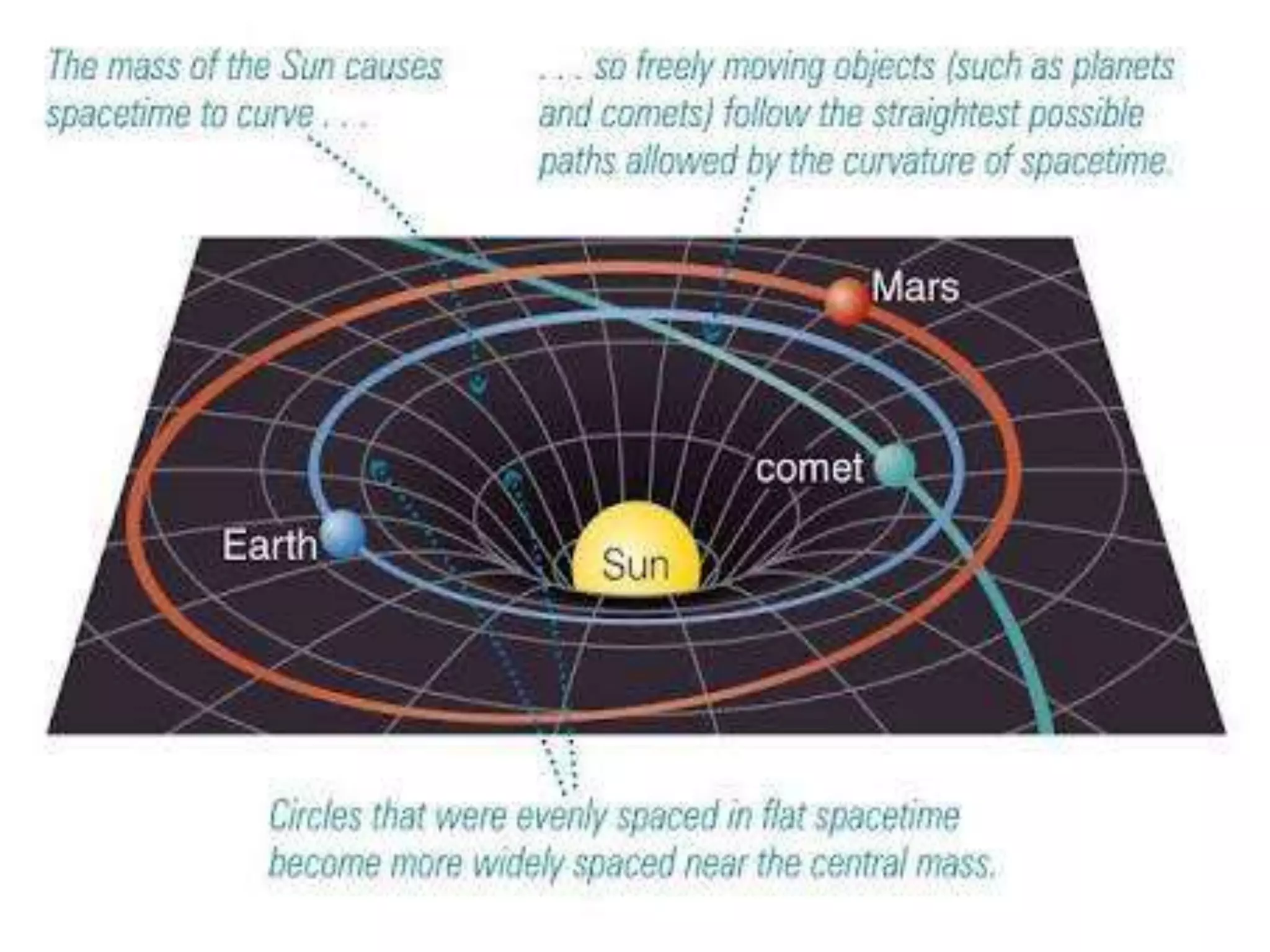
• To explain Einstein’s gravity theory let’s
imagine a ball in the middle of rubber sheet
(Space-Time Continum)
• The ball will create depression(a gravity well
or gravity field) in the sheet.
• If we roll a marble towards the ball the marble
will fall into the depression(be attracted to
ball)
Gravitational Force
• It may even circle the ball (orbit) before it hits.
• Depending upon the speed of the marble it
may even escape the depression and pass the
ball. But the depression might alter its path.
• Gravity fields around massive objects like the
sun do the same.
• Gravity appears to be most powerful force for
massive objects but it has little effect on sub
atomic level.
Electromagnetic force
• Basic theory, opposite charges attract while
like charges repel.
• Many Scientists contributed to the theory of
electromagnetism.
• Started from Coulomb, Oersted discovered
that electricity and magnetism were inter
related and proved that electric current
generates magnetic force.
Electromagnetic force
• In 1839 Faraday showed that magnetism could be
used to generate electricity.
• Finally Lorentz was able to calculate the force on
a charged particle in a electromagnetic field.
• Sub atomic particles exert electromagnetic forces
on each other.
• Further more electrons of one atom attract
protons of other atom to form a residual
electromagnetic force which prevents us from
falling through our chair.
Electromagnetic force
• But how does eletromagnetism work at an
infinte range in the large world and at an
subatomic level?
• Earlier it was believed that photons
transmitted electromagentic forces over long
distances and in later the field to Quantum
Electro Dynamics (QED) was developed to
explain it in sub atomic level.
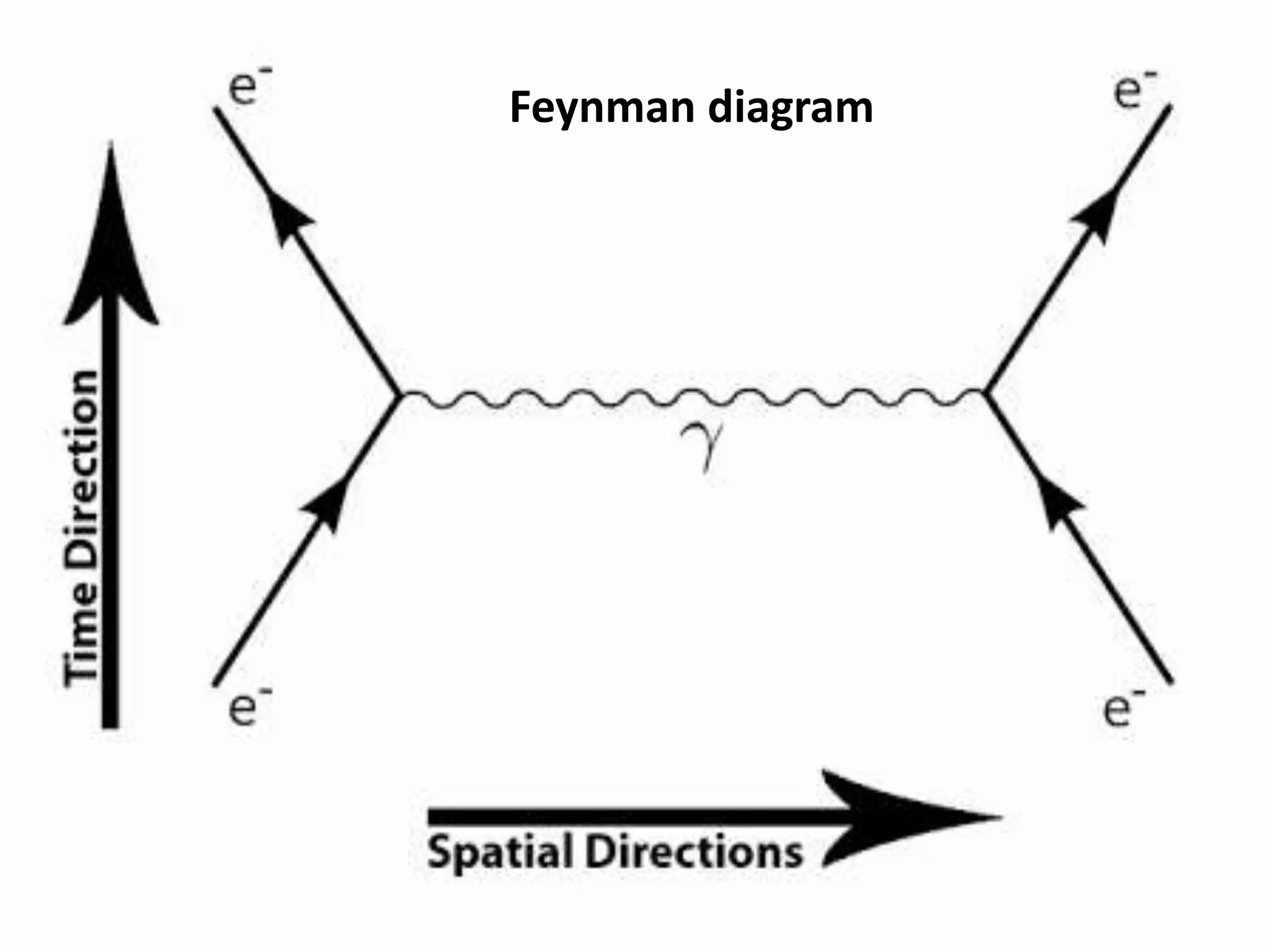
Feynman diagram
Electromagnetic force
• Subatomic particles continuously exchange
virtual photons during electro magnetic
interactions.
• But electromagnetic force couldn’t explain
how nucleus holds together.
• As per electromagnetic theory, all positively
charged protons must repel each other and
flew away. That’s where nuclear forces come
into play.
Nuclear forces (Weak and Strong)
• We could say that neither gravity nor the
electromagnetic force work inside the
nucleus.
• So some other force must exist inside the
nucleus much stronger than gravity and
electromagnetic force.
• Since we do not perceive it in our daily life like
other two it must be a short range force on
the scale of an atom.
Strong nuclear force
• The force that holds together the nucleus is
called strong nuclear force.
• In 1935 Yukawa modeled this force and
proposed that protons interacting with each
other and with neutrons exchange a particle
called meson to transmit strong nuclear force.
• In 1950’s with high particle accelerators
scientists were able to detect the Yukawa
predicted meson.
Strong nuclear force
• They also found that protons and neutrons are
made up of small particles called quarks.
• So the strong force held the quarks together
which in turn held the nucleus together.
• The other nuclear phenomena to be explained
is radio active decay.
Weak nuclear force
• The force which is responsible for radio active
decay is weaker than strong nuclear force but
much greater than the other two.
• With the discovery of quarks ,the weak force was
shown to be responsible for changing one type of
quark into another through the exchange of
particles called W and Z bosons in 1983.
• Ultimately this force is responsible for nuclear
fusion in sun and stars.
Grand Unified theory
• Physicists are currently pursuing the ideas that
these forces may be inter related and that
they sprang from one force in the Universe.
• Theories that relate the fundamental forces
and subatomic particles are called grand
unified theories.
• In 1963 Scientists suggested that weak nuclear
force and electromagnetic force may unite at
high energies ( 100 GeV).
Grand unified theory
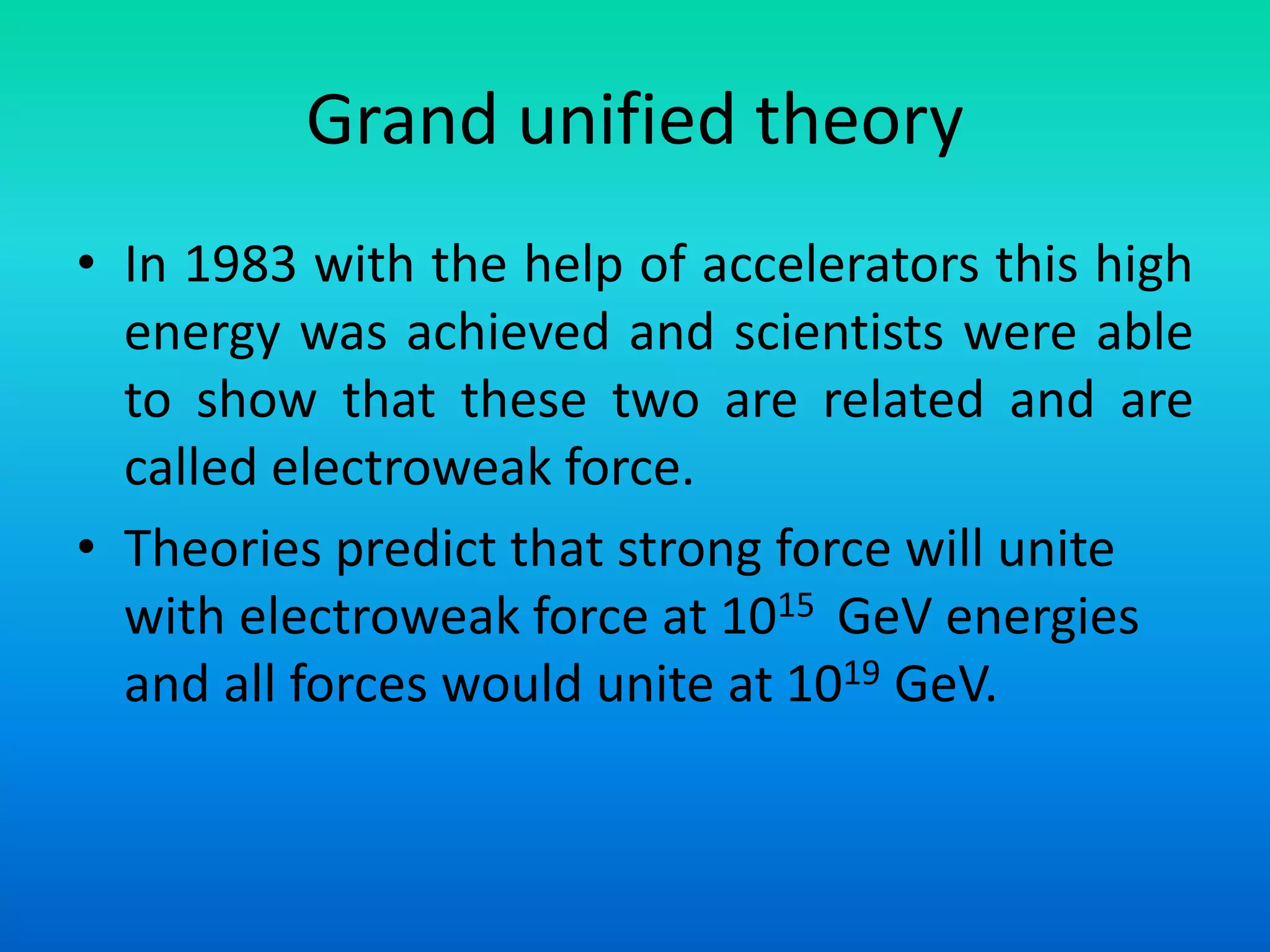
• In 1983 with the help of accelerators this high
energy was achieved and scientists were able
to show that these two are related and are
called electroweak force.
• Theories predict that strong force will unite
with electroweak force at 1015 GeV energies
and all forces would unite at 1019 GeV.

Fundamental forces in nature

  • 1.
    FUNDAMENTAL FORCES IN NATURE Mrs.P.Kanmani,M.Sc.,M.Phil., Assistant Professor of Physics, V.V.Vanniaperumal College for Women, Virudhunagar.
  • 2.
    What is aForce? • A force is defined as a push or pull that changes an object’s state of motion or causes the object to deform. • Newton defined a force as anything that caused an object to accelerate F=ma where F is force, m is mass and a is an acceleration.
  • 3.
    Four fundamental forcesin nature • Gravitational force • Electromagnetic force • Weak nuclear force • Strong nuclear force
  • 4.
    Gravitational force • Weakestforce ,infinte range • Gravity holds the moon,planets,sun,stars and galaxies together in the universe in their respective orbits. • From 1687 to early 20th century Newton’s idea of gravity as a “tug of war” between any two objects dominated physics.
  • 5.
    Gravitational Force • Newton’stheory couldn’t explain the peculiar orbit of mercury • In 1915 Albert Einstein realized that Newton’s laws of motion and gravity didn’t apply to objects in high gravity or high speeds like that of light. • In general theory of relativity Einstein envisioned gravity as a distortion of space caused by mass.
  • 6.
    Gravitational Force • Toexplain Einstein’s gravity theory let’s imagine a ball in the middle of rubber sheet (Space-Time Continum) • The ball will create depression(a gravity well or gravity field) in the sheet. • If we roll a marble towards the ball the marble will fall into the depression(be attracted to ball)
  • 8.
    Gravitational Force • Itmay even circle the ball (orbit) before it hits. • Depending upon the speed of the marble it may even escape the depression and pass the ball. But the depression might alter its path. • Gravity fields around massive objects like the sun do the same. • Gravity appears to be most powerful force for massive objects but it has little effect on sub atomic level.
  • 9.
    Electromagnetic force • Basictheory, opposite charges attract while like charges repel. • Many Scientists contributed to the theory of electromagnetism. • Started from Coulomb, Oersted discovered that electricity and magnetism were inter related and proved that electric current generates magnetic force.
  • 10.
    Electromagnetic force • In1839 Faraday showed that magnetism could be used to generate electricity. • Finally Lorentz was able to calculate the force on a charged particle in a electromagnetic field. • Sub atomic particles exert electromagnetic forces on each other. • Further more electrons of one atom attract protons of other atom to form a residual electromagnetic force which prevents us from falling through our chair.
  • 11.
    Electromagnetic force • Buthow does eletromagnetism work at an infinte range in the large world and at an subatomic level? • Earlier it was believed that photons transmitted electromagentic forces over long distances and in later the field to Quantum Electro Dynamics (QED) was developed to explain it in sub atomic level.
  • 12.
  • 13.
    Electromagnetic force • Subatomicparticles continuously exchange virtual photons during electro magnetic interactions. • But electromagnetic force couldn’t explain how nucleus holds together. • As per electromagnetic theory, all positively charged protons must repel each other and flew away. That’s where nuclear forces come into play.
  • 14.
    Nuclear forces (Weakand Strong) • We could say that neither gravity nor the electromagnetic force work inside the nucleus. • So some other force must exist inside the nucleus much stronger than gravity and electromagnetic force. • Since we do not perceive it in our daily life like other two it must be a short range force on the scale of an atom.
  • 15.
    Strong nuclear force •The force that holds together the nucleus is called strong nuclear force. • In 1935 Yukawa modeled this force and proposed that protons interacting with each other and with neutrons exchange a particle called meson to transmit strong nuclear force. • In 1950’s with high particle accelerators scientists were able to detect the Yukawa predicted meson.
  • 16.
    Strong nuclear force •They also found that protons and neutrons are made up of small particles called quarks. • So the strong force held the quarks together which in turn held the nucleus together. • The other nuclear phenomena to be explained is radio active decay.
  • 17.
    Weak nuclear force •The force which is responsible for radio active decay is weaker than strong nuclear force but much greater than the other two. • With the discovery of quarks ,the weak force was shown to be responsible for changing one type of quark into another through the exchange of particles called W and Z bosons in 1983. • Ultimately this force is responsible for nuclear fusion in sun and stars.
  • 18.
    Grand Unified theory •Physicists are currently pursuing the ideas that these forces may be inter related and that they sprang from one force in the Universe. • Theories that relate the fundamental forces and subatomic particles are called grand unified theories. • In 1963 Scientists suggested that weak nuclear force and electromagnetic force may unite at high energies ( 100 GeV).
  • 19.
    Grand unified theory •In 1983 with the help of accelerators this high energy was achieved and scientists were able to show that these two are related and are called electroweak force. • Theories predict that strong force will unite with electroweak force at 1015 GeV energies and all forces would unite at 1019 GeV.