CHAPTER 1
The Birth of Modern Physics
Napatsakon Sarapat
School of Physics, Science and Technology, TRU
SC 4101307 Modern Physics, TRU
CHAPTER 1 :
The Birth of Modern Physics
1.1 Classical Physics of the 1890s
1.2 The Kinetic Theory of Gases
1.3 Waves and Particles
1.4 Conservation Laws and Fundamental Forces
1.5 The Atomic Theory of Matter
1.6 Outstanding Problems of 1895 and New Horizons
SC 4101307 Modern Physics, TRU
Albert A. Michelson, 1894
The more important fundamental laws and facts
of physical science have all been discovered, and
these are now so firmly established that the
possibility of their ever being supplanted in
consequence of new discoveries is exceedingly
remote…Our future discoveries must be looked
for in the sixth place of decimals
1.1 : Classical Physics of the 1890s
SC 4101307 Modern Physics, TRU
Mechanics
Electromagnetism
Thermodynamics
Mechanics
Electromagnetism
Thermodynamics
CLASSICAL PHYSICS
“ CONSERVATION LAWS ”
SC 4101307 Modern Physics, TRU
Triumph of Classical Physics:
The Conservation Laws
• Conservation of energy : The total sum of
energy (in all its forms) is conserved in all
interactions.
• Conservation of linear momentum : In the
absence of external forces, linear momentum is
conserved in all interactions.
• Conservation of angular momentum : In
the absence of external torque, angular momentum
is conserved in all interactions.
• Conservation of charge : Electric charge is
conserved in all interactions.
SC 4101307 Modern Physics, TRU
𝐸𝑖 = 𝐸𝑓
𝐸 𝑃 = 𝑚𝑔ℎ
𝐸 𝑘 = 1
2
𝑚𝑣2
Conservation of energy :
∆𝐸 = 0 or 𝐸𝑖𝑛𝑖𝑡𝑖𝑎𝑙 = 𝐸𝑓𝑖𝑛𝑎𝑙
Kinetic Energy
Potential Energy
𝐸 𝑃 𝐸 𝑘
𝐸 𝑃 𝐸 𝑘
𝐸 𝑃 𝐸 𝑘
Reference level
𝐸 𝑃 𝐸 𝑘
𝐸 𝑃 𝐸 𝑘
1
2
3
4
5
1
SC 4101307 Modern Physics, TRU
𝑃𝑖𝑛𝑖𝑡𝑖𝑎𝑙 = 𝑃𝑓𝑖𝑛𝑎𝑙
Conservation of linear momentum : 𝑃𝑖𝑛𝑖𝑡𝑖𝑎𝑙 =
𝑃𝑓𝑖𝑛𝑎𝑙
m
M
V v
M
m
𝑃𝑖𝑛𝑖𝑡𝑖𝑎𝑙 = (𝑀 + 𝑚) ∙ 𝑣 𝑖 𝑃𝑓𝑖𝑛𝑎𝑙 = 𝑚 ∙ 𝑣 − 𝑀 ∙ 𝑉
2
SC 4101307 Modern Physics, TRU
Initial Final
𝐿𝑖𝑛𝑖𝑡𝑖𝑎𝑙 = 𝐿 𝑓𝑖𝑛𝑎𝑙
𝜔𝑖 < 𝜔 𝑓
𝐼𝑖 > 𝐼𝑓
Conservation of angular momentum : 𝐿𝑖𝑛𝑖𝑡𝑖𝑎𝑙 =
𝐿 𝑓𝑖𝑛𝑎𝑙
𝐿𝑖 = 𝐼𝑖 × 𝜔𝑖 𝐿 𝑓 = 𝐼𝑓 × 𝜔 𝑓
𝜔𝑖
𝐼𝑖
𝜔 𝑓
𝐼𝑓
3
SC 4101307 Modern Physics, TRU
Initial Final
𝑄𝑖𝑛𝑖𝑡𝑖𝑎𝑙 = 𝑄 𝑓𝑖𝑛𝑎𝑙
𝑄 𝑓𝑖𝑛𝑎𝑙 = 𝑞
Conservation of charge : 𝑄𝑖𝑛𝑖𝑡𝑖𝑎𝑙 = 𝑄 𝑓𝑖𝑛𝑎𝑙
Initial
Final
𝑄𝑖𝑛𝑖𝑡𝑖𝑎𝑙 = 𝑞
4
SC 4101307 Modern Physics, TRU
• Galileo, was an Italian physicist, mathematician,
engineer, astronomer, and philosopher who played
a major role in the scientific revolution.
Mechanics
 Galileo (1564-1642)
o Great experimentalist
o Principle of inertia
o Established experimental foundations
SC 4101307 Modern Physics, TRU
Isaac Newton (1642-1727)
𝐹 = 0
Three laws describing the relationship
between mass and acceleration.
Newton’s first law (law of inertia) : An object in
motion with a constant velocity will continue
in motion unless acted upon by some net
external force.
1
𝐹 𝐴 𝐹 𝐵
SC 4101307 Modern Physics, TRU
Isaac Newton (1642-1727)
𝐹 = 𝑚 𝑎 or 𝐹 =
𝑑 𝑝
𝑑𝑡
Three laws describing the relationship
between mass and acceleration.
Newton’s second law : Introduces
force (F) as responsible for the
change in linear momentum (p):2
𝐹
𝑎
𝑚
SC 4101307 Modern Physics, TRU
Isaac Newton (1642-1727)
𝐹𝐴 = − 𝐹𝑅
Three laws describing the relationship
between mass and acceleration.
Newton’s third law (law of
action and reaction) : The
force exerted by body 1 on
body 2 is equal in
magnitude and opposite in
direction to the force that
body 2 exerts on body 1.
3 𝑔
𝑚 𝑔
𝑁
SC 4101307 Modern Physics, TRU
Contributions made by :
Electromagnetism
Charles-Augustin de Coulomb (1736-
1806)
Coulomb’s Law : 𝐹 = 𝑘
𝑞1 𝑞2
𝑟2
− 𝐹
𝑞1 𝑞2
𝐹
𝑟
− 𝐹
𝑞1 𝑞2
𝐹
𝑟
𝑘 = 8.99 × 10⁹ 𝑁 ∙ 𝑚2 𝐶2
SC 4101307 Modern Physics, TRU
• Coulomb's law, the definition of the electrostatic force of attraction
and repulsion, but also did important work on friction.
Hans Christian Ørsted (1777-1851)
Thomas Young (1773-1829)
𝐵
𝐵
SC 4101307 Modern Physics, TRU
• A compassneedlewitha wire, showingtheeffect Oersteddiscovered.
• Young made notable scientific
contributions to the fields of
vision, light, solid mechanics,
energy, physiology, language,
musical harmony, and
Egyptology.
• This experiment played a major role in the general acceptance of the wave
theory of light.
Ampère’s Law : 𝐹𝑚 = 2𝑘 𝐴
𝐼1 𝐼2
𝑟
André-Marie Ampère (1775-1836)
SC 4101307 Modern Physics, TRU
• Ampère's force law states that there is
an attractive or repulsiveforce
between two parallel wires carryingan
electric current.
𝑘 𝐴 = 𝜇0
4𝜋
, 𝜇0 = 4𝜋 × 10−7
𝑁/𝐴 2
• Michael Faraday main
discoveries include those of
electromagnetic induction,
diamagnetism and electrolysis.
Faraday’s Law : 𝜀 =
𝑑Φ 𝐵
𝑑𝑡
Michael Faraday (1791-1867)
Joseph Henry (1797-1878)
James Clerk Maxwell (1831-1879)
SC 4101307 Modern Physics, TRU
• Henry discovered the
electromagnetic phenomenon of
self-inductance.
The self-inductance L ( 𝐿 =
𝑑𝜙
𝑑𝑖
) of
an electrical circuit : v(𝑡) = 𝐿
𝑑𝑖
𝑑𝑡
• Maxwell's most notable
achievement was to formulate the
classical theory of
electromagnetic radiation,
bringing together for the first time
electricity, magnetism, and light as
manifestations of the same
phenomenon.
• Heinrich Rudolf Hertz (German) was a German physicist
who first conclusively proved the existence of
electromagnetic waves theorized by James Clerk Maxwell's
electromagnetictheory of light.
Heinrich Hertz (1857-1894)
SC 4101307 Modern Physics, TRU
Culminates in Maxwell’s Equations
𝚽 𝑬 = 𝑬 ∙ 𝒅𝑨 =
𝒒
𝜺 𝟎
1
SC 4101307 Modern Physics, TRU
Gauss’s law (ΦE : electric field) : Gauss’s law states
that the total electric flux through any closed surface (a surface
enclosing a definite volume) is proportional to the total (net)
electric charge inside the surface.
Culminates in Maxwell’s Equations
𝚽 𝑩 = 𝑩 ∙ 𝒅𝑨 = 𝟎
2
SC 4101307 Modern Physics, TRU
Gauss’s law (ΦB : magnetic field) : The total
magnetic flux through a closed surface is always zero.
Culminates in Maxwell’s Equations
𝑬 ∙ 𝒅 𝒍 = −
𝒅𝚽 𝑩
𝒅𝒕
3
SC 4101307 Modern Physics, TRU
Faraday’s law : The induced emf in a closed loop equals
the negative of the time rate of change of magnetic flux
through the loop.
Culminates in Maxwell’s Equations
𝑩 ∙ 𝒅 𝒍 = 𝝁 𝟎 𝜺 𝟎
𝒅𝚽 𝑬
𝒅𝒕
+ 𝝁 𝟎 𝑰
4
SC 4101307 Modern Physics, TRU
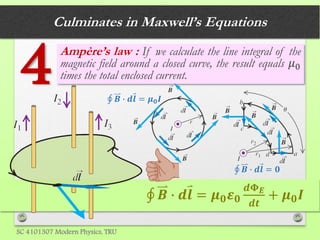
Ampère’s law : If we calculate the line integral of the
magnetic field around a closed curve, the result equals 𝜇0
times the total enclosed current.
𝑩 ∙ 𝒅 𝒍 = 𝟎
𝑩 ∙ 𝒅 𝒍 = 𝝁 𝟎 𝑰
Contributions made by :
Thermodynamics
Benjamin Thompson (1753-1814)
(Count Rumford)
• whose challenges to established
physical theory were part of
the 19th century revolution in
thermodynamics.
SC 4101307 Modern Physics, TRU
Nicolas Léonard Sadi Carnot (1796-1832)
James Prescott Joule (1818-1889)
SC 4101307 Modern Physics, TRU
• Carnot gave the first
successful theory of
the maximum
efficiency of heat
engines.
• Joule studied the nature of
heat, and discovered its
relationship to mechanical
work (see energy). This led to
the law of conservation of
energy, and this led to the
development of the first law of
thermodynamics.
Rudolf Clausius (1822-1888)
William Thomson, 1st Baron Kelvin (1824-1907)
SC 4101307 Modern Physics, TRU
• His most important paper, On the
Moving Force of Heat, published
in 1850, first stated the basic ideas
of the second law of
thermodynamics. In 1865 he
introduced the concept of entropy.
In 1870 he introduced the virial
theorem which applied to heat.
• At the University of Glasgow he did important
work in the mathematical analysis of
electricity and formulation of the first and
second laws of thermodynamics, and did
much to unify the emerging discipline of
physics in its modern form.
Primary Results
• Establishes the atomic theory of matter
• Introduces thermal equilibrium
𝑻 𝑨 > 𝑻 𝑩 𝑻 𝑨 = 𝑻 𝑩
• Establishes heat as energy
• Introduces the concept of internal energy
Primary Results
• Creates temperature as a measure of
internal energy
Primary Results
• Generates limitations of the energy
processes that cannot take place
The Laws of Thermodynamics
• First law : The change in the internal energy
ΔU of a system is equal to the heat Q added to
a system plus the work W done by the system
∆𝑼 = 𝑸 + 𝑾
• Second law : It is not possible to convert heat
completely into work without some other
change taking place.
• The “zeroth” law : Two systems in thermal
equilibrium with a third system are in thermal
equilibrium with each other.
• Third law : It is not possible to achieve an
absolute zero temperature
1.2 The Kinetic Theory of Gases
Contributions made by :
• Robert Boyle (1627-1691)
• Charles (1746-1823)
• Gay-Lussac (1778-1823)
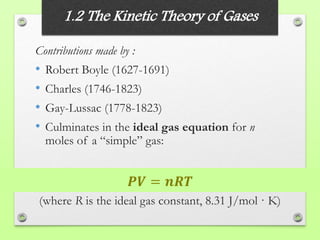
• Culminates in the ideal gas equation for n
moles of a “simple” gas:
(where R is the ideal gas constant, 8.31 J/mol · K)
𝑷𝑽 = 𝒏𝑹𝑻
Additional Contributions
• Amedeo Avogadro (1776-1856)
• Daniel Bernoulli (1700-1782)
• John Dalton (1766-1844)
• Ludwig Boltzmann (1844-1906)
• J. Willard Gibbs (1939-1903)
• James Clerk Maxwell (1831-1879)
Primary Results
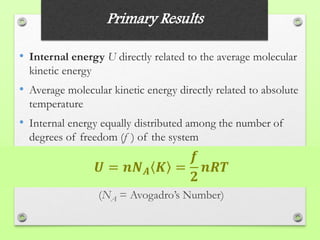
• Internal energy U directly related to the average molecular
kinetic energy
• Average molecular kinetic energy directly related to absolute
temperature
• Internal energy equally distributed among the number of
degrees of freedom (f ) of the system
(NA = Avogadro’s Number)
𝑼 = 𝒏𝑵 𝑨 𝑲 =
𝒇
𝟐
𝒏𝑹𝑻
1. The molar heat capacity (cV) is given by
𝒄 𝒗 =
𝒅𝒖
𝒅𝒕
=
𝒇
𝟐
𝑹
Primary Results
Other Primary Results
2. Maxwell derives a relation for the molecular speed
distribution f (v) :
3. Boltzmann contributes to determine the root-mean-square of
the molecular speed
Thus relating energy to the temperature for an ideal gas
𝑓(𝑣) = 4𝜋𝑁
𝑚
2𝜋𝑘𝑇
3 2
𝑣2 𝑒−𝑚𝑣2/2𝑘𝑇
𝑣𝑟𝑚𝑠 = 𝑣2 =
3𝑘𝑇
𝑚
1.3 : Waves and Particles
1) Point mass interaction : transfers of momentum and
kinetic energy : particles
Two ways in which energy is transported :
2) Extended regions wherein energy transfers by
way of vibrations and rotations are observed :
waves
1.3 : Waves and Particles
A
B
Two ways in which energy is transported :
Energy
Particle
Particles vs. Waves
• Two distinct phenomena describing physical interactions
• Both required Newtonian mass
• Particles in the form of point masses and waves in the form of
perturbation in a mass distribution, i.e., a material medium
• The distinctions are observationally quite clear; however, not so
for the case of visible light
• Thus by the 17th century begins the major disagreement
concerning the nature of light
The Nature of Light
Contributions made by :
• Isaac Newton (1642-1742)
• Christian Huygens (1629 -1695)
• Thomas Young (1773 -1829)
• Augustin Fresnel (1788 – 1829)
The Nature of Light
Isaac Newton (1642-1742)
Contributions made by :
The Nature of Light
• Newton promotes the
corpuscular (particle) theory
• Particles of light travel in straight
lines or rays
• Explained sharp shadows
• Explained reflection and
refraction
• Christian Huygens promotes the wave theory
• Light propagates as a wave of concentric circles
from the point of origin
• Explained reflection and refraction
• Did not explain sharp shadows
The Nature of Light
The Wave Theory Advances…
• Contributions by Huygens, Young, Fresnel and
Maxwell
• Double-slit interference patterns
• Refraction of light from a vacuum to a non-
medium
• Light was an electromagnetic phenomenon
• Establishes that light propagates as a wave
The Electromagnetic Spectrum
• Visible light covers only a small range of the total
electromagnetic spectrum
• All electromagnetic waves travel in a vacuum with a
speed c given by:
(where μ0 and ε0 are the respective permeability and
permittivity of “free” space)
𝒗 𝒓𝒎𝒔 =
𝟏
𝝁 𝟎 𝜺 𝟎
= 𝝀𝒇
1.4 : Conservation Laws and
Fundamental Forces
• Recall the fundamental conservation laws :
• Conservation of energy
• Conservation of linear momentum
• Conservation of angular momentum
• Conservation of electric charge
• Later we will establish the conservation of
mass as part of the conservation of
Modern Results
• In addition to the classical
conservation laws, two modern
results will include :
• The conservation of baryons and
leptons
• The fundamental invariance
principles for time reversal, distance,
and parity
Also in the Modern Context…
• The three fundamental forces are introduced :
• Gravitational : 𝑭 𝒈 = −𝑮
𝒎 𝟏 𝒎 𝟐
𝒓 𝟐 𝒓
• Electroweak
• Weak: Responsible for nuclear beta decay and effective
only over distances of ~10−15 m
• Electromagnetic: 𝐹 =
1
4𝜋𝜀0
𝑞1 𝑞2
𝑟2 𝑟 (Coulomb force)
• Strong: Responsible for “holding” the nucleus
together and effective less than ~10−15 m
Unification
• Unification of inertial mass mi and gravitational
mass mg
• mi = mg = m
• Where the same m responds to Newtonian force and
also induces the gravitational force
• This is more appropriately referred to as the
principle of equivalence in the theory of general
relativity
• Maxwell unified the electric and magnetic forces as
fundamentally the same force; now referred to as the
electromagnetic force
• In the 1970’s Glashow, Weinberg, and Salem proposed
the equivalence of the electromagnetic and the weak
forces (at high energy); now referred to as the
electroweak interaction
Unification of Forces
• Goal : Unification of All
Forces into a Single
Force
1.5 : The Atomic Theory of Matter
• Initiated by Democritus and Leucippus (~450 B.C.)
(first to us the Greek atomos, meaning “indivisible”)
• In addition to fundamental contributions by Boyle,
Charles, and Gay-Lussac, Proust (1754 – 1826) proposes
the law of definite proportions
• Dalton advances the atomic theory of matter to explain
the law of definite proportions
• Avogadro proposes that all gases at the same
temperature, pressure, and volume contain the same
number of molecules (atoms); viz. 6.02 × 10²³ atoms
• Cannizzaro (1826 – 1910) makes the distinction
between atoms and molecules advancing the ideas of
Avogadro
Further Advances in Atomic Theory
• Maxwell derives the speed distribution of atoms
in a gas
• Robert Brown (1753 – 1858) observes
microscopic “random” motion of suspended
grains of pollen in water
• Einstein in the 20th century explains this random
motion using atomic theory
Opposition to the Theory
• Ernst Mach (1838 – 1916) opposes the theory on the
basis of logical positivism, i.e., atoms being “unseen”
place into question their reality
• Wilhelm Ostwald (1853 – 1932) supports this premise
but on experimental results of radioactivity, discrete
spectral lines, and the formation of molecular structures
Overwhelming Evidence for Existence of Atoms
• Max Planck (1858 – 1947) advances the concept
to explain blackbody radiation by use of
submicroscopic “quanta”
• Boltzmann requires existence of atoms for his
advances in statistical mechanics
• Albert Einstein (1879 – 1955) uses molecules to
explain Brownian motion and determines the
approximate value of their size and mass
• Jean Perrin (1870 – 1942) experimentally verifies
Einstein’s predictions
1.6 : Unresolved Questions of 1895
and New Horizons
• The atomic theory controversy raises
fundamental questions
• It was not universally accepted
• The constitutes (if any) of atoms became a
significant question
• The structure of matter remained unknown with
certainty
Further Complications
Three fundamental problems :
• The question of the existence of an electromagnetic
medium
• The problem of observed differences in the electric
and magnetic field between stationary and moving
reference systems
• The failure of classical physics to explain blackbody
radiation.
Additional Discoveries Contribute to the
Complications
• Discovery of radioactivity
• Discovery of the electron
• Discovery of the Zeeman effect
The Beginnings of Modern Physics
• These new discoveries and the many resulting
complications required a revision of the fundamental
physical assumptions that culminated in the huge
successes of the classical foundations
• To this end the introduction of the modern theory of
relativity and quantum mechanics becomes the starting
point of this most fascinating revision

บทที่ 1 กำเนิดฟิสิกส์แผนใหม่

  • 1.
    CHAPTER 1 The Birthof Modern Physics Napatsakon Sarapat School of Physics, Science and Technology, TRU SC 4101307 Modern Physics, TRU
  • 2.
    CHAPTER 1 : TheBirth of Modern Physics 1.1 Classical Physics of the 1890s 1.2 The Kinetic Theory of Gases 1.3 Waves and Particles 1.4 Conservation Laws and Fundamental Forces 1.5 The Atomic Theory of Matter 1.6 Outstanding Problems of 1895 and New Horizons SC 4101307 Modern Physics, TRU
  • 3.
    SC 4101307 ModernPhysics, TRU Albert A. Michelson, 1894 The more important fundamental laws and facts of physical science have all been discovered, and these are now so firmly established that the possibility of their ever being supplanted in consequence of new discoveries is exceedingly remote…Our future discoveries must be looked for in the sixth place of decimals
  • 4.
    1.1 : ClassicalPhysics of the 1890s SC 4101307 Modern Physics, TRU Mechanics Electromagnetism Thermodynamics
  • 5.
  • 6.
    Triumph of ClassicalPhysics: The Conservation Laws • Conservation of energy : The total sum of energy (in all its forms) is conserved in all interactions. • Conservation of linear momentum : In the absence of external forces, linear momentum is conserved in all interactions. • Conservation of angular momentum : In the absence of external torque, angular momentum is conserved in all interactions. • Conservation of charge : Electric charge is conserved in all interactions. SC 4101307 Modern Physics, TRU
  • 7.
    𝐸𝑖 = 𝐸𝑓 𝐸𝑃 = 𝑚𝑔ℎ 𝐸 𝑘 = 1 2 𝑚𝑣2 Conservation of energy : ∆𝐸 = 0 or 𝐸𝑖𝑛𝑖𝑡𝑖𝑎𝑙 = 𝐸𝑓𝑖𝑛𝑎𝑙 Kinetic Energy Potential Energy 𝐸 𝑃 𝐸 𝑘 𝐸 𝑃 𝐸 𝑘 𝐸 𝑃 𝐸 𝑘 Reference level 𝐸 𝑃 𝐸 𝑘 𝐸 𝑃 𝐸 𝑘 1 2 3 4 5 1 SC 4101307 Modern Physics, TRU
  • 8.
    𝑃𝑖𝑛𝑖𝑡𝑖𝑎𝑙 = 𝑃𝑓𝑖𝑛𝑎𝑙 Conservationof linear momentum : 𝑃𝑖𝑛𝑖𝑡𝑖𝑎𝑙 = 𝑃𝑓𝑖𝑛𝑎𝑙 m M V v M m 𝑃𝑖𝑛𝑖𝑡𝑖𝑎𝑙 = (𝑀 + 𝑚) ∙ 𝑣 𝑖 𝑃𝑓𝑖𝑛𝑎𝑙 = 𝑚 ∙ 𝑣 − 𝑀 ∙ 𝑉 2 SC 4101307 Modern Physics, TRU Initial Final
  • 9.
    𝐿𝑖𝑛𝑖𝑡𝑖𝑎𝑙 = 𝐿𝑓𝑖𝑛𝑎𝑙 𝜔𝑖 < 𝜔 𝑓 𝐼𝑖 > 𝐼𝑓 Conservation of angular momentum : 𝐿𝑖𝑛𝑖𝑡𝑖𝑎𝑙 = 𝐿 𝑓𝑖𝑛𝑎𝑙 𝐿𝑖 = 𝐼𝑖 × 𝜔𝑖 𝐿 𝑓 = 𝐼𝑓 × 𝜔 𝑓 𝜔𝑖 𝐼𝑖 𝜔 𝑓 𝐼𝑓 3 SC 4101307 Modern Physics, TRU Initial Final
  • 10.
    𝑄𝑖𝑛𝑖𝑡𝑖𝑎𝑙 = 𝑄𝑓𝑖𝑛𝑎𝑙 𝑄 𝑓𝑖𝑛𝑎𝑙 = 𝑞 Conservation of charge : 𝑄𝑖𝑛𝑖𝑡𝑖𝑎𝑙 = 𝑄 𝑓𝑖𝑛𝑎𝑙 Initial Final 𝑄𝑖𝑛𝑖𝑡𝑖𝑎𝑙 = 𝑞 4 SC 4101307 Modern Physics, TRU
  • 11.
    • Galileo, wasan Italian physicist, mathematician, engineer, astronomer, and philosopher who played a major role in the scientific revolution. Mechanics  Galileo (1564-1642) o Great experimentalist o Principle of inertia o Established experimental foundations SC 4101307 Modern Physics, TRU
  • 12.
    Isaac Newton (1642-1727) 𝐹= 0 Three laws describing the relationship between mass and acceleration. Newton’s first law (law of inertia) : An object in motion with a constant velocity will continue in motion unless acted upon by some net external force. 1 𝐹 𝐴 𝐹 𝐵 SC 4101307 Modern Physics, TRU
  • 13.
    Isaac Newton (1642-1727) 𝐹= 𝑚 𝑎 or 𝐹 = 𝑑 𝑝 𝑑𝑡 Three laws describing the relationship between mass and acceleration. Newton’s second law : Introduces force (F) as responsible for the change in linear momentum (p):2 𝐹 𝑎 𝑚 SC 4101307 Modern Physics, TRU
  • 14.
    Isaac Newton (1642-1727) 𝐹𝐴= − 𝐹𝑅 Three laws describing the relationship between mass and acceleration. Newton’s third law (law of action and reaction) : The force exerted by body 1 on body 2 is equal in magnitude and opposite in direction to the force that body 2 exerts on body 1. 3 𝑔 𝑚 𝑔 𝑁 SC 4101307 Modern Physics, TRU
  • 15.
    Contributions made by: Electromagnetism Charles-Augustin de Coulomb (1736- 1806) Coulomb’s Law : 𝐹 = 𝑘 𝑞1 𝑞2 𝑟2 − 𝐹 𝑞1 𝑞2 𝐹 𝑟 − 𝐹 𝑞1 𝑞2 𝐹 𝑟 𝑘 = 8.99 × 10⁹ 𝑁 ∙ 𝑚2 𝐶2 SC 4101307 Modern Physics, TRU • Coulomb's law, the definition of the electrostatic force of attraction and repulsion, but also did important work on friction.
  • 16.
    Hans Christian Ørsted(1777-1851) Thomas Young (1773-1829) 𝐵 𝐵 SC 4101307 Modern Physics, TRU • A compassneedlewitha wire, showingtheeffect Oersteddiscovered. • Young made notable scientific contributions to the fields of vision, light, solid mechanics, energy, physiology, language, musical harmony, and Egyptology. • This experiment played a major role in the general acceptance of the wave theory of light.
  • 17.
    Ampère’s Law :𝐹𝑚 = 2𝑘 𝐴 𝐼1 𝐼2 𝑟 André-Marie Ampère (1775-1836) SC 4101307 Modern Physics, TRU • Ampère's force law states that there is an attractive or repulsiveforce between two parallel wires carryingan electric current. 𝑘 𝐴 = 𝜇0 4𝜋 , 𝜇0 = 4𝜋 × 10−7 𝑁/𝐴 2 • Michael Faraday main discoveries include those of electromagnetic induction, diamagnetism and electrolysis. Faraday’s Law : 𝜀 = 𝑑Φ 𝐵 𝑑𝑡 Michael Faraday (1791-1867)
  • 18.
    Joseph Henry (1797-1878) JamesClerk Maxwell (1831-1879) SC 4101307 Modern Physics, TRU • Henry discovered the electromagnetic phenomenon of self-inductance. The self-inductance L ( 𝐿 = 𝑑𝜙 𝑑𝑖 ) of an electrical circuit : v(𝑡) = 𝐿 𝑑𝑖 𝑑𝑡 • Maxwell's most notable achievement was to formulate the classical theory of electromagnetic radiation, bringing together for the first time electricity, magnetism, and light as manifestations of the same phenomenon.
  • 19.
    • Heinrich RudolfHertz (German) was a German physicist who first conclusively proved the existence of electromagnetic waves theorized by James Clerk Maxwell's electromagnetictheory of light. Heinrich Hertz (1857-1894) SC 4101307 Modern Physics, TRU
  • 20.
    Culminates in Maxwell’sEquations 𝚽 𝑬 = 𝑬 ∙ 𝒅𝑨 = 𝒒 𝜺 𝟎 1 SC 4101307 Modern Physics, TRU Gauss’s law (ΦE : electric field) : Gauss’s law states that the total electric flux through any closed surface (a surface enclosing a definite volume) is proportional to the total (net) electric charge inside the surface.
  • 21.
    Culminates in Maxwell’sEquations 𝚽 𝑩 = 𝑩 ∙ 𝒅𝑨 = 𝟎 2 SC 4101307 Modern Physics, TRU Gauss’s law (ΦB : magnetic field) : The total magnetic flux through a closed surface is always zero.
  • 22.
    Culminates in Maxwell’sEquations 𝑬 ∙ 𝒅 𝒍 = − 𝒅𝚽 𝑩 𝒅𝒕 3 SC 4101307 Modern Physics, TRU Faraday’s law : The induced emf in a closed loop equals the negative of the time rate of change of magnetic flux through the loop.
  • 23.
    Culminates in Maxwell’sEquations 𝑩 ∙ 𝒅 𝒍 = 𝝁 𝟎 𝜺 𝟎 𝒅𝚽 𝑬 𝒅𝒕 + 𝝁 𝟎 𝑰 4 SC 4101307 Modern Physics, TRU Ampère’s law : If we calculate the line integral of the magnetic field around a closed curve, the result equals 𝜇0 times the total enclosed current. 𝑩 ∙ 𝒅 𝒍 = 𝟎 𝑩 ∙ 𝒅 𝒍 = 𝝁 𝟎 𝑰
  • 24.
    Contributions made by: Thermodynamics Benjamin Thompson (1753-1814) (Count Rumford) • whose challenges to established physical theory were part of the 19th century revolution in thermodynamics. SC 4101307 Modern Physics, TRU
  • 25.
    Nicolas Léonard SadiCarnot (1796-1832) James Prescott Joule (1818-1889) SC 4101307 Modern Physics, TRU • Carnot gave the first successful theory of the maximum efficiency of heat engines. • Joule studied the nature of heat, and discovered its relationship to mechanical work (see energy). This led to the law of conservation of energy, and this led to the development of the first law of thermodynamics.
  • 26.
    Rudolf Clausius (1822-1888) WilliamThomson, 1st Baron Kelvin (1824-1907) SC 4101307 Modern Physics, TRU • His most important paper, On the Moving Force of Heat, published in 1850, first stated the basic ideas of the second law of thermodynamics. In 1865 he introduced the concept of entropy. In 1870 he introduced the virial theorem which applied to heat. • At the University of Glasgow he did important work in the mathematical analysis of electricity and formulation of the first and second laws of thermodynamics, and did much to unify the emerging discipline of physics in its modern form.
  • 27.
    Primary Results • Establishesthe atomic theory of matter • Introduces thermal equilibrium 𝑻 𝑨 > 𝑻 𝑩 𝑻 𝑨 = 𝑻 𝑩
  • 28.
    • Establishes heatas energy • Introduces the concept of internal energy Primary Results
  • 29.
    • Creates temperatureas a measure of internal energy Primary Results • Generates limitations of the energy processes that cannot take place
  • 30.
    The Laws ofThermodynamics • First law : The change in the internal energy ΔU of a system is equal to the heat Q added to a system plus the work W done by the system ∆𝑼 = 𝑸 + 𝑾 • Second law : It is not possible to convert heat completely into work without some other change taking place. • The “zeroth” law : Two systems in thermal equilibrium with a third system are in thermal equilibrium with each other. • Third law : It is not possible to achieve an absolute zero temperature
  • 31.
    1.2 The KineticTheory of Gases Contributions made by : • Robert Boyle (1627-1691) • Charles (1746-1823) • Gay-Lussac (1778-1823) • Culminates in the ideal gas equation for n moles of a “simple” gas: (where R is the ideal gas constant, 8.31 J/mol · K) 𝑷𝑽 = 𝒏𝑹𝑻
  • 32.
    Additional Contributions • AmedeoAvogadro (1776-1856) • Daniel Bernoulli (1700-1782) • John Dalton (1766-1844) • Ludwig Boltzmann (1844-1906) • J. Willard Gibbs (1939-1903) • James Clerk Maxwell (1831-1879)
  • 33.
    Primary Results • Internalenergy U directly related to the average molecular kinetic energy • Average molecular kinetic energy directly related to absolute temperature • Internal energy equally distributed among the number of degrees of freedom (f ) of the system (NA = Avogadro’s Number) 𝑼 = 𝒏𝑵 𝑨 𝑲 = 𝒇 𝟐 𝒏𝑹𝑻
  • 34.
    1. The molarheat capacity (cV) is given by 𝒄 𝒗 = 𝒅𝒖 𝒅𝒕 = 𝒇 𝟐 𝑹 Primary Results
  • 35.
    Other Primary Results 2.Maxwell derives a relation for the molecular speed distribution f (v) : 3. Boltzmann contributes to determine the root-mean-square of the molecular speed Thus relating energy to the temperature for an ideal gas 𝑓(𝑣) = 4𝜋𝑁 𝑚 2𝜋𝑘𝑇 3 2 𝑣2 𝑒−𝑚𝑣2/2𝑘𝑇 𝑣𝑟𝑚𝑠 = 𝑣2 = 3𝑘𝑇 𝑚
  • 36.
    1.3 : Wavesand Particles 1) Point mass interaction : transfers of momentum and kinetic energy : particles Two ways in which energy is transported :
  • 37.
    2) Extended regionswherein energy transfers by way of vibrations and rotations are observed : waves 1.3 : Waves and Particles A B Two ways in which energy is transported : Energy Particle
  • 38.
    Particles vs. Waves •Two distinct phenomena describing physical interactions • Both required Newtonian mass • Particles in the form of point masses and waves in the form of perturbation in a mass distribution, i.e., a material medium • The distinctions are observationally quite clear; however, not so for the case of visible light • Thus by the 17th century begins the major disagreement concerning the nature of light
  • 39.
    The Nature ofLight Contributions made by : • Isaac Newton (1642-1742) • Christian Huygens (1629 -1695) • Thomas Young (1773 -1829) • Augustin Fresnel (1788 – 1829)
  • 40.
    The Nature ofLight Isaac Newton (1642-1742) Contributions made by :
  • 41.
    The Nature ofLight • Newton promotes the corpuscular (particle) theory • Particles of light travel in straight lines or rays • Explained sharp shadows • Explained reflection and refraction
  • 42.
    • Christian Huygenspromotes the wave theory • Light propagates as a wave of concentric circles from the point of origin • Explained reflection and refraction • Did not explain sharp shadows The Nature of Light
  • 43.
    The Wave TheoryAdvances… • Contributions by Huygens, Young, Fresnel and Maxwell • Double-slit interference patterns • Refraction of light from a vacuum to a non- medium • Light was an electromagnetic phenomenon • Establishes that light propagates as a wave
  • 44.
    The Electromagnetic Spectrum •Visible light covers only a small range of the total electromagnetic spectrum • All electromagnetic waves travel in a vacuum with a speed c given by: (where μ0 and ε0 are the respective permeability and permittivity of “free” space) 𝒗 𝒓𝒎𝒔 = 𝟏 𝝁 𝟎 𝜺 𝟎 = 𝝀𝒇
  • 45.
    1.4 : ConservationLaws and Fundamental Forces • Recall the fundamental conservation laws : • Conservation of energy • Conservation of linear momentum • Conservation of angular momentum • Conservation of electric charge • Later we will establish the conservation of mass as part of the conservation of
  • 46.
    Modern Results • Inaddition to the classical conservation laws, two modern results will include : • The conservation of baryons and leptons • The fundamental invariance principles for time reversal, distance, and parity
  • 47.
    Also in theModern Context… • The three fundamental forces are introduced : • Gravitational : 𝑭 𝒈 = −𝑮 𝒎 𝟏 𝒎 𝟐 𝒓 𝟐 𝒓 • Electroweak • Weak: Responsible for nuclear beta decay and effective only over distances of ~10−15 m • Electromagnetic: 𝐹 = 1 4𝜋𝜀0 𝑞1 𝑞2 𝑟2 𝑟 (Coulomb force) • Strong: Responsible for “holding” the nucleus together and effective less than ~10−15 m
  • 48.
    Unification • Unification ofinertial mass mi and gravitational mass mg • mi = mg = m • Where the same m responds to Newtonian force and also induces the gravitational force • This is more appropriately referred to as the principle of equivalence in the theory of general relativity
  • 49.
    • Maxwell unifiedthe electric and magnetic forces as fundamentally the same force; now referred to as the electromagnetic force • In the 1970’s Glashow, Weinberg, and Salem proposed the equivalence of the electromagnetic and the weak forces (at high energy); now referred to as the electroweak interaction Unification of Forces
  • 50.
    • Goal :Unification of All Forces into a Single Force
  • 51.
    1.5 : TheAtomic Theory of Matter • Initiated by Democritus and Leucippus (~450 B.C.) (first to us the Greek atomos, meaning “indivisible”) • In addition to fundamental contributions by Boyle, Charles, and Gay-Lussac, Proust (1754 – 1826) proposes the law of definite proportions • Dalton advances the atomic theory of matter to explain the law of definite proportions • Avogadro proposes that all gases at the same temperature, pressure, and volume contain the same number of molecules (atoms); viz. 6.02 × 10²³ atoms • Cannizzaro (1826 – 1910) makes the distinction between atoms and molecules advancing the ideas of Avogadro
  • 52.
    Further Advances inAtomic Theory • Maxwell derives the speed distribution of atoms in a gas • Robert Brown (1753 – 1858) observes microscopic “random” motion of suspended grains of pollen in water • Einstein in the 20th century explains this random motion using atomic theory
  • 53.
    Opposition to theTheory • Ernst Mach (1838 – 1916) opposes the theory on the basis of logical positivism, i.e., atoms being “unseen” place into question their reality • Wilhelm Ostwald (1853 – 1932) supports this premise but on experimental results of radioactivity, discrete spectral lines, and the formation of molecular structures
  • 54.
    Overwhelming Evidence forExistence of Atoms • Max Planck (1858 – 1947) advances the concept to explain blackbody radiation by use of submicroscopic “quanta” • Boltzmann requires existence of atoms for his advances in statistical mechanics • Albert Einstein (1879 – 1955) uses molecules to explain Brownian motion and determines the approximate value of their size and mass • Jean Perrin (1870 – 1942) experimentally verifies Einstein’s predictions
  • 55.
    1.6 : UnresolvedQuestions of 1895 and New Horizons • The atomic theory controversy raises fundamental questions • It was not universally accepted • The constitutes (if any) of atoms became a significant question • The structure of matter remained unknown with certainty
  • 56.
    Further Complications Three fundamentalproblems : • The question of the existence of an electromagnetic medium • The problem of observed differences in the electric and magnetic field between stationary and moving reference systems • The failure of classical physics to explain blackbody radiation.
  • 57.
    Additional Discoveries Contributeto the Complications • Discovery of radioactivity • Discovery of the electron • Discovery of the Zeeman effect
  • 58.
    The Beginnings ofModern Physics • These new discoveries and the many resulting complications required a revision of the fundamental physical assumptions that culminated in the huge successes of the classical foundations • To this end the introduction of the modern theory of relativity and quantum mechanics becomes the starting point of this most fascinating revision

Editor's Notes

  • #25 ความท้าทายที่มีทฤษฎีทางกายภาพที่จัดตั้งขึ้นเป็นส่วนหนึ่งของการปฏิวัติศตวรรษที่ 19 ในอุณหพลศาสตร์
  • #26 การ์โนต์ให้ทฤษฎีที่ประสบความสำเร็จครั้งแรกของการมีประสิทธิภาพสูงสุดของเครื่องยนต์ร้อน จูศึกษาธรรมชาติของความร้อนและการค้นพบความสัมพันธ์กับการทำงานของเครื่องจักรกล (ดูพลังงาน) นี้นำไปสู่​​กฎหมายของการอนุรักษ์พลังงานและสิ่งนี้นำไปสู่​​การพัฒนาของกฎข้อที่หนึ่งของอุณหพลศาสตร์
  • #27  Clausius กระดาษที่สำคัญที่สุดของเขาในกองทัพย้ายความร้อนตีพิมพ์ในปี 1850 เป็นครั้งแรกที่ระบุความคิดพื้นฐานของกฎข้อที่สองของอุณหพลศาสตร์ ในปี 1865 เขาแนะนำแนวคิดของเอนโทรปี ในปี 1870 เขาแนะนำทฤษฎีบท virial ซึ่งนำไปใช้กับความร้อน Kelvin ที่มหาวิทยาลัยกลาสโกว์ที่เขาได้ทำงานที่สำคัญในการวิเคราะห์ทางคณิตศาสตร์ของการไฟฟ้าและการกำหนดของกฎหมายเป็นครั้งแรกและครั้งที่สองของอุณหพลศาสตร์และไม่มากที่จะรวมกันมีระเบียบวินัยที่เกิดขึ้นใหม่ของฟิสิกส์ในรูปแบบที่ทันสมัย