 If you have any signed pink sheets to turn in, 
please put them in the box.
How are scientific questions answered?
When can you use scientific thinking?
 Insert a Title Page. 
 Describe the activity. 
 Describe what you learned. 
 Relate how the activity compared to other 
experiences you’ve had in other science classes.
Where physics was, is, and is going…
 “Scientists” have only been around for about 
200 years. 
 Prior to that, it was all philosophy. 
 Philosophy 
 Lover of wisdom 
 Seeker of knowledge 
 Natural Philosophy 
 “seek knowledge” about “nature”!!! 
 Foundation for what became known as physics
 Aristotle 
 Greek Philosopher (Natural Philosopher) 
 Laid out foundation for Physics 
 Was ALMOST right 
 Studied for almost 2,000 years!!! 
 Galileo 
 Introduced friction 
 Corrected much of Aristotle’s teachings 
 Newton 
 Explained WHY things move the way they do…
 What were some of the major 
differences between how Aristotle 
(philosopher) understood the world 
around him, versus Galileo 
(scientist)?
Letter to the editor! 
Imagine you are a philosopher 
in the time when Galileo 
started presenting his ideas 
that contradicted Aristotle’s 
ideas on motion. How would you 
respond? 
Use the modern idea of 
editorial pages in a newspaper 
to write your response.
From the jungle to the classroom…
 What steps were taken while making the scientific 
discovery during the “Jungle Village” exercise? 
 Does this look familiar? 
 These are the steps of the Scientific Method 
 Recognize a problem (Observe) 
 Make an educated guess (Hypothesis) 
 Predict the outcome of your hypothesis (Predict) 
 Test your prediction (Experiment) 
 Formulate a general rule based on your data (Analyze) 
 (Repeat) 
 It is a natural way to discover things in the world!
 Describe some of the ways scientists make 
discoveries? 
 trial and error 
 experimentation without guessing 
 good old-fashioned accidents. 
 Alexander Fleming didn't clean up his workstation before going on 
vacation one day in 1928. When he came back, Fleming noticed that 
there was a strange fungus on some of his cultures. Even stranger 
was that bacteria didn't seem to thrive near those cultures. 
 Other things like the pacemaker, plastic and Coke were all 
discovered by accident!
There are some important science terms 
that information can be classified by. 
 Fact 
a close agreement by competent observers who make a 
series of observations of the same phenomenon 
 Law or principle 
hypothesis has been tested and retested over and over 
and not contradicted 
 Theory 
synthesis of a large body of information that 
encompasses well tested and verified hypotheses about 
the natural world; theories are not fixed but go through 
change and evolve as they go through stages of 
redefinition and refinement
 Italian physicist Galileo Galilei (1564 – 1642) and 
English philosopher Francis Bacon (1561 – 1626) share 
credit for discovering the scientific method. 
 All scientific discoveries must be repeatable to gain 
credit in the scientific community. 
 A hypothesis must be testable in order to be 
considered scientific. 
 Even if it is tested to be wrong, it must still be able to be tested. 
 Opinions don’t count either b/c they rely on an individuals 
point of view; not everyone has the same opinion. 
 Einstein said, “No number of experiments can prove 
me right; a single experiment can prove me wrong.”
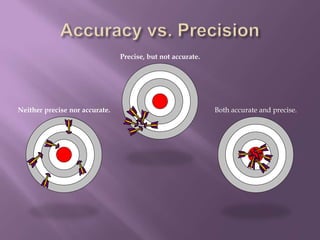
Precise, but not accurate. 
Neither precise nor accurate. Both accurate and precise.
… of the darts below are accurate? 
How many are precise?
 What is the difference between science and 
technology? 
 Einstein’s Special Theory of Relativity points out that 
a large amount of energy could be released from a 
small amount of matter, E = mc2. (Science) 
 The atomic bomb demonstrated this equation all too 
well. (Technology) 
 Simply stated, if science is the knowledge, 
technology is how that knowledge is used.
 Bananas are a good source of potassium 
(fact or opinion?) 
 Bananas are delicious 
(fact or opinion?) 
 Potassium helps reduce cramps 
(fact or opinion?) 
 Bananas feel weird when eaten 
(fact or opinion?)
 How are science and religion different? 
 Science is the search for understanding and discovery of the 
world. 
 Religion is the search for purpose and meaning in that world. 
 Put simply, Science is based on facts, Religion is based on faith. 
 Historically, science has been driven by the need to 
worship a religion. 
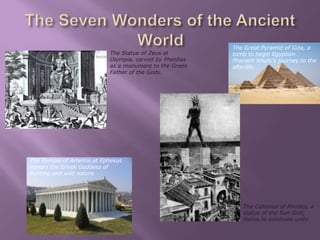
 The Seven Wonders of the Ancient World 
 Religious buildings (cathedrals, synagogues, temples, 
mosques)… need science to be build.
The Temple of Artemis at Ephesus 
honors the Greek Goddess of 
hunting and wild nature 
The Great Pyramid of Giza, a 
tomb to begin Egyptian 
Pharaoh Khufu’s journey to the 
afterlife. 
The Statue of Zeus at 
Olympia, carved by Pheidias 
as a monument to the Greek 
Father of the Gods. 
The Colossus of Rhodes, a 
statue of the Sun-God, 
Helios to celebrate unity.
 How can math be used to understand science? 
 analyze data, 
 equations, 
 graphs, etc.
Choose 
something to 
graph 
(temperature, 
speed, weight, 
etc) 
Write a story 
about this 
graph
 Measurements 
 Metric Conversions 
 Standard Conversions
How are scientific questions answered?

Natural Philosophy vs Physics

  • 1.
     If youhave any signed pink sheets to turn in, please put them in the box.
  • 2.
    How are scientificquestions answered?
  • 3.
    When can youuse scientific thinking?
  • 4.
     Insert aTitle Page.  Describe the activity.  Describe what you learned.  Relate how the activity compared to other experiences you’ve had in other science classes.
  • 5.
    Where physics was,is, and is going…
  • 6.
     “Scientists” haveonly been around for about 200 years.  Prior to that, it was all philosophy.  Philosophy  Lover of wisdom  Seeker of knowledge  Natural Philosophy  “seek knowledge” about “nature”!!!  Foundation for what became known as physics
  • 7.
     Aristotle Greek Philosopher (Natural Philosopher)  Laid out foundation for Physics  Was ALMOST right  Studied for almost 2,000 years!!!  Galileo  Introduced friction  Corrected much of Aristotle’s teachings  Newton  Explained WHY things move the way they do…
  • 8.
     What weresome of the major differences between how Aristotle (philosopher) understood the world around him, versus Galileo (scientist)?
  • 9.
    Letter to theeditor! Imagine you are a philosopher in the time when Galileo started presenting his ideas that contradicted Aristotle’s ideas on motion. How would you respond? Use the modern idea of editorial pages in a newspaper to write your response.
  • 46.
    From the jungleto the classroom…
  • 47.
     What stepswere taken while making the scientific discovery during the “Jungle Village” exercise?  Does this look familiar?  These are the steps of the Scientific Method  Recognize a problem (Observe)  Make an educated guess (Hypothesis)  Predict the outcome of your hypothesis (Predict)  Test your prediction (Experiment)  Formulate a general rule based on your data (Analyze)  (Repeat)  It is a natural way to discover things in the world!
  • 48.
     Describe someof the ways scientists make discoveries?  trial and error  experimentation without guessing  good old-fashioned accidents.  Alexander Fleming didn't clean up his workstation before going on vacation one day in 1928. When he came back, Fleming noticed that there was a strange fungus on some of his cultures. Even stranger was that bacteria didn't seem to thrive near those cultures.  Other things like the pacemaker, plastic and Coke were all discovered by accident!
  • 49.
    There are someimportant science terms that information can be classified by.  Fact a close agreement by competent observers who make a series of observations of the same phenomenon  Law or principle hypothesis has been tested and retested over and over and not contradicted  Theory synthesis of a large body of information that encompasses well tested and verified hypotheses about the natural world; theories are not fixed but go through change and evolve as they go through stages of redefinition and refinement
  • 50.
     Italian physicistGalileo Galilei (1564 – 1642) and English philosopher Francis Bacon (1561 – 1626) share credit for discovering the scientific method.  All scientific discoveries must be repeatable to gain credit in the scientific community.  A hypothesis must be testable in order to be considered scientific.  Even if it is tested to be wrong, it must still be able to be tested.  Opinions don’t count either b/c they rely on an individuals point of view; not everyone has the same opinion.  Einstein said, “No number of experiments can prove me right; a single experiment can prove me wrong.”
  • 51.
    Precise, but notaccurate. Neither precise nor accurate. Both accurate and precise.
  • 52.
    … of thedarts below are accurate? How many are precise?
  • 53.
     What isthe difference between science and technology?  Einstein’s Special Theory of Relativity points out that a large amount of energy could be released from a small amount of matter, E = mc2. (Science)  The atomic bomb demonstrated this equation all too well. (Technology)  Simply stated, if science is the knowledge, technology is how that knowledge is used.
  • 54.
     Bananas area good source of potassium (fact or opinion?)  Bananas are delicious (fact or opinion?)  Potassium helps reduce cramps (fact or opinion?)  Bananas feel weird when eaten (fact or opinion?)
  • 55.
     How arescience and religion different?  Science is the search for understanding and discovery of the world.  Religion is the search for purpose and meaning in that world.  Put simply, Science is based on facts, Religion is based on faith.  Historically, science has been driven by the need to worship a religion.  The Seven Wonders of the Ancient World  Religious buildings (cathedrals, synagogues, temples, mosques)… need science to be build.
  • 56.
    The Temple ofArtemis at Ephesus honors the Greek Goddess of hunting and wild nature The Great Pyramid of Giza, a tomb to begin Egyptian Pharaoh Khufu’s journey to the afterlife. The Statue of Zeus at Olympia, carved by Pheidias as a monument to the Greek Father of the Gods. The Colossus of Rhodes, a statue of the Sun-God, Helios to celebrate unity.
  • 57.
     How canmath be used to understand science?  analyze data,  equations,  graphs, etc.
  • 59.
    Choose something to graph (temperature, speed, weight, etc) Write a story about this graph
  • 60.
     Measurements Metric Conversions  Standard Conversions
  • 61.
    How are scientificquestions answered?

Editor's Notes

  • #10 Day 2: after they have had the history of physics lecture… and after reading the day’s letter to the editor section in local newspaper.