NLO Higgs Effective Field Theory and κ Framework
arXiv:1505.03706. M. Ghezzi, R.G. , G.Passarino, S.Uccirati
Raquel G´omez-Ambrosio
HiggsTools @Universit`a & INFN @Torino & CMS @CERN
Planck Conference 2015, Ionannina, GR
May 27, 2015
higgstools
Outline
Introduction:
The Search of BSM physics
The kappa framework
Effective Field theory
What is Effective Field Theory
Why choose Effective Field Theory
Hands on EFT:
HowTo
SM EFT
Summary & Open Questions
higgstools
Introduction:
The Search of BSM physics
Introduction: Why are we here?
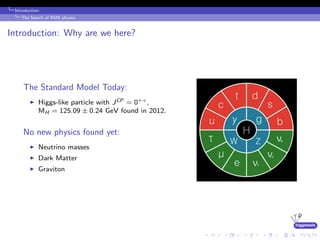
The Standard Model Today:
Higgs-like particle with JCP = 0++,
MH = 125.09 ± 0.24 GeV found in 2012.
No new physics found yet:
Neutrino masses
Dark Matter
Graviton
higgstools
Introduction:
The Search of BSM physics
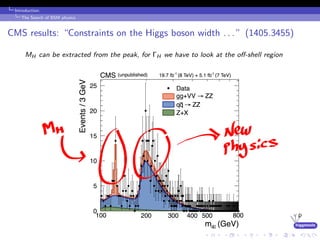
CMS results: “Constraints on the Higgs boson width . . . ” (1405.3455)
MH can be extracted from the peak, for ΓH we have to look at the off-shell region
higgstools
Introduction:
The kappa framework
Search for BSM physics: The kappa framework
First proposed by the LHC-HXSWG in 1209.0040
Idea: Introduce ad-hoc deviations for some SM observables
(Higgs’ σ’s and Γ’s)
Provide a series of benchmark parametrizations in order to
test deviations against experimental data
higgstools
Introduction:
The kappa framework
Search for BSM physics: The kappa framework
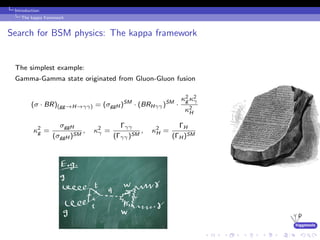
The simplest example:
Gamma-Gamma state originated from Gluon-Gluon fusion
(σ · BR)(gg→H→γγ) = (σggH )SM
· (BRHγγ)SM
·
κ2
g κ2
γ
κ2
H
κ2
g =
σggH
(σggH )SM
, κ2
γ =
Γγγ
(Γγγ)SM
, κ2
H =
ΓH
(ΓH )SM
higgstools
Introduction:
The kappa framework
Search for BSM physics: The kappa framework
Disadvantages . . .
Ad-hoc deviations are not compatible with QFT
(they break gauge invariance and unitarity)
The κ’s don’t have a direct physical interpretation
With the available amount of data and theoretical
predictions, no deviation has been found
Need to go to higher orders in perturbation theory
(NLO for signal AND background processes)
Need higher experimental accuracy
Or, maybe, need another approach . . .
higgstools
Introduction:
The kappa framework
Search for BSM physics: The kappa framework
Disadvantages . . .
Ad-hoc deviations are not compatible with QFT
(they break gauge invariance and unitarity)
The κ’s don’t have a direct physical interpretation
With the available amount of data and theoretical
predictions, no deviation has been found
Need to go to higher orders in perturbation theory
(NLO for signal AND background processes)
Need higher experimental accuracy
Or, maybe, need another approach . . .
higgstools
Introduction:
The kappa framework
Search for BSM physics: The kappa framework
Disadvantages . . .
Ad-hoc deviations are not compatible with QFT
(they break gauge invariance and unitarity)
The κ’s don’t have a direct physical interpretation
With the available amount of data and theoretical
predictions, no deviation has been found
Need to go to higher orders in perturbation theory
(NLO for signal AND background processes)
Need higher experimental accuracy
Or, maybe, need another approach . . .
higgstools
Introduction:
The kappa framework
Search for BSM physics: The kappa framework
Disadvantages . . .
Ad-hoc deviations are not compatible with QFT
(they break gauge invariance and unitarity)
The κ’s don’t have a direct physical interpretation
With the available amount of data and theoretical
predictions, no deviation has been found
Need to go to higher orders in perturbation theory
(NLO for signal AND background processes)
Need higher experimental accuracy
Or, maybe, need another approach . . .
higgstools
Effective Field theory
What is Effective Field Theory
Alternative strategy: Effective field theory
Definition:
An effective field theory (EFT) is a field theory, designed to reproduce the
behaviour of some underlying physical theory in some limited regime. It focuses
on the degrees of freedom relevant to that regime, simplifying the problem but
letting aside some physics.
higgstools
Effective Field theory
Why choose Effective Field Theory
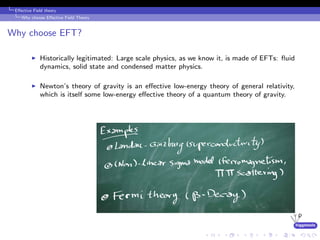
Why choose EFT?
Historically legitimated: Large scale physics, as we know it, is made of EFTs: fluid
dynamics, solid state and condensed matter physics.
Newton’s theory of gravity is an effective low-energy theory of general relativity,
which is itself some low-energy effective theory of a quantum theory of gravity.
higgstools
Hands on EFT:
HowTo
Things the apprentice has to know: Top-down Vs. Bottom-up approach
In the Top-down approach: (model dependent)
Start from a complete high energy theory.
Integrate out heavy fields: eiSeff [φ](µ) = DΦ eiSUV [φ,Φ](µ)
Use RG-flow to study the resulting theory in its low-energy regime
In the Bottom-up approach: (model independent)
Start from a low-energy known theory (the SM).
Add operators consistent with the symmetries
(recall Wilson: only dim > 4 makes sense)
Calculate (pseudo)-observables and compare with experiments
higgstools
Hands on EFT:
HowTo
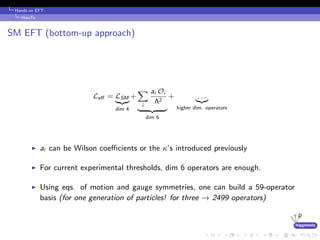
SM EFT (bottom-up approach)
Leff = LSM
dim 4
+
i
ai Oi
Λ2
dim 6
+ . . .
higher dim. operators
ai can be Wilson coefficients or the κ’s introduced previously
For current experimental thresholds, dim 6 operators are enough.
Using eqs. of motion and gauge symmetries, one can build a 59-operator
basis (for one generation of particles! for three → 2499 operators)
higgstools
Hands on EFT:
SM EFT
SM EFT
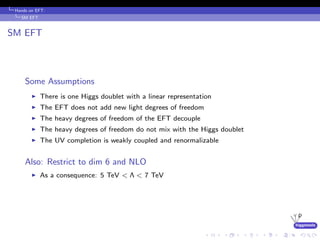
Some Assumptions
There is one Higgs doublet with a linear representation
The EFT does not add new light degrees of freedom
The heavy degrees of freedom of the EFT decouple
The heavy degrees of freedom do not mix with the Higgs doublet
The UV completion is weakly coupled and renormalizable
Also: Restrict to dim 6 and NLO
As a consequence: 5 TeV < Λ < 7 TeV
higgstools
Hands on EFT:
SM EFT
Hands on: The Strategy to follow
1. Start from the SM L
2. Add all possible dim 6 operators
(“a basis”)
3. Redefine fields and parameters to
recover the wanted expression:
L = LSM + Ldim 6
4. Write down Feynman rules and
renormalize this L
5. Do your calculations!
higgstools
Hands on EFT:
SM EFT
Redefiniton and Renormalization
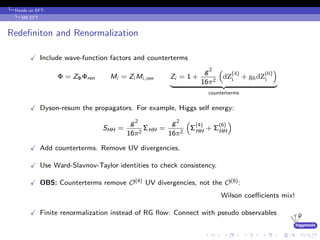
Include wave-function factors and counterterms
Φ = ZΦΦren Mi = Zi Mi,ren Zi = 1 +
g2
16π2
dZ
(4)
i + g6dZ
(6)
i
counterterms
Dyson-resum the propagators. For example, Higgs self energy:
SHH =
g2
16π2
ΣHH =
g2
16π2
Σ
(4)
HH + Σ
(6)
HH
Add counterterms. Remove UV divergencies.
Use Ward-Slavnov-Taylor identities to check consistency.
OBS: Counterterms remove O(4) UV divergencies, not the O(6):
Wilson coefficients mix!
Finite renormalization instead of RG flow: Connect with pseudo observables
higgstools
Hands on EFT:
SM EFT
The message
We want to do precision physics: We are looking for tiny deviations from the SM,
and the energy scale of our theory is relatively narrow
× Therefore cannot use the renormalization group equations
We want to isolate the O(6) contributions to the amplitudes from the O(4)
If you manage to do this, it should be easy to measure SM deviations in Higgs
production and decays (through the couplings)
higgstools
Hands on EFT:
SM EFT
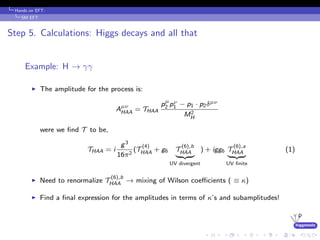
Step 5. Calculations: Higgs decays and all that
Example: H → γγ
The amplitude for the process is:
Aµν
HAA = THAA
pµ
2 pν
1 − p1 · p2δµν
M2
H
were we find T to be,
THAA = i
g3
16π2
(T
(4)
HAA + g6 T
(6),b
HAA
UV divergent
) + igg6 T
(6),a
HAA
UV finite
(1)
Need to renormalize T
(6),b
HAA → mixing of Wilson coefficients ( ≡ κ)
Find a final expression for the amplitudes in terms of κ’s and subamplitudes!
higgstools
Hands on EFT:
SM EFT
NLO Higgs EFT
More details on the paper: 1505.03706
higgstools
Summary & Open Questions
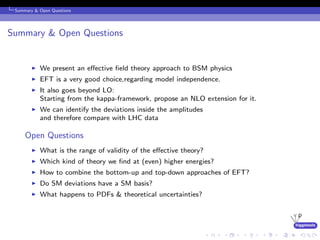
We present an effective field theory approach to BSM physics
EFT is a very good choice,regarding model independence.
It also goes beyond LO:
Starting from the kappa-framework, propose an NLO extension for it.
We can identify the deviations inside the amplitudes
and therefore compare with LHC data
Open Questions
What is the range of validity of the effective theory?
Which kind of theory we find at (even) higher energies?
How to combine the bottom-up and top-down approaches of EFT?
Do SM deviations have a SM basis?
What happens to PDFs & theoretical uncertainties?
higgstools
Summary & Open Questions
higgstools
Backup
Backup
higgstools
Backup
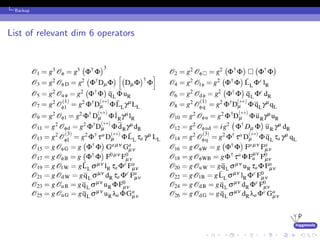
List of relevant dim 6 operators
higgstools
Backup
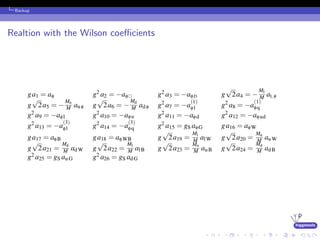
Realtion with the Wilson coefficients

NLO Higgs Effective Field Theory and κ Framework

  • 1.
    NLO Higgs EffectiveField Theory and κ Framework arXiv:1505.03706. M. Ghezzi, R.G. , G.Passarino, S.Uccirati Raquel G´omez-Ambrosio HiggsTools @Universit`a & INFN @Torino & CMS @CERN Planck Conference 2015, Ionannina, GR May 27, 2015
  • 2.
    higgstools Outline Introduction: The Search ofBSM physics The kappa framework Effective Field theory What is Effective Field Theory Why choose Effective Field Theory Hands on EFT: HowTo SM EFT Summary & Open Questions
  • 3.
    higgstools Introduction: The Search ofBSM physics Introduction: Why are we here? The Standard Model Today: Higgs-like particle with JCP = 0++, MH = 125.09 ± 0.24 GeV found in 2012. No new physics found yet: Neutrino masses Dark Matter Graviton
  • 4.
    higgstools Introduction: The Search ofBSM physics CMS results: “Constraints on the Higgs boson width . . . ” (1405.3455) MH can be extracted from the peak, for ΓH we have to look at the off-shell region
  • 5.
    higgstools Introduction: The kappa framework Searchfor BSM physics: The kappa framework First proposed by the LHC-HXSWG in 1209.0040 Idea: Introduce ad-hoc deviations for some SM observables (Higgs’ σ’s and Γ’s) Provide a series of benchmark parametrizations in order to test deviations against experimental data
  • 6.
    higgstools Introduction: The kappa framework Searchfor BSM physics: The kappa framework The simplest example: Gamma-Gamma state originated from Gluon-Gluon fusion (σ · BR)(gg→H→γγ) = (σggH )SM · (BRHγγ)SM · κ2 g κ2 γ κ2 H κ2 g = σggH (σggH )SM , κ2 γ = Γγγ (Γγγ)SM , κ2 H = ΓH (ΓH )SM
  • 7.
    higgstools Introduction: The kappa framework Searchfor BSM physics: The kappa framework Disadvantages . . . Ad-hoc deviations are not compatible with QFT (they break gauge invariance and unitarity) The κ’s don’t have a direct physical interpretation With the available amount of data and theoretical predictions, no deviation has been found Need to go to higher orders in perturbation theory (NLO for signal AND background processes) Need higher experimental accuracy Or, maybe, need another approach . . .
  • 8.
    higgstools Introduction: The kappa framework Searchfor BSM physics: The kappa framework Disadvantages . . . Ad-hoc deviations are not compatible with QFT (they break gauge invariance and unitarity) The κ’s don’t have a direct physical interpretation With the available amount of data and theoretical predictions, no deviation has been found Need to go to higher orders in perturbation theory (NLO for signal AND background processes) Need higher experimental accuracy Or, maybe, need another approach . . .
  • 9.
    higgstools Introduction: The kappa framework Searchfor BSM physics: The kappa framework Disadvantages . . . Ad-hoc deviations are not compatible with QFT (they break gauge invariance and unitarity) The κ’s don’t have a direct physical interpretation With the available amount of data and theoretical predictions, no deviation has been found Need to go to higher orders in perturbation theory (NLO for signal AND background processes) Need higher experimental accuracy Or, maybe, need another approach . . .
  • 10.
    higgstools Introduction: The kappa framework Searchfor BSM physics: The kappa framework Disadvantages . . . Ad-hoc deviations are not compatible with QFT (they break gauge invariance and unitarity) The κ’s don’t have a direct physical interpretation With the available amount of data and theoretical predictions, no deviation has been found Need to go to higher orders in perturbation theory (NLO for signal AND background processes) Need higher experimental accuracy Or, maybe, need another approach . . .
  • 11.
    higgstools Effective Field theory Whatis Effective Field Theory Alternative strategy: Effective field theory Definition: An effective field theory (EFT) is a field theory, designed to reproduce the behaviour of some underlying physical theory in some limited regime. It focuses on the degrees of freedom relevant to that regime, simplifying the problem but letting aside some physics.
  • 12.
    higgstools Effective Field theory Whychoose Effective Field Theory Why choose EFT? Historically legitimated: Large scale physics, as we know it, is made of EFTs: fluid dynamics, solid state and condensed matter physics. Newton’s theory of gravity is an effective low-energy theory of general relativity, which is itself some low-energy effective theory of a quantum theory of gravity.
  • 13.
    higgstools Hands on EFT: HowTo Thingsthe apprentice has to know: Top-down Vs. Bottom-up approach In the Top-down approach: (model dependent) Start from a complete high energy theory. Integrate out heavy fields: eiSeff [φ](µ) = DΦ eiSUV [φ,Φ](µ) Use RG-flow to study the resulting theory in its low-energy regime In the Bottom-up approach: (model independent) Start from a low-energy known theory (the SM). Add operators consistent with the symmetries (recall Wilson: only dim > 4 makes sense) Calculate (pseudo)-observables and compare with experiments
  • 14.
    higgstools Hands on EFT: HowTo SMEFT (bottom-up approach) Leff = LSM dim 4 + i ai Oi Λ2 dim 6 + . . . higher dim. operators ai can be Wilson coefficients or the κ’s introduced previously For current experimental thresholds, dim 6 operators are enough. Using eqs. of motion and gauge symmetries, one can build a 59-operator basis (for one generation of particles! for three → 2499 operators)
  • 15.
    higgstools Hands on EFT: SMEFT SM EFT Some Assumptions There is one Higgs doublet with a linear representation The EFT does not add new light degrees of freedom The heavy degrees of freedom of the EFT decouple The heavy degrees of freedom do not mix with the Higgs doublet The UV completion is weakly coupled and renormalizable Also: Restrict to dim 6 and NLO As a consequence: 5 TeV < Λ < 7 TeV
  • 16.
    higgstools Hands on EFT: SMEFT Hands on: The Strategy to follow 1. Start from the SM L 2. Add all possible dim 6 operators (“a basis”) 3. Redefine fields and parameters to recover the wanted expression: L = LSM + Ldim 6 4. Write down Feynman rules and renormalize this L 5. Do your calculations!
  • 17.
    higgstools Hands on EFT: SMEFT Redefiniton and Renormalization Include wave-function factors and counterterms Φ = ZΦΦren Mi = Zi Mi,ren Zi = 1 + g2 16π2 dZ (4) i + g6dZ (6) i counterterms Dyson-resum the propagators. For example, Higgs self energy: SHH = g2 16π2 ΣHH = g2 16π2 Σ (4) HH + Σ (6) HH Add counterterms. Remove UV divergencies. Use Ward-Slavnov-Taylor identities to check consistency. OBS: Counterterms remove O(4) UV divergencies, not the O(6): Wilson coefficients mix! Finite renormalization instead of RG flow: Connect with pseudo observables
  • 18.
    higgstools Hands on EFT: SMEFT The message We want to do precision physics: We are looking for tiny deviations from the SM, and the energy scale of our theory is relatively narrow × Therefore cannot use the renormalization group equations We want to isolate the O(6) contributions to the amplitudes from the O(4) If you manage to do this, it should be easy to measure SM deviations in Higgs production and decays (through the couplings)
  • 19.
    higgstools Hands on EFT: SMEFT Step 5. Calculations: Higgs decays and all that Example: H → γγ The amplitude for the process is: Aµν HAA = THAA pµ 2 pν 1 − p1 · p2δµν M2 H were we find T to be, THAA = i g3 16π2 (T (4) HAA + g6 T (6),b HAA UV divergent ) + igg6 T (6),a HAA UV finite (1) Need to renormalize T (6),b HAA → mixing of Wilson coefficients ( ≡ κ) Find a final expression for the amplitudes in terms of κ’s and subamplitudes!
  • 20.
    higgstools Hands on EFT: SMEFT NLO Higgs EFT More details on the paper: 1505.03706
  • 21.
    higgstools Summary & OpenQuestions Summary & Open Questions We present an effective field theory approach to BSM physics EFT is a very good choice,regarding model independence. It also goes beyond LO: Starting from the kappa-framework, propose an NLO extension for it. We can identify the deviations inside the amplitudes and therefore compare with LHC data Open Questions What is the range of validity of the effective theory? Which kind of theory we find at (even) higher energies? How to combine the bottom-up and top-down approaches of EFT? Do SM deviations have a SM basis? What happens to PDFs & theoretical uncertainties?
  • 22.
  • 23.
  • 24.
  • 25.