Downloaded 25 times
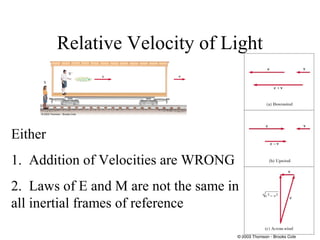
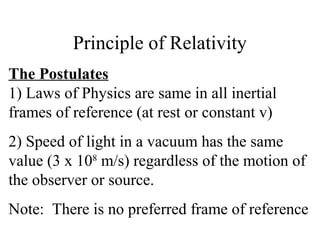
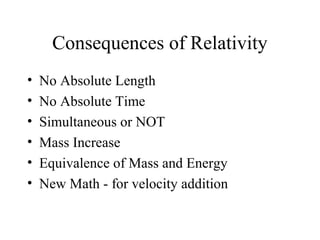
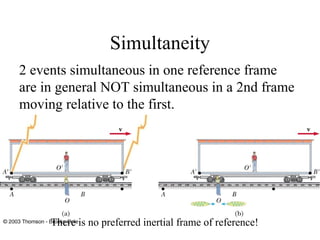
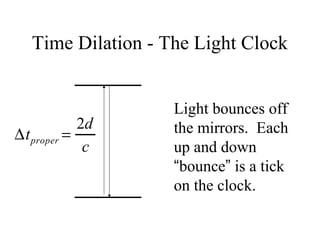
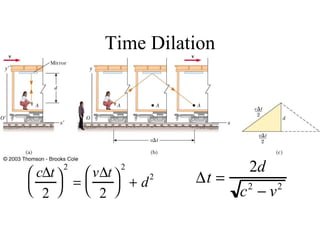
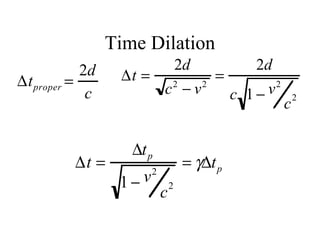

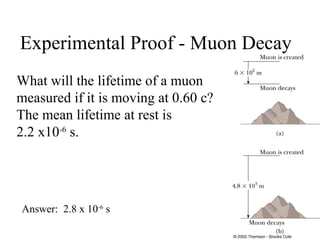


This document discusses the key principles of special relativity, including: 1) The postulates of relativity state that the laws of physics are the same in all inertial reference frames, and that the speed of light has the same value in all reference frames. 2) Consequences of relativity include that there is no absolute length, time, or simultaneity between reference frames. Mass increases and mass and energy are equivalent based on the formula E=mc^2. 3) Time dilation describes how moving clocks run slower than stationary clocks by a factor of gamma, as demonstrated through experiments with muons.


![Modern Physics_G2_Presentation [Final].pptx](https://cdn.slidesharecdn.com/ss_thumbnails/modernphysicsg2presentationfinal-250803082535-25849f96-thumbnail.jpg?width=640&height=640&fit=bounds)


