PAPILLOEDEMA
PAPILLOEDEMA
• Oedema of the optic disc or
nerve head due to raised
intracranial pressure.
• Optic nerve is enclosed up to the
lamina cribrosa within the
meningeal sheaths common to
the brain.
– Rise in ICT is equally evident
around the nerve.
– Development of oedema at the optic
disc.
– Hydrostatic, non inflammatory
phenomenon.
AETIOLOGY
• Increased intracranial pressure.
Due to intracranial space
occupying lesion, mainly
tumours of the midbrain,
parieto-occipital region and
cerebellum.
Brain abscess
Thrombosis of cavernous
sinus or other intracranial
veins Aneurysm
Subarachnoid haemorrhage
Pseudotumour cerebri
Malignant
hypertensio
n
(a) Left optic nerve sheath meningioma with disc edema and shunt vessels.(b)Axial computed
tomography of the orbits with contrast showing enhancement along the left optic nerve (arrows).
Elevated cerebrospinal
fluid
pressure.
Axoplasmic stasis in the
optic
nerve head.
Swelling of the optic disc
and secondary vascular
changes at the disc
surface.
PRINCIPAL PATHOPHYSIOLOGY- Blockage of
axoplasmic transport
PATHOLOGY
• Passive oedema without
evidence of infammation.
• Small blood vessels are engorged
and tortuous.
• Nerve fibres in ONHare swollen and
axoplasmic stasis is noted.
• Physiological cup gets filled in and
internal limiting membrane israised.
• Nerve fibres become swollen and
varicose and ultimately degenerate.
• Numerous cystoid bodies in frontof
lamina cribrosa.
• Engorgement of axons.
Swollen axonsare filled with
mitochondria.
Mitochondria are structurallyswollen
and disrupted.
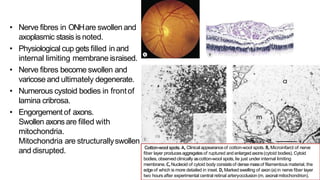
Cotton-wool spots. A, Clinical appearanceof cotton-wool spots. B,Microinfarct of nerve
fiber layer produces aggregates of ruptured and enlarged axons(cytoid bodies). Cytoid
bodies, observed clinically ascotton-wool spots, lie just under internal limiting
membrane. C,Nucleoid of cytoid body consistsof dense massof filamentous material, the
edgeof which is more detailed in inset. D, Marked swelling of axon (a) in nerve fiber layer
two hours after experimental central retinal arteryocclusion (m, axonal mitochondrion).
PATHOLOGICALCHANGES IN SURROUNDING RETINA AND MACULAR REGION
• Oedemain the nerve fibrelayer
raises the internal limiting
membrane in folds.
• Retinal exudates distributed
radially along the folds,present
in the macular region- Macular
fan or Macularstar.
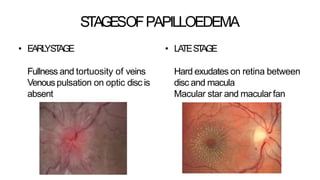
STAGESOFPAPILLOEDEMA
• EARL
YST
AGE
Fullness and tortuosity of veins
Venouspulsation on optic disc is
absent
• LA
TEST
AGE
Hard exudates on retina between
disc and macula
Macular star and macularfan
SYMPTOMS
• Early stages-Asymptomatic
• Ontime- Constant compression
leading to transient ischemia
without obscuring visual
functions (4-6 weeks)
• >6weeks- Nerve fibres
degenerate
Transient obscuration of vision
Enlargement of blind spot
Contraction of visualfield
Relative scotoma
• Transient attacks of blurred
vision- Bilateral or monocular
black outs lasting for afew
secondsoften precipitated by
changesin posture.
• Chronic papilloedema- Severe
loss of central visualacuity.
• Asatrophy sets in-
– Complete blindness
– Pupils are large and
immobile
– Headachewhich is worse in
arecumbent position
– Nauseaand vomiting
– Diplopia (Non specific
paresis of the sixthnerve)
This7-year-old boy with abrain stem glioma presented with diplopia associatedwith bilateral
sixth nerve palsiesthat had started gradually about 2 months before and more recent symptoms
of raised intracranial pressure. Theoptic discs are grossly elevated with markedly dilated
capillaries and veins, numerous cotton wool spots, and the right eye hasamacular star, asaresult
of protein/lipid accumulation from transudation from disc capillaries.Although the blind spots
were very large on Goldmann fields, the visual acuity was 0.1 (6/7.5, 20/25, 0.8) right and 0.0 left.
SIGNS
• Blurring of optic discmargins-
– Starts at upper and lower margins
and extends around the nasalside,
temporal side usually visible and
sharp
– Hyperaemic
– Progressive edema reduces sizeof
the physiologicalcup
• Veinsbecome congested and
turgescent (absentpulsations)
• Small arterioles become
prominent, appearing asred
streaks.
• Eventually the disc becomes
elevated into amound higher
than the surrounding retinaand
mushrooms out sothat the
vesslesbends sharply over its
margins
Definite parallax elicited with IDO
• Flameshaped and punctate
hemorrhages
• Surface of the disc losesits
reddish hue, now opaque.
Note circumferential retinal folds a.k.a Paton’slines.
Veinsthat are enormously dilated may be buried for large
tracts of their course in theswolen and oedematous retina.
• Macular star- Radiating,
oedematous folds around the
macula (incomplete)
• Macular fan- fan shaped folds on
the side towards the disc
• Cotton wool spots due to retinal
microinfarcts- scattered
throughout posterior half of
fundus
• Longstanding cases-Atrophic
changeswhen the nerve fibres
canno longer withstand the
pressure and degenerate.
Optic atrophy secondary to long standingpapilloedema
• Usually bilateral, not necesssarily
equal on both sides.
• Foster-Kennedy syndrome- U/L
papilledema with or without optic
atrophy on groove or orbitalsurface
if the frontal lobe or of the pituitary
body.
• DIAGNOSIS:
Indirect ophthalmoscopy-difficult
to assessin early casesfor disc
changes
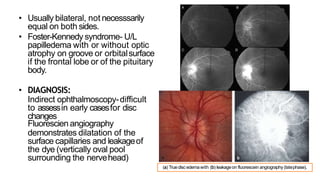
Fluorescien angiography
demonstrates dilatation of the
surface capillaries and leakageof
the dye (vertically oval pool
surrounding the nervehead)
(a) Truediscedemawith (b) leakageon fluorescein angiography (latephase).
DIFFERENTIALDIAGNOSIS
• ISCHAEMICOPTICNEUROP
A
THY
-
– Arteritic a/w GCAor NonArteritic a/w
vasculopathy
– Profound, sudden visual loss
– Swollen disc, characteristic pallid
appearance
– Selflimiting disease, >55 years,women
– Non arteritic ischaemic opticatrophy,
involvement of short posterior ciliary
branches leading to swelling of optic
nerve head and later to atrophy and
sometimes cupping.
(a) Right anterior ischemic optic neuropathy with mild disc edemaand afew
peripapillary hemorrhages. (b) Corresponding inferior altitudinal visual field
defect on a30–2 Humphrey visual field test.
TREATMENT
• Relief of causalpressure
• Timely decompression or
removal of tumour- Relief of
general symptoms of raisedICT,
vision improves rapidly if the
nerves have not been
irretrievably damaged and
papilledema subsides
• Surgical option for
pseudotumour cerebri-
Lumbar peritoneal shunt, or local
decompressionby making
multiple slits or cutting awindow
in the optic nerve sheaths (dura
and arachnoid) in the orbit.
THANK YOU

Papilledema

  • 1.
  • 2.
    PAPILLOEDEMA • Oedema ofthe optic disc or nerve head due to raised intracranial pressure. • Optic nerve is enclosed up to the lamina cribrosa within the meningeal sheaths common to the brain. – Rise in ICT is equally evident around the nerve. – Development of oedema at the optic disc. – Hydrostatic, non inflammatory phenomenon.
  • 3.
    AETIOLOGY • Increased intracranialpressure. Due to intracranial space occupying lesion, mainly tumours of the midbrain, parieto-occipital region and cerebellum. Brain abscess Thrombosis of cavernous sinus or other intracranial veins Aneurysm Subarachnoid haemorrhage Pseudotumour cerebri Malignant hypertensio n
  • 4.
    (a) Left opticnerve sheath meningioma with disc edema and shunt vessels.(b)Axial computed tomography of the orbits with contrast showing enhancement along the left optic nerve (arrows).
  • 5.
    Elevated cerebrospinal fluid pressure. Axoplasmic stasisin the optic nerve head. Swelling of the optic disc and secondary vascular changes at the disc surface. PRINCIPAL PATHOPHYSIOLOGY- Blockage of axoplasmic transport
  • 6.
    PATHOLOGY • Passive oedemawithout evidence of infammation. • Small blood vessels are engorged and tortuous.
  • 7.
    • Nerve fibresin ONHare swollen and axoplasmic stasis is noted. • Physiological cup gets filled in and internal limiting membrane israised. • Nerve fibres become swollen and varicose and ultimately degenerate. • Numerous cystoid bodies in frontof lamina cribrosa. • Engorgement of axons. Swollen axonsare filled with mitochondria. Mitochondria are structurallyswollen and disrupted. Cotton-wool spots. A, Clinical appearanceof cotton-wool spots. B,Microinfarct of nerve fiber layer produces aggregates of ruptured and enlarged axons(cytoid bodies). Cytoid bodies, observed clinically ascotton-wool spots, lie just under internal limiting membrane. C,Nucleoid of cytoid body consistsof dense massof filamentous material, the edgeof which is more detailed in inset. D, Marked swelling of axon (a) in nerve fiber layer two hours after experimental central retinal arteryocclusion (m, axonal mitochondrion).
  • 8.
    PATHOLOGICALCHANGES IN SURROUNDINGRETINA AND MACULAR REGION • Oedemain the nerve fibrelayer raises the internal limiting membrane in folds. • Retinal exudates distributed radially along the folds,present in the macular region- Macular fan or Macularstar.
  • 9.
    STAGESOFPAPILLOEDEMA • EARL YST AGE Fullness andtortuosity of veins Venouspulsation on optic disc is absent • LA TEST AGE Hard exudates on retina between disc and macula Macular star and macularfan
  • 10.
    SYMPTOMS • Early stages-Asymptomatic •Ontime- Constant compression leading to transient ischemia without obscuring visual functions (4-6 weeks) • >6weeks- Nerve fibres degenerate Transient obscuration of vision Enlargement of blind spot Contraction of visualfield Relative scotoma • Transient attacks of blurred vision- Bilateral or monocular black outs lasting for afew secondsoften precipitated by changesin posture. • Chronic papilloedema- Severe loss of central visualacuity.
  • 11.
    • Asatrophy setsin- – Complete blindness – Pupils are large and immobile – Headachewhich is worse in arecumbent position – Nauseaand vomiting – Diplopia (Non specific paresis of the sixthnerve) This7-year-old boy with abrain stem glioma presented with diplopia associatedwith bilateral sixth nerve palsiesthat had started gradually about 2 months before and more recent symptoms of raised intracranial pressure. Theoptic discs are grossly elevated with markedly dilated capillaries and veins, numerous cotton wool spots, and the right eye hasamacular star, asaresult of protein/lipid accumulation from transudation from disc capillaries.Although the blind spots were very large on Goldmann fields, the visual acuity was 0.1 (6/7.5, 20/25, 0.8) right and 0.0 left.
  • 12.
    SIGNS • Blurring ofoptic discmargins- – Starts at upper and lower margins and extends around the nasalside, temporal side usually visible and sharp – Hyperaemic – Progressive edema reduces sizeof the physiologicalcup • Veinsbecome congested and turgescent (absentpulsations)
  • 13.
    • Small arteriolesbecome prominent, appearing asred streaks. • Eventually the disc becomes elevated into amound higher than the surrounding retinaand mushrooms out sothat the vesslesbends sharply over its margins Definite parallax elicited with IDO • Flameshaped and punctate hemorrhages • Surface of the disc losesits reddish hue, now opaque. Note circumferential retinal folds a.k.a Paton’slines. Veinsthat are enormously dilated may be buried for large tracts of their course in theswolen and oedematous retina.
  • 14.
    • Macular star-Radiating, oedematous folds around the macula (incomplete) • Macular fan- fan shaped folds on the side towards the disc • Cotton wool spots due to retinal microinfarcts- scattered throughout posterior half of fundus • Longstanding cases-Atrophic changeswhen the nerve fibres canno longer withstand the pressure and degenerate. Optic atrophy secondary to long standingpapilloedema
  • 15.
    • Usually bilateral,not necesssarily equal on both sides. • Foster-Kennedy syndrome- U/L papilledema with or without optic atrophy on groove or orbitalsurface if the frontal lobe or of the pituitary body. • DIAGNOSIS: Indirect ophthalmoscopy-difficult to assessin early casesfor disc changes Fluorescien angiography demonstrates dilatation of the surface capillaries and leakageof the dye (vertically oval pool surrounding the nervehead) (a) Truediscedemawith (b) leakageon fluorescein angiography (latephase).
  • 16.
    DIFFERENTIALDIAGNOSIS • ISCHAEMICOPTICNEUROP A THY - – Arteritica/w GCAor NonArteritic a/w vasculopathy – Profound, sudden visual loss – Swollen disc, characteristic pallid appearance – Selflimiting disease, >55 years,women – Non arteritic ischaemic opticatrophy, involvement of short posterior ciliary branches leading to swelling of optic nerve head and later to atrophy and sometimes cupping. (a) Right anterior ischemic optic neuropathy with mild disc edemaand afew peripapillary hemorrhages. (b) Corresponding inferior altitudinal visual field defect on a30–2 Humphrey visual field test.
  • 17.
    TREATMENT • Relief ofcausalpressure • Timely decompression or removal of tumour- Relief of general symptoms of raisedICT, vision improves rapidly if the nerves have not been irretrievably damaged and papilledema subsides • Surgical option for pseudotumour cerebri- Lumbar peritoneal shunt, or local decompressionby making multiple slits or cutting awindow in the optic nerve sheaths (dura and arachnoid) in the orbit.
  • 18.