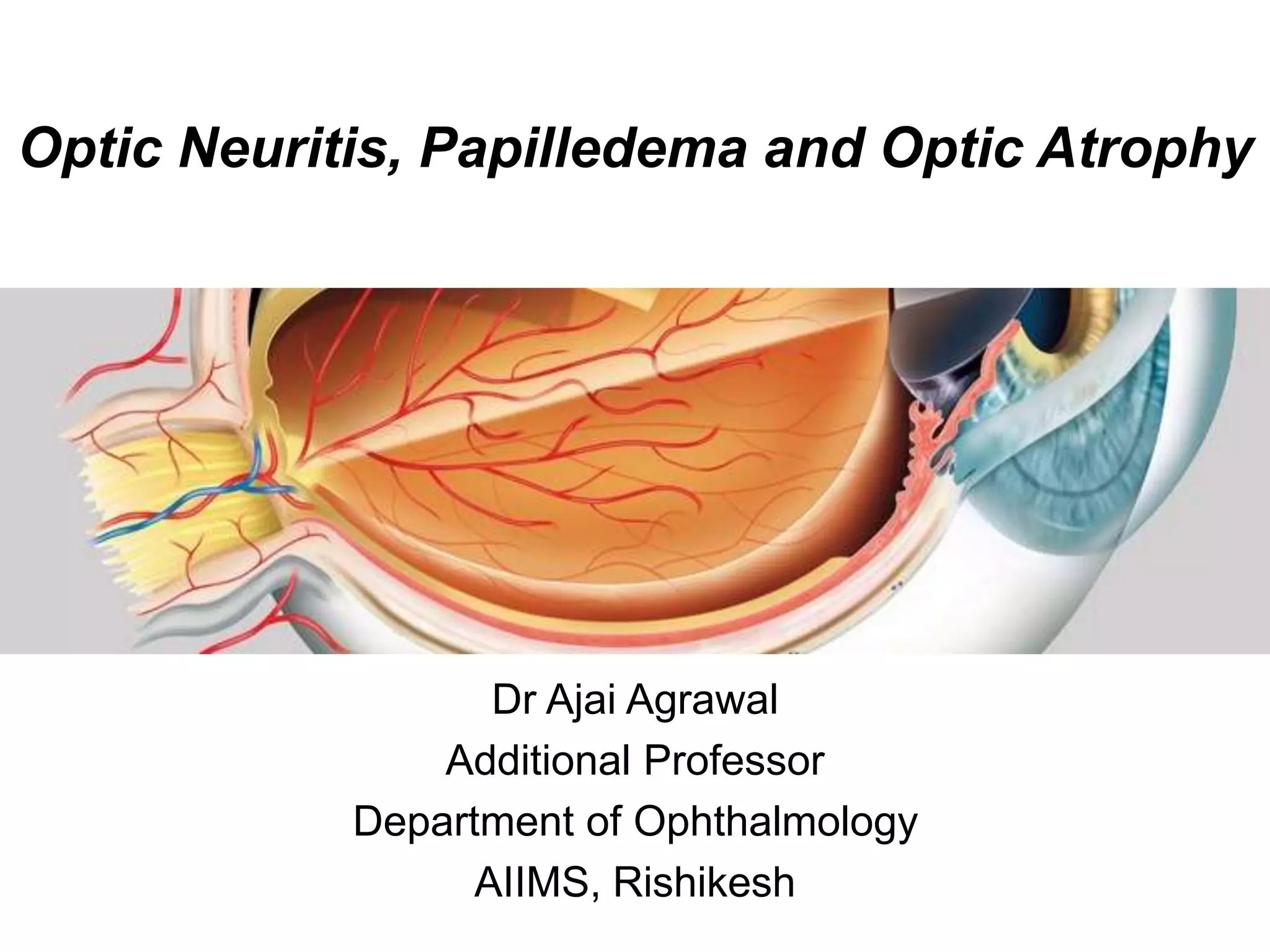
Optic Neuritis, Papilledema and Optic Atrophy
Dr Ajai Agrawal
Additional Professor
Department of Ophthalmology
AIIMS, Rishikesh
Acknowledgement
• Yanoff and Duker. Papilledema. 2016 In: Ophthalmology. Mosby Inc.
• Khurana AK. Optic atrophy 2014 In: Comprehensive Ophthalmology. CBS Publishers
• Weerasinghe, D., & Lueck, C.J. (2016). Mimics and chameleons of optic neuritis. Practical
neurology;16(2):96-110.
• CME: Optic Neuritis: Diagnosis, Treatment, and Prognosis.
https://www.medscape.org/viewarticle/571660_2
• Kahloun R et al. Infectious optic neuropathies: a clinical update. Eye and Brain 2015;7:59-81
• Creel D. Visually Evoked Potentials. 2012 Mar 1. In: Kolb H, Fernandez E, Nelson R, editors. Webvision:
The Organization of the Retina and Visual System [Internet]. Salt Lake City (UT): University of Utah
Health Sciences Center; 1995-. Available from: https://www.ncbi.nlm.nih.gov/books/NBK107218/
• Pastora-Salvador N et al. Foster Kennedy syndrome: papilledema in one eye with optic atrophy in the
other eye. CMAJ 2011;183(18):2135
• Reynolds SA. Pinpointing Papilledema. Optometric Management 2015:82-4
https://www.optometricmanagement.com/issues/2015/september-2015/clinical-posterior
• Schiffmann J et al. Evaluation and treatment of papilledema in pregnancy. Comprehensive ophthalmology
update 2006;7(4):187-202
• Toosy AT. Optic Neuritis. Lancet Neurol. 2014 Jan;13(1):83-99
2
Learning Objectives
• At the end of the class, students shall be able to
• Define and classify optic neuritis.
• Understand the aetiology and principles of
management of optic neuritis.
• Understand the stages and importance of
papilloedema.
• Differentiate between various types of optic atrophy.
3
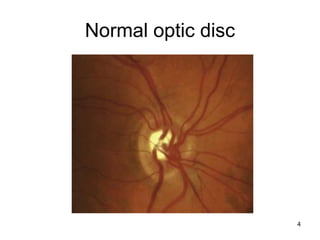
Normal optic disc
4
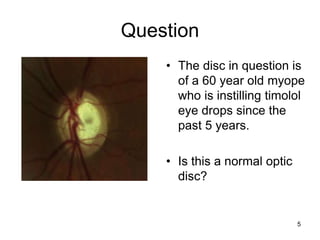
Question
• The disc in question is
of a 60 year old myope
who is instilling timolol
eye drops since the
past 5 years.
• Is this a normal optic
disc?
5
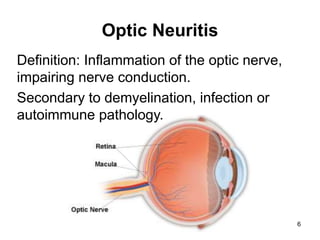
Optic Neuritis
Definition: Inflammation of the optic nerve,
impairing nerve conduction.
Secondary to demyelination, infection or
autoimmune pathology.
6
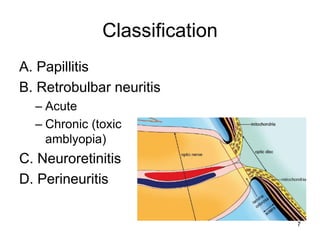
Classification
A. Papillitis
B. Retrobulbar neuritis
– Acute
– Chronic (toxic
amblyopia)
C. Neuroretinitis
D. Perineuritis
7
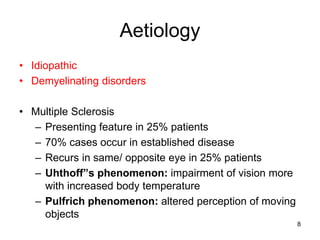
Aetiology
• Idiopathic
• Demyelinating disorders
• Multiple Sclerosis
– Presenting feature in 25% patients
– 70% cases occur in established disease
– Recurs in same/ opposite eye in 25% patients
– Uhthoff”s phenomenon: impairment of vision more
with increased body temperature
– Pulfrich phenomenon: altered perception of moving
objects
8
Aetiology
• Neuromyelitis optica (of Devic): acute, bilateral optic
neuritis in young patient with paraplegia
• Post-viral: mumps, measles, chicken pox, whooping
cough
• Metabolic/Nutritional deficiency:
B1, B6, B12, B2, Folic acid deficiency
Thyroid dysfunction, diabetes
• Hereditary optic neuritis (Leber's disease)
9
Aetiology
• Toxic amblyopia:
Chloroquine, Ethambutol
Tobacco, Ethyl alcohol, methyl alcohol
Lead, Arsenic.
• Ischaemic: Giant cell arteritis, Takayasu's disease,
PAN, SLE
• Granulomatous inflammation:
Sarcoidosis, tuberculosis, syphilis
10
Symptoms
• Idiopathic/demyelinating : 20-40 years of age
• Viral: children
• Uniocular sudden/rapid diminution of vision
• Visual loss, usually maximum by end of second week,
improves by 1-4 weeks
• Discomfort/pain behind eyeball especially when moved
superiorly
11
Signs
• Visual Acuity: Usually 6/60 or less
• Local tenderness
• Pupillary reaction: Sluggish, ill-sustained or RAPD
• Impaired coloured vision: hue, brightness
• Impaired contrast sensitivity
• Delayed dark adaptation
• Visual Field: central, centrocaecal or paracentral
scotoma, more pronounced for coloured fields
12
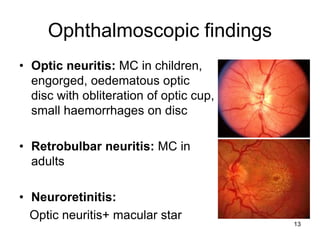
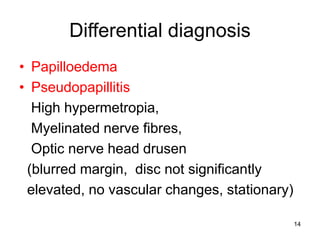
Ophthalmoscopic findings
• Optic neuritis: MC in children,
engorged, oedematous optic
disc with obliteration of optic cup,
small haemorrhages on disc
• Retrobulbar neuritis: MC in
adults
• Neuroretinitis:
Optic neuritis+ macular star
13
Differential diagnosis
• Papilloedema
• Pseudopapillitis
High hypermetropia,
Myelinated nerve fibres,
Optic nerve head drusen
(blurred margin, disc not significantly
elevated, no vascular changes, stationary)
14
Investigations
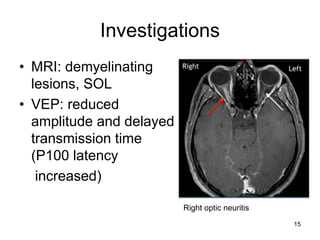
• MRI: demyelinating
lesions, SOL
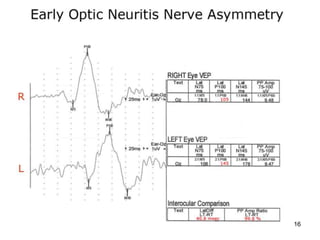
• VEP: reduced
amplitude and delayed
transmission time
(P100 latency
increased)
Right optic neuritis
15
16
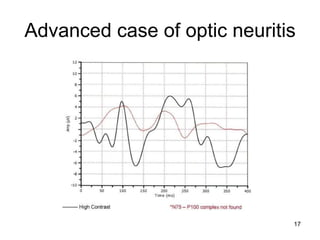
Advanced case of optic neuritis
17
Course and prognosis
• Recovery takes 4-6 weeks
• 90% recover normal VA, but colour vision
defects may persist
• No correlation between initial visual loss
and final visual outcome
• 10% secondary or post-neuritic optic
atrophy
• Better outcome in young, unilateral cases
18
Treatment
• Of cause e.g. anti-infective therapy
• Intravenous methyl prednisolone 20
mg/kg/day(250 mg QID) for 3 consecutive days
followed by oral prednisolone 1-1.5 mg/kg
• Dexamethasone 200 mg OD pulse for 3-5 days
is a cheaper alternative
• Supportive therapy
19
Papilloedema
• Definition: Bilateral, non-inflammatory
passive swelling of optic disc due to raised
Intracranial pressure.
• Does not develop if optic nerve is atrophic
20
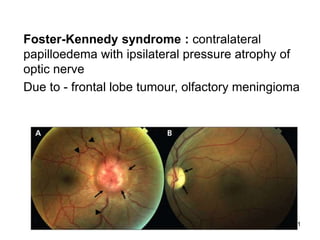
Foster-Kennedy syndrome : contralateral
papilloedema with ipsilateral pressure atrophy of
optic nerve
Due to - frontal lobe tumour, olfactory meningioma
21
D/D: Causes of 'disc oedema'
• Papillitis, neuroretinitis
• Anterior Ischemic Optic Neuropathy
• Optic Nerve glioma, meningioma
• Central Retinal Venous Occlusion
22
Aetio-Pathogenesis
• Elevated Intracranial pressure due to any cause
• Prelaminar Optic Nerve is affected by changes in tissue
pressure, IOP and CSF pressure
• Increased CSF pressure increases tissue pressure
hampering axoplasmic flow
• This further increases pressure on pre-laminar capillaries
and small veins causing vasodilatation and tortuosity
• Venous drainage compromise further increases
congestion 23
General Symptoms
• Headache, made worse by coughing or
straining
• Vomiting
• Focal neurological deficit with/without
changes in level of consciousness
24
Ocular symptoms
• VA may be normal until late stages
• Amaurosis fugax in some
• In 25% patients, visual symptoms occur
only in severe, advanced papilloedema
25
Signs
• Pupillary reactions are normal until
secondary atrophy sets in
• Early:
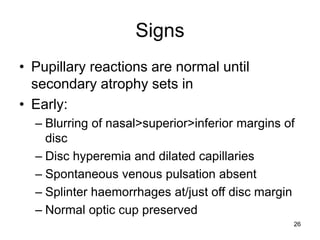
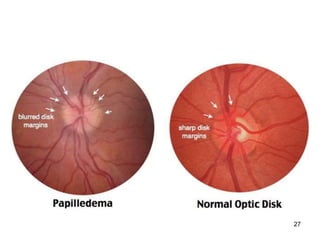
– Blurring of nasal>superior>inferior margins of
disc
– Disc hyperemia and dilated capillaries
– Spontaneous venous pulsation absent
– Splinter haemorrhages at/just off disc margin
– Normal optic cup preserved
26
27
Established papilloedema
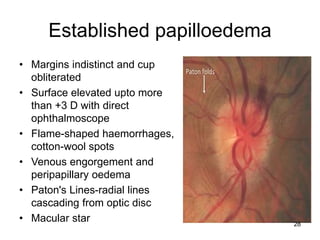
• Margins indistinct and cup
obliterated
• Surface elevated upto more
than +3 D with direct
ophthalmoscope
• Flame-shaped haemorrhages,
cotton-wool spots
• Venous engorgement and
peripapillary oedema
• Paton's Lines-radial lines
cascading from optic disc
• Macular star 28
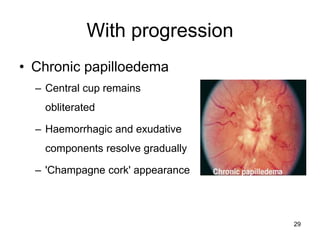
With progression
• Chronic papilloedema
– Central cup remains
obliterated
– Haemorrhagic and exudative
components resolve gradually
– 'Champagne cork' appearance
29
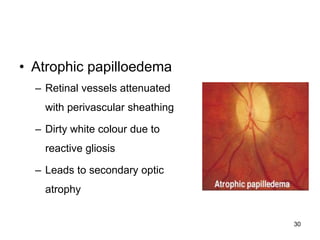
• Atrophic papilloedema
– Retinal vessels attenuated
with perivascular sheathing
– Dirty white colour due to
reactive gliosis
– Leads to secondary optic
atrophy
30
Visual fields
• Early-no changes
• Established stage- enlarged blind spot
• Chronic- peripheral constriction of field
with nerve fibre bundle defects
• Finally- total loss of visual field
31
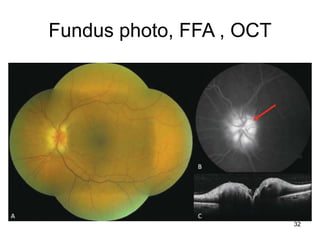
Fundus photo, FFA , OCT
32
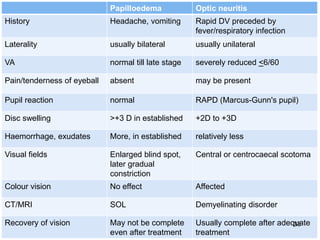
Papilloedema Optic neuritis
History Headache, vomiting Rapid DV preceded by
fever/respiratory infection
Laterality usually bilateral usually unilateral
VA normal till late stage severely reduced <6/60
Pain/tenderness of eyeball absent may be present
Pupil reaction normal RAPD (Marcus-Gunn's pupil)
Disc swelling >+3 D in established +2D to +3D
Haemorrhage, exudates More, in established relatively less
Visual fields Enlarged blind spot,
later gradual
constriction
Central or centrocaecal scotoma
Colour vision No effect Affected
CT/MRI SOL Demyelinating disorder
Recovery of vision May not be complete
even after treatment
Usually complete after adequate
treatment
33
Treatment
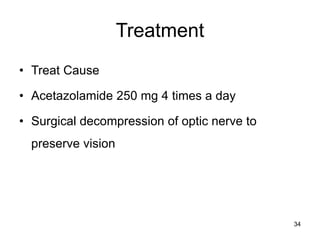
• Treat Cause
• Acetazolamide 250 mg 4 times a day
• Surgical decompression of optic nerve to
preserve vision
34
Optic Atrophy
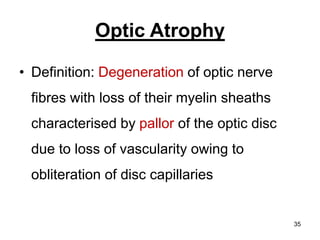
• Definition: Degeneration of optic nerve
fibres with loss of their myelin sheaths
characterised by pallor of the optic disc
due to loss of vascularity owing to
obliteration of disc capillaries
35
Classification-Aetiological
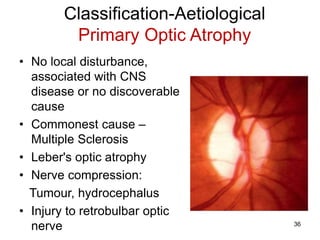
Primary Optic Atrophy
• No local disturbance,
associated with CNS
disease or no discoverable
cause
• Commonest cause –
Multiple Sclerosis
• Leber's optic atrophy
• Nerve compression:
Tumour, hydrocephalus
• Injury to retrobulbar optic
nerve 36
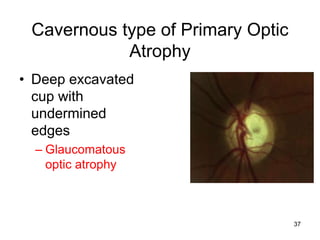
Cavernous type of Primary Optic
Atrophy
• Deep excavated
cup with
undermined
edges
– Glaucomatous
optic atrophy
37
Aetiological classification
• Secondary optic atrophy:
preceded by swelling of optic disc-
papilledema, optic neuritis, neuroretinitis
• Consecutive optic atrophy:
follows extensive disease of the retina -
Retinitis pigmentosa
Long-standing retinal detachment 38
Anatomical classification
• Ascending: Lesion in retina, terminates at
lateral geniculate body –
• Eg: RP, CRAO
• Descending: Disease involving optic
nerve fibres anterior to LGB, terminates at
optic disc –
• Eg: chiasmal compression 39
Symptoms
• Gradual/rapid loss of central/peripheral
vision
• Impairment of colour vision
40
Signs
• Visual Acuity impaired in proportion to
death of optic nerve fibres
• RAPD in unilateral Optic Atrophy
Ultimately pupil dilated and immobile
41
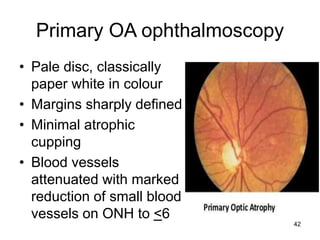
Primary OA ophthalmoscopy
• Pale disc, classically
paper white in colour
• Margins sharply defined
• Minimal atrophic
cupping
• Blood vessels
attenuated with marked
reduction of small blood
vessels on ONH to <6
42
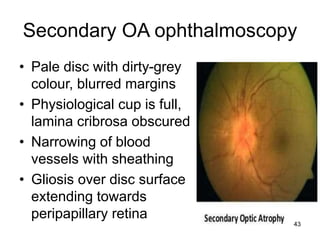
Secondary OA ophthalmoscopy
• Pale disc with dirty-grey
colour, blurred margins
• Physiological cup is full,
lamina cribrosa obscured
• Narrowing of blood
vessels with sheathing
• Gliosis over disc surface
extending towards
peripapillary retina
43
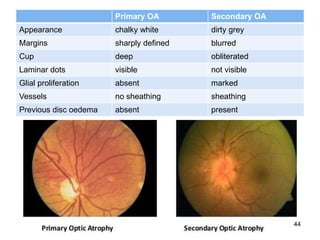
Primary OA Secondary OA
Appearance chalky white dirty grey
Margins sharply defined blurred
Cup deep obliterated
Laminar dots visible not visible
Glial proliferation absent marked
Vessels no sheathing sheathing
Previous disc oedema absent present
44
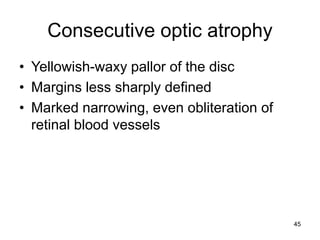
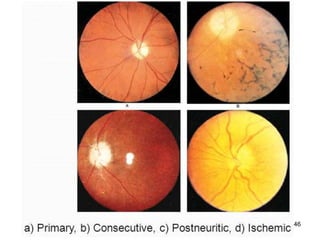
Consecutive optic atrophy
• Yellowish-waxy pallor of the disc
• Margins less sharply defined
• Marked narrowing, even obliteration of
retinal blood vessels
45
46
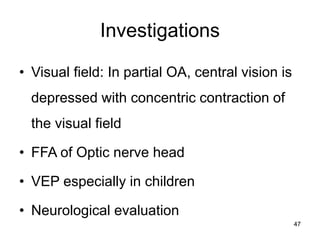
Investigations
• Visual field: In partial OA, central vision is
depressed with concentric contraction of
the visual field
• FFA of Optic nerve head
• VEP especially in children
• Neurological evaluation
47
Hereditary optic atrophy
• Autosomal recessive/dominant
• LHON: Leber's hereditary OA
48
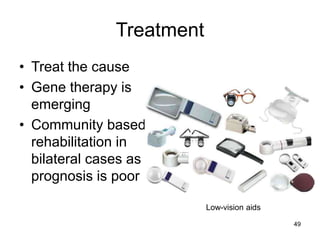
Treatment
• Treat the cause
• Gene therapy is
emerging
• Community based
rehabilitation in
bilateral cases as
prognosis is poor
Low-vision aids
49
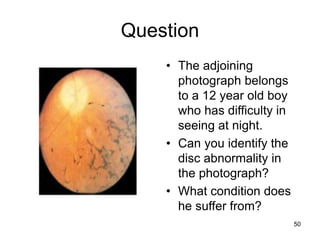
Question
• The adjoining
photograph belongs
to a 12 year old boy
who has difficulty in
seeing at night.
• Can you identify the
disc abnormality in
the photograph?
• What condition does
he suffer from?
50
Thank you
51

830_Optic_nerve_final.ppt

  • 1.
    Optic Neuritis, Papilledemaand Optic Atrophy Dr Ajai Agrawal Additional Professor Department of Ophthalmology AIIMS, Rishikesh
  • 2.
    Acknowledgement • Yanoff andDuker. Papilledema. 2016 In: Ophthalmology. Mosby Inc. • Khurana AK. Optic atrophy 2014 In: Comprehensive Ophthalmology. CBS Publishers • Weerasinghe, D., & Lueck, C.J. (2016). Mimics and chameleons of optic neuritis. Practical neurology;16(2):96-110. • CME: Optic Neuritis: Diagnosis, Treatment, and Prognosis. https://www.medscape.org/viewarticle/571660_2 • Kahloun R et al. Infectious optic neuropathies: a clinical update. Eye and Brain 2015;7:59-81 • Creel D. Visually Evoked Potentials. 2012 Mar 1. In: Kolb H, Fernandez E, Nelson R, editors. Webvision: The Organization of the Retina and Visual System [Internet]. Salt Lake City (UT): University of Utah Health Sciences Center; 1995-. Available from: https://www.ncbi.nlm.nih.gov/books/NBK107218/ • Pastora-Salvador N et al. Foster Kennedy syndrome: papilledema in one eye with optic atrophy in the other eye. CMAJ 2011;183(18):2135 • Reynolds SA. Pinpointing Papilledema. Optometric Management 2015:82-4 https://www.optometricmanagement.com/issues/2015/september-2015/clinical-posterior • Schiffmann J et al. Evaluation and treatment of papilledema in pregnancy. Comprehensive ophthalmology update 2006;7(4):187-202 • Toosy AT. Optic Neuritis. Lancet Neurol. 2014 Jan;13(1):83-99 2
  • 3.
    Learning Objectives • Atthe end of the class, students shall be able to • Define and classify optic neuritis. • Understand the aetiology and principles of management of optic neuritis. • Understand the stages and importance of papilloedema. • Differentiate between various types of optic atrophy. 3
  • 4.
  • 5.
    Question • The discin question is of a 60 year old myope who is instilling timolol eye drops since the past 5 years. • Is this a normal optic disc? 5
  • 6.
    Optic Neuritis Definition: Inflammationof the optic nerve, impairing nerve conduction. Secondary to demyelination, infection or autoimmune pathology. 6
  • 7.
    Classification A. Papillitis B. Retrobulbarneuritis – Acute – Chronic (toxic amblyopia) C. Neuroretinitis D. Perineuritis 7
  • 8.
    Aetiology • Idiopathic • Demyelinatingdisorders • Multiple Sclerosis – Presenting feature in 25% patients – 70% cases occur in established disease – Recurs in same/ opposite eye in 25% patients – Uhthoff”s phenomenon: impairment of vision more with increased body temperature – Pulfrich phenomenon: altered perception of moving objects 8
  • 9.
    Aetiology • Neuromyelitis optica(of Devic): acute, bilateral optic neuritis in young patient with paraplegia • Post-viral: mumps, measles, chicken pox, whooping cough • Metabolic/Nutritional deficiency: B1, B6, B12, B2, Folic acid deficiency Thyroid dysfunction, diabetes • Hereditary optic neuritis (Leber's disease) 9
  • 10.
    Aetiology • Toxic amblyopia: Chloroquine,Ethambutol Tobacco, Ethyl alcohol, methyl alcohol Lead, Arsenic. • Ischaemic: Giant cell arteritis, Takayasu's disease, PAN, SLE • Granulomatous inflammation: Sarcoidosis, tuberculosis, syphilis 10
  • 11.
    Symptoms • Idiopathic/demyelinating :20-40 years of age • Viral: children • Uniocular sudden/rapid diminution of vision • Visual loss, usually maximum by end of second week, improves by 1-4 weeks • Discomfort/pain behind eyeball especially when moved superiorly 11
  • 12.
    Signs • Visual Acuity:Usually 6/60 or less • Local tenderness • Pupillary reaction: Sluggish, ill-sustained or RAPD • Impaired coloured vision: hue, brightness • Impaired contrast sensitivity • Delayed dark adaptation • Visual Field: central, centrocaecal or paracentral scotoma, more pronounced for coloured fields 12
  • 13.
    Ophthalmoscopic findings • Opticneuritis: MC in children, engorged, oedematous optic disc with obliteration of optic cup, small haemorrhages on disc • Retrobulbar neuritis: MC in adults • Neuroretinitis: Optic neuritis+ macular star 13
  • 14.
    Differential diagnosis • Papilloedema •Pseudopapillitis High hypermetropia, Myelinated nerve fibres, Optic nerve head drusen (blurred margin, disc not significantly elevated, no vascular changes, stationary) 14
  • 15.
    Investigations • MRI: demyelinating lesions,SOL • VEP: reduced amplitude and delayed transmission time (P100 latency increased) Right optic neuritis 15
  • 16.
  • 17.
    Advanced case ofoptic neuritis 17
  • 18.
    Course and prognosis •Recovery takes 4-6 weeks • 90% recover normal VA, but colour vision defects may persist • No correlation between initial visual loss and final visual outcome • 10% secondary or post-neuritic optic atrophy • Better outcome in young, unilateral cases 18
  • 19.
    Treatment • Of causee.g. anti-infective therapy • Intravenous methyl prednisolone 20 mg/kg/day(250 mg QID) for 3 consecutive days followed by oral prednisolone 1-1.5 mg/kg • Dexamethasone 200 mg OD pulse for 3-5 days is a cheaper alternative • Supportive therapy 19
  • 20.
    Papilloedema • Definition: Bilateral,non-inflammatory passive swelling of optic disc due to raised Intracranial pressure. • Does not develop if optic nerve is atrophic 20
  • 21.
    Foster-Kennedy syndrome :contralateral papilloedema with ipsilateral pressure atrophy of optic nerve Due to - frontal lobe tumour, olfactory meningioma 21
  • 22.
    D/D: Causes of'disc oedema' • Papillitis, neuroretinitis • Anterior Ischemic Optic Neuropathy • Optic Nerve glioma, meningioma • Central Retinal Venous Occlusion 22
  • 23.
    Aetio-Pathogenesis • Elevated Intracranialpressure due to any cause • Prelaminar Optic Nerve is affected by changes in tissue pressure, IOP and CSF pressure • Increased CSF pressure increases tissue pressure hampering axoplasmic flow • This further increases pressure on pre-laminar capillaries and small veins causing vasodilatation and tortuosity • Venous drainage compromise further increases congestion 23
  • 24.
    General Symptoms • Headache,made worse by coughing or straining • Vomiting • Focal neurological deficit with/without changes in level of consciousness 24
  • 25.
    Ocular symptoms • VAmay be normal until late stages • Amaurosis fugax in some • In 25% patients, visual symptoms occur only in severe, advanced papilloedema 25
  • 26.
    Signs • Pupillary reactionsare normal until secondary atrophy sets in • Early: – Blurring of nasal>superior>inferior margins of disc – Disc hyperemia and dilated capillaries – Spontaneous venous pulsation absent – Splinter haemorrhages at/just off disc margin – Normal optic cup preserved 26
  • 27.
  • 28.
    Established papilloedema • Marginsindistinct and cup obliterated • Surface elevated upto more than +3 D with direct ophthalmoscope • Flame-shaped haemorrhages, cotton-wool spots • Venous engorgement and peripapillary oedema • Paton's Lines-radial lines cascading from optic disc • Macular star 28
  • 29.
    With progression • Chronicpapilloedema – Central cup remains obliterated – Haemorrhagic and exudative components resolve gradually – 'Champagne cork' appearance 29
  • 30.
    • Atrophic papilloedema –Retinal vessels attenuated with perivascular sheathing – Dirty white colour due to reactive gliosis – Leads to secondary optic atrophy 30
  • 31.
    Visual fields • Early-nochanges • Established stage- enlarged blind spot • Chronic- peripheral constriction of field with nerve fibre bundle defects • Finally- total loss of visual field 31
  • 32.
  • 33.
    Papilloedema Optic neuritis HistoryHeadache, vomiting Rapid DV preceded by fever/respiratory infection Laterality usually bilateral usually unilateral VA normal till late stage severely reduced <6/60 Pain/tenderness of eyeball absent may be present Pupil reaction normal RAPD (Marcus-Gunn's pupil) Disc swelling >+3 D in established +2D to +3D Haemorrhage, exudates More, in established relatively less Visual fields Enlarged blind spot, later gradual constriction Central or centrocaecal scotoma Colour vision No effect Affected CT/MRI SOL Demyelinating disorder Recovery of vision May not be complete even after treatment Usually complete after adequate treatment 33
  • 34.
    Treatment • Treat Cause •Acetazolamide 250 mg 4 times a day • Surgical decompression of optic nerve to preserve vision 34
  • 35.
    Optic Atrophy • Definition:Degeneration of optic nerve fibres with loss of their myelin sheaths characterised by pallor of the optic disc due to loss of vascularity owing to obliteration of disc capillaries 35
  • 36.
    Classification-Aetiological Primary Optic Atrophy •No local disturbance, associated with CNS disease or no discoverable cause • Commonest cause – Multiple Sclerosis • Leber's optic atrophy • Nerve compression: Tumour, hydrocephalus • Injury to retrobulbar optic nerve 36
  • 37.
    Cavernous type ofPrimary Optic Atrophy • Deep excavated cup with undermined edges – Glaucomatous optic atrophy 37
  • 38.
    Aetiological classification • Secondaryoptic atrophy: preceded by swelling of optic disc- papilledema, optic neuritis, neuroretinitis • Consecutive optic atrophy: follows extensive disease of the retina - Retinitis pigmentosa Long-standing retinal detachment 38
  • 39.
    Anatomical classification • Ascending:Lesion in retina, terminates at lateral geniculate body – • Eg: RP, CRAO • Descending: Disease involving optic nerve fibres anterior to LGB, terminates at optic disc – • Eg: chiasmal compression 39
  • 40.
    Symptoms • Gradual/rapid lossof central/peripheral vision • Impairment of colour vision 40
  • 41.
    Signs • Visual Acuityimpaired in proportion to death of optic nerve fibres • RAPD in unilateral Optic Atrophy Ultimately pupil dilated and immobile 41
  • 42.
    Primary OA ophthalmoscopy •Pale disc, classically paper white in colour • Margins sharply defined • Minimal atrophic cupping • Blood vessels attenuated with marked reduction of small blood vessels on ONH to <6 42
  • 43.
    Secondary OA ophthalmoscopy •Pale disc with dirty-grey colour, blurred margins • Physiological cup is full, lamina cribrosa obscured • Narrowing of blood vessels with sheathing • Gliosis over disc surface extending towards peripapillary retina 43
  • 44.
    Primary OA SecondaryOA Appearance chalky white dirty grey Margins sharply defined blurred Cup deep obliterated Laminar dots visible not visible Glial proliferation absent marked Vessels no sheathing sheathing Previous disc oedema absent present 44
  • 45.
    Consecutive optic atrophy •Yellowish-waxy pallor of the disc • Margins less sharply defined • Marked narrowing, even obliteration of retinal blood vessels 45
  • 46.
  • 47.
    Investigations • Visual field:In partial OA, central vision is depressed with concentric contraction of the visual field • FFA of Optic nerve head • VEP especially in children • Neurological evaluation 47
  • 48.
    Hereditary optic atrophy •Autosomal recessive/dominant • LHON: Leber's hereditary OA 48
  • 49.
    Treatment • Treat thecause • Gene therapy is emerging • Community based rehabilitation in bilateral cases as prognosis is poor Low-vision aids 49
  • 50.
    Question • The adjoining photographbelongs to a 12 year old boy who has difficulty in seeing at night. • Can you identify the disc abnormality in the photograph? • What condition does he suffer from? 50
  • 51.