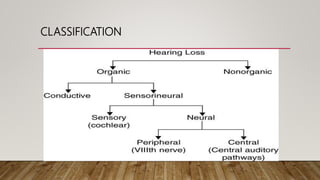
CLASSIFICATION
CONDUCTIVE HEARING LOSS
• Any disease process which interferes
with the conduction of sound to
reach cochlea causes conductive
hearing loss. The lesion may lie in
the external ear and tympanic
membrane, middle ear or ossicles up
to stapediovestibular joint.
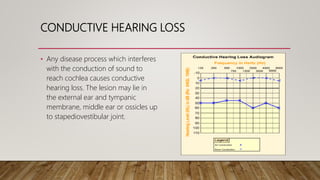
Negative Rinne test, i.e. BC > AC.
Weber lateralized to poorer ear.
Normal absolute bone conduction.
Low frequencies affected more.
Audiometry shows bone conduction better than air
conduction
with air-bone gap. Greater the air-bone gap,
more is the conductive loss.
Loss is not more than 60 dB.
Speech discrimination is good
CONGENITAL CAUSES OF
CONDUCTIVE HEARING LOSS
• Meatal atresia
• Fixation of stapes footplate
• Fixation of malleus head
• Ossicular discontinuity
• Congenital cholesteatoma
ACQUIRED CAUSES OF
CONDUCTIVE HEARING LOSS
• EXTERNAL EAR : Any obstruction in
the ear canal, e.g. wax, foreign body,
furuncle, acute inflammatory
swelling, benign or malignant
tumour or atresia of canal.
MIDDLE EAR
• (a) Perforation of tympanic membrane,
traumatic
• or infective
• (b) Fluid in the middle ear, e.g. acute
otitis media,
• serous otitis media or
haemotympanum
• (c) Mass in middle ear, e.g. benign or
malignant
• tumour
• (d) Disruption of ossicles, e.g. trauma to
ossicular
• chain, chronic suppurative otitis media,
• cholesteatoma
• (e) Fixation of ossicles, e.g. otosclerosis,
tympanosclerosis,
• adhesive otitis media
• (f) Eustachian tube blockage, e.g.
retracted tympanic
• membrane, serous otitis media
SENSORINEURAL HEARING LOSS
AND ITS MANAGEMENT
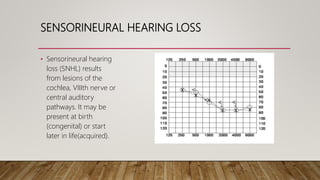
• Sensorineural hearing loss (SNHL) results from lesions of
• the cochlea, VIIIth nerve or central auditory pathways. It
• may be present at birth (congenital) or start later in life
• (acquired).
• The characteristics of sensorineural hearing loss are:
SENSORINEURAL HEARING LOSS
• Sensorineural hearing
loss (SNHL) results
from lesions of the
cochlea, VIIIth nerve or
central auditory
pathways. It may be
present at birth
(congenital) or start
later in life(acquired).
• The characteristics of sensorineural hearing loss are:
• 1. A positive Rinne test, i.e. AC > BC.
• 2. Weber lateralized to better ear.
• 3. Bone conduction reduced on Schwabach and absolute
• bone conduction tests.
• 4. More often involving high frequencies.
• 5. No gap between air and bone conduction curve on audiometry
• 6. Loss may exceed 60 dB.
• 7. Speech discrimination is poor.
• 8. There is difficulty in hearing in the presence of noise.
• 1. Infections of labyrinth—viral, bacterial
or spirochaetal
• 2. Trauma to labyrinth or VIIIth nerve, e.g.
fractures of
• temporal bone or concussion of the
labyrinth or the ear
• surgery
• 3. Noise-induced hearing loss
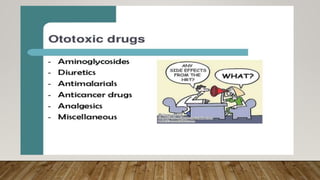
• 4. Ototoxic drugs
• 5. Presbycusis
• 6. Ménière’s disease
• 7. Acoustic neuroma
• 8. Sudden hearing loss
• 9. Familial progressive SNHL
• 10. Systemic disorders, e.g. diabetes,
hypothyroidism, kidney disease, autoimmune
disorders, multiple sclerosis, blood
dyscrasias.
SPECIFIC FORMS OF HEARING LOSS
• A. INFLAMMATIONS OF LABYRINTH
• B. FAMILIAL PROGRESSIVE SENSORINEURAL HEARING LOSS
• C. OTOTOXICITY
• D. NOISE TRAUMA
• E. AUTOIMMUNE (IMMUNE-MEDIATED) INNER EAR DISEASE
• F. SUDDEN HEARING LOSS
• G. PRESBYCUSIS
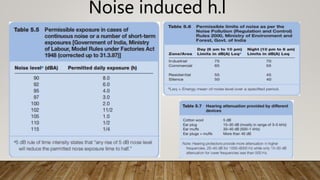
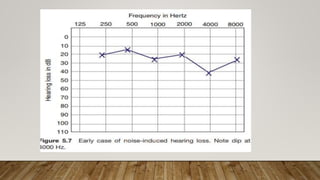
Noise induced h.l
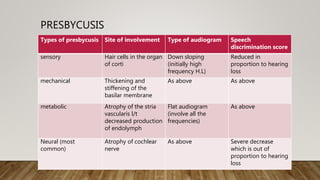
PRESBYCUSIS
Types of presbycusis Site of involvement Type of audiogram Speech
discrimination score
sensory Hair cells in the organ
of corti
Down sloping
(initially high
frequency H.L)
Reduced in
proportion to hearing
loss
mechanical Thickening and
stiffening of the
basilar membrane
As above As above
metabolic Atrophy of the stria
vascularis l/t
decreased production
of endolymph
Flat audiogram
(involve all the
frequencies)
As above
Neural (most
common)
Atrophy of cochlear
nerve
As above Severe decrease
which is out of
proportion to hearing
loss
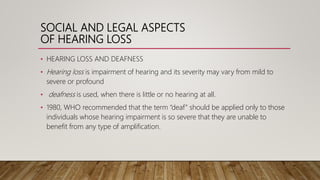
SOCIAL AND LEGAL ASPECTS
OF HEARING LOSS
• HEARING LOSS AND DEAFNESS
• Hearing loss is impairment of hearing and its severity may vary from mild to
severe or profound
• deafness is used, when there is little or no hearing at all.
• 1980, WHO recommended that the term “deaf” should be applied only to those
individuals whose hearing impairment is so severe that they are unable to
benefit from any type of amplification.
DEFINITION OF DEAF
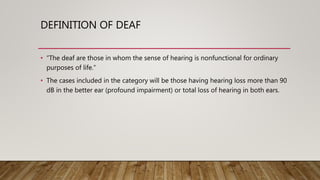
• “The deaf are those in whom the sense of hearing is nonfunctional for ordinary
purposes of life.”
• The cases included in the category will be those having hearing loss more than 90
dB in the better ear (profound impairment) or total loss of hearing in both ears.
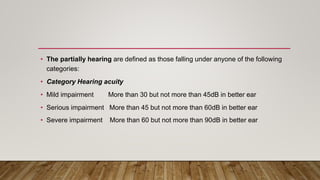
• The partially hearing are defined as those falling under anyone of the following
categories:
• Category Hearing acuity
• Mild impairment More than 30 but not more than 45dB in better ear
• Serious impairment More than 45 but not more than 60dB in better ear
• Severe impairment More than 60 but not more than 90dB in better ear
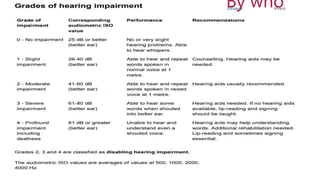
Grade of impairment Corresponding audiometric ISO value Performance Recommendations
0 - No impairment 25 dB or better (better ear) No or very slight hearing problems. Able to hear whispers.
1 - Slight impairment 26-40 dB (better ear) Able to hear and repeat words spoken in normal voice at 1 metre.
Counselling. Hearing aids may be needed.
2 - Moderate impairment 41-60 dB (better ear) Able to hear and repeat words spoken in raised voice at 1 metre.
Hearing aids usually recommended.
3 - Severe impairment 61-80 dB (better ear) Able to hear some words when shouted into better ear. Hearing aids
needed. If no hearing aids available, lip-reading and signing should be taught.
4 - Profound impairment including deafness 81 dB or greater (better ear) Unable to hear and understand even a
shouted voice. Hearing aids may help understanding words. Additional rehabilitation needed. Lip-reading and
sometimes signing essential.
Grades 2, 3 and 4 are classified as disabling hearing impairment
By who
IMPAIRMENT, DISABILITY AND HANDICAP
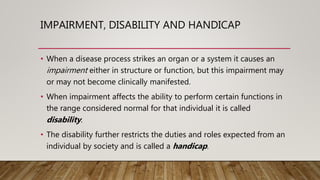
• When a disease process strikes an organ or a system it causes an
impairment either in structure or function, but this impairment may
or may not become clinically manifested.
• When impairment affects the ability to perform certain functions in
the range considered normal for that individual it is called
disability.
• The disability further restricts the duties and roles expected from an
individual by society and is called a handicap.
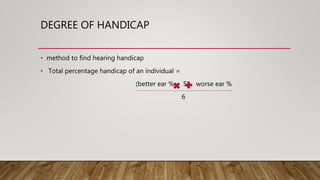
DEGREE OF HANDICAP
• method to find hearing handicap
• Total percentage handicap of an individual =
(better ear % 5) worse ear %
6

HEARING LOSS

  • 2.
  • 3.
    CONDUCTIVE HEARING LOSS •Any disease process which interferes with the conduction of sound to reach cochlea causes conductive hearing loss. The lesion may lie in the external ear and tympanic membrane, middle ear or ossicles up to stapediovestibular joint.
  • 4.
    Negative Rinne test,i.e. BC > AC. Weber lateralized to poorer ear. Normal absolute bone conduction. Low frequencies affected more. Audiometry shows bone conduction better than air conduction with air-bone gap. Greater the air-bone gap, more is the conductive loss. Loss is not more than 60 dB. Speech discrimination is good
  • 5.
    CONGENITAL CAUSES OF CONDUCTIVEHEARING LOSS • Meatal atresia • Fixation of stapes footplate • Fixation of malleus head • Ossicular discontinuity • Congenital cholesteatoma ACQUIRED CAUSES OF CONDUCTIVE HEARING LOSS • EXTERNAL EAR : Any obstruction in the ear canal, e.g. wax, foreign body, furuncle, acute inflammatory swelling, benign or malignant tumour or atresia of canal.
  • 6.
    MIDDLE EAR • (a)Perforation of tympanic membrane, traumatic • or infective • (b) Fluid in the middle ear, e.g. acute otitis media, • serous otitis media or haemotympanum • (c) Mass in middle ear, e.g. benign or malignant • tumour • (d) Disruption of ossicles, e.g. trauma to ossicular • chain, chronic suppurative otitis media, • cholesteatoma • (e) Fixation of ossicles, e.g. otosclerosis, tympanosclerosis, • adhesive otitis media • (f) Eustachian tube blockage, e.g. retracted tympanic • membrane, serous otitis media
  • 7.
    SENSORINEURAL HEARING LOSS ANDITS MANAGEMENT • Sensorineural hearing loss (SNHL) results from lesions of • the cochlea, VIIIth nerve or central auditory pathways. It • may be present at birth (congenital) or start later in life • (acquired). • The characteristics of sensorineural hearing loss are:
  • 8.
    SENSORINEURAL HEARING LOSS •Sensorineural hearing loss (SNHL) results from lesions of the cochlea, VIIIth nerve or central auditory pathways. It may be present at birth (congenital) or start later in life(acquired).
  • 9.
    • The characteristicsof sensorineural hearing loss are: • 1. A positive Rinne test, i.e. AC > BC. • 2. Weber lateralized to better ear. • 3. Bone conduction reduced on Schwabach and absolute • bone conduction tests. • 4. More often involving high frequencies. • 5. No gap between air and bone conduction curve on audiometry
  • 10.
    • 6. Lossmay exceed 60 dB. • 7. Speech discrimination is poor. • 8. There is difficulty in hearing in the presence of noise.
  • 11.
    • 1. Infectionsof labyrinth—viral, bacterial or spirochaetal • 2. Trauma to labyrinth or VIIIth nerve, e.g. fractures of • temporal bone or concussion of the labyrinth or the ear • surgery • 3. Noise-induced hearing loss • 4. Ototoxic drugs • 5. Presbycusis • 6. Ménière’s disease • 7. Acoustic neuroma • 8. Sudden hearing loss • 9. Familial progressive SNHL • 10. Systemic disorders, e.g. diabetes, hypothyroidism, kidney disease, autoimmune disorders, multiple sclerosis, blood dyscrasias.
  • 12.
    SPECIFIC FORMS OFHEARING LOSS • A. INFLAMMATIONS OF LABYRINTH • B. FAMILIAL PROGRESSIVE SENSORINEURAL HEARING LOSS • C. OTOTOXICITY • D. NOISE TRAUMA • E. AUTOIMMUNE (IMMUNE-MEDIATED) INNER EAR DISEASE • F. SUDDEN HEARING LOSS • G. PRESBYCUSIS
  • 14.
  • 16.
    PRESBYCUSIS Types of presbycusisSite of involvement Type of audiogram Speech discrimination score sensory Hair cells in the organ of corti Down sloping (initially high frequency H.L) Reduced in proportion to hearing loss mechanical Thickening and stiffening of the basilar membrane As above As above metabolic Atrophy of the stria vascularis l/t decreased production of endolymph Flat audiogram (involve all the frequencies) As above Neural (most common) Atrophy of cochlear nerve As above Severe decrease which is out of proportion to hearing loss
  • 17.
    SOCIAL AND LEGALASPECTS OF HEARING LOSS • HEARING LOSS AND DEAFNESS • Hearing loss is impairment of hearing and its severity may vary from mild to severe or profound • deafness is used, when there is little or no hearing at all. • 1980, WHO recommended that the term “deaf” should be applied only to those individuals whose hearing impairment is so severe that they are unable to benefit from any type of amplification.
  • 18.
    DEFINITION OF DEAF •“The deaf are those in whom the sense of hearing is nonfunctional for ordinary purposes of life.” • The cases included in the category will be those having hearing loss more than 90 dB in the better ear (profound impairment) or total loss of hearing in both ears.
  • 19.
    • The partiallyhearing are defined as those falling under anyone of the following categories: • Category Hearing acuity • Mild impairment More than 30 but not more than 45dB in better ear • Serious impairment More than 45 but not more than 60dB in better ear • Severe impairment More than 60 but not more than 90dB in better ear
  • 20.
    Grade of impairmentCorresponding audiometric ISO value Performance Recommendations 0 - No impairment 25 dB or better (better ear) No or very slight hearing problems. Able to hear whispers. 1 - Slight impairment 26-40 dB (better ear) Able to hear and repeat words spoken in normal voice at 1 metre. Counselling. Hearing aids may be needed. 2 - Moderate impairment 41-60 dB (better ear) Able to hear and repeat words spoken in raised voice at 1 metre. Hearing aids usually recommended. 3 - Severe impairment 61-80 dB (better ear) Able to hear some words when shouted into better ear. Hearing aids needed. If no hearing aids available, lip-reading and signing should be taught. 4 - Profound impairment including deafness 81 dB or greater (better ear) Unable to hear and understand even a shouted voice. Hearing aids may help understanding words. Additional rehabilitation needed. Lip-reading and sometimes signing essential. Grades 2, 3 and 4 are classified as disabling hearing impairment By who
  • 21.
    IMPAIRMENT, DISABILITY ANDHANDICAP • When a disease process strikes an organ or a system it causes an impairment either in structure or function, but this impairment may or may not become clinically manifested. • When impairment affects the ability to perform certain functions in the range considered normal for that individual it is called disability. • The disability further restricts the duties and roles expected from an individual by society and is called a handicap.
  • 22.
    DEGREE OF HANDICAP •method to find hearing handicap • Total percentage handicap of an individual = (better ear % 5) worse ear % 6