P-N junction
I
+ V –
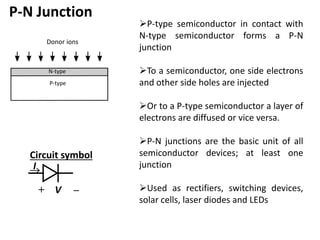
Circuit symbol
P-N Junction
Donor ions
N-type
P-type
P-type semiconductor in contact with
N-type semiconductor forms a P-N
junction
To a semiconductor, one side electrons
and other side holes are injected
Or to a P-type semiconductor a layer of
electrons are diffused or vice versa.
P-N junctions are the basic unit of all
semiconductor devices; at least one
junction
Used as rectifiers, switching devices,
solar cells, laser diodes and LEDs
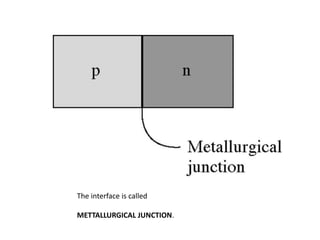
The interface is called
METTALLURGICAL JUNCTION.
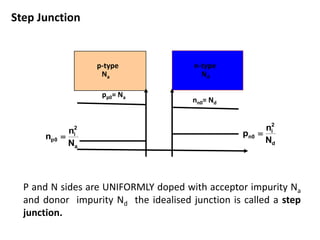
n-typep-type
NdNa
pp0= Na
nn0= Nd
a
2
i
0p
N
n
n 
d
2
i
0n
N
n
p 
Step Junction
P and N sides are UNIFORMLY doped with acceptor impurity Na
and donor impurity Nd the idealised junction is called a step
junction.
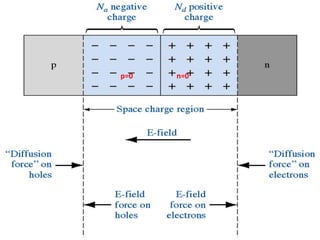
n=0p=0
BASIC STRUCTURE
1.Due to density gradient of the majority carriers across the junction, carrier
diffusion takes place.
2. Recombination of majority carriers across the junction leaves behind positive
dopant ions on the N-side and negative dopant ions on the P-side.
3. Separation of charge creates a POTENTIAL DIFFERENCE at the junction and an
ELECTRIC FIELD is established directed from N to P side of the junction.
4. In a region on both sides of the junction free carriers (electrons and holes) are
absent, this is called DEPLETION LAYER or SPACE CHARGE REGION
5. Outside this region density gradient and diffusion force on the majority
carriers exist.
6. At equilibrium, the diffusion force is balanced by the electric force on the
carriers.
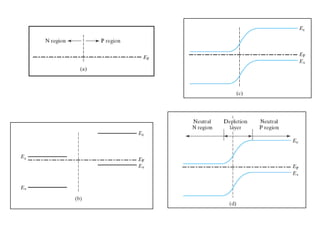
 No voltage applied to the junction– P-N junction at thermal equilibrium
 This is called ZERO BIASING.
 Majority carriers from both side experience a POTENTIAL BARRIER due to
the electric field at the junction.
 This barrier at the junction is called BUILT-IN-POTENTIAL BARRIER.
 BUILT-IN-POTENTIAL BARRIER ( Vbi) maintains equilibrium between the
carriers across the junction and prevents further recombination across the
junction.
 Vbi is calculated as it can not be measured directly.
 In the depletion layer, n=0 and p=0
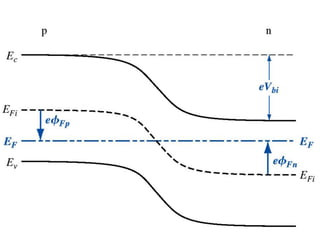
 FERMI LEVEL is constant throughout the system.
 A bending of band observed from P to N side.
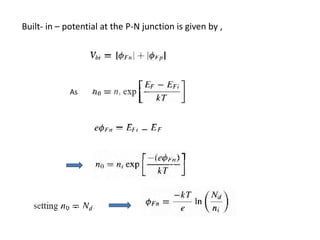
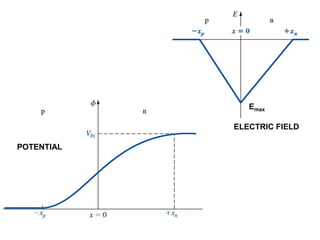
Built- in – potential at the P-N junction is given by ,
As
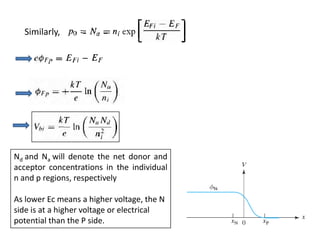
Nd and Na will denote the net donor and
acceptor concentrations in the individual
n and p regions, respectively
As lower Ec means a higher voltage, the N
side is at a higher voltage or electrical
potential than the P side.
Similarly,
ELECTRIC FIELD
POTENTIAL
Emax
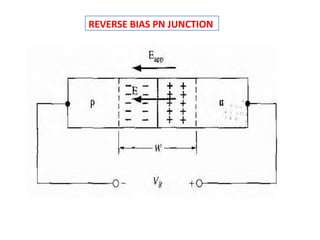
REVERSE BIAS PN JUNCTION
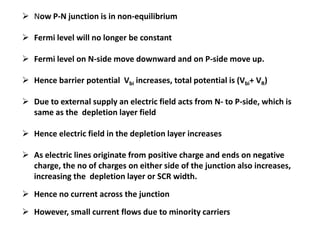
 Now P-N junction is in non-equilibrium
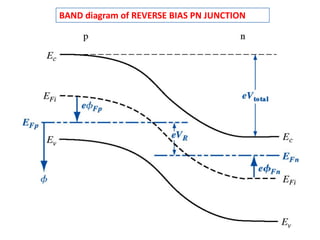
 Fermi level will no longer be constant
 Fermi level on N-side move downward and on P-side move up.
 Hence barrier potential Vbi increases, total potential is (Vbi+ VR)
 Due to external supply an electric field acts from N- to P-side, which is
same as the depletion layer field
 Hence electric field in the depletion layer increases
 As electric lines originate from positive charge and ends on negative
charge, the no of charges on either side of the junction also increases,
increasing the depletion layer or SCR width.
 Hence no current across the junction
 However, small current flows due to minority carriers
BAND diagram of REVERSE BIAS PN JUNCTION
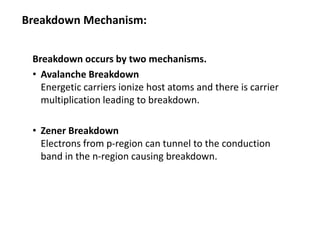
Breakdown Mechanism:
Breakdown occurs by two mechanisms.
• Avalanche Breakdown
Energetic carriers ionize host atoms and there is carrier
multiplication leading to breakdown.
• Zener Breakdown
Electrons from p-region can tunnel to the conduction
band in the n-region causing breakdown.
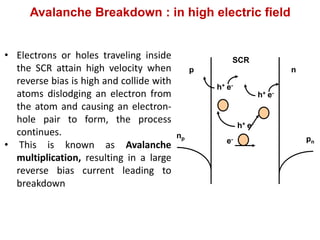
Avalanche Breakdown : in high electric field
• Electrons or holes traveling inside
the SCR attain high velocity when
reverse bias is high and collide with
atoms dislodging an electron from
the atom and causing an electron-
hole pair to form, the process
continues.
• This is known as Avalanche
multiplication, resulting in a large
reverse bias current leading to
breakdown
np pn
p n
SCR
e-
e-h+
e-h+
e-h+
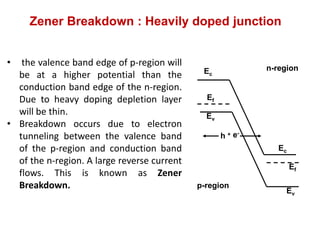
Zener Breakdown : Heavily doped junction
• the valence band edge of p-region will
be at a higher potential than the
conduction band edge of the n-region.
Due to heavy doping depletion layer
will be thin.
• Breakdown occurs due to electron
tunneling between the valence band
of the p-region and conduction band
of the n-region. A large reverse current
flows. This is known as Zener
Breakdown.
Ec
Ev
Ef
Ec
Ef
Ev
p-region
n-region
e-
h +
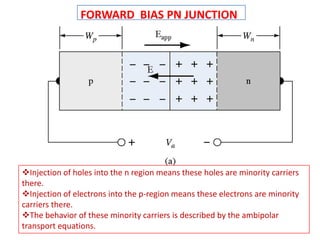
FORWARD BIAS PN JUNCTION
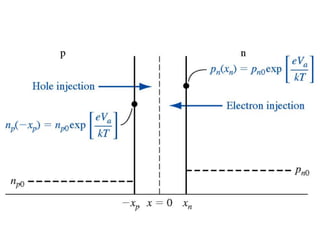
Injection of holes into the n region means these holes are minority carriers
there.
Injection of electrons into the p-region means these electrons are minority
carriers there.
The behavior of these minority carriers is described by the ambipolar
transport equations.
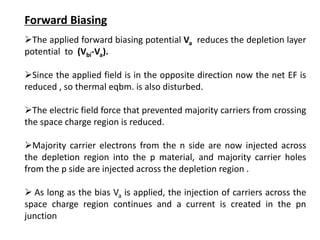
Forward Biasing
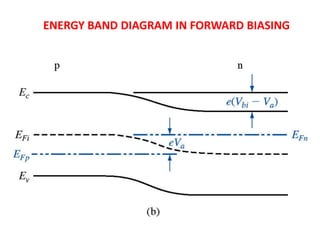
The applied forward biasing potential Va reduces the depletion layer
potential to (Vbi-Va).
Since the applied field is in the opposite direction now the net EF is
reduced , so thermal eqbm. is also disturbed.
The electric field force that prevented majority carriers from crossing
the space charge region is reduced.
Majority carrier electrons from the n side are now injected across
the depletion region into the p material, and majority carrier holes
from the p side are injected across the depletion region .
 As long as the bias Va is applied, the injection of carriers across the
space charge region continues and a current is created in the pn
junction
ENERGY BAND DIAGRAM IN FORWARD BIASING
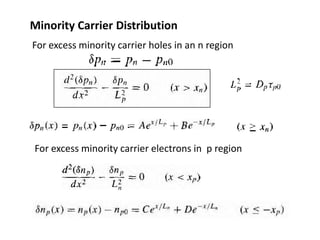
Minority Carrier Distribution
For excess minority carrier holes in an n region
For excess minority carrier electrons in p region
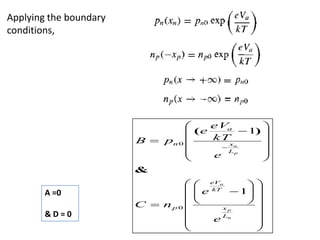
Applying the boundary
conditions,







































n
p
a
p
n
L
x
kT
eV
p
L
x
a
n
e
e
nC
e
kT
eV
e
pB
1
1
0
0
&
)(
A =0
& D = 0
)(
)()(,
n
p
nkT
eV
n
nnn
xx
L
xx
eep
pxpxpso
a












10
0
)(
)()(&,
p
n
pkT
eV
p
ppp
xx
L
xx
een
nxnxn
a












10
0
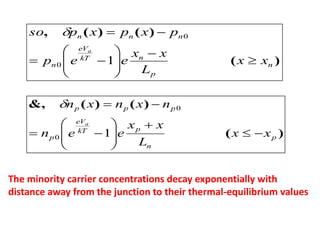
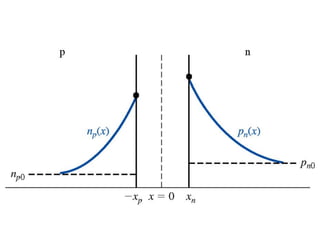
The minority carrier concentrations decay exponentially with
distance away from the junction to their thermal-equilibrium values
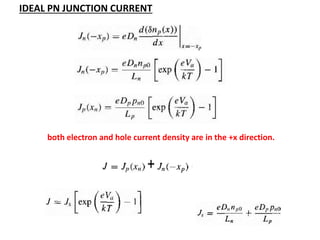
IDEAL PN JUNCTION CURRENT
both electron and hole current density are in the +x direction.
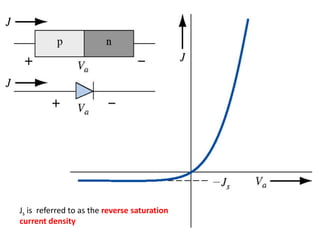
Js is referred to as the reverse saturation
current density
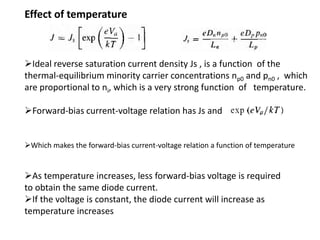
Ideal reverse saturation current density Js , is a function of the
thermal-equilibrium minority carrier concentrations np0 and pn0 , which
are proportional to ni, which is a very strong function of temperature.
Forward-bias current-voltage relation has Js and
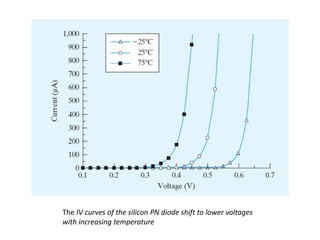
As temperature increases, less forward-bias voltage is required
to obtain the same diode current.
If the voltage is constant, the diode current will increase as
temperature increases
Which makes the forward-bias current-voltage relation a function of temperature
Effect of temperature
The IV curves of the silicon PN diode shift to lower voltages
with increasing temperature
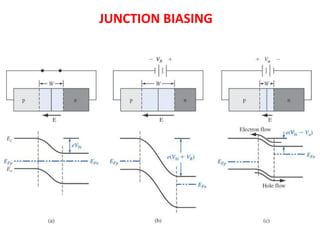
JUNCTION BIASING

P n junction--eema

  • 1.
  • 2.
    I + V – Circuitsymbol P-N Junction Donor ions N-type P-type P-type semiconductor in contact with N-type semiconductor forms a P-N junction To a semiconductor, one side electrons and other side holes are injected Or to a P-type semiconductor a layer of electrons are diffused or vice versa. P-N junctions are the basic unit of all semiconductor devices; at least one junction Used as rectifiers, switching devices, solar cells, laser diodes and LEDs
  • 3.
    The interface iscalled METTALLURGICAL JUNCTION.
  • 4.
    n-typep-type NdNa pp0= Na nn0= Nd a 2 i 0p N n n d 2 i 0n N n p  Step Junction P and N sides are UNIFORMLY doped with acceptor impurity Na and donor impurity Nd the idealised junction is called a step junction.
  • 5.
  • 6.
    BASIC STRUCTURE 1.Due todensity gradient of the majority carriers across the junction, carrier diffusion takes place. 2. Recombination of majority carriers across the junction leaves behind positive dopant ions on the N-side and negative dopant ions on the P-side. 3. Separation of charge creates a POTENTIAL DIFFERENCE at the junction and an ELECTRIC FIELD is established directed from N to P side of the junction. 4. In a region on both sides of the junction free carriers (electrons and holes) are absent, this is called DEPLETION LAYER or SPACE CHARGE REGION 5. Outside this region density gradient and diffusion force on the majority carriers exist. 6. At equilibrium, the diffusion force is balanced by the electric force on the carriers.
  • 7.
     No voltageapplied to the junction– P-N junction at thermal equilibrium  This is called ZERO BIASING.  Majority carriers from both side experience a POTENTIAL BARRIER due to the electric field at the junction.  This barrier at the junction is called BUILT-IN-POTENTIAL BARRIER.  BUILT-IN-POTENTIAL BARRIER ( Vbi) maintains equilibrium between the carriers across the junction and prevents further recombination across the junction.  Vbi is calculated as it can not be measured directly.  In the depletion layer, n=0 and p=0  FERMI LEVEL is constant throughout the system.  A bending of band observed from P to N side.
  • 10.
    Built- in –potential at the P-N junction is given by , As
  • 11.
    Nd and Nawill denote the net donor and acceptor concentrations in the individual n and p regions, respectively As lower Ec means a higher voltage, the N side is at a higher voltage or electrical potential than the P side. Similarly,
  • 12.
  • 13.
  • 14.
     Now P-Njunction is in non-equilibrium  Fermi level will no longer be constant  Fermi level on N-side move downward and on P-side move up.  Hence barrier potential Vbi increases, total potential is (Vbi+ VR)  Due to external supply an electric field acts from N- to P-side, which is same as the depletion layer field  Hence electric field in the depletion layer increases  As electric lines originate from positive charge and ends on negative charge, the no of charges on either side of the junction also increases, increasing the depletion layer or SCR width.  Hence no current across the junction  However, small current flows due to minority carriers
  • 15.
    BAND diagram ofREVERSE BIAS PN JUNCTION
  • 16.
    Breakdown Mechanism: Breakdown occursby two mechanisms. • Avalanche Breakdown Energetic carriers ionize host atoms and there is carrier multiplication leading to breakdown. • Zener Breakdown Electrons from p-region can tunnel to the conduction band in the n-region causing breakdown.
  • 17.
    Avalanche Breakdown :in high electric field • Electrons or holes traveling inside the SCR attain high velocity when reverse bias is high and collide with atoms dislodging an electron from the atom and causing an electron- hole pair to form, the process continues. • This is known as Avalanche multiplication, resulting in a large reverse bias current leading to breakdown np pn p n SCR e- e-h+ e-h+ e-h+
  • 18.
    Zener Breakdown :Heavily doped junction • the valence band edge of p-region will be at a higher potential than the conduction band edge of the n-region. Due to heavy doping depletion layer will be thin. • Breakdown occurs due to electron tunneling between the valence band of the p-region and conduction band of the n-region. A large reverse current flows. This is known as Zener Breakdown. Ec Ev Ef Ec Ef Ev p-region n-region e- h +
  • 19.
    FORWARD BIAS PNJUNCTION Injection of holes into the n region means these holes are minority carriers there. Injection of electrons into the p-region means these electrons are minority carriers there. The behavior of these minority carriers is described by the ambipolar transport equations.
  • 20.
    Forward Biasing The appliedforward biasing potential Va reduces the depletion layer potential to (Vbi-Va). Since the applied field is in the opposite direction now the net EF is reduced , so thermal eqbm. is also disturbed. The electric field force that prevented majority carriers from crossing the space charge region is reduced. Majority carrier electrons from the n side are now injected across the depletion region into the p material, and majority carrier holes from the p side are injected across the depletion region .  As long as the bias Va is applied, the injection of carriers across the space charge region continues and a current is created in the pn junction
  • 21.
    ENERGY BAND DIAGRAMIN FORWARD BIASING
  • 23.
    Minority Carrier Distribution Forexcess minority carrier holes in an n region For excess minority carrier electrons in p region
  • 24.
  • 25.
  • 27.
    IDEAL PN JUNCTIONCURRENT both electron and hole current density are in the +x direction.
  • 28.
    Js is referredto as the reverse saturation current density
  • 29.
    Ideal reverse saturationcurrent density Js , is a function of the thermal-equilibrium minority carrier concentrations np0 and pn0 , which are proportional to ni, which is a very strong function of temperature. Forward-bias current-voltage relation has Js and As temperature increases, less forward-bias voltage is required to obtain the same diode current. If the voltage is constant, the diode current will increase as temperature increases Which makes the forward-bias current-voltage relation a function of temperature Effect of temperature
  • 30.
    The IV curvesof the silicon PN diode shift to lower voltages with increasing temperature
  • 31.