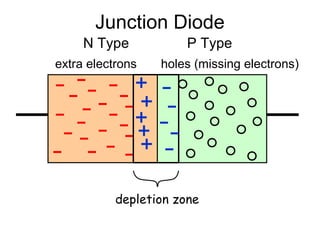
Junction Diode
     N Type            P Type
extra electrons   holes (missing electrons)


           depletion zone
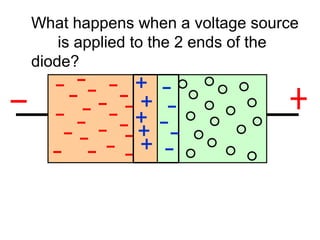
What happens when a voltage source
    is applied to the 2 ends of the
diode?
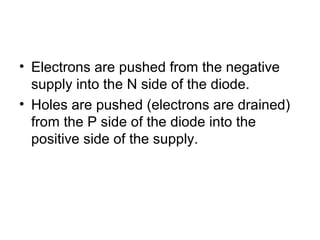
• Electrons are pushed from the negative
  supply into the N side of the diode.
• Holes are pushed (electrons are drained)
  from the P side of the diode into the
  positive side of the supply.
What happens when a voltage source
    is applied to the 2 ends of the
diode?
As more and more charges build up,
  easier for charges to move across the
  depletion zone


Current flows as electrons flow from N type
through holes of P type out to positive source
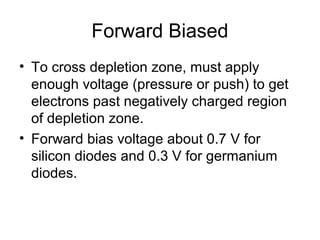
Forward Biased
• To cross depletion zone, must apply
  enough voltage (pressure or push) to get
  electrons past negatively charged region
  of depletion zone.
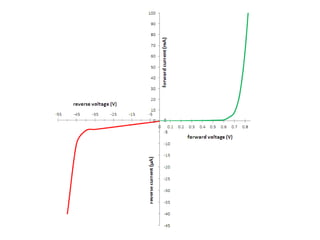
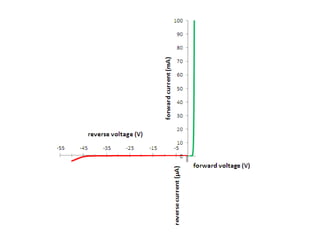
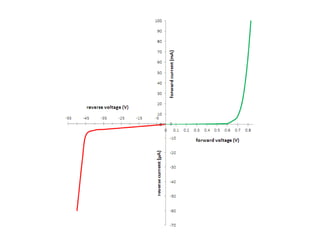
• Forward bias voltage about 0.7 V for
  silicon diodes and 0.3 V for germanium
  diodes.
What happens if the voltage
  polarity is reversed?
What happens if the voltage
  polarity is reversed?


       depletion zone
           widens
Reversed Bias
• When diodes are reverse biased, depletion
  zone widens
• Harder for charges to cross depletion zone
• High enough voltage will force charges
  across depletion zone
  – Breakdown voltage = voltage level that causes
    diodes to conduct when reverse biased
  – Heat from large reverse current destroys diode
Diodes act as switches
• When forward biased, diode acts as a
  short (very low resistance).
• When reverse biased, diode acts as an
  open circuit (huge resistance).
Testing Diodes
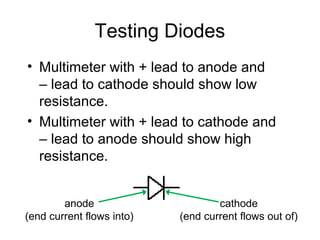
• Multimeter with + lead to anode and
  – lead to cathode should show low
  resistance.
• Multimeter with + lead to cathode and
  – lead to anode should show high
  resistance.


        anode                      cathode
(end current flows into)   (end current flows out of)
Types of diodes
Rectifier diodes
– convert AC to DC, handles higher power
   • 1N4001 to 1N4007 IF = 1A, PIV = 50V to 100V

Signal diodes or switching diodes
– faster response at high frequencies
   • 1N4148 IF = 200mA, PIV = 100V

Zener diode
– holds voltage level steady
Schottky diode
– fast recovery time, low voltage, low noise
Diodes

Diodes

  • 2.
    Junction Diode N Type P Type extra electrons holes (missing electrons) depletion zone
  • 3.
    What happens whena voltage source is applied to the 2 ends of the diode?
  • 4.
    • Electrons arepushed from the negative supply into the N side of the diode. • Holes are pushed (electrons are drained) from the P side of the diode into the positive side of the supply.
  • 5.
    What happens whena voltage source is applied to the 2 ends of the diode?
  • 6.
    As more andmore charges build up, easier for charges to move across the depletion zone Current flows as electrons flow from N type through holes of P type out to positive source
  • 7.
    Forward Biased • Tocross depletion zone, must apply enough voltage (pressure or push) to get electrons past negatively charged region of depletion zone. • Forward bias voltage about 0.7 V for silicon diodes and 0.3 V for germanium diodes.
  • 8.
    What happens ifthe voltage polarity is reversed?
  • 9.
    What happens ifthe voltage polarity is reversed? depletion zone widens
  • 10.
    Reversed Bias • Whendiodes are reverse biased, depletion zone widens • Harder for charges to cross depletion zone • High enough voltage will force charges across depletion zone – Breakdown voltage = voltage level that causes diodes to conduct when reverse biased – Heat from large reverse current destroys diode
  • 13.
    Diodes act asswitches • When forward biased, diode acts as a short (very low resistance). • When reverse biased, diode acts as an open circuit (huge resistance).
  • 14.
    Testing Diodes • Multimeterwith + lead to anode and – lead to cathode should show low resistance. • Multimeter with + lead to cathode and – lead to anode should show high resistance. anode cathode (end current flows into) (end current flows out of)
  • 17.
    Types of diodes Rectifierdiodes – convert AC to DC, handles higher power • 1N4001 to 1N4007 IF = 1A, PIV = 50V to 100V Signal diodes or switching diodes – faster response at high frequencies • 1N4148 IF = 200mA, PIV = 100V Zener diode – holds voltage level steady Schottky diode – fast recovery time, low voltage, low noise