UNITII
SEMICONDUCTOR PHYSICS
PN JUNCTIONDIODE
Biasing of PN junction diode
1. Forward bias and Reverse bias
Principle
• If the p-region (anode) is connected to the positive terminal of the external DC
source and n-side (cathode) is connected to the negative terminal of the DC source
then the biasing is said to be “forward biasing”.
• Due to the negative terminal of external source connected to the n-region, free
electrons from n-side are pushed towards the p-side. Similarly the positive end of
the supply will push holes from p-side towards the n-side.
With increase in the external supply voltage V, more and more number of holes (p-
side) and electrons (n-side) start travelling towards the junction as shown in figure.
• The holes will start converting the negative ions into neutral atoms and the
electrons will convert the positive ions into neutral atoms. As a result of this, the
width of depletion region will reduce.
• Due to reduction in the depletion region width, the barrier potential will also
reduce. Eventually at a particular value of V the depletion region will collapse. Now
there is absolutely no opposition to the flow of electrons and holes.
Hence a large number of electrons and holes (majority carriers) can cross the
junction under the influence of externally connected DC voltage.
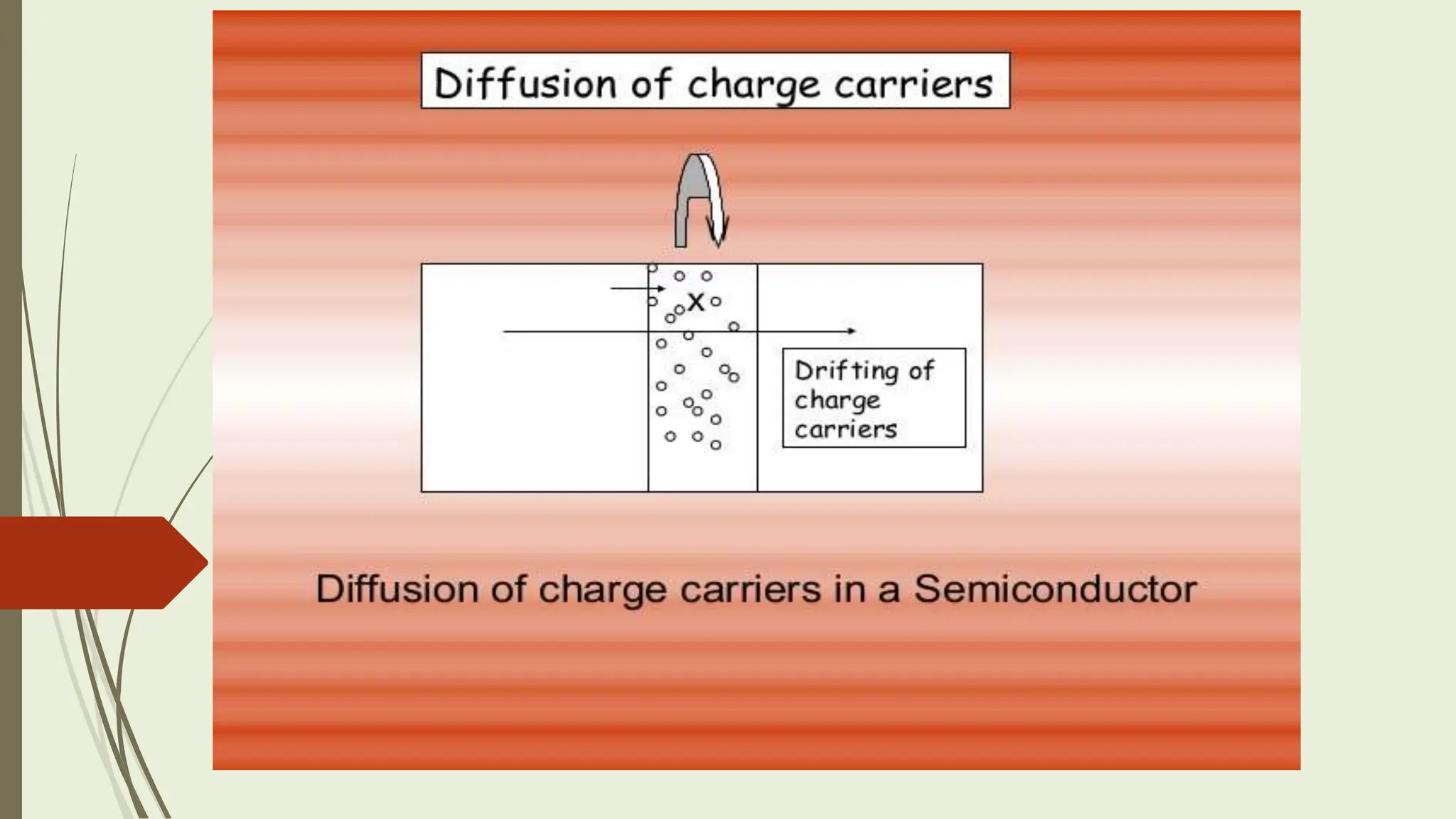
The formation of depletion layer in PN junction.
• At the instant P-N junction formation, the free electrons near the
junction in the N- region begin to diffuse across the junction in to P-
region where they combine with holes near the junction.
• The result is that N-region loses free electrons this creates a layer of
positive charges (pentavalent ions) near the junction.
• The P-region loses holes and the result that there is a negative
charges (trivalent ions near the junction.
• The shaded region on both sides of the junction in Fig. below
contains only immobile ions and no free charge carriers such as
electrons or holes.
• In other words this region is depleted of free charge carriers.
Therefore region is called as depletion region.
• Once P-N junction is formed and depletion layer is created the
diffusion of free electrons stops.
• The positive and negative charges set an electric field.
i)Reverse saturation current: In reverse bias condition there will
be negligible amount of current that will flow through the device
due to minority carrier which is called as reverse saturation
current.
ii. Knee voltage: The applied forward voltage at which the PN
junctions start conducting is called the cut-in voltage. It is also
known as knee voltage (Vk or Vz). The value of cut-in voltage is
0.7 V for Silicon and 0.3 V for Germanium PN junction diodes.
iii. Depletion layer: The region in PN junction which comprises of
immobile ions is called depletion region.
iv. Static resistance of diode: The resistance of a diode at the
operating point can be obtained by taking the ratio of VF and IF.
The resistance offered by the diode to the forward DC operating
conditions is called as “DC or static resistance”.
Avalanche break down in P- N junction
diode.
•Under reverse bias condition, the minority carrier flowing
through the P- N junction acquires a kinetic energy depending
upon the velocity with which they move.
• The increase in reverse voltage increases the amount of
kinetic energy imparted to minority carrier, as they diffuse across
the PN junction.
• When sufficient voltage is applied, the minority carrier acquires
a large amount of kinetic energy (or momentum).
• When these minority carriers collide with semiconductor
(Germanium or silicon) atoms within the crystal structure of a PN
junction they impart sufficient energy to break covalent bond and
generate additional carrier (i.e. electron- hole pairs).
•They knock out the electrons from the covalent bonds of a
PN junction.
• These additional carriers pick up the energy from the
applied voltage and generate still more carriers. As a result of
this, the reverse current through the PN junction increase.
•The cumulative process of carrier generation (i.e.
multiplication) is known as avalanche breakdown.
• Under breakdown condition, the reverse current is no longer
limited by the PN junction. But it can be limited only by the
circuit components.
• The value of breakdown voltage depends upon the degree
of doping in PN junction.
The forward and reverse characteristics of PN junction
diode
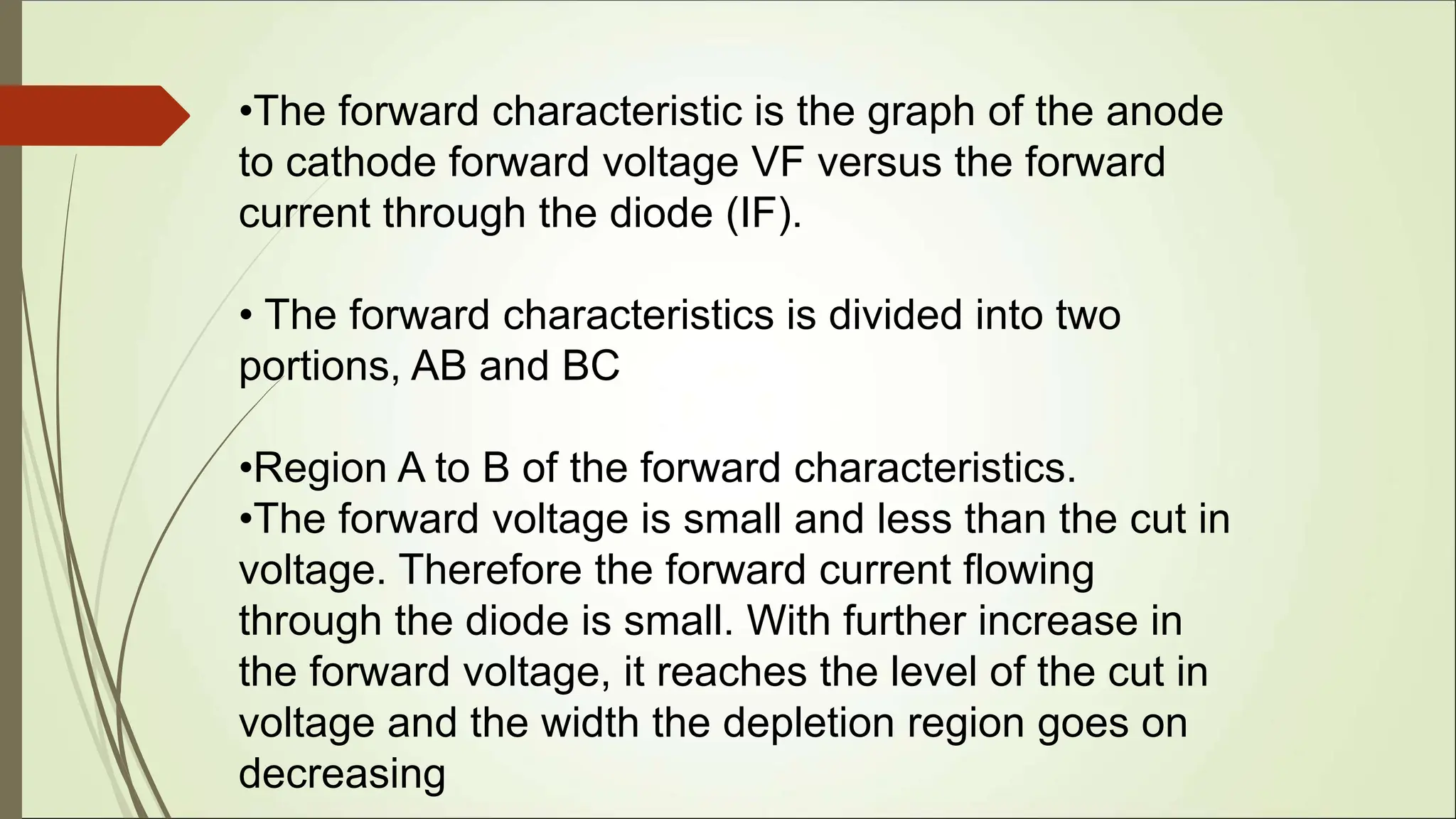
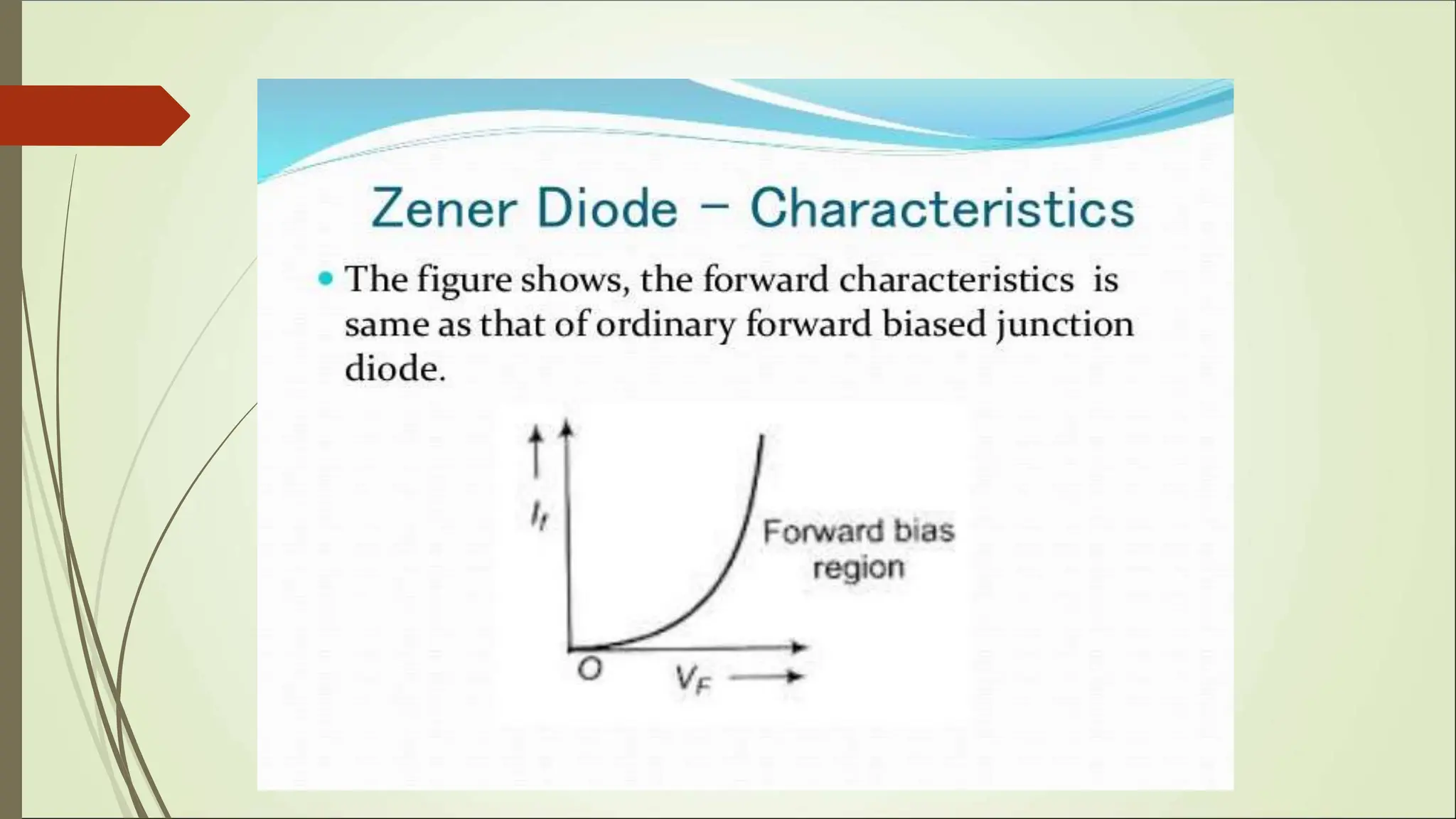
•The forward characteristic is the graph of the anode
to cathode forward voltage VF versus the forward
current through the diode (IF).
• The forward characteristics is divided into two
portions, AB and BC
•Region A to B of the forward characteristics.
•The forward voltage is small and less than the cut in
voltage. Therefore the forward current flowing
through the diode is small. With further increase in
the forward voltage, it reaches the level of the cut in
voltage and the width the depletion region goes on
decreasing
Region B to C:
•As soon as the forward voltage equals the cut in voltage,
current through the diode increase suddenly. The nature of
this current is exponential. The large forward current in the
region B-C of the forward characteristics is limited by
connecting a resistor R in series with the diode. Forward
current is of the order of a few mA.
• The forward current is a conventional current that flows
from anode to cathode. Therefore it is considered to be a
positive current, and the forward characteristics appears in
the first quadrant.
Reverse characteristics of a Diode.
Cut in voltage (Knee voltage):
• The voltage at which the forward diode current
starts increasing rapidly is known as the cut in
voltage of a diode. The cut in voltage is very close to
the barrier potential. Cut in voltage is also called as
knee voltage.
• Generally a diode is forward biased above the cut
in voltage. The cut in voltage for a silicon diode is 0.6
V and that for a germanium diode is 0.2V.
•Current flowing through a diode in the reverse biased state is the reverse saturation
current which flows due to the minority carriers.
•As the reverse voltage is increased, the reverse saturation current remains constant if the
temperature is constant. This is because, reverse saturation current does not depend on
reverse voltage but it depends only on temperature.
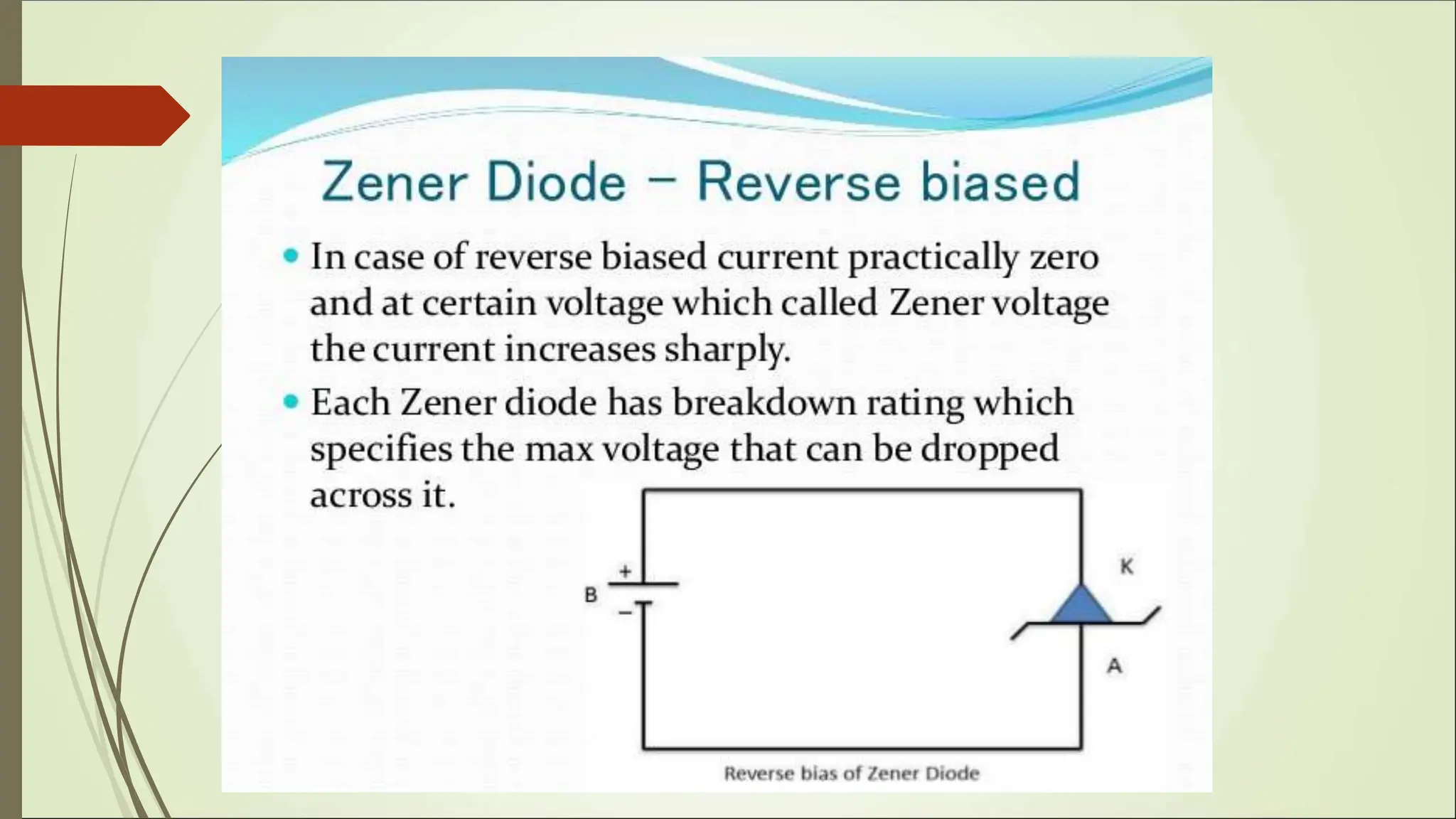
• But as the reverse voltage reaches the breakdown voltage value. a large current flows
through the diode, due to the reasons discussed earlier.
• Thus we define the reverse breakdown voltage of a pn junction diode as the reverse
voltage at which breakdown takes place and a large reverse current starts flowing through
the diode.
• Operation in the breakdown region should be avoided because the diode may be
damaged due to excessive power dissipation.
•Typically the reverse breakdown voltage for p-n junction diode is in range of 50 to 100
volts.
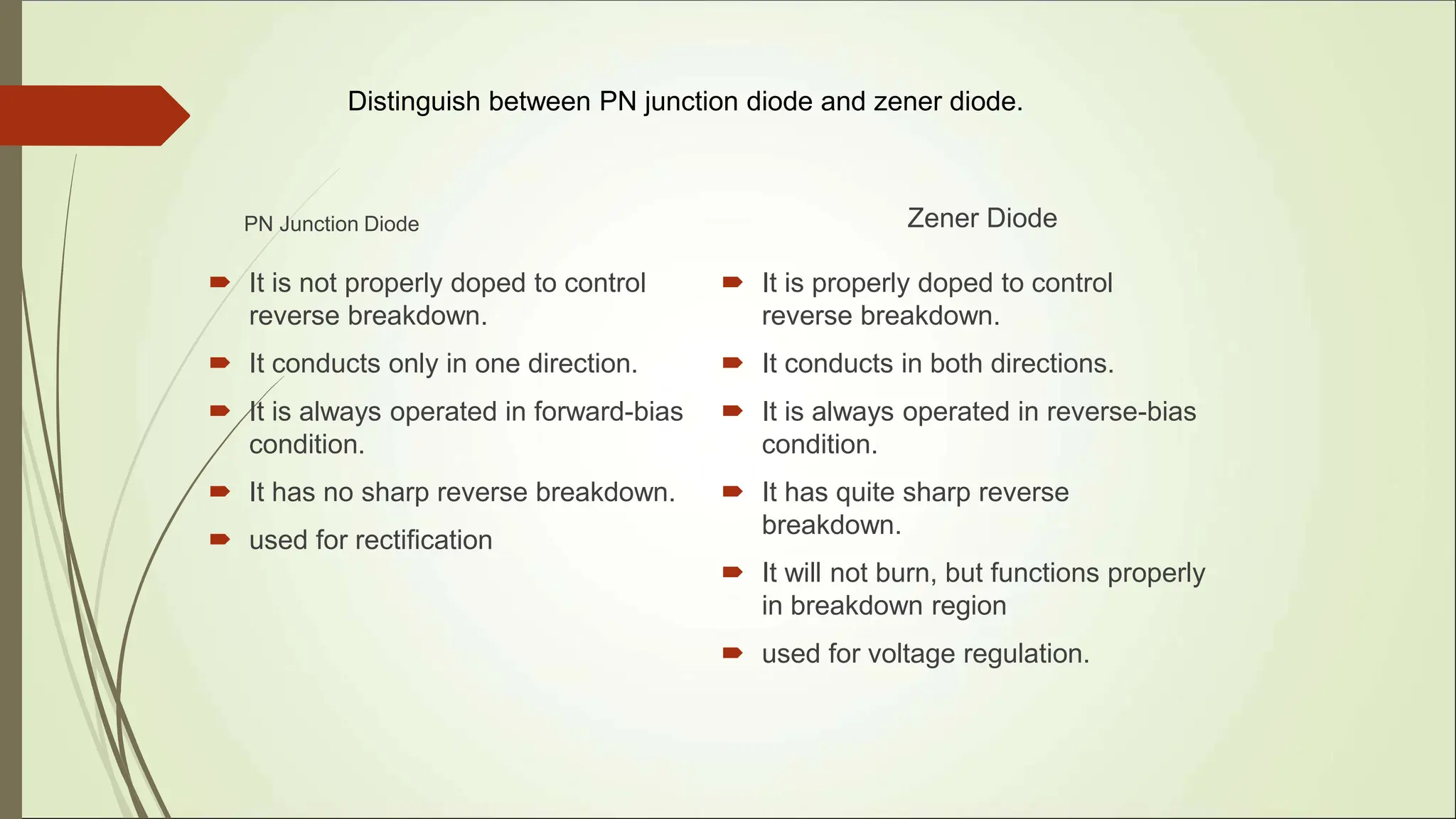
Distinguish between PN junction diode and zener diode.
PN Junction Diode
 It is not properly doped to control
reverse breakdown.
 It conducts only in one direction.
 It is always operated in forward-bias
condition.
 It has no sharp reverse breakdown.
 used for rectification
Zener Diode
 It is properly doped to control
reverse breakdown.
 It conducts in both directions.
 It is always operated in reverse-bias
condition.
 It has quite sharp reverse
breakdown.
 It will not burn, but functions properly
in breakdown region
 used for voltage regulation.
UNIT II.ppt
UNIT II.ppt
UNIT II.ppt
UNIT II.ppt
UNIT II.ppt
UNIT II.ppt
UNIT II.ppt
UNIT II.ppt
UNIT II.ppt
UNIT II.ppt
UNIT II.ppt
UNIT II.ppt
UNIT II.ppt

UNIT II.ppt

  • 1.
  • 51.
  • 52.
    Biasing of PNjunction diode 1. Forward bias and Reverse bias
  • 53.
    Principle • If thep-region (anode) is connected to the positive terminal of the external DC source and n-side (cathode) is connected to the negative terminal of the DC source then the biasing is said to be “forward biasing”. • Due to the negative terminal of external source connected to the n-region, free electrons from n-side are pushed towards the p-side. Similarly the positive end of the supply will push holes from p-side towards the n-side. With increase in the external supply voltage V, more and more number of holes (p- side) and electrons (n-side) start travelling towards the junction as shown in figure. • The holes will start converting the negative ions into neutral atoms and the electrons will convert the positive ions into neutral atoms. As a result of this, the width of depletion region will reduce. • Due to reduction in the depletion region width, the barrier potential will also reduce. Eventually at a particular value of V the depletion region will collapse. Now there is absolutely no opposition to the flow of electrons and holes. Hence a large number of electrons and holes (majority carriers) can cross the junction under the influence of externally connected DC voltage.
  • 54.
    The formation ofdepletion layer in PN junction.
  • 55.
    • At theinstant P-N junction formation, the free electrons near the junction in the N- region begin to diffuse across the junction in to P- region where they combine with holes near the junction. • The result is that N-region loses free electrons this creates a layer of positive charges (pentavalent ions) near the junction. • The P-region loses holes and the result that there is a negative charges (trivalent ions near the junction. • The shaded region on both sides of the junction in Fig. below contains only immobile ions and no free charge carriers such as electrons or holes. • In other words this region is depleted of free charge carriers. Therefore region is called as depletion region. • Once P-N junction is formed and depletion layer is created the diffusion of free electrons stops. • The positive and negative charges set an electric field.
  • 57.
    i)Reverse saturation current:In reverse bias condition there will be negligible amount of current that will flow through the device due to minority carrier which is called as reverse saturation current. ii. Knee voltage: The applied forward voltage at which the PN junctions start conducting is called the cut-in voltage. It is also known as knee voltage (Vk or Vz). The value of cut-in voltage is 0.7 V for Silicon and 0.3 V for Germanium PN junction diodes. iii. Depletion layer: The region in PN junction which comprises of immobile ions is called depletion region. iv. Static resistance of diode: The resistance of a diode at the operating point can be obtained by taking the ratio of VF and IF. The resistance offered by the diode to the forward DC operating conditions is called as “DC or static resistance”.
  • 58.
    Avalanche break downin P- N junction diode.
  • 59.
    •Under reverse biascondition, the minority carrier flowing through the P- N junction acquires a kinetic energy depending upon the velocity with which they move. • The increase in reverse voltage increases the amount of kinetic energy imparted to minority carrier, as they diffuse across the PN junction. • When sufficient voltage is applied, the minority carrier acquires a large amount of kinetic energy (or momentum). • When these minority carriers collide with semiconductor (Germanium or silicon) atoms within the crystal structure of a PN junction they impart sufficient energy to break covalent bond and generate additional carrier (i.e. electron- hole pairs).
  • 60.
    •They knock outthe electrons from the covalent bonds of a PN junction. • These additional carriers pick up the energy from the applied voltage and generate still more carriers. As a result of this, the reverse current through the PN junction increase. •The cumulative process of carrier generation (i.e. multiplication) is known as avalanche breakdown. • Under breakdown condition, the reverse current is no longer limited by the PN junction. But it can be limited only by the circuit components. • The value of breakdown voltage depends upon the degree of doping in PN junction.
  • 61.
    The forward andreverse characteristics of PN junction diode
  • 62.
    •The forward characteristicis the graph of the anode to cathode forward voltage VF versus the forward current through the diode (IF). • The forward characteristics is divided into two portions, AB and BC •Region A to B of the forward characteristics. •The forward voltage is small and less than the cut in voltage. Therefore the forward current flowing through the diode is small. With further increase in the forward voltage, it reaches the level of the cut in voltage and the width the depletion region goes on decreasing
  • 63.
    Region B toC: •As soon as the forward voltage equals the cut in voltage, current through the diode increase suddenly. The nature of this current is exponential. The large forward current in the region B-C of the forward characteristics is limited by connecting a resistor R in series with the diode. Forward current is of the order of a few mA. • The forward current is a conventional current that flows from anode to cathode. Therefore it is considered to be a positive current, and the forward characteristics appears in the first quadrant.
  • 64.
  • 65.
    Cut in voltage(Knee voltage): • The voltage at which the forward diode current starts increasing rapidly is known as the cut in voltage of a diode. The cut in voltage is very close to the barrier potential. Cut in voltage is also called as knee voltage. • Generally a diode is forward biased above the cut in voltage. The cut in voltage for a silicon diode is 0.6 V and that for a germanium diode is 0.2V.
  • 66.
    •Current flowing througha diode in the reverse biased state is the reverse saturation current which flows due to the minority carriers. •As the reverse voltage is increased, the reverse saturation current remains constant if the temperature is constant. This is because, reverse saturation current does not depend on reverse voltage but it depends only on temperature. • But as the reverse voltage reaches the breakdown voltage value. a large current flows through the diode, due to the reasons discussed earlier. • Thus we define the reverse breakdown voltage of a pn junction diode as the reverse voltage at which breakdown takes place and a large reverse current starts flowing through the diode. • Operation in the breakdown region should be avoided because the diode may be damaged due to excessive power dissipation. •Typically the reverse breakdown voltage for p-n junction diode is in range of 50 to 100 volts.
  • 77.
    Distinguish between PNjunction diode and zener diode. PN Junction Diode  It is not properly doped to control reverse breakdown.  It conducts only in one direction.  It is always operated in forward-bias condition.  It has no sharp reverse breakdown.  used for rectification Zener Diode  It is properly doped to control reverse breakdown.  It conducts in both directions.  It is always operated in reverse-bias condition.  It has quite sharp reverse breakdown.  It will not burn, but functions properly in breakdown region  used for voltage regulation.