
Microscopy
• ‘Human eye is not capable to observe the objects that
are less than 100µ.
• Microscope is important tool for a cell biologist.
• Invention of light microscope in 16th century is the
most important single contribution.
• Microscope opened the universe of microorganisms.
• It also enabled us to study structure cells and tissues in
ultra details.
• Fields of biology viz. embryology, histology, mycology,
bacteriology, etc. owe their existence due to
microscope.
• Based on source of microscopes are classified Light
Microscope and Electron Microscope
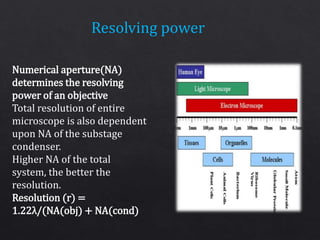
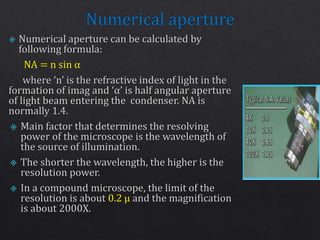
Resolving power
Numerical aperture(NA)
determines the resolving
power of an objective
Total resolution of entire
microscope is also dependent
upon NA of the substage
condenser.
Higher NA of the total
system, the better the
resolution.
Resolution (r) =
1.22λ/(NA(obj) + NA(cond)
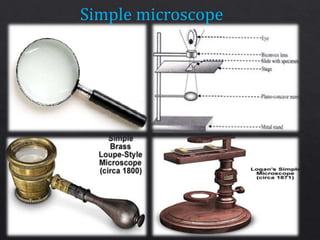
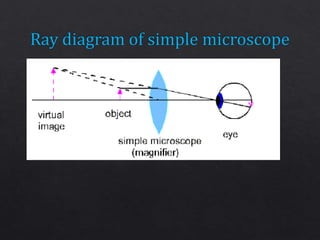
Simple microscope
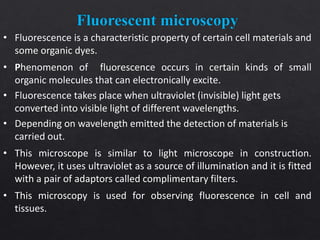
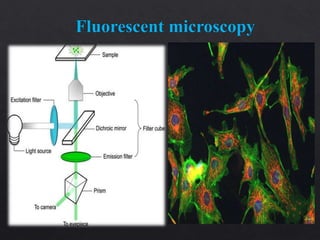
• Fluorescence is a characteristic property of certain cell materials and
some organic dyes.
• Phenomenon of fluorescence occurs in certain kinds of small
organic molecules that can electronically excite.
• Fluorescence takes place when ultraviolet (invisible) light gets
converted into visible light of different wavelengths.
• Depending on wavelength emitted the detection of materials is
carried out.
• This microscope is similar to light microscope in construction.
However, it uses ultraviolet as a source of illumination and it is fitted
with a pair of adaptors called complimentary filters.
• This microscopy is used for observing fluorescence in cell and
tissues.
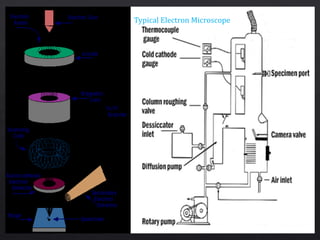
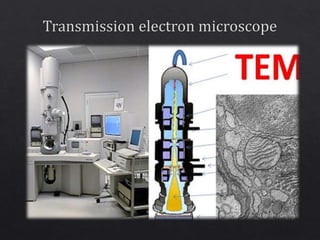
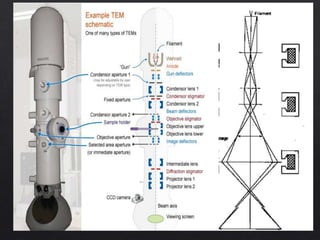
Typical Electron Microscope
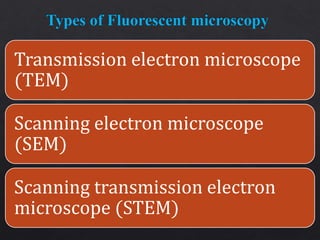
Transmission electron microscope
(TEM)
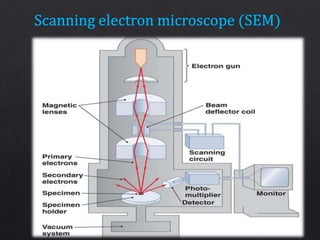
Scanning electron microscope
(SEM)
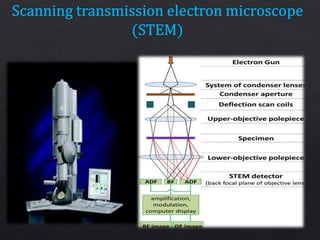
Scanning transmission electron
microscope (STEM)
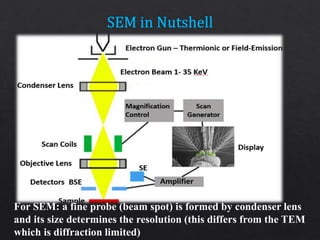
For SEM: a fine probe (beam spot) is formed by condenser lens
and its size determines the resolution (this differs from the TEM
which is diffraction limited)
1
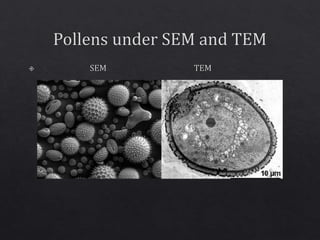
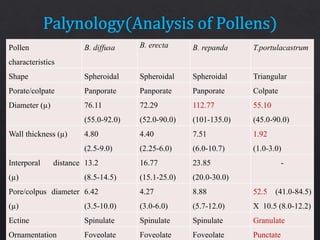
Pollen
characteristics
B. diffusa B. erecta B. repanda T.portulacastrum
Shape Spheroidal Spheroidal Spheroidal Triangular
Porate/colpate Panporate Panporate Panporate Colpate
Diameter (µ) 76.11
(55.0-92.0)
72.29
(52.0-90.0)
112.77
(101-135.0)
55.10
(45.0-90.0)
Wall thickness (µ) 4.80
(2.5-9.0)
4.40
(2.25-6.0)
7.51
(6.0-10.7)
1.92
(1.0-3.0)
Interporal distance
(µ)
13.2
(8.5-14.5)
16.77
(15.1-25.0)
23.85
(20.0-30.0)
-
Pore/colpus diameter
(µ)
6.42
(3.5-10.0)
4.27
(3.0-6.0)
8.88
(5.7-12.0)
52.5 (41.0-84.5)
X 10.5 (8.0-12.2)
Ectine Spinulate Spinulate Spinulate Granulate
Ornamentation Foveolate Foveolate Foveolate Punctate
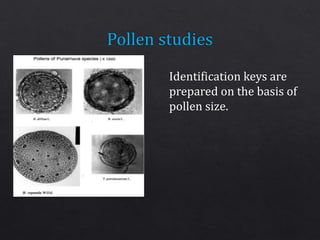
Identification keys are
prepared on the basis of
pollen size.
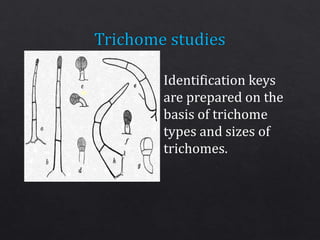
Identification keys
are prepared on the
basis of trichome
types and sizes of
trichomes.
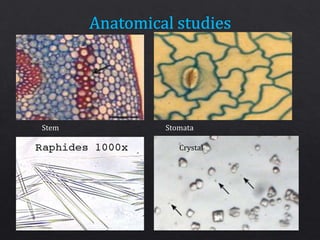
Stem Stomata
Crystals
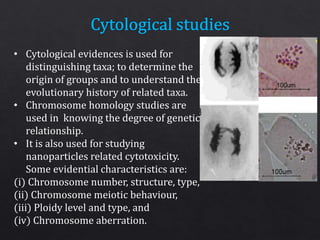
• Cytological evidences is used for
distinguishing taxa; to determine the
origin of groups and to understand the
evolutionary history of related taxa.
• Chromosome homology studies are
used in knowing the degree of genetic
relationship.
• It is also used for studying
nanoparticles related cytotoxicity.
Some evidential characteristics are:
(i) Chromosome number, structure, type,
(ii) Chromosome meiotic behaviour,
(iii) Ploidy level and type, and
(iv) Chromosome aberration.
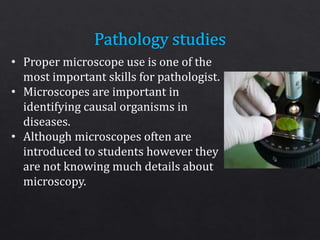
• Proper microscope use is one of the
most important skills for pathologist.
• Microscopes are important in
identifying causal organisms in
diseases.
• Although microscopes often are
introduced to students however they
are not knowing much details about
microscopy.
Overview of Microscopic techniques

Overview of Microscopic techniques

  • 2.
    Microscopy • ‘Human eyeis not capable to observe the objects that are less than 100µ. • Microscope is important tool for a cell biologist. • Invention of light microscope in 16th century is the most important single contribution. • Microscope opened the universe of microorganisms. • It also enabled us to study structure cells and tissues in ultra details. • Fields of biology viz. embryology, histology, mycology, bacteriology, etc. owe their existence due to microscope. • Based on source of microscopes are classified Light Microscope and Electron Microscope
  • 9.
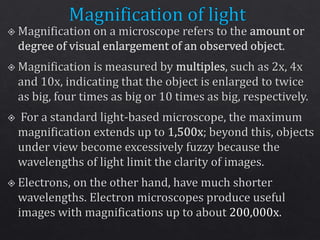
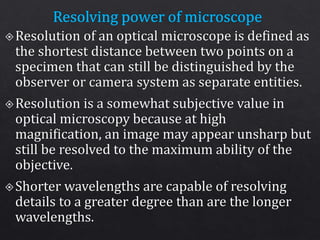
    Resolving power Numerical aperture(NA) determinesthe resolving power of an objective Total resolution of entire microscope is also dependent upon NA of the substage condenser. Higher NA of the total system, the better the resolution. Resolution (r) = 1.22λ/(NA(obj) + NA(cond)
  • 12.
  • 27.
    • Fluorescence isa characteristic property of certain cell materials and some organic dyes. • Phenomenon of fluorescence occurs in certain kinds of small organic molecules that can electronically excite. • Fluorescence takes place when ultraviolet (invisible) light gets converted into visible light of different wavelengths. • Depending on wavelength emitted the detection of materials is carried out. • This microscope is similar to light microscope in construction. However, it uses ultraviolet as a source of illumination and it is fitted with a pair of adaptors called complimentary filters. • This microscopy is used for observing fluorescence in cell and tissues.
  • 35.
  • 36.
    Transmission electron microscope (TEM) Scanningelectron microscope (SEM) Scanning transmission electron microscope (STEM)
  • 44.
    For SEM: afine probe (beam spot) is formed by condenser lens and its size determines the resolution (this differs from the TEM which is diffraction limited)
  • 53.
  • 54.
    Pollen characteristics B. diffusa B.erecta B. repanda T.portulacastrum Shape Spheroidal Spheroidal Spheroidal Triangular Porate/colpate Panporate Panporate Panporate Colpate Diameter (µ) 76.11 (55.0-92.0) 72.29 (52.0-90.0) 112.77 (101-135.0) 55.10 (45.0-90.0) Wall thickness (µ) 4.80 (2.5-9.0) 4.40 (2.25-6.0) 7.51 (6.0-10.7) 1.92 (1.0-3.0) Interporal distance (µ) 13.2 (8.5-14.5) 16.77 (15.1-25.0) 23.85 (20.0-30.0) - Pore/colpus diameter (µ) 6.42 (3.5-10.0) 4.27 (3.0-6.0) 8.88 (5.7-12.0) 52.5 (41.0-84.5) X 10.5 (8.0-12.2) Ectine Spinulate Spinulate Spinulate Granulate Ornamentation Foveolate Foveolate Foveolate Punctate
  • 55.
    Identification keys are preparedon the basis of pollen size.
  • 56.
    Identification keys are preparedon the basis of trichome types and sizes of trichomes.
  • 59.
  • 60.
    • Cytological evidencesis used for distinguishing taxa; to determine the origin of groups and to understand the evolutionary history of related taxa. • Chromosome homology studies are used in knowing the degree of genetic relationship. • It is also used for studying nanoparticles related cytotoxicity. Some evidential characteristics are: (i) Chromosome number, structure, type, (ii) Chromosome meiotic behaviour, (iii) Ploidy level and type, and (iv) Chromosome aberration.
  • 61.
    • Proper microscopeuse is one of the most important skills for pathologist. • Microscopes are important in identifying causal organisms in diseases. • Although microscopes often are introduced to students however they are not knowing much details about microscopy.