RECENT ADVANCES IN MICROSCOPIC
TECHNIQUES: CRYO-EM
PRESENTED BY- DANISH NIGAR
CONTENTS
• WHAT IS MICROSCOPY
• HISTORICAL BACKGROUND
• VARIABLES USED IN MICROSCOPY
• CLASSIFICATION OF MICROSCOPY
• RECENT DEVELOPMENTS IN MICROSCOPY
• CRYO ELECTRON MICROSCOPY
• THE RISE OF CRYO ELECTRON MICROSCOPY
• HOW THE CRYO ELECTRON MICROSCOPE WORKS
• SPECIMEN PREPARATION
• APPLICATION OF CRYO-EM
• PROS AND CONS OF CRYO-EM
• OTHER DEVELOPMENTS IN MICROSCOPY
• SUPER RESOLUTION MICROSCOPY
• INTERATIVE EXPANSION MICROSCOPY
• CONCLUSION
• REFERENCES
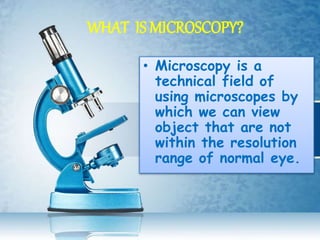
WHAT IS MICROSCOPY?
• Microscopy is a
technical field of
using microscopes by
which we can view
object that are not
within the resolution
range of normal eye.
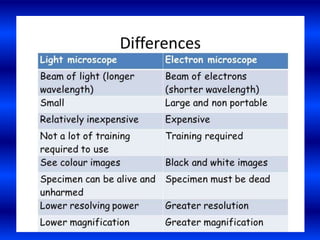
A microscope is an instrument
that magnifies objects otherwise
too small to be seen, producing
an image in which the object
appears larger. Most photographs
of cells are taken using a
microscope, and these pictures
can also be called micrographs.
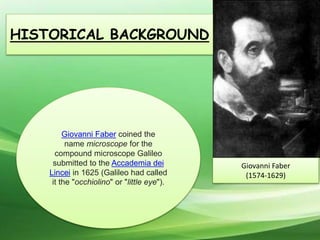
Giovanni Faber coined the
name microscope for the
compound microscope Galileo
submitted to the Accademia dei
Lincei in 1625 (Galileo had called
it the "occhiolino" or "little eye").
Giovanni Faber
(1574-1629)
HISTORICAL BACKGROUND
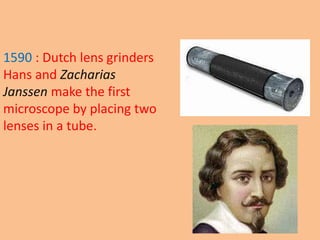
1590 : Dutch lens grinders
Hans and Zacharias
Janssen make the first
microscope by placing two
lenses in a tube.
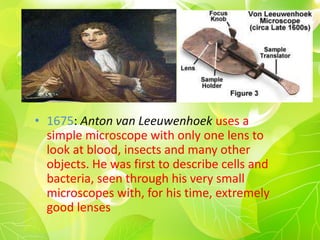
• 1675: Anton van Leeuwenhoek uses a
simple microscope with only one lens to
look at blood, insects and many other
objects. He was first to describe cells and
bacteria, seen through his very small
microscopes with, for his time, extremely
good lenses
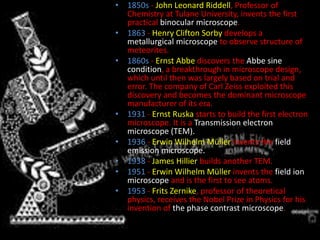
• 1850s - John Leonard Riddell, Professor of
Chemistry at Tulane University, invents the first
practical binocular microscope.
• 1863 - Henry Clifton Sorby develops a
metallurgical microscope to observe structure of
meteorites.
• 1860s - Ernst Abbe discovers the Abbe sine
condition, a breakthrough in microscope design,
which until then was largely based on trial and
error. The company of Carl Zeiss exploited this
discovery and becomes the dominant microscope
manufacturer of its era.
• 1931 - Ernst Ruska starts to build the first electron
microscope. It is a Transmission electron
microscope (TEM).
• 1936 - Erwin Wilhelm Müller invents the field
emission microscope.
• 1938 - James Hillier builds another TEM.
• 1951 - Erwin Wilhelm Müller invents the field ion
microscope and is the first to see atoms.
• 1953 - Frits Zernike, professor of theoretical
physics, receives the Nobel Prize in Physics for his
invention of the phase contrast microscope.
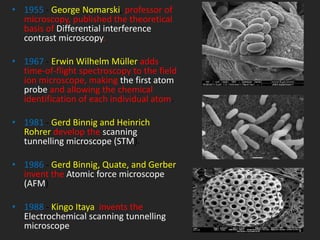
• 1955 - George Nomarski, professor of
microscopy, published the theoretical
basis of Differential interference
contrast microscopy.
• 1967 - Erwin Wilhelm Müller adds
time-of-flight spectroscopy to the field
ion microscope, making the first atom
probe and allowing the chemical
identification of each individual atom.
• 1981 - Gerd Binnig and Heinrich
Rohrer develop the scanning
tunnelling microscope (STM).
• 1986 - Gerd Binnig, Quate, and Gerber
invent the Atomic force microscope
(AFM)
• 1988 - Kingo Itaya invents the
Electrochemical scanning tunnelling
microscope
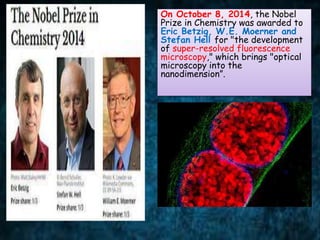
On October 8, 2014, the Nobel
Prize in Chemistry was awarded to
Eric Betzig, W.E. Moerner and
Stefan Hell for "the development
of super-resolved fluorescence
microscopy," which brings "optical
microscopy into the
nanodimension”.
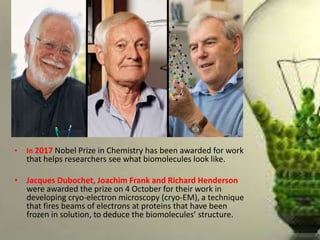
• In 2017 Nobel Prize in Chemistry has been awarded for work
that helps researchers see what biomolecules look like.
• Jacques Dubochet, Joachim Frank and Richard Henderson
were awarded the prize on 4 October for their work in
developing cryo-electron microscopy (cryo-EM), a technique
that fires beams of electrons at proteins that have been
frozen in solution, to deduce the biomolecules’ structure.
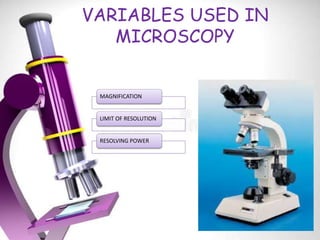
VARIABLES USED IN
MICROSCOPY
MAGNIFICATION
LIMIT OF RESOLUTION
RESOLVING POWER
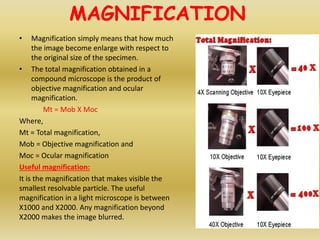
MAGNIFICATION
• Magnification simply means that how much
the image become enlarge with respect to
the original size of the specimen.
• The total magnification obtained in a
compound microscope is the product of
objective magnification and ocular
magnification.
Mt = Mob X Moc
Where,
Mt = Total magnification,
Mob = Objective magnification and
Moc = Ocular magnification
Useful magnification:
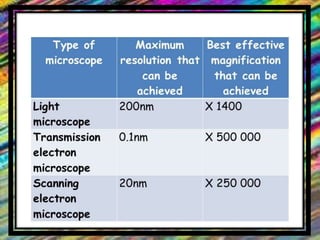
It is the magnification that makes visible the
smallest resolvable particle. The useful
magnification in a light microscope is between
X1000 and X2000. Any magnification beyond
X2000 makes the image blurred.
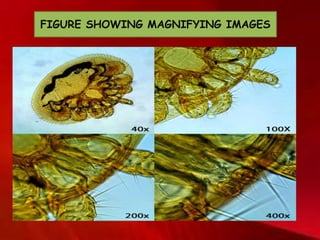
FIGURE SHOWING MAGNIFYING IMAGES
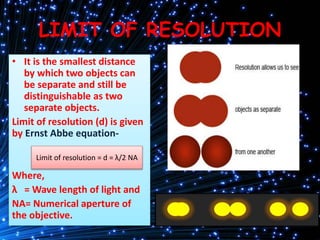
LIMIT OF RESOLUTION
• It is the smallest distance
by which two objects can
be separate and still be
distinguishable as two
separate objects.
Limit of resolution (d) is given
by Ernst Abbe equation-
Where,
λ = Wave length of light and
NA= Numerical aperture of
the objective.
Limit of resolution = d = λ/2 NA
RESOLVING POWER
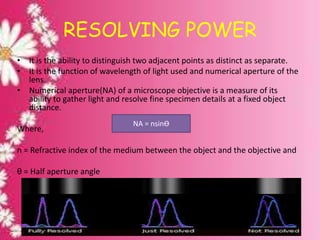
• It is the ability to distinguish two adjacent points as distinct as separate.
• It is the function of wavelength of light used and numerical aperture of the
lens.
• Numerical aperture(NA) of a microscope objective is a measure of its
ability to gather light and resolve fine specimen details at a fixed object
distance.
Where,
n = Refractive index of the medium between the object and the objective and
θ = Half aperture angle
NA = nsinƟ
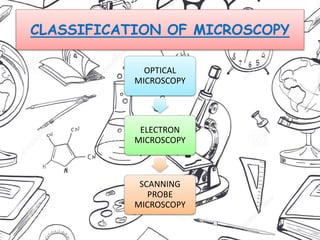
CLASSIFICATION OF MICROSCOPY
OPTICAL
MICROSCOPY
ELECTRON
MICROSCOPY
SCANNING
PROBE
MICROSCOPY
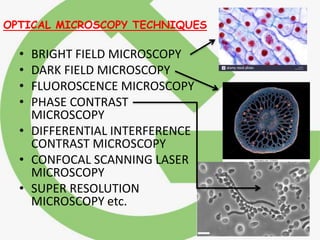
OPTICAL MICROSCOPY TECHNIQUES
• BRIGHT FIELD MICROSCOPY
• DARK FIELD MICROSCOPY
• FLUOROSCENCE MICROSCOPY
• PHASE CONTRAST
MICROSCOPY
• DIFFERENTIAL INTERFERENCE
CONTRAST MICROSCOPY
• CONFOCAL SCANNING LASER
MICROSCOPY
• SUPER RESOLUTION
MICROSCOPY etc.
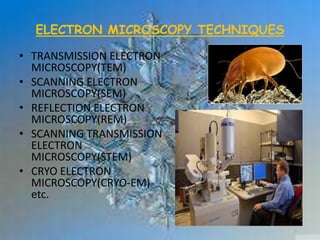
ELECTRON MICROSCOPY TECHNIQUES
• TRANSMISSION ELECTRON
MICROSCOPY(TEM)
• SCANNING ELECTRON
MICROSCOPY(SEM)
• REFLECTION ELECTRON
MICROSCOPY(REM)
• SCANNING TRANSMISSION
ELECTRON
MICROSCOPY(STEM)
• CRYO ELECTRON
MICROSCOPY(CRYO-EM)
etc.
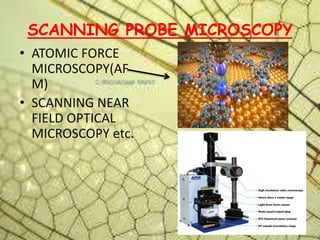
SCANNING PROBE MICROSCOPY
• ATOMIC FORCE
MICROSCOPY(AF
M)
• SCANNING NEAR
FIELD OPTICAL
MICROSCOPY etc.
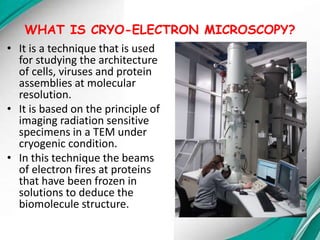
WHAT IS CRYO-ELECTRON MICROSCOPY?
• It is a technique that is used
for studying the architecture
of cells, viruses and protein
assemblies at molecular
resolution.
• It is based on the principle of
imaging radiation sensitive
specimens in a TEM under
cryogenic condition.
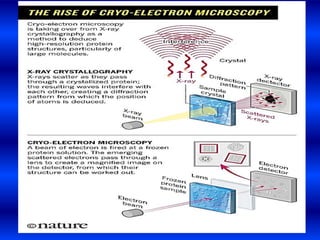
• In this technique the beams
of electron fires at proteins
that have been frozen in
solutions to deduce the
biomolecule structure.
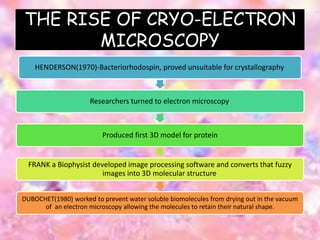
THE RISE OF CRYO-ELECTRON
MICROSCOPY
HENDERSON(1970)-Bacteriorhodospin, proved unsuitable for crystallography.
Researchers turned to electron microscopy.
Produced first 3D model for protein
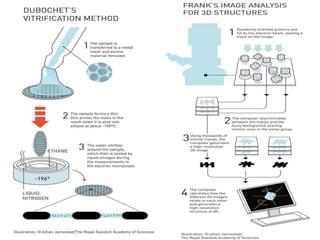
FRANK a Biophysist developed image processing software and converts that fuzzy
images into 3D molecular structure.
DUBOCHET(1980) worked to prevent water soluble biomolecules from drying out in the vacuum
of an electron microscopy allowing the molecules to retain their natural shape.
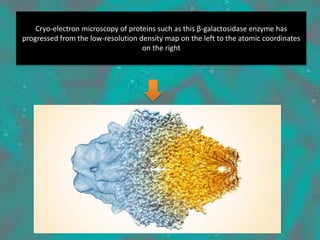
Cryo-electron microscopy of proteins such as this β-galactosidase enzyme has
progressed from the low-resolution density map on the left to the atomic coordinates
on the right
WHY IT IS USED?
• When we uses TEM, particularly
for biomolecules then these
molecules are not compatible with
the high-vacuum conditions and
intense electron beams.
• The water that surrounds the
molecules evaporates and the high
energy electron burn and destroys
the molecules.
• Besides that X-Ray crystallography
also used to resolve these
biomolecules but they requires
crystallise molecules and many
proteins won’t crystallise and in
some cases the process of
crystallisation alters the structure
of proteins.
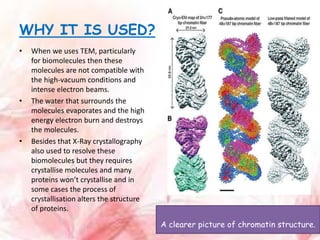
A clearer picture of chromatin structure.
• NMR can also give very
detailed structures and
investigate conformational
changes or binding of small
molecules. But it is limited
to relatively small proteins
and usually soluble
intracellular proteins rather
than those embedded in cell
membranes .
• Cryo-EM doesn’t require
crystals and it also enables
scientists to see how
biomolecules move and
interact as they perform
their functions which is
much more difficult using
crystallography.
• Hence, Cryo-EM uses to
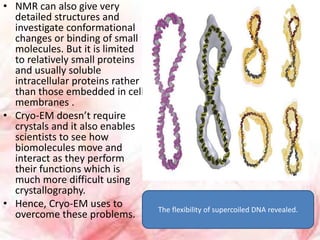
overcome these problems. The flexibility of supercoiled DNA revealed.
HOW THE CRYO-EM WORKS
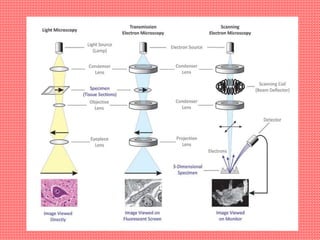
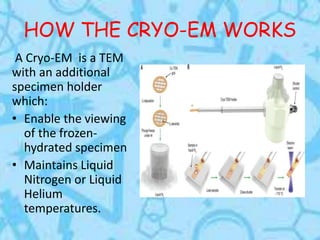
A Cryo-EM is a TEM
with an additional
specimen holder
which:
• Enable the viewing
of the frozen-
hydrated specimen
• Maintains Liquid
Nitrogen or Liquid
Helium
temperatures.
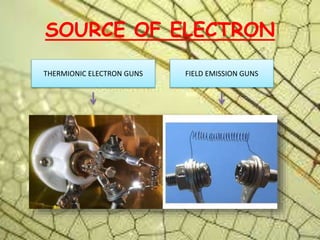
SOURCE OF ELECTRON
THERMIONIC ELECTRON GUNS FIELD EMISSION GUNS
SAMPLE USED
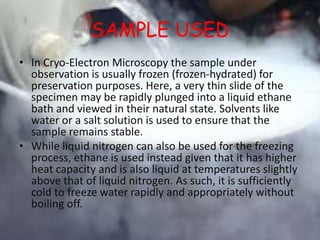
• In Cryo-Electron Microscopy the sample under
observation is usually frozen (frozen-hydrated) for
preservation purposes. Here, a very thin slide of the
specimen may be rapidly plunged into a liquid ethane
bath and viewed in their natural state. Solvents like
water or a salt solution is used to ensure that the
sample remains stable.
• While liquid nitrogen can also be used for the freezing
process, ethane is used instead given that it has higher
heat capacity and is also liquid at temperatures slightly
above that of liquid nitrogen. As such, it is sufficiently
cold to freeze water rapidly and appropriately without
boiling off.
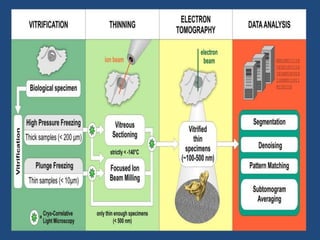
SPECIMEN PREPARATION
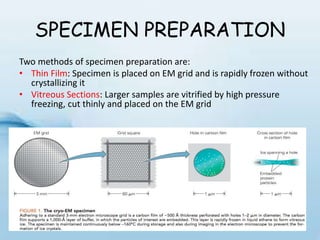
Two methods of specimen preparation are:
• Thin Film: Specimen is placed on EM grid and is rapidly frozen without
crystallizing it
• Vitreous Sections: Larger samples are vitrified by high pressure
freezing, cut thinly and placed on the EM grid
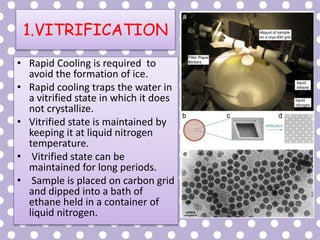
1.VITRIFICATION
• Rapid Cooling is required to
avoid the formation of ice.
• Rapid cooling traps the water in
a vitrified state in which it does
not crystallize.
• Vitrified state is maintained by
keeping it at liquid nitrogen
temperature.
• Vitrified state can be
maintained for long periods.
• Sample is placed on carbon grid
and dipped into a bath of
ethane held in a container of
liquid nitrogen.
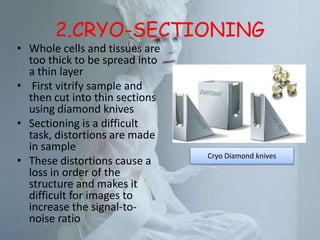
2.CRYO-SECTIONING
• Whole cells and tissues are
too thick to be spread into
a thin layer
• First vitrify sample and
then cut into thin sections
using diamond knives
• Sectioning is a difficult
task, distortions are made
in sample
• These distortions cause a
loss in order of the
structure and makes it
difficult for images to
increase the signal-to-
noise ratio
Cryo Diamond knives
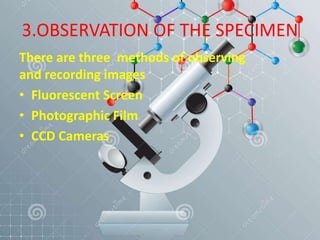
3.OBSERVATION OF THE SPECIMEN
There are three methods of observing
and recording images
• Fluorescent Screen
• Photographic Film
• CCD Cameras
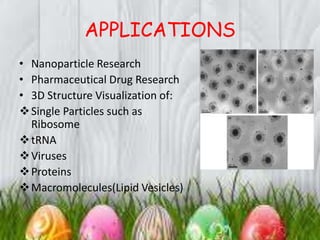
APPLICATIONS
• Nanoparticle Research
• Pharmaceutical Drug Research
• 3D Structure Visualization of:
Single Particles such as
Ribosome
tRNA
Viruses
Proteins
Macromolecules(Lipid Vesicles)
PROS AND CONS
• Advantage: Structure remains native and no
dehydration is required.
• Limitation: It is not possible to look at the
sample for a long time because of beam
damage and it causes poor resolution.
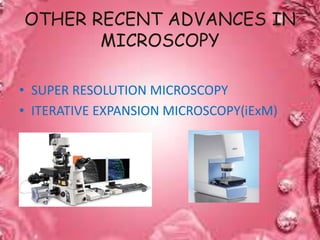
OTHER RECENT ADVANCES IN
MICROSCOPY
• SUPER RESOLUTION MICROSCOPY
• ITERATIVE EXPANSION MICROSCOPY(iExM)
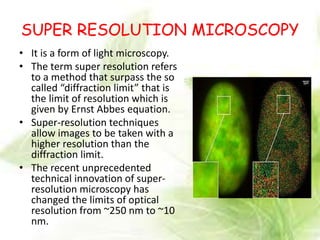
SUPER RESOLUTION MICROSCOPY
• It is a form of light microscopy.
• The term super resolution refers
to a method that surpass the so
called “diffraction limit” that is
the limit of resolution which is
given by Ernst Abbes equation.
• Super-resolution techniques
allow images to be taken with a
higher resolution than the
diffraction limit.
• The recent unprecedented
technical innovation of super-
resolution microscopy has
changed the limits of optical
resolution from ~250 nm to ~10
nm.
TECHNIQUES USED IN SUPER
RESOLUTION MICROSCOPY
• Structured Illumination Microscopy
• Photoactivated Localization Microscopy
• Stochastic Optical Reconstruction Microscopy
and
• Stimulated Emission Depletion microscopy
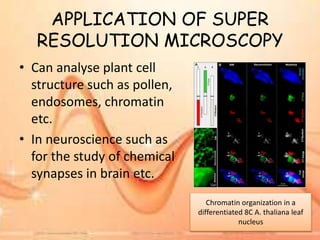
APPLICATION OF SUPER
RESOLUTION MICROSCOPY
• Can analyse plant cell
structure such as pollen,
endosomes, chromatin
etc.
• In neuroscience such as
for the study of chemical
synapses in brain etc.
Chromatin organization in a
differentiated 8C A. thaliana leaf
nucleus
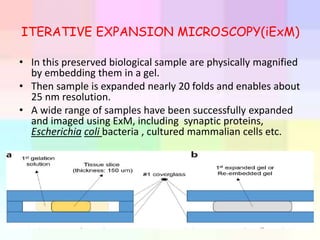
ITERATIVE EXPANSION MICROSCOPY(iExM)
• In this preserved biological sample are physically magnified
by embedding them in a gel.
• Then sample is expanded nearly 20 folds and enables about
25 nm resolution.
• A wide range of samples have been successfully expanded
and imaged using ExM, including synaptic proteins,
Escherichia coli bacteria , cultured mammalian cells etc.
CONCLUSION
• Cryo-EM is a form of Transmission
Electron Microscopy (TEM) where
the sample is studied in its native
state at cryogenic temperatures.
• It is used for 3D visualization of
biological molecules.
• Resolution of Cryo-EM is not high
enough but it is improving using
different computer techniques
• With the advancement of
technology, this technique will
certainly improve.
REFERENCES
• The University of Edinburgh (March 6, 2018). "What is
Microscopy?". The University of Edinburgh. Retrieved April 9, 2018
• https://www.microscope.com/education-center/microscopes-
101/history-of-microscopes/
• https://en.wikipedia.org/wiki/Timeline_of_microscope_technology
• https://www.slideshare.net/Madiheh/cryo-electron-microscopy
• https://www.nobelprize.org/educational/physics/microscopes/timeline/
• https://www.microscopyu.com/microscopy-basics/resolution
• https://www.chemistryworld.com/news/...is-cryo-electron-
microscopy/3008091.article
• https://www.nature.com/news/cryo-electron-microscopy-wins-
chemistry-nobel-1.22738
• https://www.microscopemaster.com/cryo-electron-microscopy.html
• Nat Methods. 2017 Jun;14(6):593-599. doi: 10.1038/nmeth.4261. Epub
2017 Apr 17.
(Iterative expansion microscopy. hang JB1,2, Chen F3, Yoon YG1,4, Jung EE1,
Babcock H5, Kang JS6, Asano S1, Suk HJ7, Pak N8, Tillberg PW4, Wassie AT3,
Cai D9, Boyden ES1)
Recent advancement in microscopic techniques  cryoem and super

Recent advancement in microscopic techniques cryoem and super

  • 1.
    RECENT ADVANCES INMICROSCOPIC TECHNIQUES: CRYO-EM PRESENTED BY- DANISH NIGAR
  • 2.
    CONTENTS • WHAT ISMICROSCOPY • HISTORICAL BACKGROUND • VARIABLES USED IN MICROSCOPY • CLASSIFICATION OF MICROSCOPY • RECENT DEVELOPMENTS IN MICROSCOPY • CRYO ELECTRON MICROSCOPY • THE RISE OF CRYO ELECTRON MICROSCOPY • HOW THE CRYO ELECTRON MICROSCOPE WORKS • SPECIMEN PREPARATION • APPLICATION OF CRYO-EM • PROS AND CONS OF CRYO-EM • OTHER DEVELOPMENTS IN MICROSCOPY • SUPER RESOLUTION MICROSCOPY • INTERATIVE EXPANSION MICROSCOPY • CONCLUSION • REFERENCES
  • 3.
    WHAT IS MICROSCOPY? •Microscopy is a technical field of using microscopes by which we can view object that are not within the resolution range of normal eye.
  • 5.
    A microscope isan instrument that magnifies objects otherwise too small to be seen, producing an image in which the object appears larger. Most photographs of cells are taken using a microscope, and these pictures can also be called micrographs.
  • 6.
    Giovanni Faber coinedthe name microscope for the compound microscope Galileo submitted to the Accademia dei Lincei in 1625 (Galileo had called it the "occhiolino" or "little eye"). Giovanni Faber (1574-1629) HISTORICAL BACKGROUND
  • 7.
    1590 : Dutchlens grinders Hans and Zacharias Janssen make the first microscope by placing two lenses in a tube.
  • 8.
    • 1675: Antonvan Leeuwenhoek uses a simple microscope with only one lens to look at blood, insects and many other objects. He was first to describe cells and bacteria, seen through his very small microscopes with, for his time, extremely good lenses
  • 9.
    • 1850s -John Leonard Riddell, Professor of Chemistry at Tulane University, invents the first practical binocular microscope. • 1863 - Henry Clifton Sorby develops a metallurgical microscope to observe structure of meteorites. • 1860s - Ernst Abbe discovers the Abbe sine condition, a breakthrough in microscope design, which until then was largely based on trial and error. The company of Carl Zeiss exploited this discovery and becomes the dominant microscope manufacturer of its era. • 1931 - Ernst Ruska starts to build the first electron microscope. It is a Transmission electron microscope (TEM). • 1936 - Erwin Wilhelm Müller invents the field emission microscope. • 1938 - James Hillier builds another TEM. • 1951 - Erwin Wilhelm Müller invents the field ion microscope and is the first to see atoms. • 1953 - Frits Zernike, professor of theoretical physics, receives the Nobel Prize in Physics for his invention of the phase contrast microscope.
  • 10.
    • 1955 -George Nomarski, professor of microscopy, published the theoretical basis of Differential interference contrast microscopy. • 1967 - Erwin Wilhelm Müller adds time-of-flight spectroscopy to the field ion microscope, making the first atom probe and allowing the chemical identification of each individual atom. • 1981 - Gerd Binnig and Heinrich Rohrer develop the scanning tunnelling microscope (STM). • 1986 - Gerd Binnig, Quate, and Gerber invent the Atomic force microscope (AFM) • 1988 - Kingo Itaya invents the Electrochemical scanning tunnelling microscope
  • 11.
    On October 8,2014, the Nobel Prize in Chemistry was awarded to Eric Betzig, W.E. Moerner and Stefan Hell for "the development of super-resolved fluorescence microscopy," which brings "optical microscopy into the nanodimension”.
  • 12.
    • In 2017Nobel Prize in Chemistry has been awarded for work that helps researchers see what biomolecules look like. • Jacques Dubochet, Joachim Frank and Richard Henderson were awarded the prize on 4 October for their work in developing cryo-electron microscopy (cryo-EM), a technique that fires beams of electrons at proteins that have been frozen in solution, to deduce the biomolecules’ structure.
  • 13.
  • 14.
    MAGNIFICATION • Magnification simplymeans that how much the image become enlarge with respect to the original size of the specimen. • The total magnification obtained in a compound microscope is the product of objective magnification and ocular magnification. Mt = Mob X Moc Where, Mt = Total magnification, Mob = Objective magnification and Moc = Ocular magnification Useful magnification: It is the magnification that makes visible the smallest resolvable particle. The useful magnification in a light microscope is between X1000 and X2000. Any magnification beyond X2000 makes the image blurred.
  • 15.
  • 16.
    LIMIT OF RESOLUTION •It is the smallest distance by which two objects can be separate and still be distinguishable as two separate objects. Limit of resolution (d) is given by Ernst Abbe equation- Where, λ = Wave length of light and NA= Numerical aperture of the objective. Limit of resolution = d = λ/2 NA
  • 18.
    RESOLVING POWER • Itis the ability to distinguish two adjacent points as distinct as separate. • It is the function of wavelength of light used and numerical aperture of the lens. • Numerical aperture(NA) of a microscope objective is a measure of its ability to gather light and resolve fine specimen details at a fixed object distance. Where, n = Refractive index of the medium between the object and the objective and θ = Half aperture angle NA = nsinƟ
  • 19.
  • 20.
    OPTICAL MICROSCOPY TECHNIQUES •BRIGHT FIELD MICROSCOPY • DARK FIELD MICROSCOPY • FLUOROSCENCE MICROSCOPY • PHASE CONTRAST MICROSCOPY • DIFFERENTIAL INTERFERENCE CONTRAST MICROSCOPY • CONFOCAL SCANNING LASER MICROSCOPY • SUPER RESOLUTION MICROSCOPY etc.
  • 21.
    ELECTRON MICROSCOPY TECHNIQUES •TRANSMISSION ELECTRON MICROSCOPY(TEM) • SCANNING ELECTRON MICROSCOPY(SEM) • REFLECTION ELECTRON MICROSCOPY(REM) • SCANNING TRANSMISSION ELECTRON MICROSCOPY(STEM) • CRYO ELECTRON MICROSCOPY(CRYO-EM) etc.
  • 22.
    SCANNING PROBE MICROSCOPY •ATOMIC FORCE MICROSCOPY(AF M) • SCANNING NEAR FIELD OPTICAL MICROSCOPY etc.
  • 25.
    WHAT IS CRYO-ELECTRONMICROSCOPY? • It is a technique that is used for studying the architecture of cells, viruses and protein assemblies at molecular resolution. • It is based on the principle of imaging radiation sensitive specimens in a TEM under cryogenic condition. • In this technique the beams of electron fires at proteins that have been frozen in solutions to deduce the biomolecule structure.
  • 26.
    THE RISE OFCRYO-ELECTRON MICROSCOPY HENDERSON(1970)-Bacteriorhodospin, proved unsuitable for crystallography. Researchers turned to electron microscopy. Produced first 3D model for protein FRANK a Biophysist developed image processing software and converts that fuzzy images into 3D molecular structure. DUBOCHET(1980) worked to prevent water soluble biomolecules from drying out in the vacuum of an electron microscopy allowing the molecules to retain their natural shape.
  • 29.
    Cryo-electron microscopy ofproteins such as this β-galactosidase enzyme has progressed from the low-resolution density map on the left to the atomic coordinates on the right
  • 30.
    WHY IT ISUSED? • When we uses TEM, particularly for biomolecules then these molecules are not compatible with the high-vacuum conditions and intense electron beams. • The water that surrounds the molecules evaporates and the high energy electron burn and destroys the molecules. • Besides that X-Ray crystallography also used to resolve these biomolecules but they requires crystallise molecules and many proteins won’t crystallise and in some cases the process of crystallisation alters the structure of proteins. A clearer picture of chromatin structure.
  • 31.
    • NMR canalso give very detailed structures and investigate conformational changes or binding of small molecules. But it is limited to relatively small proteins and usually soluble intracellular proteins rather than those embedded in cell membranes . • Cryo-EM doesn’t require crystals and it also enables scientists to see how biomolecules move and interact as they perform their functions which is much more difficult using crystallography. • Hence, Cryo-EM uses to overcome these problems. The flexibility of supercoiled DNA revealed.
  • 32.
    HOW THE CRYO-EMWORKS A Cryo-EM is a TEM with an additional specimen holder which: • Enable the viewing of the frozen- hydrated specimen • Maintains Liquid Nitrogen or Liquid Helium temperatures.
  • 33.
    SOURCE OF ELECTRON THERMIONICELECTRON GUNS FIELD EMISSION GUNS
  • 34.
    SAMPLE USED • InCryo-Electron Microscopy the sample under observation is usually frozen (frozen-hydrated) for preservation purposes. Here, a very thin slide of the specimen may be rapidly plunged into a liquid ethane bath and viewed in their natural state. Solvents like water or a salt solution is used to ensure that the sample remains stable. • While liquid nitrogen can also be used for the freezing process, ethane is used instead given that it has higher heat capacity and is also liquid at temperatures slightly above that of liquid nitrogen. As such, it is sufficiently cold to freeze water rapidly and appropriately without boiling off.
  • 35.
    SPECIMEN PREPARATION Two methodsof specimen preparation are: • Thin Film: Specimen is placed on EM grid and is rapidly frozen without crystallizing it • Vitreous Sections: Larger samples are vitrified by high pressure freezing, cut thinly and placed on the EM grid
  • 37.
    1.VITRIFICATION • Rapid Coolingis required to avoid the formation of ice. • Rapid cooling traps the water in a vitrified state in which it does not crystallize. • Vitrified state is maintained by keeping it at liquid nitrogen temperature. • Vitrified state can be maintained for long periods. • Sample is placed on carbon grid and dipped into a bath of ethane held in a container of liquid nitrogen.
  • 38.
    2.CRYO-SECTIONING • Whole cellsand tissues are too thick to be spread into a thin layer • First vitrify sample and then cut into thin sections using diamond knives • Sectioning is a difficult task, distortions are made in sample • These distortions cause a loss in order of the structure and makes it difficult for images to increase the signal-to- noise ratio Cryo Diamond knives
  • 39.
    3.OBSERVATION OF THESPECIMEN There are three methods of observing and recording images • Fluorescent Screen • Photographic Film • CCD Cameras
  • 40.
    APPLICATIONS • Nanoparticle Research •Pharmaceutical Drug Research • 3D Structure Visualization of: Single Particles such as Ribosome tRNA Viruses Proteins Macromolecules(Lipid Vesicles)
  • 41.
    PROS AND CONS •Advantage: Structure remains native and no dehydration is required. • Limitation: It is not possible to look at the sample for a long time because of beam damage and it causes poor resolution.
  • 42.
    OTHER RECENT ADVANCESIN MICROSCOPY • SUPER RESOLUTION MICROSCOPY • ITERATIVE EXPANSION MICROSCOPY(iExM)
  • 43.
    SUPER RESOLUTION MICROSCOPY •It is a form of light microscopy. • The term super resolution refers to a method that surpass the so called “diffraction limit” that is the limit of resolution which is given by Ernst Abbes equation. • Super-resolution techniques allow images to be taken with a higher resolution than the diffraction limit. • The recent unprecedented technical innovation of super- resolution microscopy has changed the limits of optical resolution from ~250 nm to ~10 nm.
  • 44.
    TECHNIQUES USED INSUPER RESOLUTION MICROSCOPY • Structured Illumination Microscopy • Photoactivated Localization Microscopy • Stochastic Optical Reconstruction Microscopy and • Stimulated Emission Depletion microscopy
  • 45.
    APPLICATION OF SUPER RESOLUTIONMICROSCOPY • Can analyse plant cell structure such as pollen, endosomes, chromatin etc. • In neuroscience such as for the study of chemical synapses in brain etc. Chromatin organization in a differentiated 8C A. thaliana leaf nucleus
  • 46.
    ITERATIVE EXPANSION MICROSCOPY(iExM) •In this preserved biological sample are physically magnified by embedding them in a gel. • Then sample is expanded nearly 20 folds and enables about 25 nm resolution. • A wide range of samples have been successfully expanded and imaged using ExM, including synaptic proteins, Escherichia coli bacteria , cultured mammalian cells etc.
  • 47.
    CONCLUSION • Cryo-EM isa form of Transmission Electron Microscopy (TEM) where the sample is studied in its native state at cryogenic temperatures. • It is used for 3D visualization of biological molecules. • Resolution of Cryo-EM is not high enough but it is improving using different computer techniques • With the advancement of technology, this technique will certainly improve.
  • 48.
    REFERENCES • The Universityof Edinburgh (March 6, 2018). "What is Microscopy?". The University of Edinburgh. Retrieved April 9, 2018 • https://www.microscope.com/education-center/microscopes- 101/history-of-microscopes/ • https://en.wikipedia.org/wiki/Timeline_of_microscope_technology • https://www.slideshare.net/Madiheh/cryo-electron-microscopy • https://www.nobelprize.org/educational/physics/microscopes/timeline/ • https://www.microscopyu.com/microscopy-basics/resolution • https://www.chemistryworld.com/news/...is-cryo-electron- microscopy/3008091.article • https://www.nature.com/news/cryo-electron-microscopy-wins- chemistry-nobel-1.22738 • https://www.microscopemaster.com/cryo-electron-microscopy.html • Nat Methods. 2017 Jun;14(6):593-599. doi: 10.1038/nmeth.4261. Epub 2017 Apr 17. (Iterative expansion microscopy. hang JB1,2, Chen F3, Yoon YG1,4, Jung EE1, Babcock H5, Kang JS6, Asano S1, Suk HJ7, Pak N8, Tillberg PW4, Wassie AT3, Cai D9, Boyden ES1)

Editor's Notes