Respiration
Dr. Anil V Dusane
Sir Parashurambhau College
Pune
anildusane@gmail.com
1
Introduction of Respiration
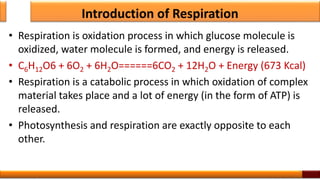
• Respiration is oxidation process in which glucose molecule is
oxidized, water molecule is formed, and energy is released.
• C6H12O6 + 6O2 + 6H2O======6CO2 + 12H2O + Energy (673 Kcal)
• Respiration is a catabolic process in which oxidation of complex
material takes place and a lot of energy (in the form of ATP) is
released.
• Photosynthesis and respiration are exactly opposite to each
other.
2
Photosynthesis and Respiration
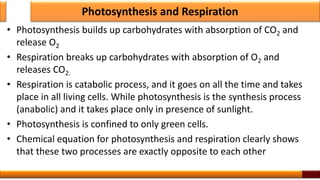
• Photosynthesis builds up carbohydrates with absorption of CO2 and
release O2
• Respiration breaks up carbohydrates with absorption of O2 and
releases CO2.
• Respiration is catabolic process, and it goes on all the time and takes
place in all living cells. While photosynthesis is the synthesis process
(anabolic) and it takes place only in presence of sunlight.
• Photosynthesis is confined to only green cells.
• Chemical equation for photosynthesis and respiration clearly shows
that these two processes are exactly opposite to each other
3
Photosynthesis and Respiration
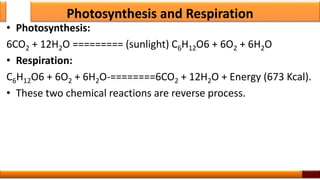
• Photosynthesis:
6CO2 + 12H2O ========= (sunlight) C6H12O6 + 6O2 + 6H2O
• Respiration:
C6H12O6 + 6O2 + 6H2O-========6CO2 + 12H2O + Energy (673 Kcal).
• These two chemical reactions are reverse process.
4
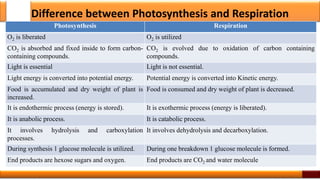
Difference between Photosynthesis and Respiration
Photosynthesis Respiration
O2 is liberated O2 is utilized
CO2 is absorbed and fixed inside to form carbon-
containing compounds.
CO2 is evolved due to oxidation of carbon containing
compounds.
Light is essential Light is not essential.
Light energy is converted into potential energy. Potential energy is converted into Kinetic energy.
Food is accumulated and dry weight of plant is
increased.
Food is consumed and dry weight of plant is decreased.
It is endothermic process (energy is stored). It is exothermic process (energy is liberated).
It is anabolic process. It is catabolic process.
It involves hydrolysis and carboxylation
processes.
It involves dehydrolysis and decarboxylation.
During synthesis 1 glucose molecule is utilized. During one breakdown 1 glucose molecule is formed.
End products are hexose sugars and oxygen. End products are CO2 and water molecule
5
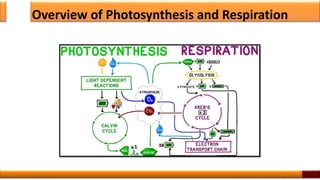
Overview of Photosynthesis and Respiration
6
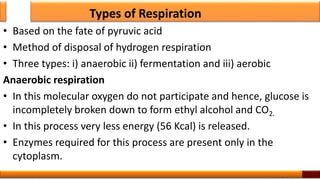
Types of Respiration
• Based on the fate of pyruvic acid
• Method of disposal of hydrogen respiration
• Three types: i) anaerobic ii) fermentation and iii) aerobic
Anaerobic respiration
• In this molecular oxygen do not participate and hence, glucose is
incompletely broken down to form ethyl alcohol and CO2.
• In this process very less energy (56 Kcal) is released.
• Enzymes required for this process are present only in the
cytoplasm.
7
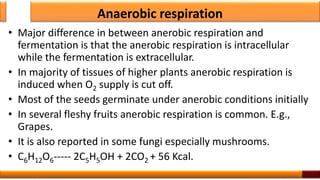
Anaerobic respiration
• Major difference in between anerobic respiration and
fermentation is that the anerobic respiration is intracellular
while the fermentation is extracellular.
• In majority of tissues of higher plants anerobic respiration is
induced when O2 supply is cut off.
• Most of the seeds germinate under anerobic conditions initially
• In several fleshy fruits anerobic respiration is common. E.g.,
Grapes.
• It is also reported in some fungi especially mushrooms.
• C6H12O6----- 2C5H5OH + 2CO2 + 56 Kcal.
8
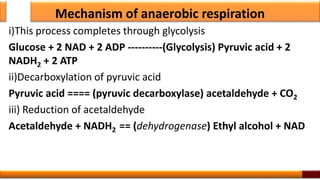
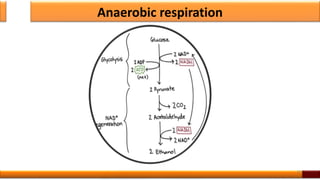
Mechanism of anaerobic respiration
i)This process completes through glycolysis
Glucose + 2 NAD + 2 ADP ----------(Glycolysis) Pyruvic acid + 2
NADH2 + 2 ATP
ii)Decarboxylation of pyruvic acid
Pyruvic acid ==== (pyruvic decarboxylase) acetaldehyde + CO2
iii) Reduction of acetaldehyde
Acetaldehyde + NADH2 == (dehydrogenase) Ethyl alcohol + NAD
9
Anaerobic respiration
10
Fermentation
• In this molecular oxygen may or may not participate
• Glucose/organic substrate is incompletely oxidized to form ethyl
alcohol (or acetic acid) and CO2
• This conversion takes place due action of enzymes secreted by
microbes
• This is intracellular process
• Based on formation of byproduct the fermentation is known as
alcoholic fermentation, lactic acid fermentation, acetic acid
fermentation, etc.
11
Fermentation
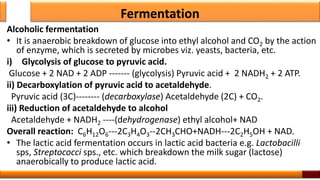
Alcoholic fermentation
• It is anaerobic breakdown of glucose into ethyl alcohol and CO2 by the action
of enzyme, which is secreted by microbes viz. yeasts, bacteria, etc.
i) Glycolysis of glucose to pyruvic acid.
Glucose + 2 NAD + 2 ADP ------- (glycolysis) Pyruvic acid + 2 NADH2 + 2 ATP.
ii) Decarboxylation of pyruvic acid to acetaldehyde.
Pyruvic acid (3C)-------- (decarboxylase) Acetaldehyde (2C) + CO2.
iii) Reduction of acetaldehyde to alcohol
Acetaldehyde + NADH2 ----(dehydrogenase) ethyl alcohol+ NAD
Overall reaction: C6H12O6---2C3H4O3--2CH3CHO+NADH---2C2H5OH + NAD.
• The lactic acid fermentation occurs in lactic acid bacteria e.g. Lactobacilli
sps, Streptococci sps., etc. which breakdown the milk sugar (lactose)
anaerobically to produce lactic acid.
12
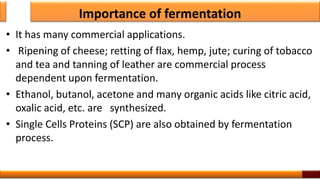
Importance of fermentation
• It has many commercial applications.
• Ripening of cheese; retting of flax, hemp, jute; curing of tobacco
and tea and tanning of leather are commercial process
dependent upon fermentation.
• Ethanol, butanol, acetone and many organic acids like citric acid,
oxalic acid, etc. are synthesized.
• Single Cells Proteins (SCP) are also obtained by fermentation
process.
13
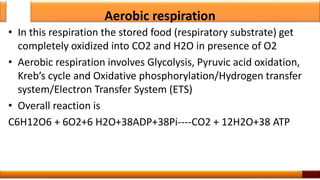
Aerobic respiration
• In this respiration the stored food (respiratory substrate) get
completely oxidized into CO2 and H2O in presence of O2
• Aerobic respiration involves Glycolysis, Pyruvic acid oxidation,
Kreb’s cycle and Oxidative phosphorylation/Hydrogen transfer
system/Electron Transfer System (ETS)
• Overall reaction is
C6H12O6 + 6O2+6 H2O+38ADP+38Pi----CO2 + 12H2O+38 ATP
14
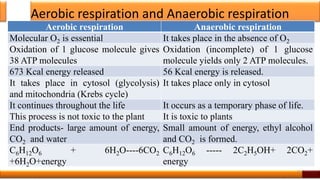
Aerobic respiration and Anaerobic respiration
Aerobic respiration Anaerobic respiration
Molecular O2 is essential It takes place in the absence of O2
Oxidation of 1 glucose molecule gives
38 ATP molecules
Oxidation (incomplete) of 1 glucose
molecule yields only 2 ATP molecules.
673 Kcal energy released 56 Kcal energy is released.
It takes place in cytosol (glycolysis)
and mitochondria (Krebs cycle)
It takes place only in cytosol
It continues throughout the life It occurs as a temporary phase of life.
This process is not toxic to the plant It is toxic to plants
End products- large amount of energy,
CO2 and water
Small amount of energy, ethyl alcohol
and CO2 is formed.
C6H12O6 + 6H2O----6CO2
+6H2O+energy
C6H12O6 ----- 2C2H5OH+ 2CO2+
energy
15
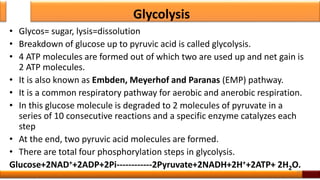
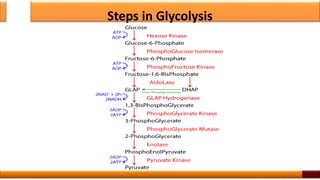
Glycolysis
• Glycos= sugar, lysis=dissolution
• Breakdown of glucose up to pyruvic acid is called glycolysis.
• 4 ATP molecules are formed out of which two are used up and net gain is
2 ATP molecules.
• It is also known as Embden, Meyerhof and Paranas (EMP) pathway.
• It is a common respiratory pathway for aerobic and anerobic respiration.
• In this glucose molecule is degraded to 2 molecules of pyruvate in a
series of 10 consecutive reactions and a specific enzyme catalyzes each
step
• At the end, two pyruvic acid molecules are formed.
• There are total four phosphorylation steps in glycolysis.
Glucose+2NAD++2ADP+2Pi------------2Pyruvate+2NADH+2H++2ATP+ 2H2O.
16
Steps in Glycolysis
17
Steps involved in Glycolysis
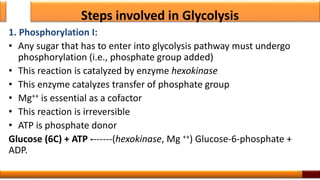
1. Phosphorylation I:
• Any sugar that has to enter into glycolysis pathway must undergo
phosphorylation (i.e., phosphate group added)
• This reaction is catalyzed by enzyme hexokinase
• This enzyme catalyzes transfer of phosphate group
• Mg++ is essential as a cofactor
• This reaction is irreversible
• ATP is phosphate donor
Glucose (6C) + ATP -------(hexokinase, Mg ++) Glucose-6-phosphate +
ADP.
18
Steps involved in Glycolysis
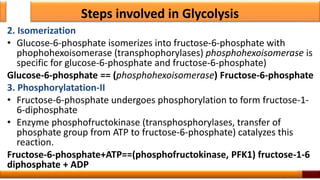
2. Isomerization
• Glucose-6-phosphate isomerizes into fructose-6-phosphate with
phophohexoisomerase (transphophorylases) phosphohexoisomerase is
specific for glucose-6-phosphate and fructose-6-phosphate)
Glucose-6-phosphate == (phosphohexoisomerase) Fructose-6-phosphate
3. Phosphorylatation-II
• Fructose-6-phosphate undergoes phosphorylation to form fructose-1-
6-diphosphate
• Enzyme phosphofructokinase (transphosphorylases, transfer of
phosphate group from ATP to fructose-6-phosphate) catalyzes this
reaction.
Fructose-6-phosphate+ATP==(phosphofructokinase, PFK1) fructose-1-6
diphosphate + ADP
19
Steps involved in Glycolysis
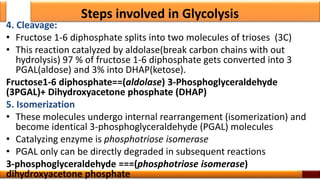
4. Cleavage:
• Fructose 1-6 diphosphate splits into two molecules of trioses (3C)
• This reaction catalyzed by aldolase(break carbon chains with out
hydrolysis) 97 % of fructose 1-6 diphosphate gets converted into 3
PGAL(aldose) and 3% into DHAP(ketose).
Fructose1-6 diphosphate==(aldolase) 3-Phosphoglyceraldehyde
(3PGAL)+ Dihydroxyacetone phosphate (DHAP)
5. Isomerization
• These molecules undergo internal rearrangement (isomerization) and
become identical 3-phosphoglyceraldehyde (PGAL) molecules
• Catalyzing enzyme is phosphotriose isomerase
• PGAL only can be directly degraded in subsequent reactions
3-phosphoglyceraldehyde ===(phosphotriose isomerase)
dihydroxyacetone phosphate 20
Steps involved in Glycolysis
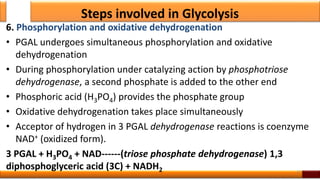
6. Phosphorylation and oxidative dehydrogenation
• PGAL undergoes simultaneous phosphorylation and oxidative
dehydrogenation
• During phosphorylation under catalyzing action by phosphotriose
dehydrogenase, a second phosphate is added to the other end
• Phosphoric acid (H3PO4) provides the phosphate group
• Oxidative dehydrogenation takes place simultaneously
• Acceptor of hydrogen in 3 PGAL dehydrogenase reactions is coenzyme
NAD+ (oxidized form).
3 PGAL + H3PO4 + NAD------(triose phosphate dehydrogenase) 1,3
diphosphoglyceric acid (3C) + NADH2 21
Steps involved in Glycolysis
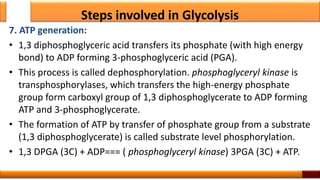
7. ATP generation:
• 1,3 diphosphoglyceric acid transfers its phosphate (with high energy
bond) to ADP forming 3-phosphoglyceric acid (PGA).
• This process is called dephosphorylation. phosphoglyceryl kinase is
transphosphorylases, which transfers the high-energy phosphate
group form carboxyl group of 1,3 diphosphoglycerate to ADP forming
ATP and 3-phosphoglycerate.
• The formation of ATP by transfer of phosphate group from a substrate
(1,3 diphosphoglycerate) is called substrate level phosphorylation.
• 1,3 DPGA (3C) + ADP=== ( phosphoglyceryl kinase) 3PGA (3C) + ATP.
22
Steps involved in Glycolysis
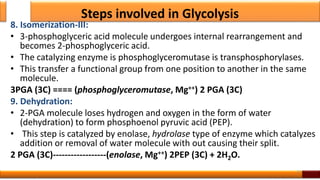
8. Isomerization-III:
• 3-phosphoglyceric acid molecule undergoes internal rearrangement and
becomes 2-phosphoglyceric acid.
• The catalyzing enzyme is phosphoglyceromutase is transphosphorylases.
• This transfer a functional group from one position to another in the same
molecule.
3PGA (3C) ==== (phosphoglyceromutase, Mg++) 2 PGA (3C)
9. Dehydration:
• 2-PGA molecule loses hydrogen and oxygen in the form of water
(dehydration) to form phosphoenol pyruvic acid (PEP).
• This step is catalyzed by enolase, hydrolase type of enzyme which catalyzes
addition or removal of water molecule with out causing their split.
2 PGA (3C)------------------(enolase, Mg++) 2PEP (3C) + 2H2O.
23
Steps involved in Glycolysis
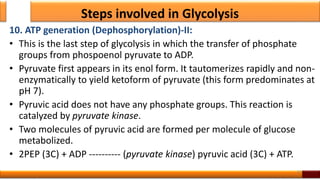
10. ATP generation (Dephosphorylation)-II:
• This is the last step of glycolysis in which the transfer of phosphate
groups from phospoenol pyruvate to ADP.
• Pyruvate first appears in its enol form. It tautomerizes rapidly and non-
enzymatically to yield ketoform of pyruvate (this form predominates at
pH 7).
• Pyruvic acid does not have any phosphate groups. This reaction is
catalyzed by pyruvate kinase.
• Two molecules of pyruvic acid are formed per molecule of glucose
metabolized.
• 2PEP (3C) + ADP ---------- (pyruvate kinase) pyruvic acid (3C) + ATP.
24
Significance of Glycolysis
• There is an intermediate net yield of two ATP molecules (four
are formed and two are used)
• Some of the energy in glucose is transferred to four hydrogen
atoms, which become part of two molecules of NADH and form
two hydrogen ions
• Eventually, the energy with in NADH is released in ETS and forms
six molecules of ATP.
25
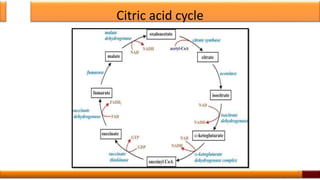
Citric acid cycle/Kreb’s cycle
• This cycle has been named in honor of English biochemists Hans A Krebs
(1937) who first postulated as the pathway.
• The series of reactions involved in the stepwise degradation of pyruvic acid
is known as Kreb’s cycle.
• This cycle is also called as citric acid cycle, tricarboxylic acid cycle,
mitochondrial respiration, organic acid cycle, oxidation of Pyruvate, etc.
transport system.
• It is amphibolic i.e., it operates both way catabolically and anabolically
• Starting point for the citric acid cycle is acetyl Co-A and oxaloacetic acid
• One molecule of ATP is generated directly at the substrate level in each cycle
• In each Kreb’s cycle proper, 11 molecules of ATP are generated through the
hydrogen.
• Net reaction is Acetyl CoA+ 3 NAD+ + FAD + GDP+ Pi+ H2O-------2CO2+
3NADH+FADH2+ GTP+ 2H+ +CoA.
26
Citric acid cycle
27
Significance of Citric acid cycle
• This cycle provides intermediates for biosynthesis of porphyrins
and many of amino acids are derived from -ketoglutarate and
OAA.
• This cycle is intimately connected with nitrogen metabolism
particularly with the synthesis of amino acids.
• The organic acid which is formed in the cycle serves as the
substrates in the synthesis of amino acids.
• This cycle opens up the possibility of pyruvic acid being diverted
to other metabolic pathways.
28
Significance of Citric acid cycle
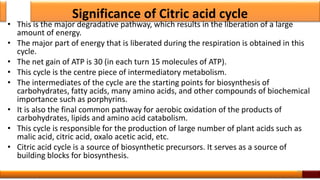
• This is the major degradative pathway, which results in the liberation of a large
amount of energy.
• The major part of energy that is liberated during the respiration is obtained in this
cycle.
• The net gain of ATP is 30 (in each turn 15 molecules of ATP).
• This cycle is the centre piece of intermediatory metabolism.
• The intermediates of the cycle are the starting points for biosynthesis of
carbohydrates, fatty acids, many amino acids, and other compounds of biochemical
importance such as porphyrins.
• It is also the final common pathway for aerobic oxidation of the products of
carbohydrates, lipids and amino acid catabolism.
• This cycle is responsible for the production of large number of plant acids such as
malic acid, citric acid, oxalo acetic acid, etc.
• Citric acid cycle is a source of biosynthetic precursors. It serves as a source of
building blocks for biosynthesis.
29
Respiratory substrate /respirable material
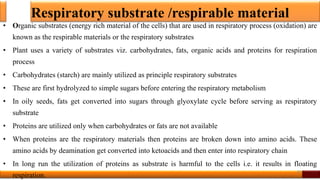
• Organic substrates (energy rich material of the cells) that are used in respiratory process (oxidation) are
known as the respirable materials or the respiratory substrates
• Plant uses a variety of substrates viz. carbohydrates, fats, organic acids and proteins for respiration
process
• Carbohydrates (starch) are mainly utilized as principle respiratory substrates
• These are first hydrolyzed to simple sugars before entering the respiratory metabolism
• In oily seeds, fats get converted into sugars through glyoxylate cycle before serving as respiratory
substrate
• Proteins are utilized only when carbohydrates or fats are not available
• When proteins are the respiratory materials then proteins are broken down into amino acids. These
amino acids by deamination get converted into ketoacids and then enter into respiratory chain
• In long run the utilization of proteins as substrate is harmful to the cells i.e. it results in floating
respiration.
30
Respiratory quotient (R.Q.)
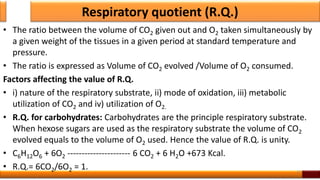
• The ratio between the volume of CO2 given out and O2 taken simultaneously by
a given weight of the tissues in a given period at standard temperature and
pressure.
• The ratio is expressed as Volume of CO2 evolved /Volume of O2 consumed.
Factors affecting the value of R.Q.
• i) nature of the respiratory substrate, ii) mode of oxidation, iii) metabolic
utilization of CO2 and iv) utilization of O2.
• R.Q. for carbohydrates: Carbohydrates are the principle respiratory substrate.
When hexose sugars are used as the respiratory substrate the volume of CO2
evolved equals to the volume of O2 used. Hence the value of R.Q. is unity.
• C6H12O6 + 6O2 ---------------------- 6 CO2 + 6 H2O +673 Kcal.
• R.Q.= 6CO2/6O2 = 1. 31
Respiratory quotient (R.Q.)
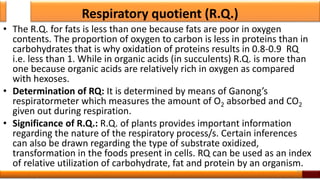
• The R.Q. for fats is less than one because fats are poor in oxygen
contents. The proportion of oxygen to carbon is less in proteins than in
carbohydrates that is why oxidation of proteins results in 0.8-0.9 RQ
i.e. less than 1. While in organic acids (in succulents) R.Q. is more than
one because organic acids are relatively rich in oxygen as compared
with hexoses.
• Determination of RQ: It is determined by means of Ganong’s
respiratormeter which measures the amount of O2 absorbed and CO2
given out during respiration.
• Significance of R.Q.: R.Q. of plants provides important information
regarding the nature of the respiratory process/s. Certain inferences
can also be drawn regarding the type of substrate oxidized,
transformation in the foods present in cells. RQ can be used as an index
of relative utilization of carbohydrate, fat and protein by an organism.
32
Electron Transport System/Oxidative Phosphorylation
• Definition: Oxidative phosphorylation is the process in which electrons
are transferred from NADH or FADH2 (energy rich molecules) to
molecular oxygen by a series of electron carriers (ETS) and during this
process ATP molecules are synthesized.
• It is the final stage of aerobic respiration.
• This is the pathway along which electrons are transferred so called as
ETS.
• Several pairs of hydrogen atoms are released during glycolysis, pyruvic
acid oxidation and Kreb’s cycle.
• The hydrogen liberated in the above process is splits up to in protons
and electrons. H2--------2H+ +e- Out of these protons 2H+ remain in the
matrix while only a pair of electrons (2e-) is transferred through the
sequence of electron acceptors.
33
Salient features of ETS
• NADH and FADH (energy rich compounds) formed in glycolysis and Krebs cycle can
not directly combine with O2 to form H2O. But their several electrons are transferred
via several intermediates (electrons carriers) before H2O is formed.
• The sequence of electron carriers is as follows:
• NAD----FAD---Cyt Q- (ubquinone)---Cyt b----Cyt c1---Cyt c ---Cyt a--- cyt a3—
molecular O2.
• NAD has the highest energy content value; it is a strong reducing agent and have –ve
redox (reduction) potential. While oxygen has lowest energy content. It is strong
oxidizing agent and has +ve redox (reduction potential).
• The flow of electrons is one way i.e., from higher energy level to the lower energy
level.
• In biological reactions electrons are transferred in between electron donating
molecule (a reducing agent) and electron accepting molecule (oxidizing agent).
• The electrons carriers are reversibly interconverted between oxidized and reduced
states.
34
Salient features of ETS
• The mitochondrial ETS consists of a series of electron carrier arranged
in a close physical contact with mitochondrial membrane.
• iv)During the transfer of electrons in ETS a lot of energy is liberated,
and this released energy is used for the synthesis of ATP from ADP
and Pi i.e., oxidative phosphorylation. This is the main route for the
synthesis of ATP molecules.
• The rate of electron transport in proportional to the rate of O2 uptake
by mitochondria.
• The driving force of oxidative phosphorylation is electron transport
potential of NADH or FADH2.
35
Site of oxidative phosphorylation
• It takes place in the elementary particles of mitochondria
(located in the inner surface of cristae)
• An elementary particle has a hexagonal, basal plate, stalk
and knob like structure
• Electron transfer complex I and II located in the basal plate,
complex III in the stalk and complex IV in knob.
36
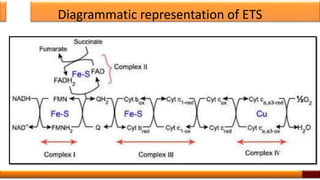
Diagrammatic representation of ETS
37
Mechanism of ETS
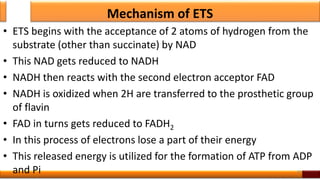
• ETS begins with the acceptance of 2 atoms of hydrogen from the
substrate (other than succinate) by NAD
• This NAD gets reduced to NADH
• NADH then reacts with the second electron acceptor FAD
• NADH is oxidized when 2H are transferred to the prosthetic group
of flavin
• FAD in turns gets reduced to FADH2
• In this process of electrons lose a part of their energy
• This released energy is utilized for the formation of ATP from ADP
and Pi 38
Mechanism of ETS
• FAD carries two electrons, and the hydrogens are released in the
aqueous medium inside the mitochondrion at flavin protein step
• Reduced FAD (FADH2) then passes its electron to COQ
(ubiquinone) and it get reduced
• Then electrons are transferred to a common acceptor i.e., Cyt b
(these are conjugated proteins having prosthetic group of iron
containing porphyrin) which then becomes reduced
• Cytochromes Cyt c1, Cyt c, cyt a and Cyt a3 becomes alternately
reduced and oxidized by the passage of electrons
39
Mechanism of ETS
• Their oxidized form is ferric ( Fe+++) and reduced form has (Fe++)
iron. When electrons are passing through cytochromes at two
places energy is liberated and 2 ATP molecules are formed.
• Thus, reducing the electron flow from NAD+ to Cyt a3 three ATP
molecules are formed. O2 is the last electron acceptor in ETS.
• At the last electron combines with oxygen and get ionized (O--)
and ionized O combine with 2 protons (2H+) present in the
matrix to form water molecule (H2O).
• This formation of H2O molecule at the end of ETS by addition of
O- - and 2H+ in presence of enzyme cytochrome oxidase is called
terminal oxidation.
40
Significance of ETS
• This is the only process in which energy is released, trapped
and conserved in the form of ATP.
• The hydrogen atoms released during glycolysis and Kreb’s
cycle enters in ETS to produce actual energy and in this
process energy of electrons is used for ATP generation in a
very controlled and stepwise manner.
• This process is the major source of ATP generation, and 32
ATP molecules are formed out of 36 ATP molecules.
41
ATP (Adenine Triphosphate)
It was first perceived by Fritz Lipmann (1941).
Properties of ATP
• It is the major chemical link between energy producing (anabolic) and
energy consuming (catabolic) activities of the cell.
• Free energy released by hydrolysis of ATP under standard conditions at
pH 7 is -7.3 Kcal/mol
• ATP + H2O---- ADP+ Pi + G (free energy) = -7.3 Kcal.
• ATP serves as the principle immediate donor of free energy in
biological systems rather than a storage form of the free energy
• ATP, ADP and AMP are interconvertible forms in the presence of
adenylatekinase enzyme.
42
ATP (Adenine Triphosphate)
• Consumption of ATP involves hydrolysis of terminal phosphate of
ATP while synthesis involves the covalent attachment of inorganic
phosphate (Pi) to ADP.
• ATP is high-energy phosphate group donor
• Phosphate transfer serves as the means of chemically
transferring energy of cell
• ATP is the universal currency of free energy in biological systems
• The living organisms requires a continual input of energy for
three main purposes viz. mechanical work, cellular movements
and active transport of molecules and ions
43
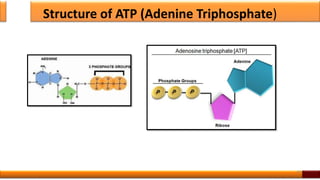
Structure of ATP (Adenine Triphosphate)
44
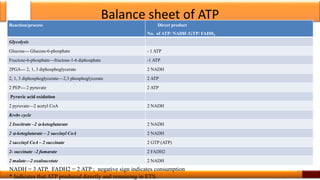
Balance sheet of ATP
Reaction/process Direct product
No. of ATP/ NADH /GTP/ FADH2
Glycolysis
Glucose--- Glucose-6-phosphate - 1 ATP
Fructose-6-phosphate—fructose-1-6 diphosphate -1 ATP
2PGA--- 2, 1, 3 diphosphoglycerate 2 NADH
2, 1, 3 diphosphoglycerate—2,3 phosphoglycerate 2 ATP
2 PEP--- 2 pyruvate 2 ATP
Pyruvic acid oxidation
2 pyruvate—2 acetyl CoA 2 NADH
Krebs cycle
2 Isocitrate –2 -ketoglutarate 2 NADH
2 -ketoglutarate – 2 succinyl CoA 2 NADH
2 succinyl CoA – 2 succinate 2 GTP (ATP)
2- succinate –2 fumarate 2 FADH2
2 malate—2 oxaloacetate 2 NADH
45
NADH = 3 ATP, FADH2 = 2 ATP ; negative sign indicates consumption
* Indicates that ATP produced directly and remaining in ETS.
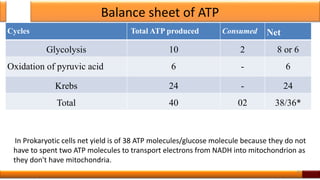
Balance sheet of ATP
Cycles Total ATP produced Consumed Net
Glycolysis 10 2 8 or 6
Oxidation of pyruvic acid 6 - 6
Krebs 24 - 24
Total 40 02 38/36*
46
In Prokaryotic cells net yield is of 38 ATP molecules/glucose molecule because they do not
have to spent two ATP molecules to transport electrons from NADH into mitochondrion as
they don't have mitochondria.
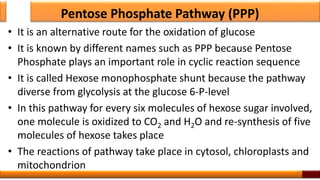
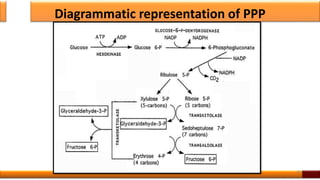
Pentose Phosphate Pathway (PPP)
• It is an alternative route for the oxidation of glucose
• It is known by different names such as PPP because Pentose
Phosphate plays an important role in cyclic reaction sequence
• It is called Hexose monophosphate shunt because the pathway
diverse from glycolysis at the glucose 6-P-level
• In this pathway for every six molecules of hexose sugar involved,
one molecule is oxidized to CO2 and H2O and re-synthesis of five
molecules of hexose takes place
• The reactions of pathway take place in cytosol, chloroplasts and
mitochondrion 47
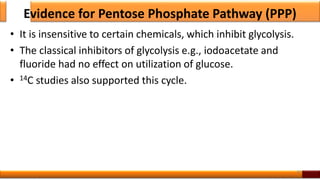
Evidence for Pentose Phosphate Pathway (PPP)
• It is insensitive to certain chemicals, which inhibit glycolysis.
• The classical inhibitors of glycolysis e.g., iodoacetate and
fluoride had no effect on utilization of glucose.
• 14C studies also supported this cycle.
48
Diagrammatic representation of PPP
49
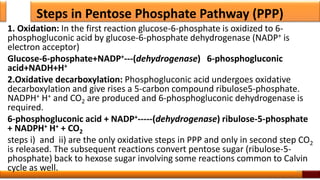
Steps in Pentose Phosphate Pathway (PPP)
1. Oxidation: In the first reaction glucose-6-phosphate is oxidized to 6-
phosphogluconic acid by glucose-6-phosphate dehydrogenase (NADP+ is
electron acceptor)
Glucose-6-phosphate+NADP+---(dehydrogenase) 6-phosphogluconic
acid+NADH+H+
2.Oxidative decarboxylation: Phosphogluconic acid undergoes oxidative
decarboxylation and give rises a 5-carbon compound ribulose5-phosphate.
NADPH+ H+ and CO2 are produced and 6-phosphogluconic dehydrogenase is
required.
6-phosphogluconic acid + NADP+-----(dehydrogenase) ribulose-5-phosphate
+ NADPH+ H+ + CO2
steps i) and ii) are the only oxidative steps in PPP and only in second step CO2
is released. The subsequent reactions convert pentose sugar (ribulose-5-
phosphate) back to hexose sugar involving some reactions common to Calvin
cycle as well. 50
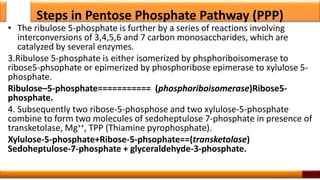
Steps in Pentose Phosphate Pathway (PPP)
• The ribulose 5-phosphate is further by a series of reactions involving
interconversions of 3,4,5,6 and 7 carbon monosaccharides, which are
catalyzed by several enzymes.
3.Ribulose 5-phosphate is either isomerized by phsphoriboisomerase to
ribose5-phsophate or epimerized by phosphoribose epimerase to xylulose 5-
phosphate.
Ribulose–5-phosphate=========== (phosphoriboisomerase)Ribose5-
phosphate.
4. Subsequently two ribose-5-phosphose and two xylulose-5-phosphate
combine to form two molecules of sedoheptulose 7-phosphate in presence of
transketolase, Mg++, TPP (Thiamine pyrophosphate).
Xylulose-5-phosphate+Ribose-5-phsophate==(transketolase)
Sedoheptulose-7-phosphate + glyceraldehyde-3-phosphate.
51
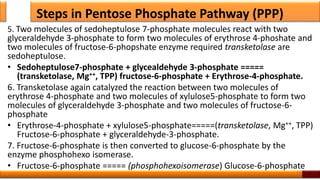
Steps in Pentose Phosphate Pathway (PPP)
5. Two molecules of sedoheptulose 7-phosphate molecules react with two
glyceraldehyde 3-phosphate to form two molecules of erythrose 4-phoshate and
two molecules of fructose-6-phopshate enzyme required transketolase are
sedoheptulose.
• Sedoheptulose7-phosphate + glycealdehyde 3-phosphate =====
(transketolase, Mg++, TPP) fructose-6-phosphate + Erythrose-4-phosphate.
6. Transketolase again catalyzed the reaction between two molecules of
erythrose 4-phosphate and two molecules of xylulose5-phosphate to form two
molecules of glyceraldehyde 3-phosphate and two molecules of fructose-6-
phosphate
• Erythrose-4-phosphate + xylulose5-phosphate=====(transketolase, Mg++, TPP)
Fructose-6-phosphate + glyceraldehyde-3-phosphate.
7. Fructose-6-phosphate is then converted to glucose-6-phosphate by the
enzyme phosphohexo isomerase.
• Fructose-6-phosphate ===== (phosphohexoisomerase) Glucose-6-phosphate
52
Significance of Pentose Phosphate Pathway (PPP)
• Metabolites viz. ribsose-5-phosphate and erythrose-3-phosphate produced in
this pathway are used in nucleic acid and lignin biosynthesis respectively
• If necessary, the intermediates such as glycerol aldehyde-3-Phosphate and
fructose- 6-Phosphate may enter in glycolysis and then aerobically degraded
• This pathway provides reduced NADPH for many biosynthetic reactions
especially for fatty acids, steroids etc.
• It is the short cut pathway for oxidation of glucose
• Pathway has a key role in plants because it generates ribulose-bi-phosphate,
which is the acceptor to CO2 during photosynthesis
• This pathway is the major source of NADP formation
• It is the shortcut pathway for oxidation of glucose
• In this pathway for every six glucose molecules one glucose molecule is
oxidized and other 5 molecules are resynthesized.
53
Chemiosmotic theory
• To explain the mechanism of oxidative phosphorylation three theories viz.
chemical coupling hypothesis, Conformational coupling hypothesis and
chemiosmotic hypothesis.
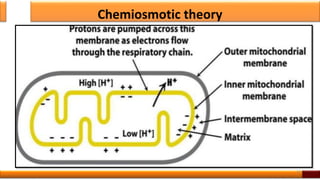
• The chemiosmotic hypothesis has been proposed by Mitchell (1961).
• This theory is most convincing and acceptable to date. The word chemiosmosis
refers to conversion of chemical energy (oxidation of NADH by oxygen) to
osmotic energy (i.e. difference in the concentration of proton on two sides of
mitochondrial membrane) and energy released by the proton flow is used to
form ATP from ADP and Pi.
• There are number of evidences in the support of this theory but most important
came from the use of 2,4-dinitrophenol. This chemical destroys the proton
gradient across the mitochondrial membranes and prevents ATP synthesis.
54
Chemiosmotic theory
55
Chemiosmotic theory
• However, if pH (proton) gradient is imposed on mitochondria even
in absence of electron transport ATP synthesis takes place.
• Chemiosmotic theory provides the intellectual framework for
understanding many biological energy transductions including
process of oxidative phosphorylation in mitochondria and
phosphorylation in chloroplasts. The mechanism of energy
coupling is similar in both cases.
Drawback:
• The precise mechanism for the arrangement of the proton pump
and functioning.
56
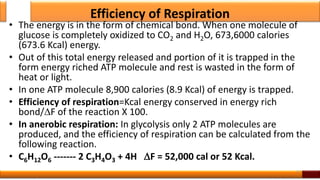
Efficiency of Respiration
• The energy is in the form of chemical bond. When one molecule of
glucose is completely oxidized to CO2 and H2O, 673,6000 calories
(673.6 Kcal) energy.
• Out of this total energy released and portion of it is trapped in the
form energy riched ATP molecule and rest is wasted in the form of
heat or light.
• In one ATP molecule 8,900 calories (8.9 Kcal) of energy is trapped.
• Efficiency of respiration=Kcal energy conserved in energy rich
bond/F of the reaction X 100.
• In anerobic respiration: In glycolysis only 2 ATP molecules are
produced, and the efficiency of respiration can be calculated from the
following reaction.
• C6H12O6 ------- 2 C3H4O3 + 4H F = 52,000 cal or 52 Kcal.
57
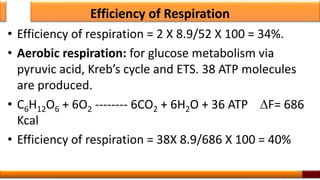
Efficiency of Respiration
• Efficiency of respiration = 2 X 8.9/52 X 100 = 34%.
• Aerobic respiration: for glucose metabolism via
pyruvic acid, Kreb’s cycle and ETS. 38 ATP molecules
are produced.
• C6H12O6 + 6O2 -------- 6CO2 + 6H2O + 36 ATP F= 686
Kcal
• Efficiency of respiration = 38X 8.9/686 X 100 = 40%
58
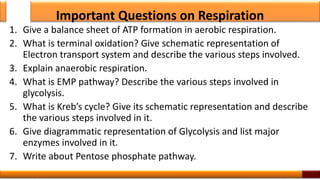
Important Questions on Respiration
1. Give a balance sheet of ATP formation in aerobic respiration.
2. What is terminal oxidation? Give schematic representation of
Electron transport system and describe the various steps involved.
3. Explain anaerobic respiration.
4. What is EMP pathway? Describe the various steps involved in
glycolysis.
5. What is Kreb’s cycle? Give its schematic representation and describe
the various steps involved in it.
6. Give diagrammatic representation of Glycolysis and list major
enzymes involved in it.
7. Write about Pentose phosphate pathway.
59
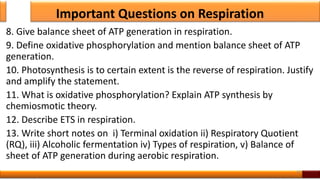
Important Questions on Respiration
8. Give balance sheet of ATP generation in respiration.
9. Define oxidative phosphorylation and mention balance sheet of ATP
generation.
10. Photosynthesis is to certain extent is the reverse of respiration. Justify
and amplify the statement.
11. What is oxidative phosphorylation? Explain ATP synthesis by
chemiosmotic theory.
12. Describe ETS in respiration.
13. Write short notes on i) Terminal oxidation ii) Respiratory Quotient
(RQ), iii) Alcoholic fermentation iv) Types of respiration, v) Balance of
sheet of ATP generation during aerobic respiration.
60

Respiration

  • 1.
    Respiration Dr. Anil VDusane Sir Parashurambhau College Pune anildusane@gmail.com 1
  • 2.
    Introduction of Respiration •Respiration is oxidation process in which glucose molecule is oxidized, water molecule is formed, and energy is released. • C6H12O6 + 6O2 + 6H2O======6CO2 + 12H2O + Energy (673 Kcal) • Respiration is a catabolic process in which oxidation of complex material takes place and a lot of energy (in the form of ATP) is released. • Photosynthesis and respiration are exactly opposite to each other. 2
  • 3.
    Photosynthesis and Respiration •Photosynthesis builds up carbohydrates with absorption of CO2 and release O2 • Respiration breaks up carbohydrates with absorption of O2 and releases CO2. • Respiration is catabolic process, and it goes on all the time and takes place in all living cells. While photosynthesis is the synthesis process (anabolic) and it takes place only in presence of sunlight. • Photosynthesis is confined to only green cells. • Chemical equation for photosynthesis and respiration clearly shows that these two processes are exactly opposite to each other 3
  • 4.
    Photosynthesis and Respiration •Photosynthesis: 6CO2 + 12H2O ========= (sunlight) C6H12O6 + 6O2 + 6H2O • Respiration: C6H12O6 + 6O2 + 6H2O-========6CO2 + 12H2O + Energy (673 Kcal). • These two chemical reactions are reverse process. 4
  • 5.
    Difference between Photosynthesisand Respiration Photosynthesis Respiration O2 is liberated O2 is utilized CO2 is absorbed and fixed inside to form carbon- containing compounds. CO2 is evolved due to oxidation of carbon containing compounds. Light is essential Light is not essential. Light energy is converted into potential energy. Potential energy is converted into Kinetic energy. Food is accumulated and dry weight of plant is increased. Food is consumed and dry weight of plant is decreased. It is endothermic process (energy is stored). It is exothermic process (energy is liberated). It is anabolic process. It is catabolic process. It involves hydrolysis and carboxylation processes. It involves dehydrolysis and decarboxylation. During synthesis 1 glucose molecule is utilized. During one breakdown 1 glucose molecule is formed. End products are hexose sugars and oxygen. End products are CO2 and water molecule 5
  • 6.
    Overview of Photosynthesisand Respiration 6
  • 7.
    Types of Respiration •Based on the fate of pyruvic acid • Method of disposal of hydrogen respiration • Three types: i) anaerobic ii) fermentation and iii) aerobic Anaerobic respiration • In this molecular oxygen do not participate and hence, glucose is incompletely broken down to form ethyl alcohol and CO2. • In this process very less energy (56 Kcal) is released. • Enzymes required for this process are present only in the cytoplasm. 7
  • 8.
    Anaerobic respiration • Majordifference in between anerobic respiration and fermentation is that the anerobic respiration is intracellular while the fermentation is extracellular. • In majority of tissues of higher plants anerobic respiration is induced when O2 supply is cut off. • Most of the seeds germinate under anerobic conditions initially • In several fleshy fruits anerobic respiration is common. E.g., Grapes. • It is also reported in some fungi especially mushrooms. • C6H12O6----- 2C5H5OH + 2CO2 + 56 Kcal. 8
  • 9.
    Mechanism of anaerobicrespiration i)This process completes through glycolysis Glucose + 2 NAD + 2 ADP ----------(Glycolysis) Pyruvic acid + 2 NADH2 + 2 ATP ii)Decarboxylation of pyruvic acid Pyruvic acid ==== (pyruvic decarboxylase) acetaldehyde + CO2 iii) Reduction of acetaldehyde Acetaldehyde + NADH2 == (dehydrogenase) Ethyl alcohol + NAD 9
  • 10.
  • 11.
    Fermentation • In thismolecular oxygen may or may not participate • Glucose/organic substrate is incompletely oxidized to form ethyl alcohol (or acetic acid) and CO2 • This conversion takes place due action of enzymes secreted by microbes • This is intracellular process • Based on formation of byproduct the fermentation is known as alcoholic fermentation, lactic acid fermentation, acetic acid fermentation, etc. 11
  • 12.
    Fermentation Alcoholic fermentation • Itis anaerobic breakdown of glucose into ethyl alcohol and CO2 by the action of enzyme, which is secreted by microbes viz. yeasts, bacteria, etc. i) Glycolysis of glucose to pyruvic acid. Glucose + 2 NAD + 2 ADP ------- (glycolysis) Pyruvic acid + 2 NADH2 + 2 ATP. ii) Decarboxylation of pyruvic acid to acetaldehyde. Pyruvic acid (3C)-------- (decarboxylase) Acetaldehyde (2C) + CO2. iii) Reduction of acetaldehyde to alcohol Acetaldehyde + NADH2 ----(dehydrogenase) ethyl alcohol+ NAD Overall reaction: C6H12O6---2C3H4O3--2CH3CHO+NADH---2C2H5OH + NAD. • The lactic acid fermentation occurs in lactic acid bacteria e.g. Lactobacilli sps, Streptococci sps., etc. which breakdown the milk sugar (lactose) anaerobically to produce lactic acid. 12
  • 13.
    Importance of fermentation •It has many commercial applications. • Ripening of cheese; retting of flax, hemp, jute; curing of tobacco and tea and tanning of leather are commercial process dependent upon fermentation. • Ethanol, butanol, acetone and many organic acids like citric acid, oxalic acid, etc. are synthesized. • Single Cells Proteins (SCP) are also obtained by fermentation process. 13
  • 14.
    Aerobic respiration • Inthis respiration the stored food (respiratory substrate) get completely oxidized into CO2 and H2O in presence of O2 • Aerobic respiration involves Glycolysis, Pyruvic acid oxidation, Kreb’s cycle and Oxidative phosphorylation/Hydrogen transfer system/Electron Transfer System (ETS) • Overall reaction is C6H12O6 + 6O2+6 H2O+38ADP+38Pi----CO2 + 12H2O+38 ATP 14
  • 15.
    Aerobic respiration andAnaerobic respiration Aerobic respiration Anaerobic respiration Molecular O2 is essential It takes place in the absence of O2 Oxidation of 1 glucose molecule gives 38 ATP molecules Oxidation (incomplete) of 1 glucose molecule yields only 2 ATP molecules. 673 Kcal energy released 56 Kcal energy is released. It takes place in cytosol (glycolysis) and mitochondria (Krebs cycle) It takes place only in cytosol It continues throughout the life It occurs as a temporary phase of life. This process is not toxic to the plant It is toxic to plants End products- large amount of energy, CO2 and water Small amount of energy, ethyl alcohol and CO2 is formed. C6H12O6 + 6H2O----6CO2 +6H2O+energy C6H12O6 ----- 2C2H5OH+ 2CO2+ energy 15
  • 16.
    Glycolysis • Glycos= sugar,lysis=dissolution • Breakdown of glucose up to pyruvic acid is called glycolysis. • 4 ATP molecules are formed out of which two are used up and net gain is 2 ATP molecules. • It is also known as Embden, Meyerhof and Paranas (EMP) pathway. • It is a common respiratory pathway for aerobic and anerobic respiration. • In this glucose molecule is degraded to 2 molecules of pyruvate in a series of 10 consecutive reactions and a specific enzyme catalyzes each step • At the end, two pyruvic acid molecules are formed. • There are total four phosphorylation steps in glycolysis. Glucose+2NAD++2ADP+2Pi------------2Pyruvate+2NADH+2H++2ATP+ 2H2O. 16
  • 17.
  • 18.
    Steps involved inGlycolysis 1. Phosphorylation I: • Any sugar that has to enter into glycolysis pathway must undergo phosphorylation (i.e., phosphate group added) • This reaction is catalyzed by enzyme hexokinase • This enzyme catalyzes transfer of phosphate group • Mg++ is essential as a cofactor • This reaction is irreversible • ATP is phosphate donor Glucose (6C) + ATP -------(hexokinase, Mg ++) Glucose-6-phosphate + ADP. 18
  • 19.
    Steps involved inGlycolysis 2. Isomerization • Glucose-6-phosphate isomerizes into fructose-6-phosphate with phophohexoisomerase (transphophorylases) phosphohexoisomerase is specific for glucose-6-phosphate and fructose-6-phosphate) Glucose-6-phosphate == (phosphohexoisomerase) Fructose-6-phosphate 3. Phosphorylatation-II • Fructose-6-phosphate undergoes phosphorylation to form fructose-1- 6-diphosphate • Enzyme phosphofructokinase (transphosphorylases, transfer of phosphate group from ATP to fructose-6-phosphate) catalyzes this reaction. Fructose-6-phosphate+ATP==(phosphofructokinase, PFK1) fructose-1-6 diphosphate + ADP 19
  • 20.
    Steps involved inGlycolysis 4. Cleavage: • Fructose 1-6 diphosphate splits into two molecules of trioses (3C) • This reaction catalyzed by aldolase(break carbon chains with out hydrolysis) 97 % of fructose 1-6 diphosphate gets converted into 3 PGAL(aldose) and 3% into DHAP(ketose). Fructose1-6 diphosphate==(aldolase) 3-Phosphoglyceraldehyde (3PGAL)+ Dihydroxyacetone phosphate (DHAP) 5. Isomerization • These molecules undergo internal rearrangement (isomerization) and become identical 3-phosphoglyceraldehyde (PGAL) molecules • Catalyzing enzyme is phosphotriose isomerase • PGAL only can be directly degraded in subsequent reactions 3-phosphoglyceraldehyde ===(phosphotriose isomerase) dihydroxyacetone phosphate 20
  • 21.
    Steps involved inGlycolysis 6. Phosphorylation and oxidative dehydrogenation • PGAL undergoes simultaneous phosphorylation and oxidative dehydrogenation • During phosphorylation under catalyzing action by phosphotriose dehydrogenase, a second phosphate is added to the other end • Phosphoric acid (H3PO4) provides the phosphate group • Oxidative dehydrogenation takes place simultaneously • Acceptor of hydrogen in 3 PGAL dehydrogenase reactions is coenzyme NAD+ (oxidized form). 3 PGAL + H3PO4 + NAD------(triose phosphate dehydrogenase) 1,3 diphosphoglyceric acid (3C) + NADH2 21
  • 22.
    Steps involved inGlycolysis 7. ATP generation: • 1,3 diphosphoglyceric acid transfers its phosphate (with high energy bond) to ADP forming 3-phosphoglyceric acid (PGA). • This process is called dephosphorylation. phosphoglyceryl kinase is transphosphorylases, which transfers the high-energy phosphate group form carboxyl group of 1,3 diphosphoglycerate to ADP forming ATP and 3-phosphoglycerate. • The formation of ATP by transfer of phosphate group from a substrate (1,3 diphosphoglycerate) is called substrate level phosphorylation. • 1,3 DPGA (3C) + ADP=== ( phosphoglyceryl kinase) 3PGA (3C) + ATP. 22
  • 23.
    Steps involved inGlycolysis 8. Isomerization-III: • 3-phosphoglyceric acid molecule undergoes internal rearrangement and becomes 2-phosphoglyceric acid. • The catalyzing enzyme is phosphoglyceromutase is transphosphorylases. • This transfer a functional group from one position to another in the same molecule. 3PGA (3C) ==== (phosphoglyceromutase, Mg++) 2 PGA (3C) 9. Dehydration: • 2-PGA molecule loses hydrogen and oxygen in the form of water (dehydration) to form phosphoenol pyruvic acid (PEP). • This step is catalyzed by enolase, hydrolase type of enzyme which catalyzes addition or removal of water molecule with out causing their split. 2 PGA (3C)------------------(enolase, Mg++) 2PEP (3C) + 2H2O. 23
  • 24.
    Steps involved inGlycolysis 10. ATP generation (Dephosphorylation)-II: • This is the last step of glycolysis in which the transfer of phosphate groups from phospoenol pyruvate to ADP. • Pyruvate first appears in its enol form. It tautomerizes rapidly and non- enzymatically to yield ketoform of pyruvate (this form predominates at pH 7). • Pyruvic acid does not have any phosphate groups. This reaction is catalyzed by pyruvate kinase. • Two molecules of pyruvic acid are formed per molecule of glucose metabolized. • 2PEP (3C) + ADP ---------- (pyruvate kinase) pyruvic acid (3C) + ATP. 24
  • 25.
    Significance of Glycolysis •There is an intermediate net yield of two ATP molecules (four are formed and two are used) • Some of the energy in glucose is transferred to four hydrogen atoms, which become part of two molecules of NADH and form two hydrogen ions • Eventually, the energy with in NADH is released in ETS and forms six molecules of ATP. 25
  • 26.
    Citric acid cycle/Kreb’scycle • This cycle has been named in honor of English biochemists Hans A Krebs (1937) who first postulated as the pathway. • The series of reactions involved in the stepwise degradation of pyruvic acid is known as Kreb’s cycle. • This cycle is also called as citric acid cycle, tricarboxylic acid cycle, mitochondrial respiration, organic acid cycle, oxidation of Pyruvate, etc. transport system. • It is amphibolic i.e., it operates both way catabolically and anabolically • Starting point for the citric acid cycle is acetyl Co-A and oxaloacetic acid • One molecule of ATP is generated directly at the substrate level in each cycle • In each Kreb’s cycle proper, 11 molecules of ATP are generated through the hydrogen. • Net reaction is Acetyl CoA+ 3 NAD+ + FAD + GDP+ Pi+ H2O-------2CO2+ 3NADH+FADH2+ GTP+ 2H+ +CoA. 26
  • 27.
  • 28.
    Significance of Citricacid cycle • This cycle provides intermediates for biosynthesis of porphyrins and many of amino acids are derived from -ketoglutarate and OAA. • This cycle is intimately connected with nitrogen metabolism particularly with the synthesis of amino acids. • The organic acid which is formed in the cycle serves as the substrates in the synthesis of amino acids. • This cycle opens up the possibility of pyruvic acid being diverted to other metabolic pathways. 28
  • 29.
    Significance of Citricacid cycle • This is the major degradative pathway, which results in the liberation of a large amount of energy. • The major part of energy that is liberated during the respiration is obtained in this cycle. • The net gain of ATP is 30 (in each turn 15 molecules of ATP). • This cycle is the centre piece of intermediatory metabolism. • The intermediates of the cycle are the starting points for biosynthesis of carbohydrates, fatty acids, many amino acids, and other compounds of biochemical importance such as porphyrins. • It is also the final common pathway for aerobic oxidation of the products of carbohydrates, lipids and amino acid catabolism. • This cycle is responsible for the production of large number of plant acids such as malic acid, citric acid, oxalo acetic acid, etc. • Citric acid cycle is a source of biosynthetic precursors. It serves as a source of building blocks for biosynthesis. 29
  • 30.
    Respiratory substrate /respirablematerial • Organic substrates (energy rich material of the cells) that are used in respiratory process (oxidation) are known as the respirable materials or the respiratory substrates • Plant uses a variety of substrates viz. carbohydrates, fats, organic acids and proteins for respiration process • Carbohydrates (starch) are mainly utilized as principle respiratory substrates • These are first hydrolyzed to simple sugars before entering the respiratory metabolism • In oily seeds, fats get converted into sugars through glyoxylate cycle before serving as respiratory substrate • Proteins are utilized only when carbohydrates or fats are not available • When proteins are the respiratory materials then proteins are broken down into amino acids. These amino acids by deamination get converted into ketoacids and then enter into respiratory chain • In long run the utilization of proteins as substrate is harmful to the cells i.e. it results in floating respiration. 30
  • 31.
    Respiratory quotient (R.Q.) •The ratio between the volume of CO2 given out and O2 taken simultaneously by a given weight of the tissues in a given period at standard temperature and pressure. • The ratio is expressed as Volume of CO2 evolved /Volume of O2 consumed. Factors affecting the value of R.Q. • i) nature of the respiratory substrate, ii) mode of oxidation, iii) metabolic utilization of CO2 and iv) utilization of O2. • R.Q. for carbohydrates: Carbohydrates are the principle respiratory substrate. When hexose sugars are used as the respiratory substrate the volume of CO2 evolved equals to the volume of O2 used. Hence the value of R.Q. is unity. • C6H12O6 + 6O2 ---------------------- 6 CO2 + 6 H2O +673 Kcal. • R.Q.= 6CO2/6O2 = 1. 31
  • 32.
    Respiratory quotient (R.Q.) •The R.Q. for fats is less than one because fats are poor in oxygen contents. The proportion of oxygen to carbon is less in proteins than in carbohydrates that is why oxidation of proteins results in 0.8-0.9 RQ i.e. less than 1. While in organic acids (in succulents) R.Q. is more than one because organic acids are relatively rich in oxygen as compared with hexoses. • Determination of RQ: It is determined by means of Ganong’s respiratormeter which measures the amount of O2 absorbed and CO2 given out during respiration. • Significance of R.Q.: R.Q. of plants provides important information regarding the nature of the respiratory process/s. Certain inferences can also be drawn regarding the type of substrate oxidized, transformation in the foods present in cells. RQ can be used as an index of relative utilization of carbohydrate, fat and protein by an organism. 32
  • 33.
    Electron Transport System/OxidativePhosphorylation • Definition: Oxidative phosphorylation is the process in which electrons are transferred from NADH or FADH2 (energy rich molecules) to molecular oxygen by a series of electron carriers (ETS) and during this process ATP molecules are synthesized. • It is the final stage of aerobic respiration. • This is the pathway along which electrons are transferred so called as ETS. • Several pairs of hydrogen atoms are released during glycolysis, pyruvic acid oxidation and Kreb’s cycle. • The hydrogen liberated in the above process is splits up to in protons and electrons. H2--------2H+ +e- Out of these protons 2H+ remain in the matrix while only a pair of electrons (2e-) is transferred through the sequence of electron acceptors. 33
  • 34.
    Salient features ofETS • NADH and FADH (energy rich compounds) formed in glycolysis and Krebs cycle can not directly combine with O2 to form H2O. But their several electrons are transferred via several intermediates (electrons carriers) before H2O is formed. • The sequence of electron carriers is as follows: • NAD----FAD---Cyt Q- (ubquinone)---Cyt b----Cyt c1---Cyt c ---Cyt a--- cyt a3— molecular O2. • NAD has the highest energy content value; it is a strong reducing agent and have –ve redox (reduction) potential. While oxygen has lowest energy content. It is strong oxidizing agent and has +ve redox (reduction potential). • The flow of electrons is one way i.e., from higher energy level to the lower energy level. • In biological reactions electrons are transferred in between electron donating molecule (a reducing agent) and electron accepting molecule (oxidizing agent). • The electrons carriers are reversibly interconverted between oxidized and reduced states. 34
  • 35.
    Salient features ofETS • The mitochondrial ETS consists of a series of electron carrier arranged in a close physical contact with mitochondrial membrane. • iv)During the transfer of electrons in ETS a lot of energy is liberated, and this released energy is used for the synthesis of ATP from ADP and Pi i.e., oxidative phosphorylation. This is the main route for the synthesis of ATP molecules. • The rate of electron transport in proportional to the rate of O2 uptake by mitochondria. • The driving force of oxidative phosphorylation is electron transport potential of NADH or FADH2. 35
  • 36.
    Site of oxidativephosphorylation • It takes place in the elementary particles of mitochondria (located in the inner surface of cristae) • An elementary particle has a hexagonal, basal plate, stalk and knob like structure • Electron transfer complex I and II located in the basal plate, complex III in the stalk and complex IV in knob. 36
  • 37.
  • 38.
    Mechanism of ETS •ETS begins with the acceptance of 2 atoms of hydrogen from the substrate (other than succinate) by NAD • This NAD gets reduced to NADH • NADH then reacts with the second electron acceptor FAD • NADH is oxidized when 2H are transferred to the prosthetic group of flavin • FAD in turns gets reduced to FADH2 • In this process of electrons lose a part of their energy • This released energy is utilized for the formation of ATP from ADP and Pi 38
  • 39.
    Mechanism of ETS •FAD carries two electrons, and the hydrogens are released in the aqueous medium inside the mitochondrion at flavin protein step • Reduced FAD (FADH2) then passes its electron to COQ (ubiquinone) and it get reduced • Then electrons are transferred to a common acceptor i.e., Cyt b (these are conjugated proteins having prosthetic group of iron containing porphyrin) which then becomes reduced • Cytochromes Cyt c1, Cyt c, cyt a and Cyt a3 becomes alternately reduced and oxidized by the passage of electrons 39
  • 40.
    Mechanism of ETS •Their oxidized form is ferric ( Fe+++) and reduced form has (Fe++) iron. When electrons are passing through cytochromes at two places energy is liberated and 2 ATP molecules are formed. • Thus, reducing the electron flow from NAD+ to Cyt a3 three ATP molecules are formed. O2 is the last electron acceptor in ETS. • At the last electron combines with oxygen and get ionized (O--) and ionized O combine with 2 protons (2H+) present in the matrix to form water molecule (H2O). • This formation of H2O molecule at the end of ETS by addition of O- - and 2H+ in presence of enzyme cytochrome oxidase is called terminal oxidation. 40
  • 41.
    Significance of ETS •This is the only process in which energy is released, trapped and conserved in the form of ATP. • The hydrogen atoms released during glycolysis and Kreb’s cycle enters in ETS to produce actual energy and in this process energy of electrons is used for ATP generation in a very controlled and stepwise manner. • This process is the major source of ATP generation, and 32 ATP molecules are formed out of 36 ATP molecules. 41
  • 42.
    ATP (Adenine Triphosphate) Itwas first perceived by Fritz Lipmann (1941). Properties of ATP • It is the major chemical link between energy producing (anabolic) and energy consuming (catabolic) activities of the cell. • Free energy released by hydrolysis of ATP under standard conditions at pH 7 is -7.3 Kcal/mol • ATP + H2O---- ADP+ Pi + G (free energy) = -7.3 Kcal. • ATP serves as the principle immediate donor of free energy in biological systems rather than a storage form of the free energy • ATP, ADP and AMP are interconvertible forms in the presence of adenylatekinase enzyme. 42
  • 43.
    ATP (Adenine Triphosphate) •Consumption of ATP involves hydrolysis of terminal phosphate of ATP while synthesis involves the covalent attachment of inorganic phosphate (Pi) to ADP. • ATP is high-energy phosphate group donor • Phosphate transfer serves as the means of chemically transferring energy of cell • ATP is the universal currency of free energy in biological systems • The living organisms requires a continual input of energy for three main purposes viz. mechanical work, cellular movements and active transport of molecules and ions 43
  • 44.
    Structure of ATP(Adenine Triphosphate) 44
  • 45.
    Balance sheet ofATP Reaction/process Direct product No. of ATP/ NADH /GTP/ FADH2 Glycolysis Glucose--- Glucose-6-phosphate - 1 ATP Fructose-6-phosphate—fructose-1-6 diphosphate -1 ATP 2PGA--- 2, 1, 3 diphosphoglycerate 2 NADH 2, 1, 3 diphosphoglycerate—2,3 phosphoglycerate 2 ATP 2 PEP--- 2 pyruvate 2 ATP Pyruvic acid oxidation 2 pyruvate—2 acetyl CoA 2 NADH Krebs cycle 2 Isocitrate –2 -ketoglutarate 2 NADH 2 -ketoglutarate – 2 succinyl CoA 2 NADH 2 succinyl CoA – 2 succinate 2 GTP (ATP) 2- succinate –2 fumarate 2 FADH2 2 malate—2 oxaloacetate 2 NADH 45 NADH = 3 ATP, FADH2 = 2 ATP ; negative sign indicates consumption * Indicates that ATP produced directly and remaining in ETS.
  • 46.
    Balance sheet ofATP Cycles Total ATP produced Consumed Net Glycolysis 10 2 8 or 6 Oxidation of pyruvic acid 6 - 6 Krebs 24 - 24 Total 40 02 38/36* 46 In Prokaryotic cells net yield is of 38 ATP molecules/glucose molecule because they do not have to spent two ATP molecules to transport electrons from NADH into mitochondrion as they don't have mitochondria.
  • 47.
    Pentose Phosphate Pathway(PPP) • It is an alternative route for the oxidation of glucose • It is known by different names such as PPP because Pentose Phosphate plays an important role in cyclic reaction sequence • It is called Hexose monophosphate shunt because the pathway diverse from glycolysis at the glucose 6-P-level • In this pathway for every six molecules of hexose sugar involved, one molecule is oxidized to CO2 and H2O and re-synthesis of five molecules of hexose takes place • The reactions of pathway take place in cytosol, chloroplasts and mitochondrion 47
  • 48.
    Evidence for PentosePhosphate Pathway (PPP) • It is insensitive to certain chemicals, which inhibit glycolysis. • The classical inhibitors of glycolysis e.g., iodoacetate and fluoride had no effect on utilization of glucose. • 14C studies also supported this cycle. 48
  • 49.
  • 50.
    Steps in PentosePhosphate Pathway (PPP) 1. Oxidation: In the first reaction glucose-6-phosphate is oxidized to 6- phosphogluconic acid by glucose-6-phosphate dehydrogenase (NADP+ is electron acceptor) Glucose-6-phosphate+NADP+---(dehydrogenase) 6-phosphogluconic acid+NADH+H+ 2.Oxidative decarboxylation: Phosphogluconic acid undergoes oxidative decarboxylation and give rises a 5-carbon compound ribulose5-phosphate. NADPH+ H+ and CO2 are produced and 6-phosphogluconic dehydrogenase is required. 6-phosphogluconic acid + NADP+-----(dehydrogenase) ribulose-5-phosphate + NADPH+ H+ + CO2 steps i) and ii) are the only oxidative steps in PPP and only in second step CO2 is released. The subsequent reactions convert pentose sugar (ribulose-5- phosphate) back to hexose sugar involving some reactions common to Calvin cycle as well. 50
  • 51.
    Steps in PentosePhosphate Pathway (PPP) • The ribulose 5-phosphate is further by a series of reactions involving interconversions of 3,4,5,6 and 7 carbon monosaccharides, which are catalyzed by several enzymes. 3.Ribulose 5-phosphate is either isomerized by phsphoriboisomerase to ribose5-phsophate or epimerized by phosphoribose epimerase to xylulose 5- phosphate. Ribulose–5-phosphate=========== (phosphoriboisomerase)Ribose5- phosphate. 4. Subsequently two ribose-5-phosphose and two xylulose-5-phosphate combine to form two molecules of sedoheptulose 7-phosphate in presence of transketolase, Mg++, TPP (Thiamine pyrophosphate). Xylulose-5-phosphate+Ribose-5-phsophate==(transketolase) Sedoheptulose-7-phosphate + glyceraldehyde-3-phosphate. 51
  • 52.
    Steps in PentosePhosphate Pathway (PPP) 5. Two molecules of sedoheptulose 7-phosphate molecules react with two glyceraldehyde 3-phosphate to form two molecules of erythrose 4-phoshate and two molecules of fructose-6-phopshate enzyme required transketolase are sedoheptulose. • Sedoheptulose7-phosphate + glycealdehyde 3-phosphate ===== (transketolase, Mg++, TPP) fructose-6-phosphate + Erythrose-4-phosphate. 6. Transketolase again catalyzed the reaction between two molecules of erythrose 4-phosphate and two molecules of xylulose5-phosphate to form two molecules of glyceraldehyde 3-phosphate and two molecules of fructose-6- phosphate • Erythrose-4-phosphate + xylulose5-phosphate=====(transketolase, Mg++, TPP) Fructose-6-phosphate + glyceraldehyde-3-phosphate. 7. Fructose-6-phosphate is then converted to glucose-6-phosphate by the enzyme phosphohexo isomerase. • Fructose-6-phosphate ===== (phosphohexoisomerase) Glucose-6-phosphate 52
  • 53.
    Significance of PentosePhosphate Pathway (PPP) • Metabolites viz. ribsose-5-phosphate and erythrose-3-phosphate produced in this pathway are used in nucleic acid and lignin biosynthesis respectively • If necessary, the intermediates such as glycerol aldehyde-3-Phosphate and fructose- 6-Phosphate may enter in glycolysis and then aerobically degraded • This pathway provides reduced NADPH for many biosynthetic reactions especially for fatty acids, steroids etc. • It is the short cut pathway for oxidation of glucose • Pathway has a key role in plants because it generates ribulose-bi-phosphate, which is the acceptor to CO2 during photosynthesis • This pathway is the major source of NADP formation • It is the shortcut pathway for oxidation of glucose • In this pathway for every six glucose molecules one glucose molecule is oxidized and other 5 molecules are resynthesized. 53
  • 54.
    Chemiosmotic theory • Toexplain the mechanism of oxidative phosphorylation three theories viz. chemical coupling hypothesis, Conformational coupling hypothesis and chemiosmotic hypothesis. • The chemiosmotic hypothesis has been proposed by Mitchell (1961). • This theory is most convincing and acceptable to date. The word chemiosmosis refers to conversion of chemical energy (oxidation of NADH by oxygen) to osmotic energy (i.e. difference in the concentration of proton on two sides of mitochondrial membrane) and energy released by the proton flow is used to form ATP from ADP and Pi. • There are number of evidences in the support of this theory but most important came from the use of 2,4-dinitrophenol. This chemical destroys the proton gradient across the mitochondrial membranes and prevents ATP synthesis. 54
  • 55.
  • 56.
    Chemiosmotic theory • However,if pH (proton) gradient is imposed on mitochondria even in absence of electron transport ATP synthesis takes place. • Chemiosmotic theory provides the intellectual framework for understanding many biological energy transductions including process of oxidative phosphorylation in mitochondria and phosphorylation in chloroplasts. The mechanism of energy coupling is similar in both cases. Drawback: • The precise mechanism for the arrangement of the proton pump and functioning. 56
  • 57.
    Efficiency of Respiration •The energy is in the form of chemical bond. When one molecule of glucose is completely oxidized to CO2 and H2O, 673,6000 calories (673.6 Kcal) energy. • Out of this total energy released and portion of it is trapped in the form energy riched ATP molecule and rest is wasted in the form of heat or light. • In one ATP molecule 8,900 calories (8.9 Kcal) of energy is trapped. • Efficiency of respiration=Kcal energy conserved in energy rich bond/F of the reaction X 100. • In anerobic respiration: In glycolysis only 2 ATP molecules are produced, and the efficiency of respiration can be calculated from the following reaction. • C6H12O6 ------- 2 C3H4O3 + 4H F = 52,000 cal or 52 Kcal. 57
  • 58.
    Efficiency of Respiration •Efficiency of respiration = 2 X 8.9/52 X 100 = 34%. • Aerobic respiration: for glucose metabolism via pyruvic acid, Kreb’s cycle and ETS. 38 ATP molecules are produced. • C6H12O6 + 6O2 -------- 6CO2 + 6H2O + 36 ATP F= 686 Kcal • Efficiency of respiration = 38X 8.9/686 X 100 = 40% 58
  • 59.
    Important Questions onRespiration 1. Give a balance sheet of ATP formation in aerobic respiration. 2. What is terminal oxidation? Give schematic representation of Electron transport system and describe the various steps involved. 3. Explain anaerobic respiration. 4. What is EMP pathway? Describe the various steps involved in glycolysis. 5. What is Kreb’s cycle? Give its schematic representation and describe the various steps involved in it. 6. Give diagrammatic representation of Glycolysis and list major enzymes involved in it. 7. Write about Pentose phosphate pathway. 59
  • 60.
    Important Questions onRespiration 8. Give balance sheet of ATP generation in respiration. 9. Define oxidative phosphorylation and mention balance sheet of ATP generation. 10. Photosynthesis is to certain extent is the reverse of respiration. Justify and amplify the statement. 11. What is oxidative phosphorylation? Explain ATP synthesis by chemiosmotic theory. 12. Describe ETS in respiration. 13. Write short notes on i) Terminal oxidation ii) Respiratory Quotient (RQ), iii) Alcoholic fermentation iv) Types of respiration, v) Balance of sheet of ATP generation during aerobic respiration. 60