THE
MICROSCOPE
Antony van Leeuwenhoek (1632-1723)
• Inventor of the first microscope
• Leeuwenhoek earned his living as a draper, but spent much of
his spare time constructing simple microscopes composed of
double convex glass lenses held between two silver plates (figure
below)
• his microscope could magnify around 50 to 300 times,
• A microscope is an instrument used to see objects that are too
small for the naked eye. The science of investigating small objects
using such an instrument is called microscopy


There are many types of microscopes, the most common two
main type,
1. light microscope
2. electron microscope .
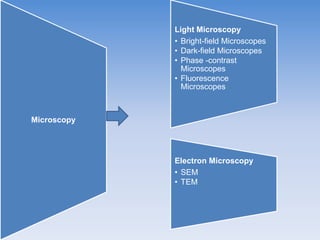
Light Microscopy
             • Bright-field Microscopes
             • Dark-field Microscopes
             • Phase -contrast
               Microscopes
             • Fluorescence
               Microscopes


Microscopy


             Electron Microscopy
             • SEM
             • TEM
Light Microscope

In the light microscopy there is a use of visible light and glass
lenses for the magnification. Microbiologist currently employ a
variedly light microscopes in their work. The most commonly used
basic types of microscopes include;

a.   Bright-field microscopes,
b.   Dark-field microscope,
c.   Phase-contrast microscopes
d.   Fluorescence microscope
• Modern microscopes are all compound microscopes, that is the magnified
image formed by the objective lens is further enlarged by one or more
additional lenses like eyepiece (ocular) . A compound microscope with a single
eyepiece is said to be monocular; one with two eyepiece is said to be binocular

•The part of a modern compound microscope and the part light takes through it
are shown in the above figure. light enters the microscope from a light source
in the base and often passes through a blue filter, which filter out the base and
often passes light, leaving the shorter wavelengths and improving resolution. It
then goes through a condenser, which gathering the light beams so that they
pass through a specimen. The iris diaphragm controls the amount of light that
passes though the specimen and into the objective lens. The higher the
magnification, the greater the amount of light needed to see the specimen
clearly. The objective lens magnifies the image before it passes though the
body tube to the ocular lens in the eyepiece. The ocular lens (eyepiece) further
magnifies the image. A mechanical stage allows precise control of moving the
slide , which is especially useful in the study of microbes. The focusing
mechanism consist of a coarse adjustment knob, which changes the distance
very slowly. The coarse adjustment knob is used to locate the specimen. The
fine adjustment knob is used to bring it into sharp focus.
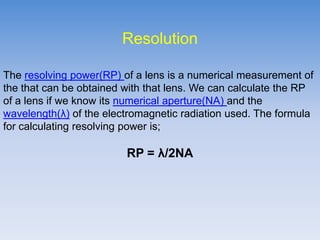
Resolution

The resolving power(RP) of a lens is a numerical measurement of
the that can be obtained with that lens. We can calculate the RP
of a lens if we know its numerical aperture(NA) and the
wavelength(λ) of the electromagnetic radiation used. The formula
for calculating resolving power is;

                         RP = λ/2NA
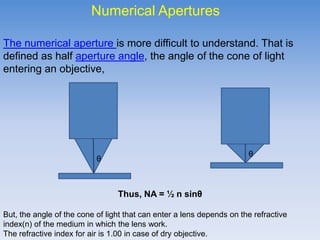
Numerical Apertures

The numerical aperture is more difficult to understand. That is
defined as half aperture angle, the angle of the cone of light
entering an objective,


                                                                       θ
                           θ


                                 Thus, NA = ½ n sinθ

But, the angle of the cone of light that can enter a lens depends on the refractive
index(n) of the medium in which the lens work.
The refractive index for air is 1.00 in case of dry objective.
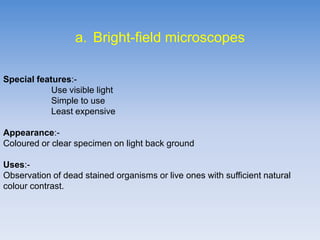
a. Bright-field microscopes

Special features:-
            Use visible light
            Simple to use
            Least expensive

Appearance:-
Coloured or clear specimen on light back ground

Uses:-
Observation of dead stained organisms or live ones with sufficient natural
colour contrast.
b. Dark-field microscope

Special features:-
Uses visible light with special condenser that causes light rays to reflect   off
specimen at an angle

Appearance:-
Bright specimen on dark background

Uses:-
Observation of unstained living or difficult to stain organisms. Allows one to see
motions
c. Phase-contrast microscopes


Special features:-
Use visible plus phase shifting plate in objective with a special condenser that
causes some light rays to strike specimen out of phase with each other

Appearance:-
specimen has different degrees of brightness and darkness

Uses:-
Detail observation of internal structure of living unstained organisms
d. Fluorescence microscope

Special features:-
Uses ultraviolet light to excite molecules to emit light of different wave
lengths, often brilliant colour, because UV can burn eyes, special lens materials
are used

Appearance:-
Bright fluorescent colour specimen on dark back ground

Uses:-
Diagnostic tool for detection of organism or antibiotic s in clinical specimens or
for immunological studies
Electron Microscopy
Special features:-
 Uses electron beams and electromagnetic
lenses, inexpensive, preparation requires considerable time and
practice.

Appearance: -
Three dimensional view of surfaces.

Uses:-
Observation of exterior of cells or of internal surfaces


• To visualise the internal structure - TEM
• Electrons instead of light
• Greater resolving power
• Disadvantages:
    Expensive
    A high vacuum is required
    Very thin sections (<100 nm thick)
Figure:-   Bacterial cells viewed with light microscope
Figure:-   Bacterial cell viewed with electron microscope
STAINING OF BACTERIA


Why to stain bacteria?
Because bacteria are semitransparent and difficult to see in the unstained state.
It is necessary to make bacteria visible to find out their shape, arrangements
and other morphological characters. Staining will make the cells more visible
and help in revealing their internal structures.

Types of stains and dyes
A large number of colored organic compounds are available for staining
microorganisms. Based on the chemical behavior of the dye, these can be
classified into three., acidic, basic or neutral. An acidic dye is one in which the
change on the dye ion is negative. An basic dye is one in which the change on
the dye ion is positive. A neutral dye is a complex salt of a dye acid with a dye
base. Acid dyes generally stain basic cell components, and basic dyes
generally stain acidic cell components.
Process of staining
the process of staining may be involve ion-exchange reactions between the stain and
active sites at the surface of or within the cell. The colored ions of dye may replace other
ions on cellular components. For example the ionic exchange which takes place during
staining can be represented by the following equation, in which the (MB+) action
replaced the (NA+ action in the cell.
                   )

(Bacterial cell ˉ) (NA ) + (MB+) (Clˉ) ------- (Bacterial cell ˉ) (MB ) + (NA ) (Clˉ)
                      +                                              +      +

In this MB is methylene blue dye, which is actually methylene blue chloride.

Staining methods can be divided into two groups.
1. simple staining and 2. differential staining.

Under differential staining comes.
• gram’s staining
• acid-fast staining
• endospore staining
• capsule staining
• flagella staining
• cytoplasmic inclusion staining
• giemsa staining

The Microscope

  • 1.
  • 3.
    Antony van Leeuwenhoek(1632-1723) • Inventor of the first microscope
  • 4.
    • Leeuwenhoek earnedhis living as a draper, but spent much of his spare time constructing simple microscopes composed of double convex glass lenses held between two silver plates (figure below) • his microscope could magnify around 50 to 300 times,
  • 5.
    • A microscopeis an instrument used to see objects that are too small for the naked eye. The science of investigating small objects using such an instrument is called microscopy There are many types of microscopes, the most common two main type, 1. light microscope 2. electron microscope .
  • 6.
    Light Microscopy • Bright-field Microscopes • Dark-field Microscopes • Phase -contrast Microscopes • Fluorescence Microscopes Microscopy Electron Microscopy • SEM • TEM
  • 7.
    Light Microscope In thelight microscopy there is a use of visible light and glass lenses for the magnification. Microbiologist currently employ a variedly light microscopes in their work. The most commonly used basic types of microscopes include; a. Bright-field microscopes, b. Dark-field microscope, c. Phase-contrast microscopes d. Fluorescence microscope
  • 9.
    • Modern microscopesare all compound microscopes, that is the magnified image formed by the objective lens is further enlarged by one or more additional lenses like eyepiece (ocular) . A compound microscope with a single eyepiece is said to be monocular; one with two eyepiece is said to be binocular •The part of a modern compound microscope and the part light takes through it are shown in the above figure. light enters the microscope from a light source in the base and often passes through a blue filter, which filter out the base and often passes light, leaving the shorter wavelengths and improving resolution. It then goes through a condenser, which gathering the light beams so that they pass through a specimen. The iris diaphragm controls the amount of light that passes though the specimen and into the objective lens. The higher the magnification, the greater the amount of light needed to see the specimen clearly. The objective lens magnifies the image before it passes though the body tube to the ocular lens in the eyepiece. The ocular lens (eyepiece) further magnifies the image. A mechanical stage allows precise control of moving the slide , which is especially useful in the study of microbes. The focusing mechanism consist of a coarse adjustment knob, which changes the distance very slowly. The coarse adjustment knob is used to locate the specimen. The fine adjustment knob is used to bring it into sharp focus.
  • 10.
    Resolution The resolving power(RP)of a lens is a numerical measurement of the that can be obtained with that lens. We can calculate the RP of a lens if we know its numerical aperture(NA) and the wavelength(λ) of the electromagnetic radiation used. The formula for calculating resolving power is; RP = λ/2NA
  • 11.
    Numerical Apertures The numericalaperture is more difficult to understand. That is defined as half aperture angle, the angle of the cone of light entering an objective, θ θ Thus, NA = ½ n sinθ But, the angle of the cone of light that can enter a lens depends on the refractive index(n) of the medium in which the lens work. The refractive index for air is 1.00 in case of dry objective.
  • 12.
    a. Bright-field microscopes Specialfeatures:- Use visible light Simple to use Least expensive Appearance:- Coloured or clear specimen on light back ground Uses:- Observation of dead stained organisms or live ones with sufficient natural colour contrast.
  • 13.
    b. Dark-field microscope Specialfeatures:- Uses visible light with special condenser that causes light rays to reflect off specimen at an angle Appearance:- Bright specimen on dark background Uses:- Observation of unstained living or difficult to stain organisms. Allows one to see motions
  • 14.
    c. Phase-contrast microscopes Specialfeatures:- Use visible plus phase shifting plate in objective with a special condenser that causes some light rays to strike specimen out of phase with each other Appearance:- specimen has different degrees of brightness and darkness Uses:- Detail observation of internal structure of living unstained organisms
  • 15.
    d. Fluorescence microscope Specialfeatures:- Uses ultraviolet light to excite molecules to emit light of different wave lengths, often brilliant colour, because UV can burn eyes, special lens materials are used Appearance:- Bright fluorescent colour specimen on dark back ground Uses:- Diagnostic tool for detection of organism or antibiotic s in clinical specimens or for immunological studies
  • 16.
  • 17.
    Special features:- Useselectron beams and electromagnetic lenses, inexpensive, preparation requires considerable time and practice. Appearance: - Three dimensional view of surfaces. Uses:- Observation of exterior of cells or of internal surfaces • To visualise the internal structure - TEM • Electrons instead of light • Greater resolving power • Disadvantages: Expensive A high vacuum is required Very thin sections (<100 nm thick)
  • 18.
    Figure:- Bacterial cells viewed with light microscope
  • 19.
    Figure:- Bacterial cell viewed with electron microscope
  • 20.
    STAINING OF BACTERIA Whyto stain bacteria? Because bacteria are semitransparent and difficult to see in the unstained state. It is necessary to make bacteria visible to find out their shape, arrangements and other morphological characters. Staining will make the cells more visible and help in revealing their internal structures. Types of stains and dyes A large number of colored organic compounds are available for staining microorganisms. Based on the chemical behavior of the dye, these can be classified into three., acidic, basic or neutral. An acidic dye is one in which the change on the dye ion is negative. An basic dye is one in which the change on the dye ion is positive. A neutral dye is a complex salt of a dye acid with a dye base. Acid dyes generally stain basic cell components, and basic dyes generally stain acidic cell components.
  • 21.
    Process of staining theprocess of staining may be involve ion-exchange reactions between the stain and active sites at the surface of or within the cell. The colored ions of dye may replace other ions on cellular components. For example the ionic exchange which takes place during staining can be represented by the following equation, in which the (MB+) action replaced the (NA+ action in the cell. ) (Bacterial cell ˉ) (NA ) + (MB+) (Clˉ) ------- (Bacterial cell ˉ) (MB ) + (NA ) (Clˉ) + + + In this MB is methylene blue dye, which is actually methylene blue chloride. Staining methods can be divided into two groups. 1. simple staining and 2. differential staining. Under differential staining comes. • gram’s staining • acid-fast staining • endospore staining • capsule staining • flagella staining • cytoplasmic inclusion staining • giemsa staining