Microscopy
                Group 2
Cabatit, Mendoza, Ramos, Rodriguez, Tan
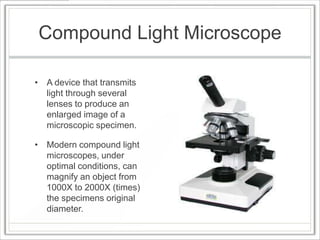
Compound Light Microscope

• A device that transmits
  light through several
  lenses to produce an
  enlarged image of a
  microscopic specimen.

• Modern compound light
  microscopes, under
  optimal conditions, can
  magnify an object from
  1000X to 2000X (times)
  the specimens original
  diameter.
Bright Field Microscopy

•       Simplest optical microscopy illumination
        technique

•       Uses visible light as source of illumination

    •       > the shorter the wavelength, the greater the
                   resolution (blue is the best)

•       Contrast comes from absorbance of light in the
        sample, or from staining.

•       When the diaphragm is wide open the image is
        brighter and contrast is low.
Bright Field Microscopy

•   Sources of illumination: Lamp on the base

•   Types of image produced: Relatively large
    internal structures and outline can be seen


•   Total Magnification: (if 10x ocular magnification is
    used)                        Range: 10x-1000x

•   Resolution: Up to 200nm (white light)
Source:
http://www.austincc.edu/biocr/1406/labm/ex3/prelab_3_8.htm
Dark Field Microscopy

• Type of microscopy which is the exact opposite of
  a bright field microscope

• Dark background/field with the specimen being
  the only one illuminated.

• Used in observing unstained specimens

• Most microscopes have the potential to do dark
  field microscopy such as compound or
  stereomicroscopes.
Dark Field Microscopy

• Light source: Light bulb from a microscope

• Condenser type: Specialized to block most light
  from the source; contains an annular/patch stop
  which disperses the light in various
  directions, resulting to a ―cone of light‖

• Image formed: Dark background with illuminated
  specimen; may be inverted or not depending on
  microscope used
Dark Field Microscopy

• Total Magnification: Can range from those of
  compound microscopes (10x to 1000x)
Pros and Cons of Dark Field
           Microscopy
       Advantages                      Disadvantages
• Used to view unstained          •   Can be inaccurate
  specimens more clearly.             compared to other methods.

                                  •   Special care if more needed
• Can be used to study
                                      for this type of microscopy
  various live                        to prevent aberrations.
  bacteria, protists, algae, fu
  ngi, and many other             •   Needs intense amount of
  cultures.                           light which can hurt the
                                      eyes and cause glare.
• Can examine the external
                                  •   Air bubbles in the slide can
  of the specimen with detail         cause problems.
Phase Contrast
 Microscopy
Phase-contrast
 microscope
Phase-contrast
            microscope
• Type of light microscope

• Enhances contrast in micrographs by converting
  phase shifts of light waves into brightness
  • Offers more contrast than brightfield microscopy

• Does not require the use of staining procedures
  which usually kill cells
  • Especially useful for examining living, unpigmented
    cells
Source of illumination
• Visible light from an illuminator


      TOTAL MAGNIFICATION
• Phase contrast objective lenses (Nikon)
  come in 4x, 10x, 20x, and 40x powers, so
  the total magnification for phase contrast
  microscopes range from 40x to 400x
Principle

• Differences in density (Campbell et. al., 1999) or
  refractive index (Tortora et. al., 2007) within the
  specimen or cell causes light waves to be
  diffracted at different degrees

• Diffraction of light waves implies a change in the
  phase of their wavelength
Principle

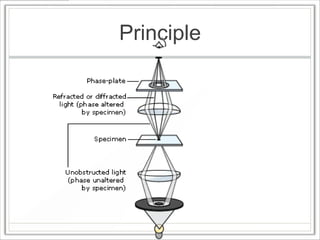
• A unique part of the phase-contrast
  microscope, called the phase-plate, amplifies this
  change in phase to one-half wavelength

• When both the direct (undiffracted) and reflected
  (diffracted) types of light waves converge at the
  ocular lens, constructive and destructive
  interference occurs
Principle
Principle
Principle
• Constructive interference corresponds to bright
  spots in the field of view

• Destructive interference corresponds to dark spots
Type of image produced

• The end result is a magnified and highly
  contrasted view of a living, unstained, normally
  transparent specimen
Electron Microscopy
Scanning Electron
             Microscope
• Illumination: electrons

• Magnification: ~100,000x

• How it works: Detect electrons back-scattered by
  the sample.

• Image: Monotone (but may be color enhanced), 3-
  D surface of specimen
• Magnetic lens—
  focuses electron
  beam
• Scanning coils—for
  systematic scanning
  (left to right, then
  down)
• Backscattered
  Electron Detector–
  detects electrons that
  bounced off the film
• Secondary Electron
  Detector– detects
  electrons emitted by
                Source: http://www.purdue.edu/rem/rs/graphics/sem2.gif
Pros                           Cons
• High magnification           •   Needs specimen to be in
                                   vacuum
• High resolution
                               •   Needs living cells and tissues
• Shows the surface of specimen    and whole, soft-bodied
                                   organisms to be treated, usu.
                                   coated w/ gold film

                               •   No color

                               •   Cannot examine live specimen

                               •   Really. Big. And Expensive.
                                   Equipment.
Transmission Electron
             Microscope

• Illumination: electrons

• Magnification: ~100,000x

• How it works: Detect electrons scattered as they
  move through the sample.

• Image: Monotone (but may be color enhanced), 2-
  D structure of specimen
Source:
http://www.lab.anhb.uwa.
edu.au/hb313/main_pag
es/timetable/lectures/Ima
ge6.gif
Pros                            Cons
• High magnification            •   Needs specimen to be in
                                    vacuum
• High resolution
                                •   Needs specimen to be covered
• Shows small structures that       in gold film
  cannot be seen under light
  microscopes                   •   Specimen <100nm thick
                                    (obviously cannot observe live
                                    specimen)

                                •   No color

                                •   Really. Big. And. Expensive.
                                    Equipment
End

Microscopy

  • 1.
    Microscopy Group 2 Cabatit, Mendoza, Ramos, Rodriguez, Tan
  • 2.
    Compound Light Microscope •A device that transmits light through several lenses to produce an enlarged image of a microscopic specimen. • Modern compound light microscopes, under optimal conditions, can magnify an object from 1000X to 2000X (times) the specimens original diameter.
  • 3.
  • 4.
    Bright Field Microscopy • Simplest optical microscopy illumination technique • Uses visible light as source of illumination • > the shorter the wavelength, the greater the resolution (blue is the best) • Contrast comes from absorbance of light in the sample, or from staining. • When the diaphragm is wide open the image is brighter and contrast is low.
  • 5.
    Bright Field Microscopy • Sources of illumination: Lamp on the base • Types of image produced: Relatively large internal structures and outline can be seen • Total Magnification: (if 10x ocular magnification is used) Range: 10x-1000x • Resolution: Up to 200nm (white light)
  • 6.
  • 8.
  • 9.
    Dark Field Microscopy •Type of microscopy which is the exact opposite of a bright field microscope • Dark background/field with the specimen being the only one illuminated. • Used in observing unstained specimens • Most microscopes have the potential to do dark field microscopy such as compound or stereomicroscopes.
  • 10.
    Dark Field Microscopy •Light source: Light bulb from a microscope • Condenser type: Specialized to block most light from the source; contains an annular/patch stop which disperses the light in various directions, resulting to a ―cone of light‖ • Image formed: Dark background with illuminated specimen; may be inverted or not depending on microscope used
  • 11.
    Dark Field Microscopy •Total Magnification: Can range from those of compound microscopes (10x to 1000x)
  • 12.
    Pros and Consof Dark Field Microscopy Advantages Disadvantages • Used to view unstained • Can be inaccurate specimens more clearly. compared to other methods. • Special care if more needed • Can be used to study for this type of microscopy various live to prevent aberrations. bacteria, protists, algae, fu ngi, and many other • Needs intense amount of cultures. light which can hurt the eyes and cause glare. • Can examine the external • Air bubbles in the slide can of the specimen with detail cause problems.
  • 14.
  • 15.
  • 16.
    Phase-contrast microscope • Type of light microscope • Enhances contrast in micrographs by converting phase shifts of light waves into brightness • Offers more contrast than brightfield microscopy • Does not require the use of staining procedures which usually kill cells • Especially useful for examining living, unpigmented cells
  • 17.
    Source of illumination •Visible light from an illuminator TOTAL MAGNIFICATION • Phase contrast objective lenses (Nikon) come in 4x, 10x, 20x, and 40x powers, so the total magnification for phase contrast microscopes range from 40x to 400x
  • 18.
    Principle • Differences indensity (Campbell et. al., 1999) or refractive index (Tortora et. al., 2007) within the specimen or cell causes light waves to be diffracted at different degrees • Diffraction of light waves implies a change in the phase of their wavelength
  • 19.
    Principle • A uniquepart of the phase-contrast microscope, called the phase-plate, amplifies this change in phase to one-half wavelength • When both the direct (undiffracted) and reflected (diffracted) types of light waves converge at the ocular lens, constructive and destructive interference occurs
  • 20.
  • 21.
  • 22.
    Principle • Constructive interferencecorresponds to bright spots in the field of view • Destructive interference corresponds to dark spots
  • 23.
    Type of imageproduced • The end result is a magnified and highly contrasted view of a living, unstained, normally transparent specimen
  • 26.
  • 27.
    Scanning Electron Microscope • Illumination: electrons • Magnification: ~100,000x • How it works: Detect electrons back-scattered by the sample. • Image: Monotone (but may be color enhanced), 3- D surface of specimen
  • 28.
    • Magnetic lens— focuses electron beam • Scanning coils—for systematic scanning (left to right, then down) • Backscattered Electron Detector– detects electrons that bounced off the film • Secondary Electron Detector– detects electrons emitted by Source: http://www.purdue.edu/rem/rs/graphics/sem2.gif
  • 29.
    Pros Cons • High magnification • Needs specimen to be in vacuum • High resolution • Needs living cells and tissues • Shows the surface of specimen and whole, soft-bodied organisms to be treated, usu. coated w/ gold film • No color • Cannot examine live specimen • Really. Big. And Expensive. Equipment.
  • 30.
    Transmission Electron Microscope • Illumination: electrons • Magnification: ~100,000x • How it works: Detect electrons scattered as they move through the sample. • Image: Monotone (but may be color enhanced), 2- D structure of specimen
  • 31.
  • 32.
    Pros Cons • High magnification • Needs specimen to be in vacuum • High resolution • Needs specimen to be covered • Shows small structures that in gold film cannot be seen under light microscopes • Specimen <100nm thick (obviously cannot observe live specimen) • No color • Really. Big. And. Expensive. Equipment
  • 34.

Editor's Notes

  • #6 Hence, best suited to viewing stained or naturally pigmented specimens such as stained prepared slides of tissue sections or living photosynthetic organisms