Outsourcing: Issues & Technicalities
Dr. Elijah Ezendu
FIMC, FCCM, FIIAN, FBDI, FAAFM, FSSM, MIMIS, MIAP, MITD, ACIArb, ACIPM,
PhD, DocM, MBA, CWM, CBDA, CMA, MPM, PME, CSOL, CCIP, CMC, CMgr
Learning Objectives
At the end of this programme, participants
should be able to do the following:
Identify outsourcing as an alliance strategy
Implement outsourcing process in a firm
Develop outsourcing strategy
Conduct effective management of a firm’s
outsourced services
What is Outsourcing?
“Outsourcing is a type of business alliance in
which an organisation set up contract with a
service provider, with the aim of driving a
feasible framework for the service provider to
take charge of a set of processes or function
within it, in order to enhance corporate
performance.”
Source: Elijah Ezendu, Outsourcing
Alliance
Alliance is definite agreement
between firms such that each shall
commit resources to achieve
common set of objectives.
“Alliances are institutional arrangements
which combine resources and
governance forms of several partnering
organisations, making them mutually
interdependent.”
Source: Inkpen
i. Define business vision and strategy in order
to understand how alliance fits stated
objectives.
ii. Evaluate and select potential partners based
on synergy and ability to work together.
iii. Develop working relationship and mutual
recognition of opportunities with prospective
partner.
iv. Negotiate and implement formal agreement
that includes systems to monitor
performance.
Alliance Methodology
i. Shortened product life-cycle.
ii. Globalization of competition
iii. Entry restriction
iv. Focus on increasing cost efficiency
v. Neoinstitutionalism for imitation
vi. Development of Regional Economic Bloc
vii. Scarce Resources
viii.Culture
ix. Increased specialization of skills and capabilities
especially in high technology businesses.
x. Boundaries of Industries are becoming hazy
xi. Focus on core-competencies
xii. Best-in-class industry practices
Reasons Why More Organizations form Alliance
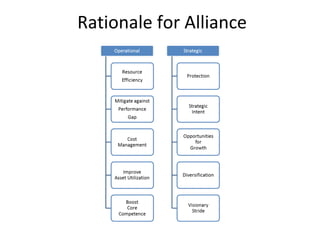
Rationale for Alliance
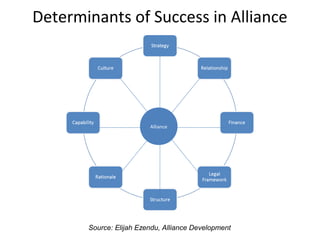
Determinants of Success in Alliance
Alliance
Source: Elijah Ezendu, Alliance Development
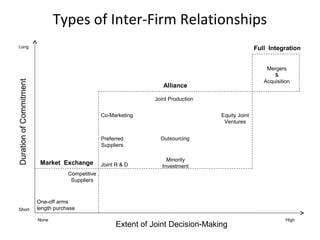
Short
Long
None High
DurationofCommitment
Extent of Joint Decision-Making
One-off arms
length purchase
Competitive
Suppliers
Joint R & D
Preferred
Suppliers
Co-Marketing
Joint Production
Equity Joint
Ventures
Mergers
&
Acquisition
Full Integration
Alliance
Market Exchange
Minority
Investment
Types of Inter-Firm Relationships
Outsourcing
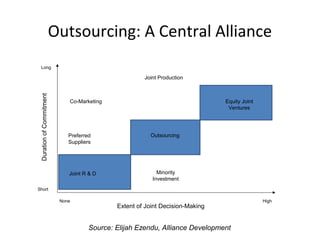
Outsourcing: A Central Alliance
Joint R & D
Preferred
Suppliers
Co-Marketing
Joint Production
Equity Joint
Ventures
Minority
Investment
Outsourcing
DurationofCommitment
Extent of Joint Decision-Making
Long
Short
None High
Source: Elijah Ezendu, Alliance Development
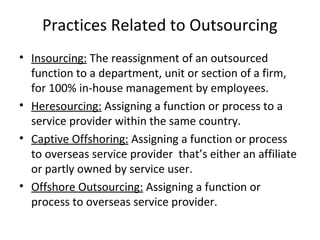
Practices Related to Outsourcing
• Insourcing: The reassignment of an outsourced
function to a department, unit or section of a firm,
for 100% in-house management by employees.
• Heresourcing: Assigning a function or process to a
service provider within the same country.
• Captive Offshoring: Assigning a function or process
to overseas service provider that’s either an affiliate
or partly owned by service user.
• Offshore Outsourcing: Assigning a function or
process to overseas service provider.
Why Organisations Prefer Captive Offshoring to
Generic Offshore Outsourcing
i. To gain from service development
ii. To be involved in building capability of service
provider
iii. To explore and exploit competitive national
advantage
iv. To gain from the arithmetic of asset ownership
v. To ward off managerial uncertainties in
commitment of service provider
Key Drivers of Outsourcing
• Vertical Disintegration
• Search for Higher Cost Efficiency
• Unbundling of corporate functions
• Focus on Core Competencies
• Scarcity of Required Skills and Capabilities
• Best-in-class industry practices
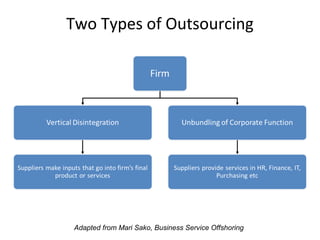
Two Types of Outsourcing
Adapted from Mari Sako, Business Service Offshoring
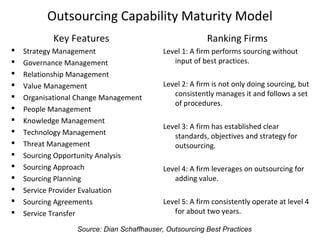
Outsourcing Capability Maturity Model
Key Features
 Strategy Management
 Governance Management
 Relationship Management
 Value Management
 Organisational Change Management
 People Management
 Knowledge Management
 Technology Management
 Threat Management
 Sourcing Opportunity Analysis
 Sourcing Approach
 Sourcing Planning
 Service Provider Evaluation
 Sourcing Agreements
 Service Transfer
Source: Dian Schaffhauser, Outsourcing Best Practices
Ranking Firms
Level 1: A firm performs sourcing without
input of best practices.
Level 2: A firm is not only doing sourcing, but
consistently manages it and follows a set
of procedures.
Level 3: A firm has established clear
standards, objectives and strategy for
outsourcing.
Level 4: A firm leverages on outsourcing for
adding value.
Level 5: A firm consistently operate at level 4
for about two years.
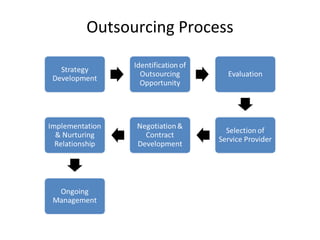
Outsourcing Process
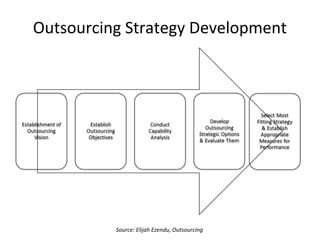
Outsourcing Strategy Development
Source: Elijah Ezendu, Outsourcing
The Outsourcing Strategy must have a high level
of interoperability with the Corporate Strategy
and Competitive Strategy of the Business
Portfolio.
Interoperability of Outsourcing Strategy
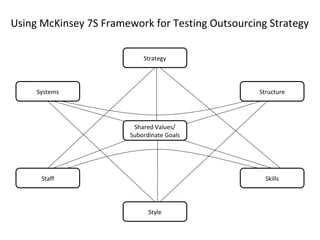
Using McKinsey 7S Framework for Testing Outsourcing Strategy
Style
Staff
Shared Values/
Subordinate Goals
StructureSystems
Strategy
Skills
Action Points for Testing Outsourcing Strategy
• Examine each of the 7S.
• Identify the key success factors of each ‘S’.
• Ascertain the gap between the elements and
the strategic fit.
• Solution should be either to amend the
elements accordingly or to alter the
outsourcing strategy.
Aligning Outsourcing Strategy to Business Model
It’s imperative to align Outsourcing Strategy to a
firm’s Business Model due to its role. Business
Model is the logic behind value generation.
The Business Model binds Business Strategy
and Business Process together and functions
as link between them. The focus of strategy is
determination of position and codification of
aims and objectives, while business process
captures and implements the strategy.
Identification of Outsourcing Opportunity
Outsourcing opportunity should be identified
based on the direction and structure of
outsourcing strategy. Consideration should
differentiate rightsourcing targets from core
competence and residual processes.
Thereafter, key components of rightsourcing
targets shall be isolated for comprehensive
evaluation.
Evaluation
• Evaluation of Barriers
• Evaluation of Risks
• Evaluation of Business Transformation
Indicators
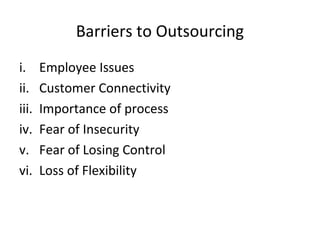
Barriers to Outsourcing
i. Employee Issues
ii. Customer Connectivity
iii. Importance of process
iv. Fear of Insecurity
v. Fear of Losing Control
vi. Loss of Flexibility
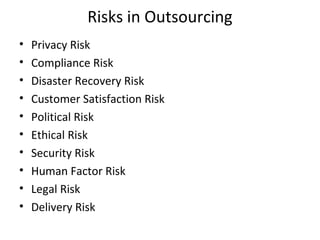
Risks in Outsourcing
• Privacy Risk
• Compliance Risk
• Disaster Recovery Risk
• Customer Satisfaction Risk
• Political Risk
• Ethical Risk
• Security Risk
• Human Factor Risk
• Legal Risk
• Delivery Risk
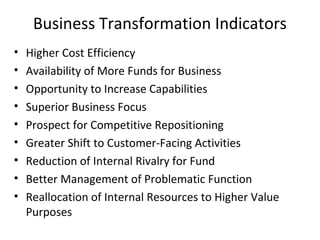
Business Transformation Indicators
• Higher Cost Efficiency
• Availability of More Funds for Business
• Opportunity to Increase Capabilities
• Superior Business Focus
• Prospect for Competitive Repositioning
• Greater Shift to Customer-Facing Activities
• Reduction of Internal Rivalry for Fund
• Better Management of Problematic Function
• Reallocation of Internal Resources to Higher Value
Purposes
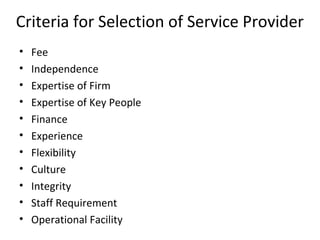
Criteria for Selection of Service Provider
• Fee
• Independence
• Expertise of Firm
• Expertise of Key People
• Finance
• Experience
• Flexibility
• Culture
• Integrity
• Staff Requirement
• Operational Facility
Importance of Due Diligence
In a large scale outsourcing programme,
comprehensive due diligence of the
prospective service provider must be done to
ensure clear-cut identity and clarify suitability.
Negotiation
The outsourcing team must aim at reaching an
acceptable point between the firm’s position
and that of the prospective service provider.
Team members must be well trained in
advanced negotiation skills which are required
for the tasks.
Service Level Agreements
“Service level agreements validate expectations
of the respective parties and set parameters
for measuring project success. This important
tool helps determine value and define success
and discourages potential disagreements.”
Source: Syntel
Schedule of SLA
Service Level Agreements commonly set out provisions for the
following:
• Service definition
• Timing standards
• Minimum and maximum quality needs
• Compliance with set standards
• Payment (incentives and rebates)
• Consequences for performance drops
• Current and Future needs
• Monitoring methods
• Security of premises and information
• Alternative dispute resolution
• Variation of arrangements
Source: Noric Dilanchian, Hints for Service Level Agreements
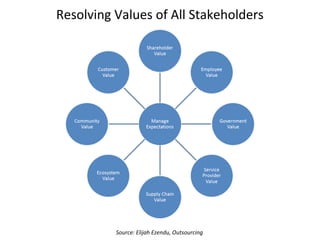
Resolving Values of All Stakeholders
Source: Elijah Ezendu, Outsourcing
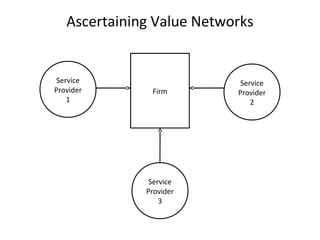
Ascertaining Value Networks
Firm
Service
Provider
1
Service
Provider
3
Service
Provider
2
Merits of Face-to-Face Meetings in
Nurturing Outsourcing Relationships
• Physical Proximity
• Multiple Modalities
• Vocal Inflection and Timing
• Real-Time Question and Answer
Staffing Models in Outsourcing
Product Vendors: These are service providers who focus on
selling deliverables. They are assigned to staff functions and
report to an executive, who ensures fulfillment of SLAs.
Temporary Employees: These are flexible workers used for lower
level and short-term jobs.
Project Employees: These are workers obtained for a specific
project, and their contracts terminate at the expiration of the
project.
Long-Term Contract Employees: These are employed by a
service provider and assigned to a firm. They are the closest
to full staff of a firm.
Problems with Staff Extension
• Control of strategic evolution
• Improper supervision due to shortage of skill
in cases of scarce competencies
• Abandonment of competency development in
the area being outsourced
• Service provider may end up as problematic
decision –maker for the firm
• Tendency to continue reducing staff strength
because of cost savings
Using Technology For Driving Outsourcing
The complexity of multiple outsourcing
relationships can be solved by infusion of
technology enablement. Suitable software for
Business Process Management that highlights
SQL, ERP and other intelligence systems can
provide the requisite leverage to track,
identify, monitor, and analyse service
provider’s performance. Example of such
software is Ajira.
Dr Elijah Ezendu is Award-Winning Business Expert & Certified Management Consultant with expertise
in Interim Management, Strategy, Competitive Intelligence, Transformation, Restructuring, Turnaround
Management, Business Development, Marketing, Project & Cost Management, Leadership, HR, CSR, e-
Business & Software Architecture. He had functioned as Founder, Initiative for Sustainable Business
Equity; Chairman of Board, Charisma Broadcast Film Academy; Group Chief Operating Officer, Idova
Group; CEO, Rubiini (UAE); Special Advisor, RTEAN; Director, MMNA Investments; Chair, Int’l Board of
GCC Business Council (UAE); Senior Partner, Shevach Consulting; Chairman (Certification & Training),
Coordinator (Board of Fellows), Lead Assessor & Governing Council Member, Institute of Management
Consultants, Nigeria; Lead Resource, Centre for Competitive Intelligence Development; Lead
Consultant/ Partner, JK Michaels; Turnaround Project Director, Consolidated Business Holdings Limited;
Technical Director, Gestalt; Chief Operating Officer, Rohan Group; Executive Director (Various Roles),
Fortuna, Gambia & Malta; Chief Advisor/ Partner, D & E; Vice Chairman of Board, Refined Shipping;
Director of Programmes & Governing Council Member, Institute of Business Development, Nigeria;
Member of TDD Committee, International Association of Software Architects, USA; Member of Strategic
Planning and Implementation Committee, Chartered Institute of Personnel Management of Nigeria;
Country Manager (Nigeria) & Adjunct Faculty (MBA Programme), Regent Business School, South Africa;
Adjunct Faculty (MBA Programme), Ladoke Akintola University of Technology; Editor-in-Chief, Cost
Management Journal; Council Member, Institute of Internal Auditors of Nigeria; Member, Board of
Directors (Several Organizations). He holds Doctoral Degree in Management, Master of Business
Administration and Fellow of Professional Institutes in North America, UK & Nigeria. He is Innovator of
Corporate Investment Structure Based on Financials and Intangibles, for valuation highlighting
intangible contributions of host communities and ecological environment: A model celebrated globally
as remedy for unmitigated depreciation of ecological capital and developmental deprivation of host
communities. He had served as Examiner to Professional Institutes and Universities. He had been a
member of Guild of Soundtrack Producers of Nigeria. He's an author and extensively featured speaker.
Thank You

Outsourcing: Issues & Technicalities

  • 1.
    Outsourcing: Issues &Technicalities Dr. Elijah Ezendu FIMC, FCCM, FIIAN, FBDI, FAAFM, FSSM, MIMIS, MIAP, MITD, ACIArb, ACIPM, PhD, DocM, MBA, CWM, CBDA, CMA, MPM, PME, CSOL, CCIP, CMC, CMgr
  • 2.
    Learning Objectives At theend of this programme, participants should be able to do the following: Identify outsourcing as an alliance strategy Implement outsourcing process in a firm Develop outsourcing strategy Conduct effective management of a firm’s outsourced services
  • 3.
    What is Outsourcing? “Outsourcingis a type of business alliance in which an organisation set up contract with a service provider, with the aim of driving a feasible framework for the service provider to take charge of a set of processes or function within it, in order to enhance corporate performance.” Source: Elijah Ezendu, Outsourcing
  • 4.
    Alliance Alliance is definiteagreement between firms such that each shall commit resources to achieve common set of objectives.
  • 5.
    “Alliances are institutionalarrangements which combine resources and governance forms of several partnering organisations, making them mutually interdependent.” Source: Inkpen
  • 6.
    i. Define businessvision and strategy in order to understand how alliance fits stated objectives. ii. Evaluate and select potential partners based on synergy and ability to work together. iii. Develop working relationship and mutual recognition of opportunities with prospective partner. iv. Negotiate and implement formal agreement that includes systems to monitor performance. Alliance Methodology
  • 7.
    i. Shortened productlife-cycle. ii. Globalization of competition iii. Entry restriction iv. Focus on increasing cost efficiency v. Neoinstitutionalism for imitation vi. Development of Regional Economic Bloc vii. Scarce Resources viii.Culture ix. Increased specialization of skills and capabilities especially in high technology businesses. x. Boundaries of Industries are becoming hazy xi. Focus on core-competencies xii. Best-in-class industry practices Reasons Why More Organizations form Alliance
  • 8.
  • 9.
    Determinants of Successin Alliance Alliance Source: Elijah Ezendu, Alliance Development
  • 10.
    Short Long None High DurationofCommitment Extent ofJoint Decision-Making One-off arms length purchase Competitive Suppliers Joint R & D Preferred Suppliers Co-Marketing Joint Production Equity Joint Ventures Mergers & Acquisition Full Integration Alliance Market Exchange Minority Investment Types of Inter-Firm Relationships Outsourcing
  • 11.
    Outsourcing: A CentralAlliance Joint R & D Preferred Suppliers Co-Marketing Joint Production Equity Joint Ventures Minority Investment Outsourcing DurationofCommitment Extent of Joint Decision-Making Long Short None High Source: Elijah Ezendu, Alliance Development
  • 12.
    Practices Related toOutsourcing • Insourcing: The reassignment of an outsourced function to a department, unit or section of a firm, for 100% in-house management by employees. • Heresourcing: Assigning a function or process to a service provider within the same country. • Captive Offshoring: Assigning a function or process to overseas service provider that’s either an affiliate or partly owned by service user. • Offshore Outsourcing: Assigning a function or process to overseas service provider.
  • 13.
    Why Organisations PreferCaptive Offshoring to Generic Offshore Outsourcing i. To gain from service development ii. To be involved in building capability of service provider iii. To explore and exploit competitive national advantage iv. To gain from the arithmetic of asset ownership v. To ward off managerial uncertainties in commitment of service provider
  • 14.
    Key Drivers ofOutsourcing • Vertical Disintegration • Search for Higher Cost Efficiency • Unbundling of corporate functions • Focus on Core Competencies • Scarcity of Required Skills and Capabilities • Best-in-class industry practices
  • 15.
    Two Types ofOutsourcing Adapted from Mari Sako, Business Service Offshoring
  • 16.
    Outsourcing Capability MaturityModel Key Features  Strategy Management  Governance Management  Relationship Management  Value Management  Organisational Change Management  People Management  Knowledge Management  Technology Management  Threat Management  Sourcing Opportunity Analysis  Sourcing Approach  Sourcing Planning  Service Provider Evaluation  Sourcing Agreements  Service Transfer Source: Dian Schaffhauser, Outsourcing Best Practices Ranking Firms Level 1: A firm performs sourcing without input of best practices. Level 2: A firm is not only doing sourcing, but consistently manages it and follows a set of procedures. Level 3: A firm has established clear standards, objectives and strategy for outsourcing. Level 4: A firm leverages on outsourcing for adding value. Level 5: A firm consistently operate at level 4 for about two years.
  • 17.
  • 18.
    Outsourcing Strategy Development Source:Elijah Ezendu, Outsourcing
  • 19.
    The Outsourcing Strategymust have a high level of interoperability with the Corporate Strategy and Competitive Strategy of the Business Portfolio. Interoperability of Outsourcing Strategy
  • 20.
    Using McKinsey 7SFramework for Testing Outsourcing Strategy Style Staff Shared Values/ Subordinate Goals StructureSystems Strategy Skills
  • 21.
    Action Points forTesting Outsourcing Strategy • Examine each of the 7S. • Identify the key success factors of each ‘S’. • Ascertain the gap between the elements and the strategic fit. • Solution should be either to amend the elements accordingly or to alter the outsourcing strategy.
  • 22.
    Aligning Outsourcing Strategyto Business Model It’s imperative to align Outsourcing Strategy to a firm’s Business Model due to its role. Business Model is the logic behind value generation. The Business Model binds Business Strategy and Business Process together and functions as link between them. The focus of strategy is determination of position and codification of aims and objectives, while business process captures and implements the strategy.
  • 23.
    Identification of OutsourcingOpportunity Outsourcing opportunity should be identified based on the direction and structure of outsourcing strategy. Consideration should differentiate rightsourcing targets from core competence and residual processes. Thereafter, key components of rightsourcing targets shall be isolated for comprehensive evaluation.
  • 24.
    Evaluation • Evaluation ofBarriers • Evaluation of Risks • Evaluation of Business Transformation Indicators
  • 25.
    Barriers to Outsourcing i.Employee Issues ii. Customer Connectivity iii. Importance of process iv. Fear of Insecurity v. Fear of Losing Control vi. Loss of Flexibility
  • 26.
    Risks in Outsourcing •Privacy Risk • Compliance Risk • Disaster Recovery Risk • Customer Satisfaction Risk • Political Risk • Ethical Risk • Security Risk • Human Factor Risk • Legal Risk • Delivery Risk
  • 27.
    Business Transformation Indicators •Higher Cost Efficiency • Availability of More Funds for Business • Opportunity to Increase Capabilities • Superior Business Focus • Prospect for Competitive Repositioning • Greater Shift to Customer-Facing Activities • Reduction of Internal Rivalry for Fund • Better Management of Problematic Function • Reallocation of Internal Resources to Higher Value Purposes
  • 28.
    Criteria for Selectionof Service Provider • Fee • Independence • Expertise of Firm • Expertise of Key People • Finance • Experience • Flexibility • Culture • Integrity • Staff Requirement • Operational Facility
  • 29.
    Importance of DueDiligence In a large scale outsourcing programme, comprehensive due diligence of the prospective service provider must be done to ensure clear-cut identity and clarify suitability.
  • 30.
    Negotiation The outsourcing teammust aim at reaching an acceptable point between the firm’s position and that of the prospective service provider. Team members must be well trained in advanced negotiation skills which are required for the tasks.
  • 31.
    Service Level Agreements “Servicelevel agreements validate expectations of the respective parties and set parameters for measuring project success. This important tool helps determine value and define success and discourages potential disagreements.” Source: Syntel
  • 32.
    Schedule of SLA ServiceLevel Agreements commonly set out provisions for the following: • Service definition • Timing standards • Minimum and maximum quality needs • Compliance with set standards • Payment (incentives and rebates) • Consequences for performance drops • Current and Future needs • Monitoring methods • Security of premises and information • Alternative dispute resolution • Variation of arrangements Source: Noric Dilanchian, Hints for Service Level Agreements
  • 33.
    Resolving Values ofAll Stakeholders Source: Elijah Ezendu, Outsourcing
  • 34.
  • 35.
    Merits of Face-to-FaceMeetings in Nurturing Outsourcing Relationships • Physical Proximity • Multiple Modalities • Vocal Inflection and Timing • Real-Time Question and Answer
  • 36.
    Staffing Models inOutsourcing Product Vendors: These are service providers who focus on selling deliverables. They are assigned to staff functions and report to an executive, who ensures fulfillment of SLAs. Temporary Employees: These are flexible workers used for lower level and short-term jobs. Project Employees: These are workers obtained for a specific project, and their contracts terminate at the expiration of the project. Long-Term Contract Employees: These are employed by a service provider and assigned to a firm. They are the closest to full staff of a firm.
  • 37.
    Problems with StaffExtension • Control of strategic evolution • Improper supervision due to shortage of skill in cases of scarce competencies • Abandonment of competency development in the area being outsourced • Service provider may end up as problematic decision –maker for the firm • Tendency to continue reducing staff strength because of cost savings
  • 38.
    Using Technology ForDriving Outsourcing The complexity of multiple outsourcing relationships can be solved by infusion of technology enablement. Suitable software for Business Process Management that highlights SQL, ERP and other intelligence systems can provide the requisite leverage to track, identify, monitor, and analyse service provider’s performance. Example of such software is Ajira.
  • 39.
    Dr Elijah Ezenduis Award-Winning Business Expert & Certified Management Consultant with expertise in Interim Management, Strategy, Competitive Intelligence, Transformation, Restructuring, Turnaround Management, Business Development, Marketing, Project & Cost Management, Leadership, HR, CSR, e- Business & Software Architecture. He had functioned as Founder, Initiative for Sustainable Business Equity; Chairman of Board, Charisma Broadcast Film Academy; Group Chief Operating Officer, Idova Group; CEO, Rubiini (UAE); Special Advisor, RTEAN; Director, MMNA Investments; Chair, Int’l Board of GCC Business Council (UAE); Senior Partner, Shevach Consulting; Chairman (Certification & Training), Coordinator (Board of Fellows), Lead Assessor & Governing Council Member, Institute of Management Consultants, Nigeria; Lead Resource, Centre for Competitive Intelligence Development; Lead Consultant/ Partner, JK Michaels; Turnaround Project Director, Consolidated Business Holdings Limited; Technical Director, Gestalt; Chief Operating Officer, Rohan Group; Executive Director (Various Roles), Fortuna, Gambia & Malta; Chief Advisor/ Partner, D & E; Vice Chairman of Board, Refined Shipping; Director of Programmes & Governing Council Member, Institute of Business Development, Nigeria; Member of TDD Committee, International Association of Software Architects, USA; Member of Strategic Planning and Implementation Committee, Chartered Institute of Personnel Management of Nigeria; Country Manager (Nigeria) & Adjunct Faculty (MBA Programme), Regent Business School, South Africa; Adjunct Faculty (MBA Programme), Ladoke Akintola University of Technology; Editor-in-Chief, Cost Management Journal; Council Member, Institute of Internal Auditors of Nigeria; Member, Board of Directors (Several Organizations). He holds Doctoral Degree in Management, Master of Business Administration and Fellow of Professional Institutes in North America, UK & Nigeria. He is Innovator of Corporate Investment Structure Based on Financials and Intangibles, for valuation highlighting intangible contributions of host communities and ecological environment: A model celebrated globally as remedy for unmitigated depreciation of ecological capital and developmental deprivation of host communities. He had served as Examiner to Professional Institutes and Universities. He had been a member of Guild of Soundtrack Producers of Nigeria. He's an author and extensively featured speaker.
  • 40.