Lecture 7- 29th Aug , 2021
By Prof K Gadegaonkar
Pillai Institute of Management Studies and Research
ļ‚§ Transnational dispersion or relocation of service activities that companies previously performed
in their home country
ļ‚§ Includes captive (internal) and outsourced ( external ) delivery mode
ļ‚§ Includes a wide range of activities ranging from software development to medical transcription .
ļ‚§ One of the top phenomenon in international businesses (IB )
ļ‚§ Characterized by four essential qualities
- Intangibility
- heterogeneity in output
- perishability
- inseparability of production and consumption
So the key question is if production and consumption can’t be separated , then how can offshoring
be done ?
The advances in information technology and communication and availability of global workforce
have helped to address this problem.
ļ‚§ Offshoring – decision is made up of two key sub decisions –Outsourcing and going offshore
ļ‚§ Outsourcing is more than the choice of purchasing occasionally from a supplier something that
could be produced in house . It’s a strategic long term commitment.
ļ‚§ Going offshore is often framed as part of global sourcing strategy aimed at the ā€˜worldwide
integration of engineering , services, operations, logistics, procurement, and even marketing
with upstream portion of firm’s supply chain’.
ļ‚§ Increasing trend in offshoring both in manufacturing and business services . However, expected
benefits are not seen. Cost savings have been lower , customers have been upset and
competencies have been lost. This is because ā€˜offshoring decisions are often taken considering
short term benefits like lower price or miscalculation of total landed cost of supply .
ļ‚§ Offshoring is when production or operations are performed in another country .
ļ‚§ Often criticized for transferring jobs to another country but it can be extremely beneficial for
companies and can ultimately improve economies in both the countries
Benefits –
ļ‚§ Low labor cost can be advantageous
ļ‚§ Creates skilled employment
ļ‚§ Reduces risks to companies, thereby allowing companies to support clients better
ļ‚§ Allows companies to maintain complete control over the operations/ production activity
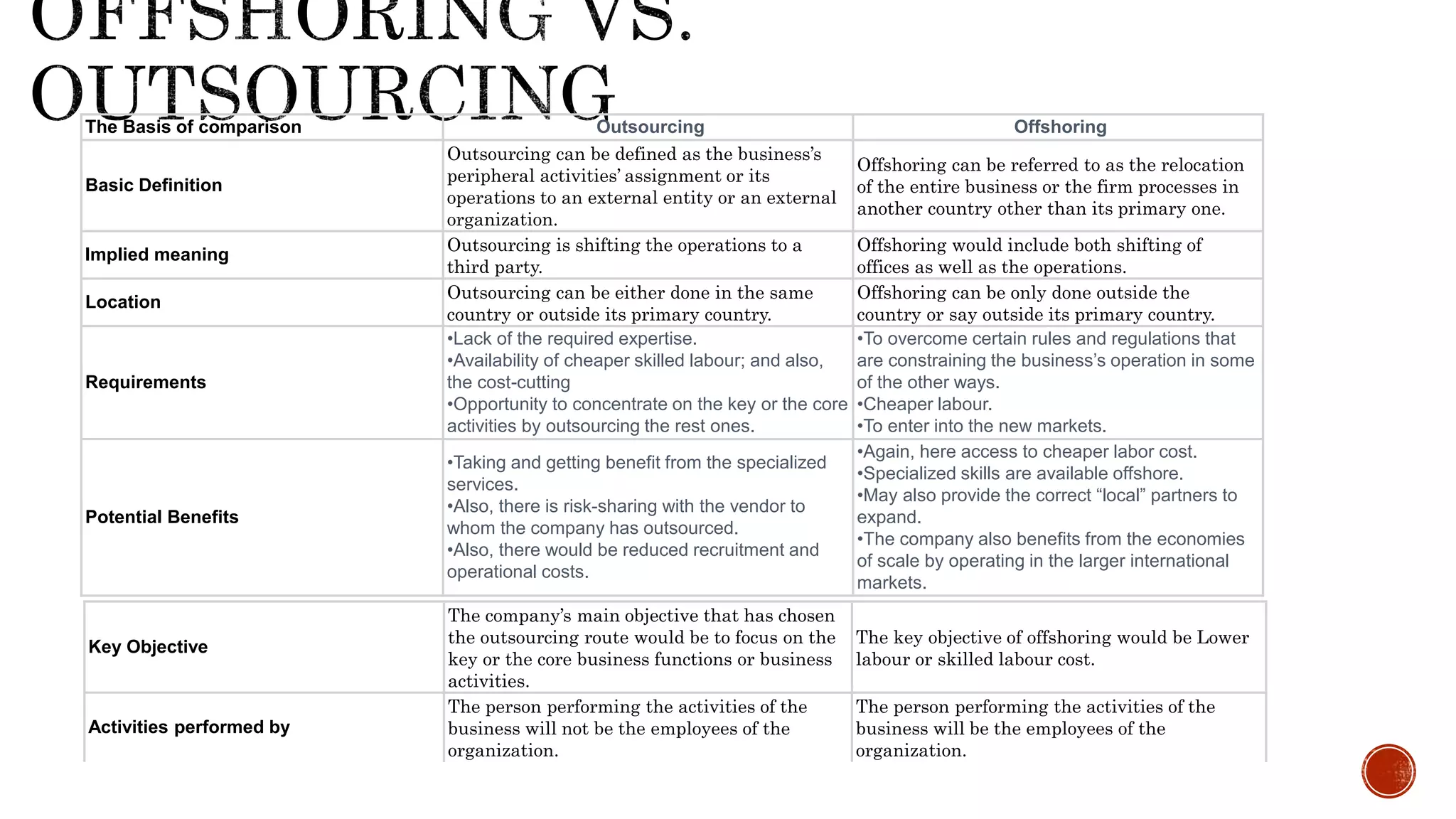
The Basis of comparison Outsourcing Offshoring
Basic Definition
Outsourcing can be defined as the business’s
peripheral activities’ assignment or its
operations to an external entity or an external
organization.
Offshoring can be referred to as the relocation
of the entire business or the firm processes in
another country other than its primary one.
Implied meaning
Outsourcing is shifting the operations to a
third party.
Offshoring would include both shifting of
offices as well as the operations.
Location
Outsourcing can be either done in the same
country or outside its primary country.
Offshoring can be only done outside the
country or say outside its primary country.
Requirements
•Lack of the required expertise.
•Availability of cheaper skilled labour; and also,
the cost-cutting
•Opportunity to concentrate on the key or the core
activities by outsourcing the rest ones.
•To overcome certain rules and regulations that
are constraining the business’s operation in some
of the other ways.
•Cheaper labour.
•To enter into the new markets.
Potential Benefits
•Taking and getting benefit from the specialized
services.
•Also, there is risk-sharing with the vendor to
whom the company has outsourced.
•Also, there would be reduced recruitment and
operational costs.
•Again, here access to cheaper labor cost.
•Specialized skills are available offshore.
•May also provide the correct ā€œlocalā€ partners to
expand.
•The company also benefits from the economies
of scale by operating in the larger international
markets.
Key Objective
The company’s main objective that has chosen
the outsourcing route would be to focus on the
key or the core business functions or business
activities.
The key objective of offshoring would be Lower
labour or skilled labour cost.
Activities performed by
The person performing the activities of the
business will not be the employees of the
organization.
The person performing the activities of the
business will be the employees of the
organization.
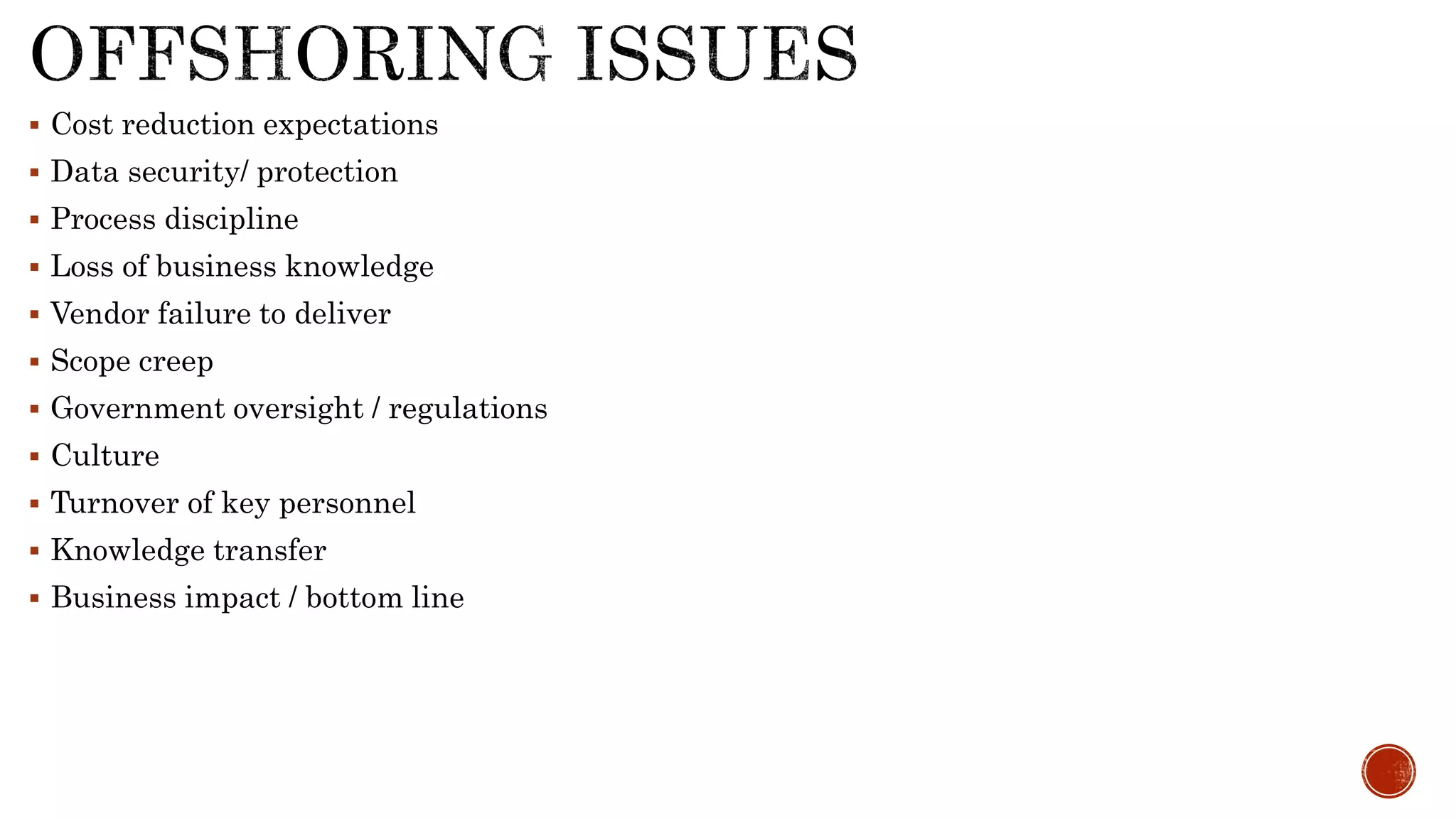
ļ‚§ Cost reduction expectations
ļ‚§ Data security/ protection
ļ‚§ Process discipline
ļ‚§ Loss of business knowledge
ļ‚§ Vendor failure to deliver
ļ‚§ Scope creep
ļ‚§ Government oversight / regulations
ļ‚§ Culture
ļ‚§ Turnover of key personnel
ļ‚§ Knowledge transfer
ļ‚§ Business impact / bottom line
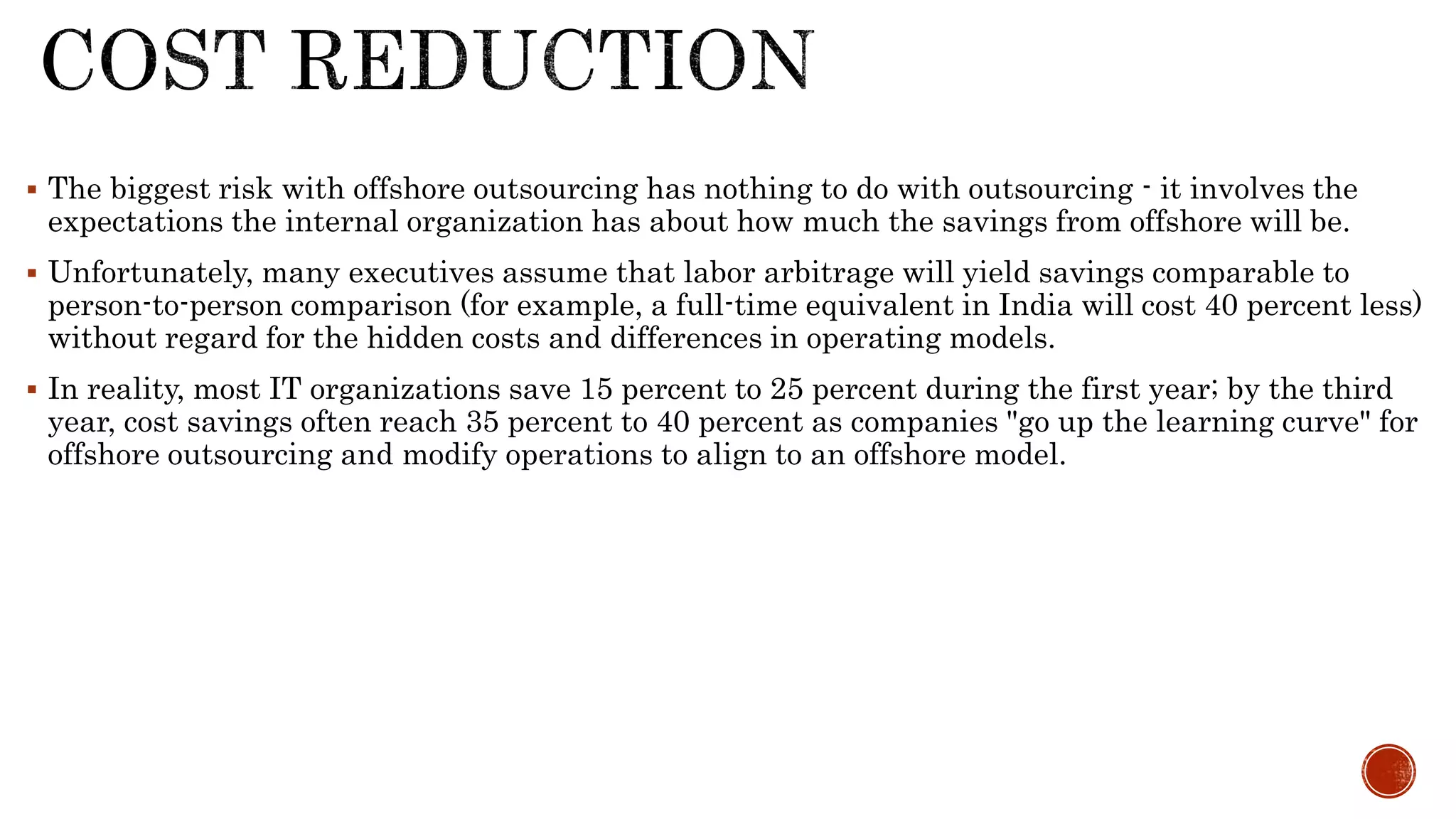
ļ‚§ The biggest risk with offshore outsourcing has nothing to do with outsourcing - it involves the
expectations the internal organization has about how much the savings from offshore will be.
ļ‚§ Unfortunately, many executives assume that labor arbitrage will yield savings comparable to
person-to-person comparison (for example, a full-time equivalent in India will cost 40 percent less)
without regard for the hidden costs and differences in operating models.
ļ‚§ In reality, most IT organizations save 15 percent to 25 percent during the first year; by the third
year, cost savings often reach 35 percent to 40 percent as companies "go up the learning curve" for
offshore outsourcing and modify operations to align to an offshore model.
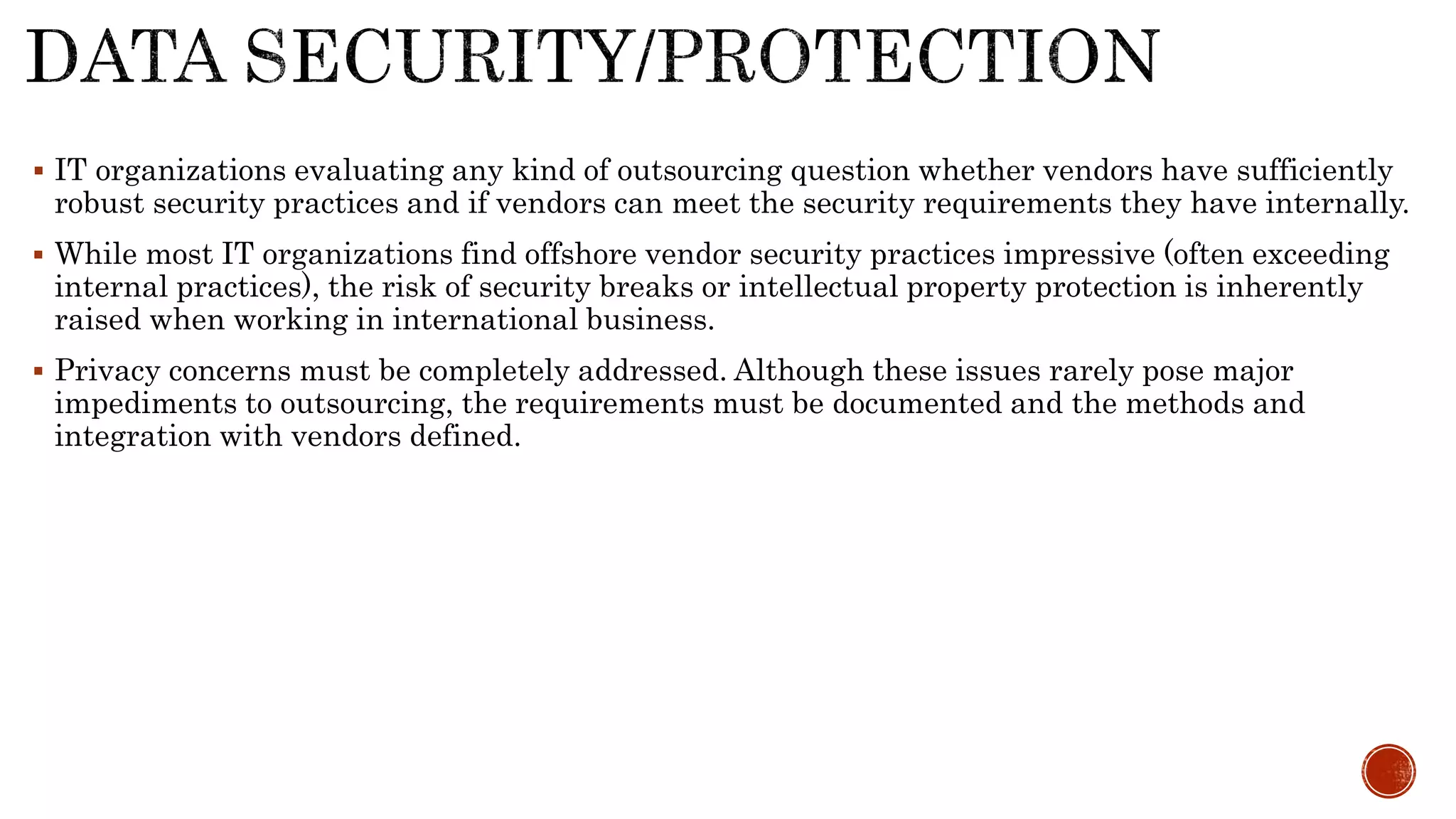
ļ‚§ IT organizations evaluating any kind of outsourcing question whether vendors have sufficiently
robust security practices and if vendors can meet the security requirements they have internally.
ļ‚§ While most IT organizations find offshore vendor security practices impressive (often exceeding
internal practices), the risk of security breaks or intellectual property protection is inherently
raised when working in international business.
ļ‚§ Privacy concerns must be completely addressed. Although these issues rarely pose major
impediments to outsourcing, the requirements must be documented and the methods and
integration with vendors defined.
ļ‚§ The Capability Maturity Model (CMM) becomes an important measure of a
company's readiness to adopt an offshore model.
ļ‚§ Offshore vendors require a standardized and repeatable model, which is why
CMM Level 5 is a common characteristic.
ļ‚§ META Group observes that approximately 70 percent of IT organizations are at
CMM Level 1 - creating a gap that is compensated for by additional vendor
resources on-site
ļ‚§ Companies lacking internal process model maturity will undermine potential cost
savings.
ļ‚§ A common oversight for IT organizations is a contingency plan - what happens if the vendor, all
best intentions and contracts aside, simply fails to deliver.
ļ‚§ Although such failures are exceptions, they do occur, even with the superb quality methodologies
of offshore vendors.
ļ‚§ When considering outsourcing, IT organizations should assess the implications of vendor failure
(such as, does failure have significant business performance implications?).
ļ‚§ High risk or exposure might deter the organization from outsourcing, it might shift the
outsourcing strategy (e.g., from a single vendor to multiple vendors), or it might drive the
company toward outsourcing (if the vendor has specific skills to reduce risks).
ļ‚§ The results of risk analysis vary between companies; it is the process of risk analysis that is
paramount.
ļ‚§ There is no such thing as a fixed-price contract. All outsourcing contracts contain baselines
and assumptions.
ļ‚§ If the actual work varies from estimates, the client will pay the difference. This simple fact
has become a major obstacle for IT organizations that are surprised that the price was not
"fixed" or that the vendor expects to be paid for incremental scope changes.
ļ‚§ Most projects change by 10 percent to 15 percent during the development cycle. This leads to
conflicts and delays in projects.
ļ‚§ Agile methodologies must be used to accommodate suggested changes . Must be driven from
top management.
ļ‚§ Outsourcing/offshoring - can support the firm to become very focused on those activities that
are considered key for long term competitiveness .
ļ‚§ Outsourcing noncore activities allows the company to increase managerial attention and
resource allocation to those tasks that it does bestā€
ļ‚§ By outsourcing standard and well established components or processes, the management team
can focus all its efforts on improving higher value-added activities and on strengthening
product/service innovation.
ļ‚§ The advantage of being more focused on core competencies also must consider the risk of the
capabilities / activities becoming non core in future or also can become basis of development of
new businesses. (e.g. Flat panel display of TV )
ļ‚§ Company can become more flexible in terms of service / new launches , can also achieve cost
leadership or product differentiation.
ļ‚§ Measured as = out put / employee hr.
ļ‚§ Index is prepared by relating the output to the hours of all the persons involved in producing
that output, includes self employed and unpaid family workers also.
ļ‚§ Index of the output per hour is expressed as the quotient of an index of weighted output and an
index of employee hours.
ļ‚§ Effect of shifts in product mix on productivity is eliminated. Changes in product mix , shifts
and various quantities in output will not impact index.
ļ‚§ There is at least one published measure for every industry in the service sector .
e.g. Transportation, Communication, Trade, Hotels, Laundry, Beauty / Barbeque shops,
Automotive repairs, Banking , Insurance , finance, Retail etc.
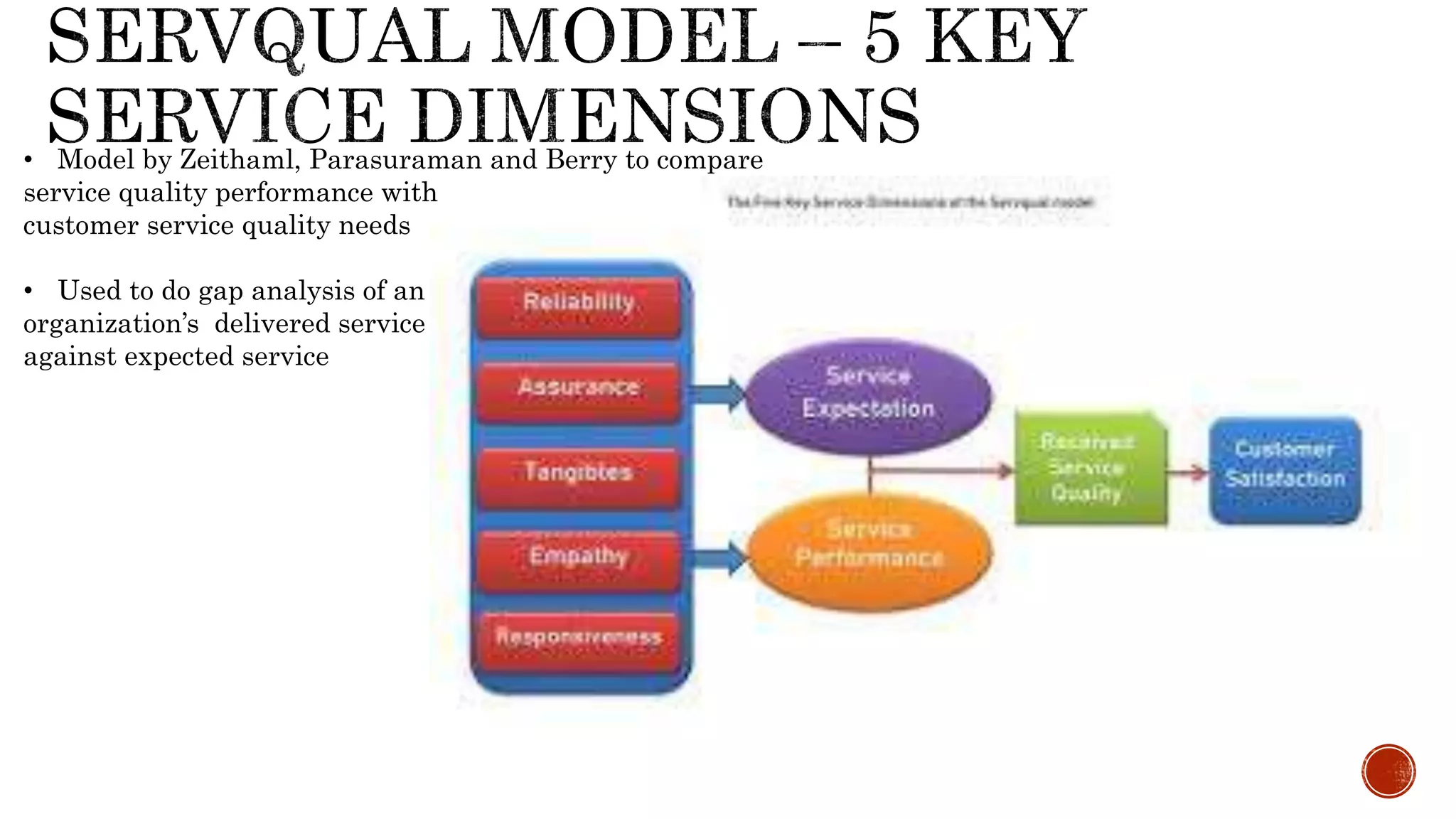
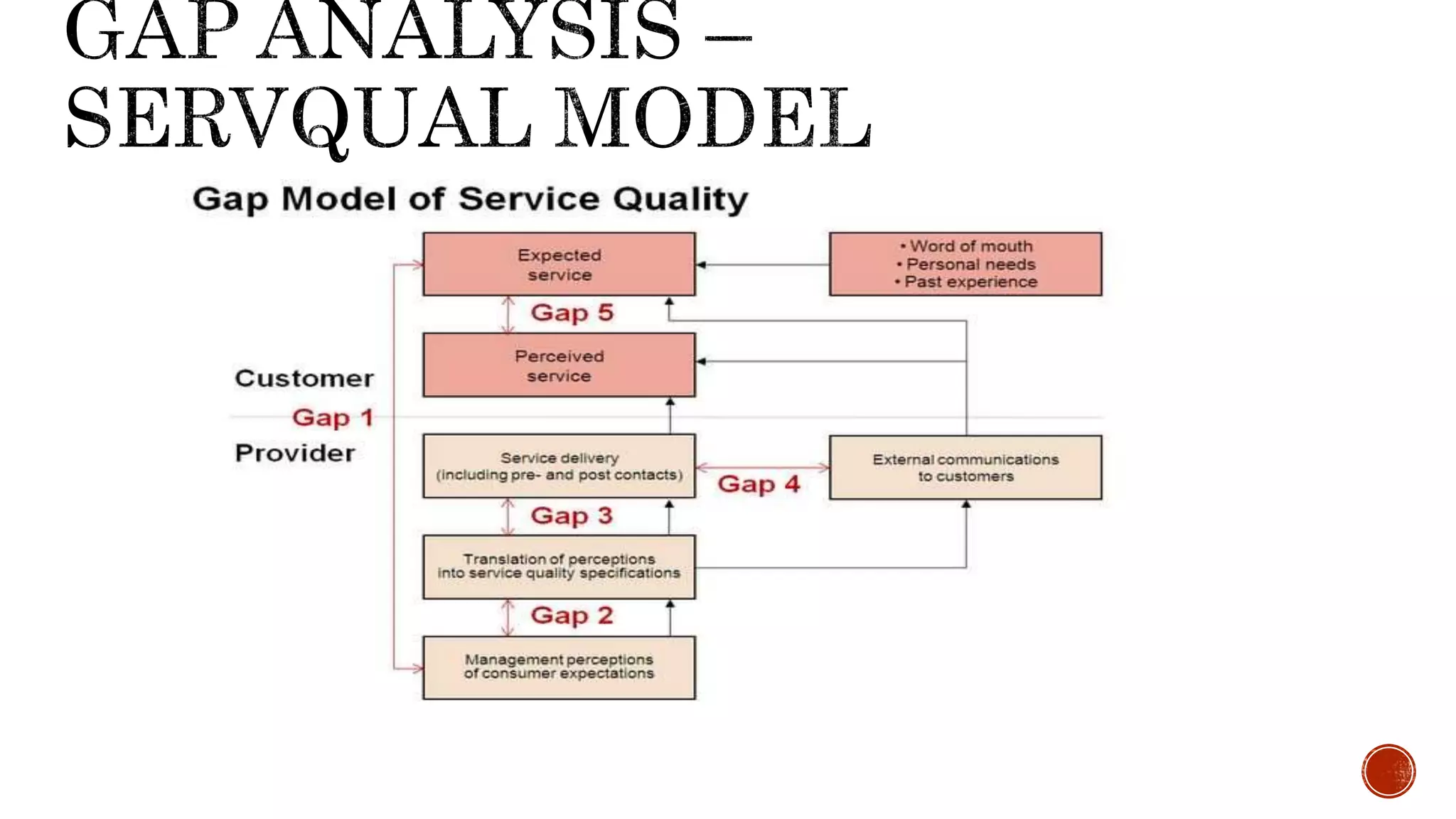
• Model by Zeithaml, Parasuraman and Berry to compare
service quality performance with
customer service quality needs
• Used to do gap analysis of an
organization’s delivered service
against expected service
ļ‚§ Study the current dispute between – Future – Amazon and RIL deal and share your
understating of the case .
ļ‚§ Take help of all the news articles available in public domain from the beginning till date to
arrive at your conclusion.
ļ‚§ Make not more than 5-6 points of your understanding.
Thank you !

Service Operations management _Lecture 7.pptx

  • 1.
    Lecture 7- 29thAug , 2021 By Prof K Gadegaonkar Pillai Institute of Management Studies and Research
  • 2.
    ļ‚§ Transnational dispersionor relocation of service activities that companies previously performed in their home country ļ‚§ Includes captive (internal) and outsourced ( external ) delivery mode ļ‚§ Includes a wide range of activities ranging from software development to medical transcription . ļ‚§ One of the top phenomenon in international businesses (IB ) ļ‚§ Characterized by four essential qualities - Intangibility - heterogeneity in output - perishability - inseparability of production and consumption So the key question is if production and consumption can’t be separated , then how can offshoring be done ? The advances in information technology and communication and availability of global workforce have helped to address this problem.
  • 3.
    ļ‚§ Offshoring –decision is made up of two key sub decisions –Outsourcing and going offshore ļ‚§ Outsourcing is more than the choice of purchasing occasionally from a supplier something that could be produced in house . It’s a strategic long term commitment. ļ‚§ Going offshore is often framed as part of global sourcing strategy aimed at the ā€˜worldwide integration of engineering , services, operations, logistics, procurement, and even marketing with upstream portion of firm’s supply chain’. ļ‚§ Increasing trend in offshoring both in manufacturing and business services . However, expected benefits are not seen. Cost savings have been lower , customers have been upset and competencies have been lost. This is because ā€˜offshoring decisions are often taken considering short term benefits like lower price or miscalculation of total landed cost of supply .
  • 4.
    ļ‚§ Offshoring iswhen production or operations are performed in another country . ļ‚§ Often criticized for transferring jobs to another country but it can be extremely beneficial for companies and can ultimately improve economies in both the countries Benefits – ļ‚§ Low labor cost can be advantageous ļ‚§ Creates skilled employment ļ‚§ Reduces risks to companies, thereby allowing companies to support clients better ļ‚§ Allows companies to maintain complete control over the operations/ production activity
  • 5.
    The Basis ofcomparison Outsourcing Offshoring Basic Definition Outsourcing can be defined as the business’s peripheral activities’ assignment or its operations to an external entity or an external organization. Offshoring can be referred to as the relocation of the entire business or the firm processes in another country other than its primary one. Implied meaning Outsourcing is shifting the operations to a third party. Offshoring would include both shifting of offices as well as the operations. Location Outsourcing can be either done in the same country or outside its primary country. Offshoring can be only done outside the country or say outside its primary country. Requirements •Lack of the required expertise. •Availability of cheaper skilled labour; and also, the cost-cutting •Opportunity to concentrate on the key or the core activities by outsourcing the rest ones. •To overcome certain rules and regulations that are constraining the business’s operation in some of the other ways. •Cheaper labour. •To enter into the new markets. Potential Benefits •Taking and getting benefit from the specialized services. •Also, there is risk-sharing with the vendor to whom the company has outsourced. •Also, there would be reduced recruitment and operational costs. •Again, here access to cheaper labor cost. •Specialized skills are available offshore. •May also provide the correct ā€œlocalā€ partners to expand. •The company also benefits from the economies of scale by operating in the larger international markets. Key Objective The company’s main objective that has chosen the outsourcing route would be to focus on the key or the core business functions or business activities. The key objective of offshoring would be Lower labour or skilled labour cost. Activities performed by The person performing the activities of the business will not be the employees of the organization. The person performing the activities of the business will be the employees of the organization.
  • 6.
    ļ‚§ Cost reductionexpectations ļ‚§ Data security/ protection ļ‚§ Process discipline ļ‚§ Loss of business knowledge ļ‚§ Vendor failure to deliver ļ‚§ Scope creep ļ‚§ Government oversight / regulations ļ‚§ Culture ļ‚§ Turnover of key personnel ļ‚§ Knowledge transfer ļ‚§ Business impact / bottom line
  • 7.
    ļ‚§ The biggestrisk with offshore outsourcing has nothing to do with outsourcing - it involves the expectations the internal organization has about how much the savings from offshore will be. ļ‚§ Unfortunately, many executives assume that labor arbitrage will yield savings comparable to person-to-person comparison (for example, a full-time equivalent in India will cost 40 percent less) without regard for the hidden costs and differences in operating models. ļ‚§ In reality, most IT organizations save 15 percent to 25 percent during the first year; by the third year, cost savings often reach 35 percent to 40 percent as companies "go up the learning curve" for offshore outsourcing and modify operations to align to an offshore model.
  • 8.
    ļ‚§ IT organizationsevaluating any kind of outsourcing question whether vendors have sufficiently robust security practices and if vendors can meet the security requirements they have internally. ļ‚§ While most IT organizations find offshore vendor security practices impressive (often exceeding internal practices), the risk of security breaks or intellectual property protection is inherently raised when working in international business. ļ‚§ Privacy concerns must be completely addressed. Although these issues rarely pose major impediments to outsourcing, the requirements must be documented and the methods and integration with vendors defined.
  • 9.
    ļ‚§ The CapabilityMaturity Model (CMM) becomes an important measure of a company's readiness to adopt an offshore model. ļ‚§ Offshore vendors require a standardized and repeatable model, which is why CMM Level 5 is a common characteristic. ļ‚§ META Group observes that approximately 70 percent of IT organizations are at CMM Level 1 - creating a gap that is compensated for by additional vendor resources on-site ļ‚§ Companies lacking internal process model maturity will undermine potential cost savings.
  • 10.
    ļ‚§ A commonoversight for IT organizations is a contingency plan - what happens if the vendor, all best intentions and contracts aside, simply fails to deliver. ļ‚§ Although such failures are exceptions, they do occur, even with the superb quality methodologies of offshore vendors. ļ‚§ When considering outsourcing, IT organizations should assess the implications of vendor failure (such as, does failure have significant business performance implications?). ļ‚§ High risk or exposure might deter the organization from outsourcing, it might shift the outsourcing strategy (e.g., from a single vendor to multiple vendors), or it might drive the company toward outsourcing (if the vendor has specific skills to reduce risks). ļ‚§ The results of risk analysis vary between companies; it is the process of risk analysis that is paramount.
  • 11.
    ļ‚§ There isno such thing as a fixed-price contract. All outsourcing contracts contain baselines and assumptions. ļ‚§ If the actual work varies from estimates, the client will pay the difference. This simple fact has become a major obstacle for IT organizations that are surprised that the price was not "fixed" or that the vendor expects to be paid for incremental scope changes. ļ‚§ Most projects change by 10 percent to 15 percent during the development cycle. This leads to conflicts and delays in projects. ļ‚§ Agile methodologies must be used to accommodate suggested changes . Must be driven from top management.
  • 12.
    ļ‚§ Outsourcing/offshoring -can support the firm to become very focused on those activities that are considered key for long term competitiveness . ļ‚§ Outsourcing noncore activities allows the company to increase managerial attention and resource allocation to those tasks that it does bestā€ ļ‚§ By outsourcing standard and well established components or processes, the management team can focus all its efforts on improving higher value-added activities and on strengthening product/service innovation. ļ‚§ The advantage of being more focused on core competencies also must consider the risk of the capabilities / activities becoming non core in future or also can become basis of development of new businesses. (e.g. Flat panel display of TV ) ļ‚§ Company can become more flexible in terms of service / new launches , can also achieve cost leadership or product differentiation.
  • 13.
    ļ‚§ Measured as= out put / employee hr. ļ‚§ Index is prepared by relating the output to the hours of all the persons involved in producing that output, includes self employed and unpaid family workers also. ļ‚§ Index of the output per hour is expressed as the quotient of an index of weighted output and an index of employee hours. ļ‚§ Effect of shifts in product mix on productivity is eliminated. Changes in product mix , shifts and various quantities in output will not impact index. ļ‚§ There is at least one published measure for every industry in the service sector . e.g. Transportation, Communication, Trade, Hotels, Laundry, Beauty / Barbeque shops, Automotive repairs, Banking , Insurance , finance, Retail etc.
  • 14.
    • Model byZeithaml, Parasuraman and Berry to compare service quality performance with customer service quality needs • Used to do gap analysis of an organization’s delivered service against expected service
  • 16.
    ļ‚§ Study thecurrent dispute between – Future – Amazon and RIL deal and share your understating of the case . ļ‚§ Take help of all the news articles available in public domain from the beginning till date to arrive at your conclusion. ļ‚§ Make not more than 5-6 points of your understanding.
  • 17.