Outsourcing Best Practices
What is Outsourcing
Outsourcing is the contracting of an outside vendor to produce products,
services, or to perform specific business functions. This can range from
subcontracting with a business associate across town or offshoring with a
freelancer across the world. The definition of outsourcing encompasses
both subcontracting and offshoring.
Factors
For an organization the decision to outsource can be brought about by a number of
factors:
•Heavy workload
•Lack of time or urgency
•Lack of expertise
•Deplorable cost to perform services
•Shift to new technologies and/or existing technologies
•Add to existing staffing levels hastily
•Focus on operational, functional, or technical limitations
•Return the focus of staff to core capabilities
•Hasten benefits by rapidly employing services or projects
•Trim down costs in an explicit functional area
•Increase service levels
•Reduce capital costs
•Cut recurring operational costs
•Enable business tactics and/or transformations
Best Practices: How to avoid outsourcing blues
Establish clear objectives
Get a compatible provider
Determine the business results you wish to achieve through outsourcing. You should establish business
objectives for outsourcing with clearly defined goals. This may sound obvious but having scheduled
checkpoints to review the status of your outcomes is an easy way to ensure that the provider meets your
standards. Otherwise you run the risk of a he-said, she-said confrontation.
Make sure your service provider understands more than just how to code or implement. An outsourcer
needs to be compatible with your company's culture and business objectives, with the right experience,
communications skills, and working style.
Don't go in shortsighted
Stakeholders often get lost in the deal itself. In the attempt to save the company lots of money, the
emphasis shifts to documenting the benefits of the deal and locking prices down, savings, terms, and
conditions. Often missing is a focus on the long-term result desired to justify such a fundamental switch
in business operations.
Best practices..
Never confuse sales and delivery
Focus on getting a good delivery -- it's the ultimate point of the deal. It is those delivery details that get lost
in transition from the deal guys to the execution team.
Change your attitude toward IT
Don't think of IT as a cost center; instead, consider it a value center. Such a switch clarifies what is key to
the business and what is in fact generic
Get the communications right
Make sure the service provider understands the project specifications. Be as detailed and precise as
possible.
Expect to get what you pay for
If you put the outsourcer under too much cost pressure, it will cut corners too, such as using junior
resources
Stay on-site
If possible, budget to keep on-site presence at the service provider. You need to see what is actually
happening, and have your ambassador there so that the outsourcer can stay connected with you as well.
Best practices... .
Retain responsibility
Outsourcing shouldn't mean that you are abdicating responsibility.
You still own the overall results, so you need to be actively involved in
working with and managing the outsourcer.
Get C-level sign-offs
Make sure you have senior-level stakeholders such as the CIO on the
client side and CEO on the vendor side. Don't delegate everything to middle management.
Pick the right projects to outsource
In many cases, the outsourcing decision is made for the wrong reasons. What to outsource depends on the
company's objectives. If the primary goal is to save money, then start with the applications that cost you the
most money.
Clean up before you outsource
Companies tend to dump their problems on outsourcers, then are surprised a bad result ensues. If the
company couldn't get the systems right, how it can it expect the outsourcer to do it? It's actually harder for
the outsourcer because they don't have your history, culture, and business context when trying to decide
what is "right."
Get the SLA metrics right
Because IT organizations are not typically good about collecting metrics, they make several mistakes, the
biggest of which may be to accept the outsourcers' SLAs. If the vendor sets the baselines, you can be sure it
was done in such a way to minimize risk and penalties and maximize incentives.
Outsourcing Key Findings
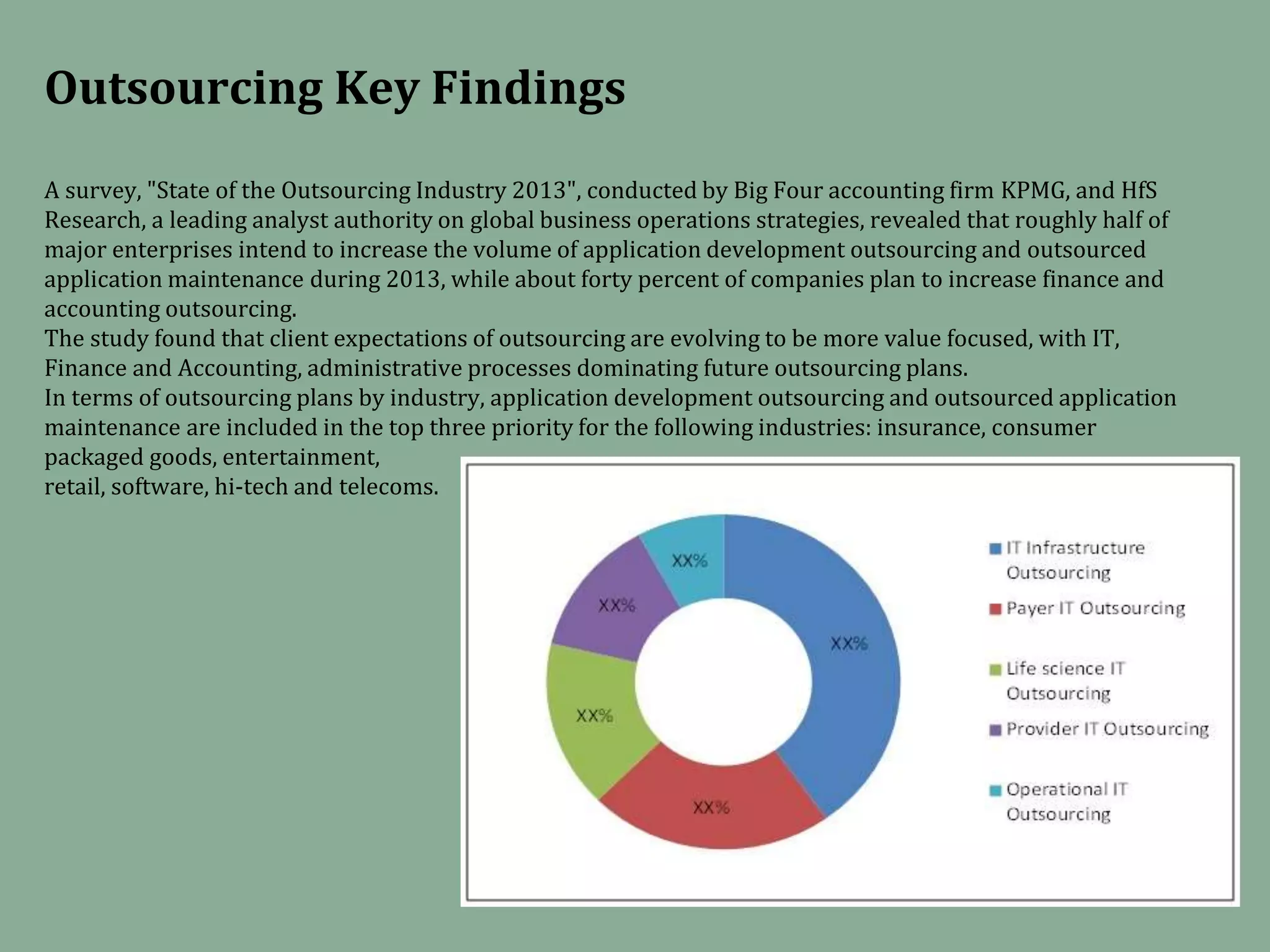
A survey, "State of the Outsourcing Industry 2013", conducted by Big Four accounting firm KPMG, and HfS
Research, a leading analyst authority on global business operations strategies, revealed that roughly half of
major enterprises intend to increase the volume of application development outsourcing and outsourced
application maintenance during 2013, while about forty percent of companies plan to increase finance and
accounting outsourcing.
The study found that client expectations of outsourcing are evolving to be more value focused, with IT,
Finance and Accounting, administrative processes dominating future outsourcing plans.
In terms of outsourcing plans by industry, application development outsourcing and outsourced application
maintenance are included in the top three priority for the following industries: insurance, consumer
packaged goods, entertainment,
retail, software, hi-tech and telecoms.
Presentation done by Dixita
Sources: Internet
Here comes your footer  Page 8

Outsourcing best practices

  • 1.
  • 2.
    What is Outsourcing Outsourcingis the contracting of an outside vendor to produce products, services, or to perform specific business functions. This can range from subcontracting with a business associate across town or offshoring with a freelancer across the world. The definition of outsourcing encompasses both subcontracting and offshoring.
  • 3.
    Factors For an organizationthe decision to outsource can be brought about by a number of factors: •Heavy workload •Lack of time or urgency •Lack of expertise •Deplorable cost to perform services •Shift to new technologies and/or existing technologies •Add to existing staffing levels hastily •Focus on operational, functional, or technical limitations •Return the focus of staff to core capabilities •Hasten benefits by rapidly employing services or projects •Trim down costs in an explicit functional area •Increase service levels •Reduce capital costs •Cut recurring operational costs •Enable business tactics and/or transformations
  • 4.
    Best Practices: Howto avoid outsourcing blues Establish clear objectives Get a compatible provider Determine the business results you wish to achieve through outsourcing. You should establish business objectives for outsourcing with clearly defined goals. This may sound obvious but having scheduled checkpoints to review the status of your outcomes is an easy way to ensure that the provider meets your standards. Otherwise you run the risk of a he-said, she-said confrontation. Make sure your service provider understands more than just how to code or implement. An outsourcer needs to be compatible with your company's culture and business objectives, with the right experience, communications skills, and working style. Don't go in shortsighted Stakeholders often get lost in the deal itself. In the attempt to save the company lots of money, the emphasis shifts to documenting the benefits of the deal and locking prices down, savings, terms, and conditions. Often missing is a focus on the long-term result desired to justify such a fundamental switch in business operations.
  • 5.
    Best practices.. Never confusesales and delivery Focus on getting a good delivery -- it's the ultimate point of the deal. It is those delivery details that get lost in transition from the deal guys to the execution team. Change your attitude toward IT Don't think of IT as a cost center; instead, consider it a value center. Such a switch clarifies what is key to the business and what is in fact generic Get the communications right Make sure the service provider understands the project specifications. Be as detailed and precise as possible. Expect to get what you pay for If you put the outsourcer under too much cost pressure, it will cut corners too, such as using junior resources Stay on-site If possible, budget to keep on-site presence at the service provider. You need to see what is actually happening, and have your ambassador there so that the outsourcer can stay connected with you as well.
  • 6.
    Best practices... . Retainresponsibility Outsourcing shouldn't mean that you are abdicating responsibility. You still own the overall results, so you need to be actively involved in working with and managing the outsourcer. Get C-level sign-offs Make sure you have senior-level stakeholders such as the CIO on the client side and CEO on the vendor side. Don't delegate everything to middle management. Pick the right projects to outsource In many cases, the outsourcing decision is made for the wrong reasons. What to outsource depends on the company's objectives. If the primary goal is to save money, then start with the applications that cost you the most money. Clean up before you outsource Companies tend to dump their problems on outsourcers, then are surprised a bad result ensues. If the company couldn't get the systems right, how it can it expect the outsourcer to do it? It's actually harder for the outsourcer because they don't have your history, culture, and business context when trying to decide what is "right." Get the SLA metrics right Because IT organizations are not typically good about collecting metrics, they make several mistakes, the biggest of which may be to accept the outsourcers' SLAs. If the vendor sets the baselines, you can be sure it was done in such a way to minimize risk and penalties and maximize incentives.
  • 7.
    Outsourcing Key Findings Asurvey, "State of the Outsourcing Industry 2013", conducted by Big Four accounting firm KPMG, and HfS Research, a leading analyst authority on global business operations strategies, revealed that roughly half of major enterprises intend to increase the volume of application development outsourcing and outsourced application maintenance during 2013, while about forty percent of companies plan to increase finance and accounting outsourcing. The study found that client expectations of outsourcing are evolving to be more value focused, with IT, Finance and Accounting, administrative processes dominating future outsourcing plans. In terms of outsourcing plans by industry, application development outsourcing and outsourced application maintenance are included in the top three priority for the following industries: insurance, consumer packaged goods, entertainment, retail, software, hi-tech and telecoms.
  • 8.
    Presentation done byDixita Sources: Internet Here comes your footer  Page 8