 “ A Project is a temporary organisation that is created
for the purposes of delivering one of more business
products according to an agreed business case”
PRINCE 2
 “ A Project is a temporary endeavour undertaken to
create a unique product, service or result”
PMBOK
https://www.xpert.chat/profession1/project-managers?ref=jd8q0
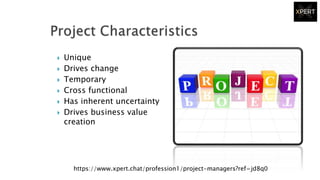
 Unique
 Drives change
 Temporary
 Cross functional
 Has inherent uncertainty
 Drives business value
creation
https://www.xpert.chat/profession1/project-managers?ref=jd8q0
 “Project Management is the planning, delegating, monitoring
and control of all aspects of the projects, and the motivation
of those involved to achieve project objectives within the
expected performance targets for time, cost, quality, scope,
benefits and risks.
PRINCE2
 Project Management is the application of skills, tools and
techniques to project activities to meet the project
requirements. Project Management is accomplished through
the appropriate application and integration of the Project
Management processes identified for the project. Project
management enables organisations to execute projects
effectively and efficiently”
PMBOK
 Creates better predictability
 Provides for better control of resources needed for the project –
financial, physical and human resources
 Creates informed outcomes aligned with stakeholders and end users
 Better chance of meeting expectations
 Better internal collaboration
 Improved worker morale – everyone should know what their role is
 Better coordination
 More cost effective with enhanced benefit outcomes
 Numerous Agile approaches that will work well in a research
environment.
Project management delivers an outcome that both sets and meets expectations of
key stakeholders in a way that is predictable, and bound in scope
https://www.xpert.chat/profession1/project-managers?ref=jd8q0
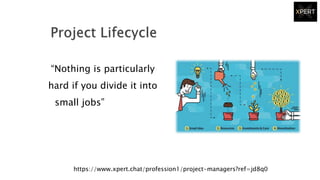
“Nothing is particularly
hard if you divide it into
small jobs”
https://www.xpert.chat/profession1/project-managers?ref=jd8q0
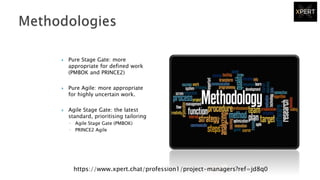
 Pure Stage Gate: more
appropriate for defined work
(PMBOK and PRINCE2)
 Pure Agile: more appropriate
for highly uncertain work.
 Agile Stage Gate: the latest
standard, prioritising tailoring
◦ Agile Stage Gate (PMBOK)
◦ PRINCE2 Agile
https://www.xpert.chat/profession1/project-managers?ref=jd8q0
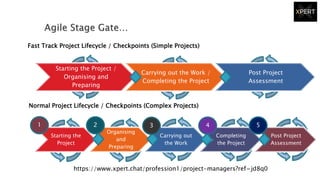
Starting the Project /
Organising and
Preparing
Carrying out the Work /
Completing the Project
Post Project
Assessment
Fast Track Project Lifecycle / Checkpoints (Simple Projects)
Normal Project Lifecycle / Checkpoints (Complex Projects)
Starting the
Project
Organising
and
Preparing
Carrying out
the Work
Completing
the Project
Post Project
Assessment
1 2 3 4 5
https://www.xpert.chat/profession1/project-managers?ref=jd8q0
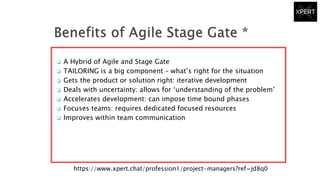
 A Hybrid of Agile and Stage Gate
 TAILORING is a big component – what’s right for the situation
 Gets the product or solution right: iterative development
 Deals with uncertainty: allows for ‘understanding of the problem’
 Accelerates development: can impose time bound phases
 Focuses teams: requires dedicated focused resources
 Improves within team communication
https://www.xpert.chat/profession1/project-managers?ref=jd8q0
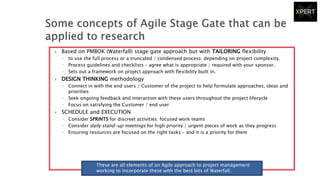
 Based on PMBOK (Waterfall) stage gate approach but with TAILORING flexibility
◦ to use the full process or a truncated / condensed process: depending on project complexity.
◦ Process guidelines and checklists – agree what is appropriate / required with your sponsor.
◦ Sets out a framework on project approach with flexibility built in.
 DESIGN THINKING methodology
◦ Connect in with the end users / Customer of the project to help formulate approaches, ideas and
priorities
◦ Seek ongoing feedback and interaction with these users throughout the project lifecycle
◦ Focus on satisfying the Customer / end user
 SCHEDULE and EXECUTION
◦ Consider SPRINTS for discreet activities: focused work teams
◦ Consider daily stand-up meetings for high priority / urgent pieces of work as they progress
◦ Ensuring resources are focused on the right tasks – and it is a priority for them
These are all elements of an Agile approach to project management
working to incorporate these with the best bits of Waterfall.
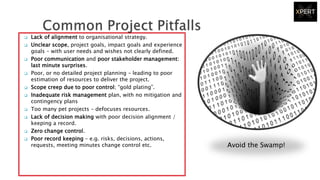
 Lack of alignment to organisational strategy.
 Unclear scope, project goals, impact goals and experience
goals – with user needs and wishes not clearly defined.
 Poor communication and poor stakeholder management:
last minute surprises.
 Poor, or no detailed project planning – leading to poor
estimation of resources to deliver the project.
 Scope creep due to poor control; “gold plating”.
 Inadequate risk management plan, with no mitigation and
contingency plans
 Too many pet projects – defocuses resources.
 Lack of decision making with poor decision alignment /
keeping a record.
 Zero change control.
 Poor record keeping – e.g. risks, decisions, actions,
requests, meeting minutes change control etc. Avoid the Swamp!
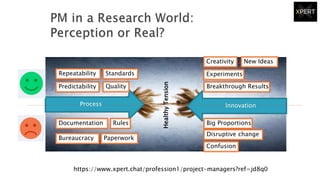
Process Innovation
Predictability
Standards
Quality
Repeatability
Bureaucracy
Rules
Paperwork
Documentation
HealthyTension
Creativity New Ideas
Experiments
Breakthrough Results
Big Proportions
Disruptive change
Confusion
https://www.xpert.chat/profession1/project-managers?ref=jd8q0
 Sponsor
 Project Manager / PI for Research Projects
 Project Team Members
https://www.xpert.chat/profession1/project-managers?ref=jd8q0
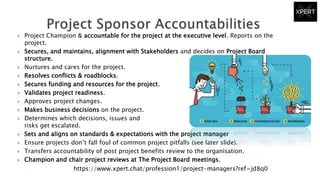
 Project Champion & accountable for the project at the executive level. Reports on the
project.
 Secures, and maintains, alignment with Stakeholders and decides on Project Board
structure.
 Nurtures and cares for the project.
 Resolves conflicts & roadblocks.
 Secures funding and resources for the project.
 Validates project readiness.
 Approves project changes.
 Makes business decisions on the project.
 Determines which decisions, issues and
risks get escalated.
 Sets and aligns on standards & expectations with the project manager
 Ensure projects don’t fall foul of common project pitfalls (see later slide).
 Transfers accountability of post project benefits review to the organisation.
 Champion and chair project reviews at The Project Board meetings.
https://www.xpert.chat/profession1/project-managers?ref=jd8q0
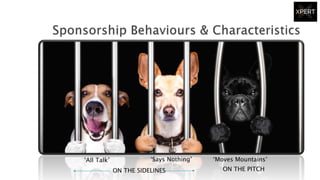
‘Says Nothing’‘All Talk’ ‘Moves Mountains’
ON THE SIDELINES ON THE PITCH
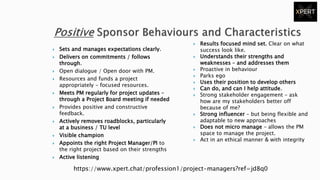
 Sets and manages expectations clearly.
 Delivers on commitments / follows
through.
 Open dialogue / Open door with PM.
 Resources and funds a project
appropriately – focused resources.
 Meets PM regularly for project updates –
through a Project Board meeting if needed
 Provides positive and constructive
feedback.
 Actively removes roadblocks, particularly
at a business / TU level
 Visible champion
 Appoints the right Project Manager/PI to
the right project based on their strengths
 Active listening
 Results focused mind set. Clear on what
success look like.
 Understands their strengths and
weaknesses – and addresses them
 Proactive in behaviour
 Parks ego
 Uses their position to develop others
 Can do, and can I help attitude.
 Strong stakeholder engagement – ask
how are my stakeholders better off
because of me?
 Strong influencer – but being flexible and
adaptable to new approaches
 Does not micro manage – allows the PM
space to manage the project.
 Act in an ethical manner & with integrity
https://www.xpert.chat/profession1/project-managers?ref=jd8q0
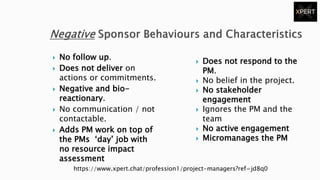
 No follow up.
 Does not deliver on
actions or commitments.
 Negative and bio-
reactionary.
 No communication / not
contactable.
 Adds PM work on top of
the PMs ‘day’ job with
no resource impact
assessment
 Does not respond to the
PM.
 No belief in the project.
 No stakeholder
engagement
 Ignores the PM and the
team
 No active engagement
 Micromanages the PM
https://www.xpert.chat/profession1/project-managers?ref=jd8q0
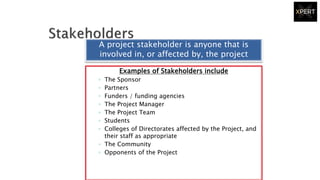
Examples of Stakeholders include
◦ The Sponsor
◦ Partners
◦ Funders / funding agencies
◦ The Project Manager
◦ The Project Team
◦ Students
◦ Colleges of Directorates affected by the Project, and
their staff as appropriate
◦ The Community
◦ Opponents of the Project
A project stakeholder is anyone that is
involved in, or affected by, the project
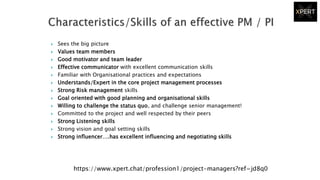
 Sees the big picture
 Values team members
 Good motivator and team leader
 Effective communicator with excellent communication skills
 Familiar with Organisational practices and expectations
 Understands/Expert in the core project management processes
 Strong Risk management skills
 Goal oriented with good planning and organisational skills
 Willing to challenge the status quo, and challenge senior management!
 Committed to the project and well respected by their peers
 Strong Listening skills
 Strong vision and goal setting skills
 Strong influencer….has excellent influencing and negotiating skills
https://www.xpert.chat/profession1/project-managers?ref=jd8q0
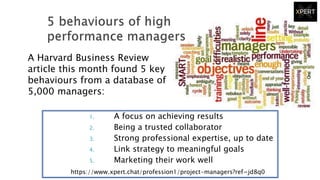
1. A focus on achieving results
2. Being a trusted collaborator
3. Strong professional expertise, up to date
4. Link strategy to meaningful goals
5. Marketing their work well
A Harvard Business Review
article this month found 5 key
behaviours from a database of
5,000 managers:
https://www.xpert.chat/profession1/project-managers?ref=jd8q0

Project management

  • 2.
     “ AProject is a temporary organisation that is created for the purposes of delivering one of more business products according to an agreed business case” PRINCE 2  “ A Project is a temporary endeavour undertaken to create a unique product, service or result” PMBOK https://www.xpert.chat/profession1/project-managers?ref=jd8q0
  • 3.
     Unique  Driveschange  Temporary  Cross functional  Has inherent uncertainty  Drives business value creation https://www.xpert.chat/profession1/project-managers?ref=jd8q0
  • 4.
     “Project Managementis the planning, delegating, monitoring and control of all aspects of the projects, and the motivation of those involved to achieve project objectives within the expected performance targets for time, cost, quality, scope, benefits and risks. PRINCE2  Project Management is the application of skills, tools and techniques to project activities to meet the project requirements. Project Management is accomplished through the appropriate application and integration of the Project Management processes identified for the project. Project management enables organisations to execute projects effectively and efficiently” PMBOK
  • 5.
     Creates betterpredictability  Provides for better control of resources needed for the project – financial, physical and human resources  Creates informed outcomes aligned with stakeholders and end users  Better chance of meeting expectations  Better internal collaboration  Improved worker morale – everyone should know what their role is  Better coordination  More cost effective with enhanced benefit outcomes  Numerous Agile approaches that will work well in a research environment. Project management delivers an outcome that both sets and meets expectations of key stakeholders in a way that is predictable, and bound in scope https://www.xpert.chat/profession1/project-managers?ref=jd8q0
  • 6.
    “Nothing is particularly hardif you divide it into small jobs” https://www.xpert.chat/profession1/project-managers?ref=jd8q0
  • 7.
     Pure StageGate: more appropriate for defined work (PMBOK and PRINCE2)  Pure Agile: more appropriate for highly uncertain work.  Agile Stage Gate: the latest standard, prioritising tailoring ◦ Agile Stage Gate (PMBOK) ◦ PRINCE2 Agile https://www.xpert.chat/profession1/project-managers?ref=jd8q0
  • 8.
    Starting the Project/ Organising and Preparing Carrying out the Work / Completing the Project Post Project Assessment Fast Track Project Lifecycle / Checkpoints (Simple Projects) Normal Project Lifecycle / Checkpoints (Complex Projects) Starting the Project Organising and Preparing Carrying out the Work Completing the Project Post Project Assessment 1 2 3 4 5 https://www.xpert.chat/profession1/project-managers?ref=jd8q0
  • 9.
     A Hybridof Agile and Stage Gate  TAILORING is a big component – what’s right for the situation  Gets the product or solution right: iterative development  Deals with uncertainty: allows for ‘understanding of the problem’  Accelerates development: can impose time bound phases  Focuses teams: requires dedicated focused resources  Improves within team communication https://www.xpert.chat/profession1/project-managers?ref=jd8q0
  • 10.
     Based onPMBOK (Waterfall) stage gate approach but with TAILORING flexibility ◦ to use the full process or a truncated / condensed process: depending on project complexity. ◦ Process guidelines and checklists – agree what is appropriate / required with your sponsor. ◦ Sets out a framework on project approach with flexibility built in.  DESIGN THINKING methodology ◦ Connect in with the end users / Customer of the project to help formulate approaches, ideas and priorities ◦ Seek ongoing feedback and interaction with these users throughout the project lifecycle ◦ Focus on satisfying the Customer / end user  SCHEDULE and EXECUTION ◦ Consider SPRINTS for discreet activities: focused work teams ◦ Consider daily stand-up meetings for high priority / urgent pieces of work as they progress ◦ Ensuring resources are focused on the right tasks – and it is a priority for them These are all elements of an Agile approach to project management working to incorporate these with the best bits of Waterfall.
  • 12.
     Lack ofalignment to organisational strategy.  Unclear scope, project goals, impact goals and experience goals – with user needs and wishes not clearly defined.  Poor communication and poor stakeholder management: last minute surprises.  Poor, or no detailed project planning – leading to poor estimation of resources to deliver the project.  Scope creep due to poor control; “gold plating”.  Inadequate risk management plan, with no mitigation and contingency plans  Too many pet projects – defocuses resources.  Lack of decision making with poor decision alignment / keeping a record.  Zero change control.  Poor record keeping – e.g. risks, decisions, actions, requests, meeting minutes change control etc. Avoid the Swamp!
  • 13.
    Process Innovation Predictability Standards Quality Repeatability Bureaucracy Rules Paperwork Documentation HealthyTension Creativity NewIdeas Experiments Breakthrough Results Big Proportions Disruptive change Confusion https://www.xpert.chat/profession1/project-managers?ref=jd8q0
  • 14.
     Sponsor  ProjectManager / PI for Research Projects  Project Team Members https://www.xpert.chat/profession1/project-managers?ref=jd8q0
  • 15.
     Project Champion& accountable for the project at the executive level. Reports on the project.  Secures, and maintains, alignment with Stakeholders and decides on Project Board structure.  Nurtures and cares for the project.  Resolves conflicts & roadblocks.  Secures funding and resources for the project.  Validates project readiness.  Approves project changes.  Makes business decisions on the project.  Determines which decisions, issues and risks get escalated.  Sets and aligns on standards & expectations with the project manager  Ensure projects don’t fall foul of common project pitfalls (see later slide).  Transfers accountability of post project benefits review to the organisation.  Champion and chair project reviews at The Project Board meetings. https://www.xpert.chat/profession1/project-managers?ref=jd8q0
  • 16.
    ‘Says Nothing’‘All Talk’‘Moves Mountains’ ON THE SIDELINES ON THE PITCH
  • 17.
     Sets andmanages expectations clearly.  Delivers on commitments / follows through.  Open dialogue / Open door with PM.  Resources and funds a project appropriately – focused resources.  Meets PM regularly for project updates – through a Project Board meeting if needed  Provides positive and constructive feedback.  Actively removes roadblocks, particularly at a business / TU level  Visible champion  Appoints the right Project Manager/PI to the right project based on their strengths  Active listening  Results focused mind set. Clear on what success look like.  Understands their strengths and weaknesses – and addresses them  Proactive in behaviour  Parks ego  Uses their position to develop others  Can do, and can I help attitude.  Strong stakeholder engagement – ask how are my stakeholders better off because of me?  Strong influencer – but being flexible and adaptable to new approaches  Does not micro manage – allows the PM space to manage the project.  Act in an ethical manner & with integrity https://www.xpert.chat/profession1/project-managers?ref=jd8q0
  • 18.
     No followup.  Does not deliver on actions or commitments.  Negative and bio- reactionary.  No communication / not contactable.  Adds PM work on top of the PMs ‘day’ job with no resource impact assessment  Does not respond to the PM.  No belief in the project.  No stakeholder engagement  Ignores the PM and the team  No active engagement  Micromanages the PM https://www.xpert.chat/profession1/project-managers?ref=jd8q0
  • 19.
    Examples of Stakeholdersinclude ◦ The Sponsor ◦ Partners ◦ Funders / funding agencies ◦ The Project Manager ◦ The Project Team ◦ Students ◦ Colleges of Directorates affected by the Project, and their staff as appropriate ◦ The Community ◦ Opponents of the Project A project stakeholder is anyone that is involved in, or affected by, the project
  • 20.
     Sees thebig picture  Values team members  Good motivator and team leader  Effective communicator with excellent communication skills  Familiar with Organisational practices and expectations  Understands/Expert in the core project management processes  Strong Risk management skills  Goal oriented with good planning and organisational skills  Willing to challenge the status quo, and challenge senior management!  Committed to the project and well respected by their peers  Strong Listening skills  Strong vision and goal setting skills  Strong influencer….has excellent influencing and negotiating skills https://www.xpert.chat/profession1/project-managers?ref=jd8q0
  • 21.
    1. A focuson achieving results 2. Being a trusted collaborator 3. Strong professional expertise, up to date 4. Link strategy to meaningful goals 5. Marketing their work well A Harvard Business Review article this month found 5 key behaviours from a database of 5,000 managers: https://www.xpert.chat/profession1/project-managers?ref=jd8q0