IT Services Development
Dr. Elijah Ezendu
FIMC, FCCM, FIIAN, FBDI, FAAFM, FSSM, MIMIS, MIAP, MITD, ACIArb, ACIPM,
PhD, DocM, MBA, CWM, CBDA, CMA, MPM, PME, CSOL, CCIP, CMC, CMgr
“Amid dramatic changes in the technology
marketplace in recent years, many IT
providers are trying to move up the value
chain by providing more comprehensive
and business-oriented solutions. The
move to solutions responds to buyer
demand for business value as well as
providers' needs to stake out competitive
differentiation and new areas for
profitable growth.”
- Rob Leavitt
IT Service CMM
The Service CMM is a capability maturity
model that specifies different maturity
levels for organizations that provide IT
services
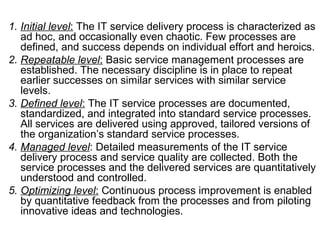
1. Initial level: The IT service delivery process is characterized as
ad hoc, and occasionally even chaotic. Few processes are
defined, and success depends on individual effort and heroics.
2. Repeatable level: Basic service management processes are
established. The necessary discipline is in place to repeat
earlier successes on similar services with similar service
levels.
3. Defined level: The IT service processes are documented,
standardized, and integrated into standard service processes.
All services are delivered using approved, tailored versions of
the organization’s standard service processes.
4. Managed level: Detailed measurements of the IT service
delivery process and service quality are collected. Both the
service processes and the delivered services are quantitatively
understood and controlled.
5. Optimizing level: Continuous process improvement is enabled
by quantitative feedback from the processes and from piloting
innovative ideas and technologies.
- Frank Niessink, Viktor Clerc, Ton Tijdink and Hans Van Vliet
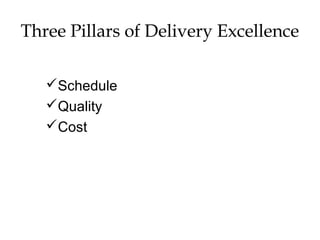
Three Pillars of Delivery Excellence
Schedule
Quality
Cost
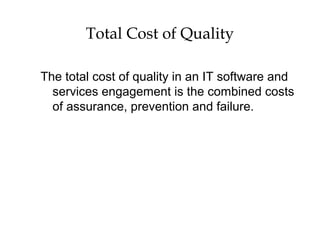
Total Cost of Quality
The total cost of quality in an IT software and
services engagement is the combined costs
of assurance, prevention and failure.
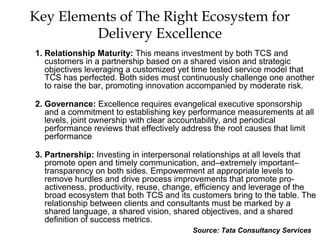
Key Elements of The Right Ecosystem for
Delivery Excellence
1. Relationship Maturity: This means investment by both TCS and
customers in a partnership based on a shared vision and strategic
objectives leveraging a customized yet time tested service model that
TCS has perfected. Both sides must continuously challenge one another
to raise the bar, promoting innovation accompanied by moderate risk.
2. Governance: Excellence requires evangelical executive sponsorship
and a commitment to establishing key performance measurements at all
levels, joint ownership with clear accountability, and periodical
performance reviews that effectively address the root causes that limit
performance
3. Partnership: Investing in interpersonal relationships at all levels that
promote open and timely communication, and–extremely important–
transparency on both sides. Empowerment at appropriate levels to
remove hurdles and drive process improvements that promote pro-
activeness, productivity, reuse, change, efficiency and leverage of the
broad ecosystem that both TCS and its customers bring to the table. The
relationship between clients and consultants must be marked by a
shared language, a shared vision, shared objectives, and a shared
definition of success metrics.
Source: Tata Consultancy Services
Making The Solutions Transition
• Developing New Solutions
• Generating Solutions Demand
• Enabling Solutions Sales
• Building a Solutions Organization
• Measuring Solutions Success
Typical IT Services 1
Applications Outsourcing Services
Applications Rationalization Services
Content Management
Enterprise Application Management Services
Testing Services
Portals/ Composite Applications
Flight Planning Services
Typical IT Services 2 2
Customer information systems and utility billing
services
Payroll services
Card services
Consumer direct services
Contact center outsourcing services
Customer relationship management services
Typical IT Services 3
Server management services
Enterprise networking services
Information protection services
Business intelligence services
Hosting services
IT security
Applications Outsourcing Services
Offering choice and flexibility in outsourcing
support for select applications or entire
applications portfolio.
Applications Rationalization Services
performs an assessment of a client’s
applications portfolio from a business,
functional, technical, and financial
perspective in order to develop a
roadmap to optimize and modernize the
applications to better support the
business agenda.
Content Management
This provides an integrated
approach for managing all
content-related processes across
an extended enterprise.
Testing Services
This is the delivery of the right mix
of testing and quality assurance.
IT security
• Blocking network based attacks
– Examples: firewall, antivirus gateways, secure email, spam
protection, and secure web filtering, intrusion detection and
prevention
• Blocking host based attacks
– Examples: personal antivirus, personal firewalls, spyware removal,
host intrusion prevention
• Eliminating security vulnerabilities
– Examples: patch configuration management and compliance,
vulnerability management and penetration testing
• Safely supporting authorized users
– Examples: strong passwords, VPNs, secure remote access, file
encryption, ID access and management
• Tools to minimize business losses and maximize effectiveness
– Examples: backup, log management, regulatory compliance tools
Global Trend in Outsourcing
• India has become a strong player in IT outsourcing
around the world, from humble beginnings;
• Global IT outsourcing in excess of $2 trn and most
of it is in terms of Software Development, Call
Centers and related services;
• Increasingly the global market is looking to recruit
new markets in Africa;
• Nigeria has a strong potential for being the hub for
West Africa:
– given the level of literacy
– Size of population and hence market
– Nigeria accounts for over 70% of West African
market;
• Government business provides a huge opportunity
for developing a ‘software Nigeria’ brand.Source: Presidential Committee on the National Identity Management System,
Consumer Credit System and Outsourcing Initiative
Dr Elijah Ezendu is Award-Winning Business Expert & Certified Management Consultant with expertise
in Interim Management, Strategy, Competitive Intelligence, Transformation, Restructuring, Turnaround
Management, Business Development, Marketing, Project & Cost Management, Leadership, HR, CSR, e-
Business & Software Architecture. He had functioned as Founder, Initiative for Sustainable Business
Equity; Chairman of Board, Charisma Broadcast Film Academy; Group Chief Operating Officer, Idova
Group; CEO, Rubiini (UAE); Special Advisor, RTEAN; Director, MMNA Investments; Chair, Int’l Board of
GCC Business Council (UAE); Senior Partner, Shevach Consulting; Chairman (Certification & Training),
Coordinator (Board of Fellows), Lead Assessor & Governing Council Member, Institute of Management
Consultants, Nigeria; Lead Resource, Centre for Competitive Intelligence Development; Lead
Consultant/ Partner, JK Michaels; Turnaround Project Director, Consolidated Business Holdings Limited;
Technical Director, Gestalt; Chief Operating Officer, Rohan Group; Executive Director (Various Roles),
Fortuna, Gambia & Malta; Chief Advisor/ Partner, D & E; Vice Chairman of Board, Refined Shipping;
Director of Programmes & Governing Council Member, Institute of Business Development, Nigeria;
Member of TDD Committee, International Association of Software Architects, USA; Member of Strategic
Planning and Implementation Committee, Chartered Institute of Personnel Management of Nigeria;
Country Manager (Nigeria) & Adjunct Faculty (MBA Programme), Regent Business School, South Africa;
Adjunct Faculty (MBA Programme), Ladoke Akintola University of Technology; Editor-in-Chief, Cost
Management Journal; Council Member, Institute of Internal Auditors of Nigeria; Member, Board of
Directors (Several Organizations). He holds Doctoral Degree in Management, Master of Business
Administration and Fellow of Professional Institutes in North America, UK & Nigeria. He is Innovator of
Corporate Investment Structure Based on Financials and Intangibles, for valuation highlighting
intangible contributions of host communities and ecological environment: A model celebrated globally
as remedy for unmitigated depreciation of ecological capital and developmental deprivation of host
communities. He had served as Examiner to Professional Institutes and Universities. He had been a
member of Guild of Soundtrack Producers of Nigeria. He's an author and extensively featured speaker.
Thank You

IT Services Development

  • 1.
    IT Services Development Dr.Elijah Ezendu FIMC, FCCM, FIIAN, FBDI, FAAFM, FSSM, MIMIS, MIAP, MITD, ACIArb, ACIPM, PhD, DocM, MBA, CWM, CBDA, CMA, MPM, PME, CSOL, CCIP, CMC, CMgr
  • 2.
    “Amid dramatic changesin the technology marketplace in recent years, many IT providers are trying to move up the value chain by providing more comprehensive and business-oriented solutions. The move to solutions responds to buyer demand for business value as well as providers' needs to stake out competitive differentiation and new areas for profitable growth.” - Rob Leavitt
  • 3.
    IT Service CMM TheService CMM is a capability maturity model that specifies different maturity levels for organizations that provide IT services
  • 4.
    1. Initial level:The IT service delivery process is characterized as ad hoc, and occasionally even chaotic. Few processes are defined, and success depends on individual effort and heroics. 2. Repeatable level: Basic service management processes are established. The necessary discipline is in place to repeat earlier successes on similar services with similar service levels. 3. Defined level: The IT service processes are documented, standardized, and integrated into standard service processes. All services are delivered using approved, tailored versions of the organization’s standard service processes. 4. Managed level: Detailed measurements of the IT service delivery process and service quality are collected. Both the service processes and the delivered services are quantitatively understood and controlled. 5. Optimizing level: Continuous process improvement is enabled by quantitative feedback from the processes and from piloting innovative ideas and technologies. - Frank Niessink, Viktor Clerc, Ton Tijdink and Hans Van Vliet
  • 5.
    Three Pillars ofDelivery Excellence Schedule Quality Cost
  • 6.
    Total Cost ofQuality The total cost of quality in an IT software and services engagement is the combined costs of assurance, prevention and failure.
  • 7.
    Key Elements ofThe Right Ecosystem for Delivery Excellence 1. Relationship Maturity: This means investment by both TCS and customers in a partnership based on a shared vision and strategic objectives leveraging a customized yet time tested service model that TCS has perfected. Both sides must continuously challenge one another to raise the bar, promoting innovation accompanied by moderate risk. 2. Governance: Excellence requires evangelical executive sponsorship and a commitment to establishing key performance measurements at all levels, joint ownership with clear accountability, and periodical performance reviews that effectively address the root causes that limit performance 3. Partnership: Investing in interpersonal relationships at all levels that promote open and timely communication, and–extremely important– transparency on both sides. Empowerment at appropriate levels to remove hurdles and drive process improvements that promote pro- activeness, productivity, reuse, change, efficiency and leverage of the broad ecosystem that both TCS and its customers bring to the table. The relationship between clients and consultants must be marked by a shared language, a shared vision, shared objectives, and a shared definition of success metrics. Source: Tata Consultancy Services
  • 8.
    Making The SolutionsTransition • Developing New Solutions • Generating Solutions Demand • Enabling Solutions Sales • Building a Solutions Organization • Measuring Solutions Success
  • 9.
    Typical IT Services1 Applications Outsourcing Services Applications Rationalization Services Content Management Enterprise Application Management Services Testing Services Portals/ Composite Applications Flight Planning Services
  • 10.
    Typical IT Services2 2 Customer information systems and utility billing services Payroll services Card services Consumer direct services Contact center outsourcing services Customer relationship management services
  • 11.
    Typical IT Services3 Server management services Enterprise networking services Information protection services Business intelligence services Hosting services IT security
  • 12.
    Applications Outsourcing Services Offeringchoice and flexibility in outsourcing support for select applications or entire applications portfolio.
  • 13.
    Applications Rationalization Services ApplicationsRationalization Services performs an assessment of a client’s applications portfolio from a business, functional, technical, and financial perspective in order to develop a roadmap to optimize and modernize the applications to better support the business agenda.
  • 14.
    Content Management This providesan integrated approach for managing all content-related processes across an extended enterprise.
  • 15.
    Testing Services This isthe delivery of the right mix of testing and quality assurance.
  • 16.
    IT security • Blockingnetwork based attacks – Examples: firewall, antivirus gateways, secure email, spam protection, and secure web filtering, intrusion detection and prevention • Blocking host based attacks – Examples: personal antivirus, personal firewalls, spyware removal, host intrusion prevention • Eliminating security vulnerabilities – Examples: patch configuration management and compliance, vulnerability management and penetration testing • Safely supporting authorized users – Examples: strong passwords, VPNs, secure remote access, file encryption, ID access and management • Tools to minimize business losses and maximize effectiveness – Examples: backup, log management, regulatory compliance tools
  • 17.
    Global Trend inOutsourcing • India has become a strong player in IT outsourcing around the world, from humble beginnings; • Global IT outsourcing in excess of $2 trn and most of it is in terms of Software Development, Call Centers and related services; • Increasingly the global market is looking to recruit new markets in Africa; • Nigeria has a strong potential for being the hub for West Africa: – given the level of literacy – Size of population and hence market – Nigeria accounts for over 70% of West African market; • Government business provides a huge opportunity for developing a ‘software Nigeria’ brand.Source: Presidential Committee on the National Identity Management System, Consumer Credit System and Outsourcing Initiative
  • 18.
    Dr Elijah Ezenduis Award-Winning Business Expert & Certified Management Consultant with expertise in Interim Management, Strategy, Competitive Intelligence, Transformation, Restructuring, Turnaround Management, Business Development, Marketing, Project & Cost Management, Leadership, HR, CSR, e- Business & Software Architecture. He had functioned as Founder, Initiative for Sustainable Business Equity; Chairman of Board, Charisma Broadcast Film Academy; Group Chief Operating Officer, Idova Group; CEO, Rubiini (UAE); Special Advisor, RTEAN; Director, MMNA Investments; Chair, Int’l Board of GCC Business Council (UAE); Senior Partner, Shevach Consulting; Chairman (Certification & Training), Coordinator (Board of Fellows), Lead Assessor & Governing Council Member, Institute of Management Consultants, Nigeria; Lead Resource, Centre for Competitive Intelligence Development; Lead Consultant/ Partner, JK Michaels; Turnaround Project Director, Consolidated Business Holdings Limited; Technical Director, Gestalt; Chief Operating Officer, Rohan Group; Executive Director (Various Roles), Fortuna, Gambia & Malta; Chief Advisor/ Partner, D & E; Vice Chairman of Board, Refined Shipping; Director of Programmes & Governing Council Member, Institute of Business Development, Nigeria; Member of TDD Committee, International Association of Software Architects, USA; Member of Strategic Planning and Implementation Committee, Chartered Institute of Personnel Management of Nigeria; Country Manager (Nigeria) & Adjunct Faculty (MBA Programme), Regent Business School, South Africa; Adjunct Faculty (MBA Programme), Ladoke Akintola University of Technology; Editor-in-Chief, Cost Management Journal; Council Member, Institute of Internal Auditors of Nigeria; Member, Board of Directors (Several Organizations). He holds Doctoral Degree in Management, Master of Business Administration and Fellow of Professional Institutes in North America, UK & Nigeria. He is Innovator of Corporate Investment Structure Based on Financials and Intangibles, for valuation highlighting intangible contributions of host communities and ecological environment: A model celebrated globally as remedy for unmitigated depreciation of ecological capital and developmental deprivation of host communities. He had served as Examiner to Professional Institutes and Universities. He had been a member of Guild of Soundtrack Producers of Nigeria. He's an author and extensively featured speaker.
  • 19.