Cracking the Outsourcing Process Code
The right solution to drive profitability and business growth
How effective is your
Outsourcing Process
The complexity of today’s business
processes and the demands to
consistently deliver results are
driving HR & business leaders in the
direction of outsourcing.
But achieving success with your
outsourcing strategy is not simple.
It is important to know when to
outsource, and also essential to
know how to use outsourcing to its
full advantage.
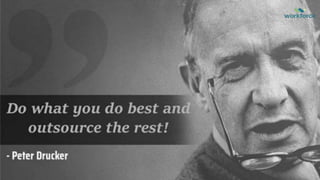
Outsourcing is a great way for
businesses to realise success
without hiring a lot of full-time or
in-house employees
HOW?
By leveraging outsourcing experts to
handle some of your business
processes or less strategic tasks, in
order for you to focus on your core
business functions.
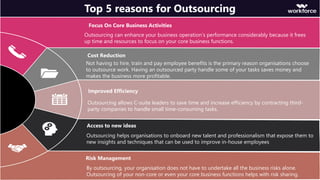
Focus On Core Business Activities
Outsourcing can enhance your business operation’s performance considerably because it frees
up time and resources to focus on your core business functions.
Top 5 reasons for Outsourcing
Cost Reduction
Not having to hire, train and pay employee benefits is the primary reason organisations choose
to outsource work. Having an outsourced party handle some of your tasks saves money and
makes the business more profitable.
Improved Efficiency
Outsourcing allows C-suite leaders to save time and increase efficiency by contracting third-
party companies to handle small time-consuming tasks.
Access to new ideas
Outsourcing helps organisations to onboard new talent and professionalism that expose them to
new insights and techniques that can be used to improve in-house employees
Risk Management
By outsourcing, your organisation does not have to undertake all the business risks alone.
Outsourcing of your non-core or even your core business functions helps with risk sharing.
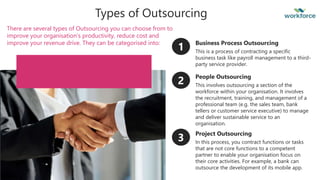
Types of Outsourcing
1
2
3
There are several types of Outsourcing you can choose from to
improve your organisation’s productivity, reduce cost and
improve your revenue drive. They can be categorised into: Business Process Outsourcing
This is a process of contracting a specific
business task like payroll management to a third-
party service provider.
People Outsourcing
This involves outsourcing a section of the
workforce within your organisation. It involves
the recruitment, training, and management of a
professional team (e.g. the sales team, bank
tellers or customer service executive) to manage
and deliver sustainable service to an
organisation.
Project Outsourcing
In this process, you contract functions or tasks
that are not core functions to a competent
partner to enable your organisation focus on
their core activities. For example, a bank can
outsource the development of its mobile app.
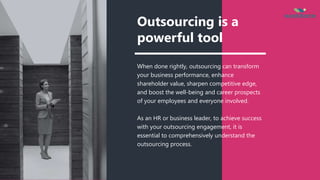
Outsourcing is a
powerful tool
When done rightly, outsourcing can transform
your business performance, enhance
shareholder value, sharpen competitive edge,
and boost the well-being and career prospects
of your employees and everyone involved.
As an HR or business leader, to achieve success
with your outsourcing engagement, it is
essential to comprehensively understand the
outsourcing process.
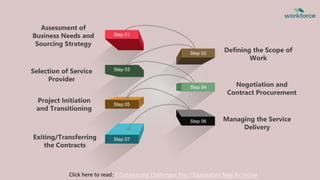
7 STAGES OF OUTSOURCING
Step 01
Step 03
Step 07
Step 05
Step 04
Step 02
Step 06
Defining the Scope of
Work
Negotiation and
Contract Procurement
Managing the Service
Delivery
Assessment of
Business Needs and
Sourcing Strategy
Selection of Service
Provider
Project Initiation
and Transitioning
Exiting/Transferring
the Contracts
Click here to read: 7 Outsourcing Challenges Your Organisation May Be Facing
Step 01
Step 03
Step 07
Step 05
Step 04
Step 02
Step 06
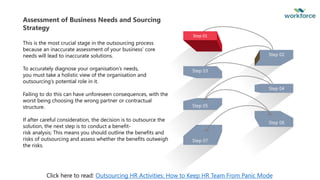
Assessment of Business Needs and Sourcing
Strategy
This is the most crucial stage in the outsourcing process
because an inaccurate assessment of your business’ core
needs will lead to inaccurate solutions.
To accurately diagnose your organisation’s needs,
you must take a holistic view of the organisation and
outsourcing’s potential role in it.
Failing to do this can have unforeseen consequences, with the
worst being choosing the wrong partner or contractual
structure.
If after careful consideration, the decision is to outsource the
solution, the next step is to conduct a benefit-
risk analysis; This means you should outline the benefits and
risks of outsourcing and assess whether the benefits outweigh
the risks.
Click here to read: Outsourcing HR Activities: How to Keep HR Team From Panic Mode
Step 01
Step 03
Step 07
Step 05
Step 04
Step 02
Step 06
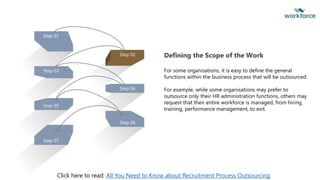
Defining the Scope of the Work
For some organisations, it is easy to define the general
functions within the business process that will be outsourced.
For example, while some organisations may prefer to
outsource only their HR administration functions, others may
request that their entire workforce is managed, from hiring,
training, performance management, to exit.
Click here to read: All You Need to Know about Recruitment Process Outsourcing
Step 01
Step 03
Step 07
Step 05
Step 04
Step 02
Step 06
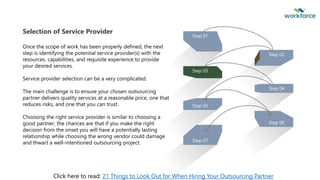
Selection of Service Provider
Once the scope of work has been properly defined, the next
step is identifying the potential service provider(s) with the
resources, capabilities, and requisite experience to provide
your desired services.
Service provider selection can be a very complicated.
The main challenge is to ensure your chosen outsourcing
partner delivers quality services at a reasonable price, one that
reduces risks, and one that you can trust.
Choosing the right service provider is similar to choosing a
good partner; the chances are that if you make the right
decision from the onset you will have a potentially lasting
relationship while choosing the wrong vendor could damage
and thwart a well-intentioned outsourcing project.
Click here to read: 21 Things to Look Out for When Hiring Your Outsourcing Partner
Step 01
Step 03
Step 07
Step 05
Step 04
Step 02
Step 06
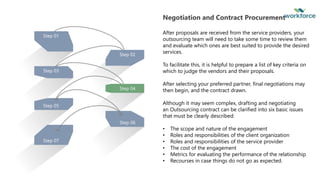
Negotiation and Contract Procurement
After proposals are received from the service providers, your
outsourcing team will need to take some time to review them
and evaluate which ones are best suited to provide the desired
services.
To facilitate this, it is helpful to prepare a list of key criteria on
which to judge the vendors and their proposals.
After selecting your preferred partner, final negotiations may
then begin, and the contract drawn.
Although it may seem complex, drafting and negotiating
an Outsourcing contract can be clarified into six basic issues
that must be clearly described:
• The scope and nature of the engagement
• Roles and responsibilities of the client organization
• Roles and responsibilities of the service provider
• The cost of the engagement
• Metrics for evaluating the performance of the relationship
• Recourses in case things do not go as expected.
Step 01
Step 03
Step 07
Step 05
Step 04
Step 02
Step 06
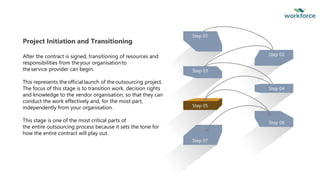
Project Initiation and Transitioning
After the contract is signed, transitioning of resources and
responsibilities from theyour organisationto
theservice provider can begin.
This represents theofficiallaunch of theoutsourcing project.
The focus of this stage is to transition work, decision rights
and knowledge to the vendor organisation, so that they can
conduct the work effectively and, for the most part,
independently from your organisation.
This stage is one of the most critical parts of
the entire outsourcing process because it sets the tone for
how the entire contract will play out.
Step 01
Step 03
Step 07
Step 05
Step 04
Step 02
Step 06
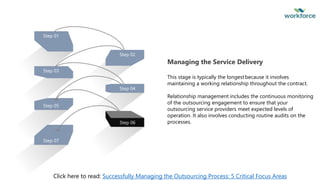
Managing the Service Delivery
This stage is typically the longestbecause it involves
maintaining a working relationship throughout the contract.
Relationship management includes the continuous monitoring
of the outsourcing engagement to ensure that your
outsourcing service providers meet expected levels of
operation. It also involves conducting routine audits on the
processes.
Click here to read: Successfully Managing the Outsourcing Process: 5 Critical Focus Areas
Step 01
Step 03
Step 07
Step 05
Step 04
Step 02
Step 06
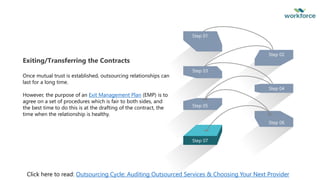
Exiting/Transferring the Contracts
Once mutual trust is established, outsourcing relationships can
last for a long time.
However, the purpose of an Exit Management Plan (EMP) is to
agree on a set of procedures which is fair to both sides, and
the best time to do this is at the drafting of the contract, the
time when the relationship is healthy.
Click here to read: Outsourcing Cycle: Auditing Outsourced Services & Choosing Your Next Provider
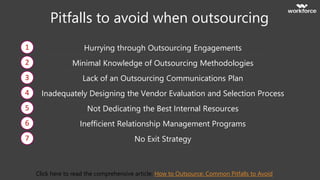
Hurrying through Outsourcing Engagements
Minimal Knowledge of Outsourcing Methodologies
Lack of an Outsourcing Communications Plan
Inadequately Designing the Vendor Evaluation and Selection Process
Not Dedicating the Best Internal Resources
Inefficient Relationship Management Programs
No Exit Strategy
1
2
3
4
5
6
7
Pitfalls to avoid when outsourcing
Click here to read the comprehensive article: How to Outsource: Common Pitfalls to Avoid
Outsourcing is a game-changer for businesses when done the right way
With 18+ years of experience, over 200 consultants and 8,000+ outsourced staff, we
have helped over 300+ clients achieve their desired business results, increase revenue
and mitigate risks of doing business in Nigeria and across the African continent.
With Workforce Group as your HR outsourcing partner, we will handle both core and
non-core HR activities and functions while you focus on the essentials.
Our in-depth industry expertise, experience and capabilities cuts across recruitment,
talent development, welfare management, performance management, and payroll
services.
To partner with us, please send us an email to hello@workforcegroup.com.
Scale the advantage…
READY TO GET
STARTED?
Visit www.workforcegroup.com or
Send an email to -
hello@workforcegroup.com
YOUR BUSINESS YOUR PEOPLE OUR FOCUS
=
Workforce Group
… We go
beyond
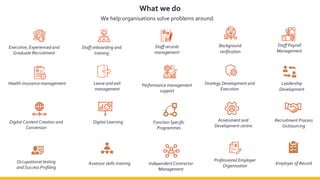
What we do
We help organisations solve problems around:
Staff Payroll
Management
Performance management
support
Health insurance management
Executive, Experienced and
Graduate Recruitment
Staff onboarding and
training
Staff records
management
Leave and exit
management
Background
verification
Strategy Development and
Execution
Digital Learning Function Specific
Programmes
Leadership
Development
Digital Content Creation and
Conversion
Assessment and
Development centre
Occupational testing
and Success Profiling
Independent Contractor
Management
Assessor skills training
Professional Employer
Organisation
Employer of Record
Recruitment Process
Outsourcing
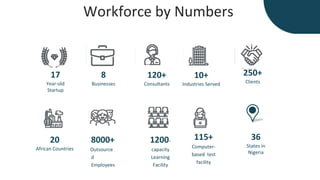
Workforce by Numbers
17
Year-old
Startup
8
Businesses
120+
Consultants
20
African Countries
8000+
Outsource
d
Employees
1200-
capacity
Learning
Facility
115+
Computer-
based test
facility
250+
Clients
10+
Industries Served
36
States in
Nigeria

Cracking The Outsourcing Process Code

  • 1.
    Cracking the OutsourcingProcess Code The right solution to drive profitability and business growth
  • 2.
    How effective isyour Outsourcing Process
  • 3.
    The complexity oftoday’s business processes and the demands to consistently deliver results are driving HR & business leaders in the direction of outsourcing. But achieving success with your outsourcing strategy is not simple. It is important to know when to outsource, and also essential to know how to use outsourcing to its full advantage.
  • 4.
    Outsourcing is agreat way for businesses to realise success without hiring a lot of full-time or in-house employees HOW? By leveraging outsourcing experts to handle some of your business processes or less strategic tasks, in order for you to focus on your core business functions.
  • 6.
    Focus On CoreBusiness Activities Outsourcing can enhance your business operation’s performance considerably because it frees up time and resources to focus on your core business functions. Top 5 reasons for Outsourcing Cost Reduction Not having to hire, train and pay employee benefits is the primary reason organisations choose to outsource work. Having an outsourced party handle some of your tasks saves money and makes the business more profitable. Improved Efficiency Outsourcing allows C-suite leaders to save time and increase efficiency by contracting third- party companies to handle small time-consuming tasks. Access to new ideas Outsourcing helps organisations to onboard new talent and professionalism that expose them to new insights and techniques that can be used to improve in-house employees Risk Management By outsourcing, your organisation does not have to undertake all the business risks alone. Outsourcing of your non-core or even your core business functions helps with risk sharing.
  • 7.
    Types of Outsourcing 1 2 3 Thereare several types of Outsourcing you can choose from to improve your organisation’s productivity, reduce cost and improve your revenue drive. They can be categorised into: Business Process Outsourcing This is a process of contracting a specific business task like payroll management to a third- party service provider. People Outsourcing This involves outsourcing a section of the workforce within your organisation. It involves the recruitment, training, and management of a professional team (e.g. the sales team, bank tellers or customer service executive) to manage and deliver sustainable service to an organisation. Project Outsourcing In this process, you contract functions or tasks that are not core functions to a competent partner to enable your organisation focus on their core activities. For example, a bank can outsource the development of its mobile app.
  • 8.
    Outsourcing is a powerfultool When done rightly, outsourcing can transform your business performance, enhance shareholder value, sharpen competitive edge, and boost the well-being and career prospects of your employees and everyone involved. As an HR or business leader, to achieve success with your outsourcing engagement, it is essential to comprehensively understand the outsourcing process.
  • 9.
    7 STAGES OFOUTSOURCING
  • 10.
    Step 01 Step 03 Step07 Step 05 Step 04 Step 02 Step 06 Defining the Scope of Work Negotiation and Contract Procurement Managing the Service Delivery Assessment of Business Needs and Sourcing Strategy Selection of Service Provider Project Initiation and Transitioning Exiting/Transferring the Contracts Click here to read: 7 Outsourcing Challenges Your Organisation May Be Facing
  • 11.
    Step 01 Step 03 Step07 Step 05 Step 04 Step 02 Step 06 Assessment of Business Needs and Sourcing Strategy This is the most crucial stage in the outsourcing process because an inaccurate assessment of your business’ core needs will lead to inaccurate solutions. To accurately diagnose your organisation’s needs, you must take a holistic view of the organisation and outsourcing’s potential role in it. Failing to do this can have unforeseen consequences, with the worst being choosing the wrong partner or contractual structure. If after careful consideration, the decision is to outsource the solution, the next step is to conduct a benefit- risk analysis; This means you should outline the benefits and risks of outsourcing and assess whether the benefits outweigh the risks. Click here to read: Outsourcing HR Activities: How to Keep HR Team From Panic Mode
  • 12.
    Step 01 Step 03 Step07 Step 05 Step 04 Step 02 Step 06 Defining the Scope of the Work For some organisations, it is easy to define the general functions within the business process that will be outsourced. For example, while some organisations may prefer to outsource only their HR administration functions, others may request that their entire workforce is managed, from hiring, training, performance management, to exit. Click here to read: All You Need to Know about Recruitment Process Outsourcing
  • 13.
    Step 01 Step 03 Step07 Step 05 Step 04 Step 02 Step 06 Selection of Service Provider Once the scope of work has been properly defined, the next step is identifying the potential service provider(s) with the resources, capabilities, and requisite experience to provide your desired services. Service provider selection can be a very complicated. The main challenge is to ensure your chosen outsourcing partner delivers quality services at a reasonable price, one that reduces risks, and one that you can trust. Choosing the right service provider is similar to choosing a good partner; the chances are that if you make the right decision from the onset you will have a potentially lasting relationship while choosing the wrong vendor could damage and thwart a well-intentioned outsourcing project. Click here to read: 21 Things to Look Out for When Hiring Your Outsourcing Partner
  • 14.
    Step 01 Step 03 Step07 Step 05 Step 04 Step 02 Step 06 Negotiation and Contract Procurement After proposals are received from the service providers, your outsourcing team will need to take some time to review them and evaluate which ones are best suited to provide the desired services. To facilitate this, it is helpful to prepare a list of key criteria on which to judge the vendors and their proposals. After selecting your preferred partner, final negotiations may then begin, and the contract drawn. Although it may seem complex, drafting and negotiating an Outsourcing contract can be clarified into six basic issues that must be clearly described: • The scope and nature of the engagement • Roles and responsibilities of the client organization • Roles and responsibilities of the service provider • The cost of the engagement • Metrics for evaluating the performance of the relationship • Recourses in case things do not go as expected.
  • 15.
    Step 01 Step 03 Step07 Step 05 Step 04 Step 02 Step 06 Project Initiation and Transitioning After the contract is signed, transitioning of resources and responsibilities from theyour organisationto theservice provider can begin. This represents theofficiallaunch of theoutsourcing project. The focus of this stage is to transition work, decision rights and knowledge to the vendor organisation, so that they can conduct the work effectively and, for the most part, independently from your organisation. This stage is one of the most critical parts of the entire outsourcing process because it sets the tone for how the entire contract will play out.
  • 16.
    Step 01 Step 03 Step07 Step 05 Step 04 Step 02 Step 06 Managing the Service Delivery This stage is typically the longestbecause it involves maintaining a working relationship throughout the contract. Relationship management includes the continuous monitoring of the outsourcing engagement to ensure that your outsourcing service providers meet expected levels of operation. It also involves conducting routine audits on the processes. Click here to read: Successfully Managing the Outsourcing Process: 5 Critical Focus Areas
  • 17.
    Step 01 Step 03 Step07 Step 05 Step 04 Step 02 Step 06 Exiting/Transferring the Contracts Once mutual trust is established, outsourcing relationships can last for a long time. However, the purpose of an Exit Management Plan (EMP) is to agree on a set of procedures which is fair to both sides, and the best time to do this is at the drafting of the contract, the time when the relationship is healthy. Click here to read: Outsourcing Cycle: Auditing Outsourced Services & Choosing Your Next Provider
  • 18.
    Hurrying through OutsourcingEngagements Minimal Knowledge of Outsourcing Methodologies Lack of an Outsourcing Communications Plan Inadequately Designing the Vendor Evaluation and Selection Process Not Dedicating the Best Internal Resources Inefficient Relationship Management Programs No Exit Strategy 1 2 3 4 5 6 7 Pitfalls to avoid when outsourcing Click here to read the comprehensive article: How to Outsource: Common Pitfalls to Avoid
  • 19.
    Outsourcing is agame-changer for businesses when done the right way With 18+ years of experience, over 200 consultants and 8,000+ outsourced staff, we have helped over 300+ clients achieve their desired business results, increase revenue and mitigate risks of doing business in Nigeria and across the African continent. With Workforce Group as your HR outsourcing partner, we will handle both core and non-core HR activities and functions while you focus on the essentials. Our in-depth industry expertise, experience and capabilities cuts across recruitment, talent development, welfare management, performance management, and payroll services. To partner with us, please send us an email to hello@workforcegroup.com. Scale the advantage…
  • 20.
    READY TO GET STARTED? Visitwww.workforcegroup.com or Send an email to - hello@workforcegroup.com
  • 21.
    YOUR BUSINESS YOURPEOPLE OUR FOCUS = Workforce Group … We go beyond
  • 22.
    What we do Wehelp organisations solve problems around: Staff Payroll Management Performance management support Health insurance management Executive, Experienced and Graduate Recruitment Staff onboarding and training Staff records management Leave and exit management Background verification Strategy Development and Execution Digital Learning Function Specific Programmes Leadership Development Digital Content Creation and Conversion Assessment and Development centre Occupational testing and Success Profiling Independent Contractor Management Assessor skills training Professional Employer Organisation Employer of Record Recruitment Process Outsourcing
  • 23.
    Workforce by Numbers 17 Year-old Startup 8 Businesses 120+ Consultants 20 AfricanCountries 8000+ Outsource d Employees 1200- capacity Learning Facility 115+ Computer- based test facility 250+ Clients 10+ Industries Served 36 States in Nigeria