1
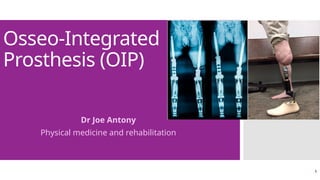
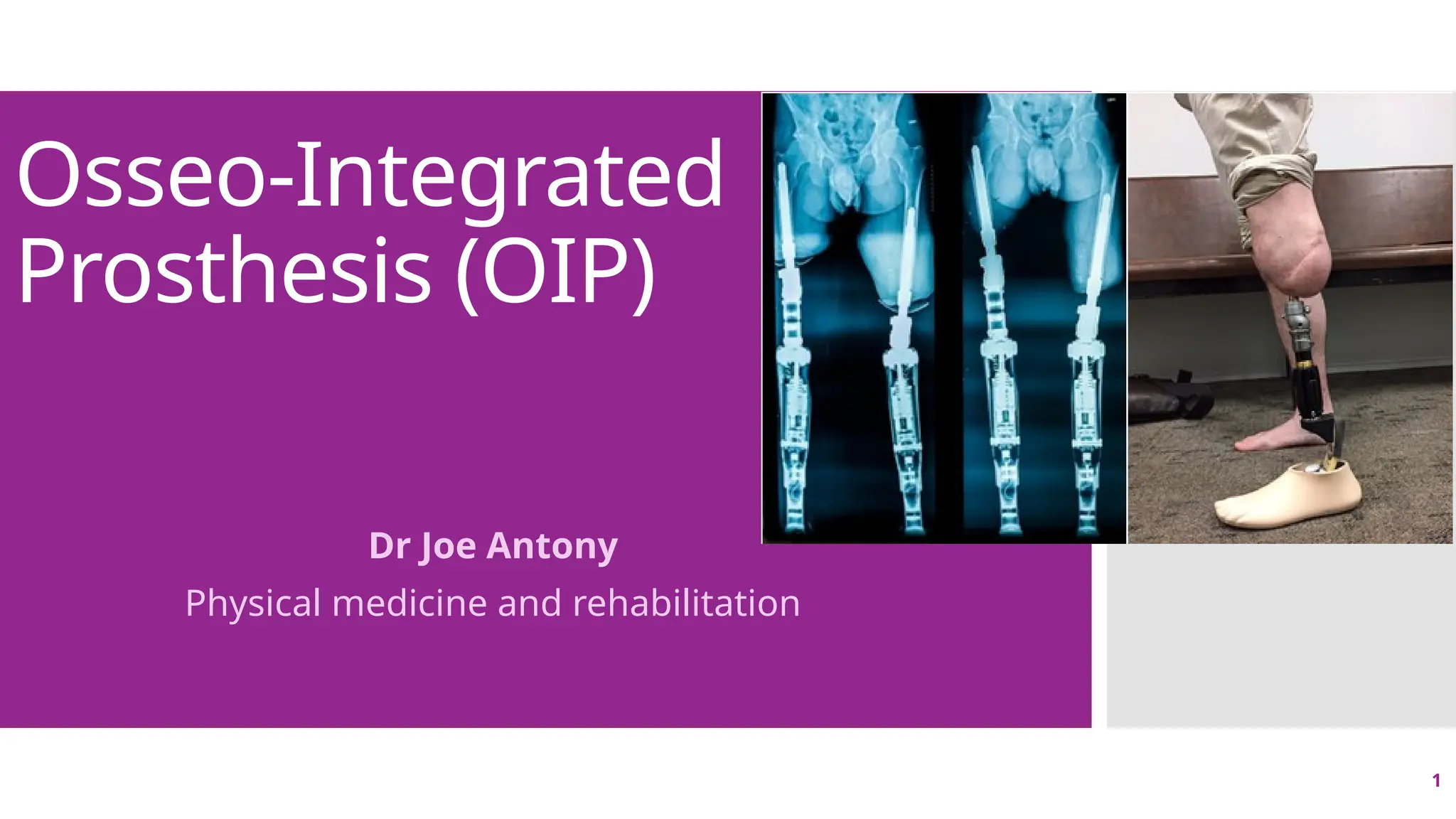
Osseo-Integrated
Prosthesis (OIP)
Dr Joe Antony
Physical medicine and rehabilitation
2
Contents
 Introduction
 Implant material
 Physiology of Osseo-Integration
 Implants
 Complications
 Rehabilitation Protocol
 Indications
 Advantages and disadvantages
 Contraindications
 Socket mounted vs OIP
 Functional evaluation of OIP
 Future directions
3
Introduction
 Osseo-Integrated Prosthesis- An external
prosthesis directly attached to appendicular
skeleton transcutaneously by osseointegration
using an intramedullary implant.
 Osseointegration- Direct bone anchorage to
an implant body that can provide a bone
foundation to support prosthesis.
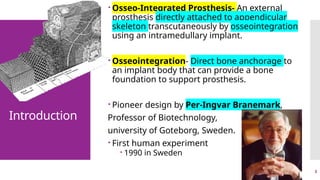
 Pioneer design by Per-Ingvar Branemark,
Professor of Biotechnology,
university of Goteborg, Sweden.
 First human experiment
 1990 in Sweden
4
Implant
material
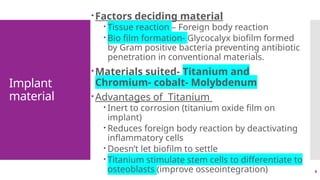
Factors deciding material
 Tissue reaction – Foreign body reaction
 Bio film formation- Glycocalyx biofilm formed
by Gram positive bacteria preventing antibiotic
penetration in conventional materials.
Materials suited- Titanium and
Chromium- cobalt- Molybdenum
Advantages of Titanium
 Inert to corrosion (titanium oxide film on
implant)
 Reduces foreign body reaction by deactivating
inflammatory cells
 Doesn’t let biofilm to settle
 Titanium stimulate stem cells to differentiate to
osteoblasts (improve osseointegration)
5
Physiology
of Osseo-
Integration
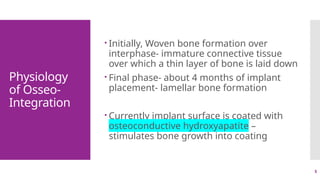
 Initially, Woven bone formation over
interphase- immature connective tissue
over which a thin layer of bone is laid down
 Final phase- about 4 months of implant
placement- lamellar bone formation
 Currently implant surface is coated with
osteoconductive hydroxyapatite –
stimulates bone growth into coating
6
Various
implants
used Osseo
Integrated
Prosthesis
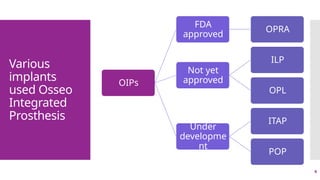
OIPs
FDA
approved
OPRA
Not yet
approved
ILP
OPL
Under
developme
nt
ITAP
POP
7
Osseo
Integrated
Prosthesis
for
Rehabilitatio
n of
Amputee
(OPRA)
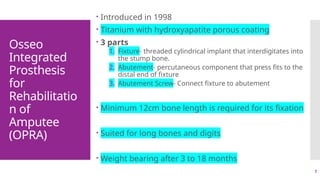
 Introduced in 1998
 Titanium with hydroxyapatite porous coating
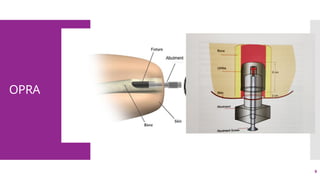
 3 parts
1. Fixture- threaded cylindrical implant that interdigitates into
the stump bone.
2. Abutement- percutaneous component that press fits to the
distal end of fixture
3. Abutement Screw- Connect fixture to abutement
 Minimum 12cm bone length is required for its fixation
 Suited for long bones and digits
 Weight bearing after 3 to 18 months
8
Osseo
Integrated
Prosthesis
for
Rehabilitatio
n of
Amputee
(OPRA)
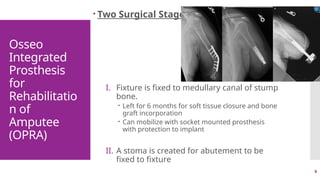
 Two Surgical Stages
I. Fixture is fixed to medullary canal of stump
bone.
 Left for 6 months for soft tissue closure and bone
graft incorporation
 Can mobilize with socket mounted prosthesis
with protection to implant
II. A stoma is created for abutement to be
fixed to fixture
9
OPRA
10
OPRA
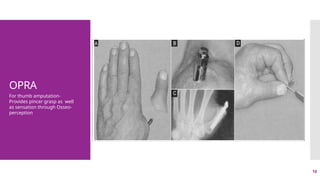
For thumb amputation-
Provides pincer grasp as well
as sensation through Osseo-
perception
11
Osseo-
Perception
 Osseo-Perception is the term used to describe
the ability of patients with Osseo-integrated
fixtures to identify tactile thresholds transmitted
through their prostheses.
 Various studies have suggested the measured
perception of vibration with an osseointegrated
amputation prosthesis in place was generally
comparable to that of the normal contralateral
hand or foot.
12
Rehabilitatio
n protocol
after OPRA
Phase 1 – management of pain and
swelling
 Gentle residual limb massage for
lymphatic drainage
 Positioning and strengthening
exercises
13
Rehabilitatio
n protocol
after OPRA
 Phase 2 – Prosthetic fitting and
progressive weight bearing.
 Progressive weight bearing by axillary
crutches followed by Canadian crutch
 Gait training with parallel bar
 Gradual increase in prosthetic time
14
Rehabilitatio
n protocol
after OPRA
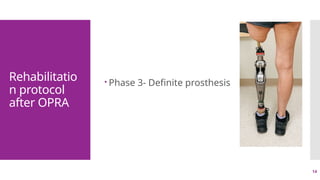
 Phase 3- Definite prosthesis
15
Stoma Care
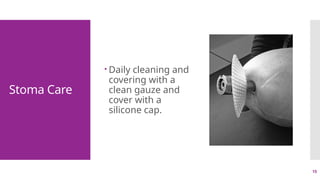
 Daily cleaning and
covering with a
clean gauze and
cover with a
silicone cap.
16
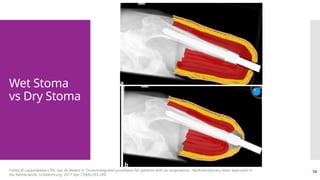
Wet Stoma
vs Dry Stoma
Frölke JP, Leijendekkers RA, van de Meent H. Osseointegrated prosthesis for patients with an amputation : Multidisciplinary team approach in
the Netherlands. Unfallchirurg. 2017 Apr;120(4):293-299.
17
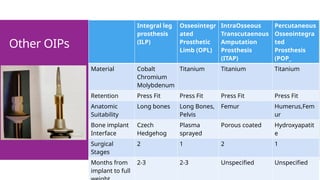
Other OIPs
Integral leg
prosthesis
(ILP)
Osseointegr
ated
Prosthetic
Limb (OPL)
IntraOsseous
Transcutaenous
Amputation
Prosthesis
(ITAP)
Percutaneous
Osseointegra
ted
Prosthesis
(POP_
Material Cobalt
Chromium
Molybdenum
Titanium Titanium Titanium
Retention Press Fit Press Fit Press Fit Press Fit
Anatomic
Suitability
Long bones Long Bones,
Pelvis
Femur Humerus,Fem
ur
Bone implant
Interface
Czech
Hedgehog
Plasma
sprayed
Porous coated Hydroxyapatit
e
Surgical
Stages
2 1 2 1
Months from
implant to full
2-3 2-3 Unspecified Unspecified
18
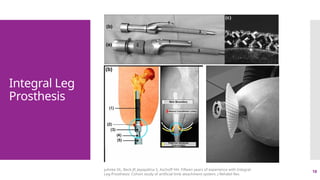
Integral Leg
Prosthesis
juhnke DL, Beck JP, Jeyapalina S, Aschoff HH. Fifteen years of experience with Integral-
Leg-Prosthesis: Cohort study of artificial limb attachment system. J Rehabil Res
19
Indications
 Very short stump
 Recurrent skin infection and ulceration
 Soft tissue scarring
 Volume fluctuation of stump
 Extensive skin scarring or grafts
 Skin allergies
 Conventional socket intolerable-
Discomfort, pain, Poor suspension and
excessive perspiration
 Age group 18-70 years
20
Advantages
vs
Disadvantag
es
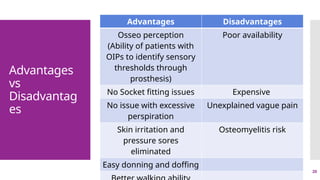
Advantages Disadvantages
Osseo perception
(Ability of patients with
OIPs to identify sensory
thresholds through
prosthesis)
Poor availability
No Socket fitting issues Expensive
No issue with excessive
perspiration
Unexplained vague pain
Skin irritation and
pressure sores
eliminated
Osteomyelitis risk
Easy donning and doffing
21
Contraindicatio
ns
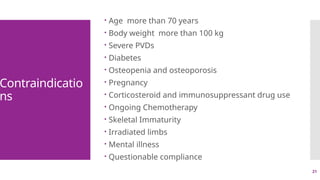
 Age more than 70 years
 Body weight more than 100 kg
 Severe PVDs
 Diabetes
 Osteopenia and osteoporosis
 Pregnancy
 Corticosteroid and immunosuppressant drug use
 Ongoing Chemotherapy
 Skeletal Immaturity
 Irradiated limbs
 Mental illness
 Questionable compliance
22
Socket
Mounted vs
OIP
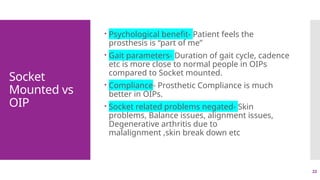
 Psychological benefit- Patient feels the
prosthesis is “part of me”
 Gait parameters- Duration of gait cycle, cadence
etc is more close to normal people in OIPs
compared to Socket mounted.
 Compliance- Prosthetic Compliance is much
better in OIPs.
 Socket related problems negated- Skin
problems, Balance issues, alignment issues,
Degenerative arthritis due to
malalignment ,skin break down etc
23
Functional
Evaluation of
OIP
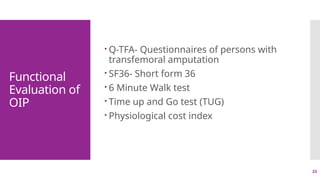
 Q-TFA- Questionnaires of persons with
transfemoral amputation
 SF36- Short form 36
 6 Minute Walk test
 Time up and Go test (TUG)
 Physiological cost index
24
Future of
osseointegrati
on
 Current research is directed towards OIPs
for higher level amputations like
hemipelvectomy or hip disarticulation.
 Techniques to prevent infections.
25
Reference
 IAPMR textbook of PMR
 Juhnke DL, Beck JP, Jeyapalina S, Aschoff HH. Fifteen years
of experience with Integral-Leg-Prosthesis: Cohort study
of artificial limb attachment system. J Rehabil Res
 Frölke JP, Leijendekkers RA, van de Meent H.
Osseointegrated prosthesis for patients with an
amputation : Multidisciplinary team approach in the
Netherlands. Unfallchirurg. 2017 Apr;120(4):293-299.

Osseo-Integrated Prosthesis for amputation

  • 1.
    1 Osseo-Integrated Prosthesis (OIP) Dr JoeAntony Physical medicine and rehabilitation
  • 2.
    2 Contents  Introduction  Implantmaterial  Physiology of Osseo-Integration  Implants  Complications  Rehabilitation Protocol  Indications  Advantages and disadvantages  Contraindications  Socket mounted vs OIP  Functional evaluation of OIP  Future directions
  • 3.
    3 Introduction  Osseo-Integrated Prosthesis-An external prosthesis directly attached to appendicular skeleton transcutaneously by osseointegration using an intramedullary implant.  Osseointegration- Direct bone anchorage to an implant body that can provide a bone foundation to support prosthesis.  Pioneer design by Per-Ingvar Branemark, Professor of Biotechnology, university of Goteborg, Sweden.  First human experiment  1990 in Sweden
  • 4.
    4 Implant material Factors deciding material Tissue reaction – Foreign body reaction  Bio film formation- Glycocalyx biofilm formed by Gram positive bacteria preventing antibiotic penetration in conventional materials. Materials suited- Titanium and Chromium- cobalt- Molybdenum Advantages of Titanium  Inert to corrosion (titanium oxide film on implant)  Reduces foreign body reaction by deactivating inflammatory cells  Doesn’t let biofilm to settle  Titanium stimulate stem cells to differentiate to osteoblasts (improve osseointegration)
  • 5.
    5 Physiology of Osseo- Integration  Initially,Woven bone formation over interphase- immature connective tissue over which a thin layer of bone is laid down  Final phase- about 4 months of implant placement- lamellar bone formation  Currently implant surface is coated with osteoconductive hydroxyapatite – stimulates bone growth into coating
  • 6.
  • 7.
    7 Osseo Integrated Prosthesis for Rehabilitatio n of Amputee (OPRA)  Introducedin 1998  Titanium with hydroxyapatite porous coating  3 parts 1. Fixture- threaded cylindrical implant that interdigitates into the stump bone. 2. Abutement- percutaneous component that press fits to the distal end of fixture 3. Abutement Screw- Connect fixture to abutement  Minimum 12cm bone length is required for its fixation  Suited for long bones and digits  Weight bearing after 3 to 18 months
  • 8.
    8 Osseo Integrated Prosthesis for Rehabilitatio n of Amputee (OPRA)  TwoSurgical Stages I. Fixture is fixed to medullary canal of stump bone.  Left for 6 months for soft tissue closure and bone graft incorporation  Can mobilize with socket mounted prosthesis with protection to implant II. A stoma is created for abutement to be fixed to fixture
  • 9.
  • 10.
    10 OPRA For thumb amputation- Providespincer grasp as well as sensation through Osseo- perception
  • 11.
    11 Osseo- Perception  Osseo-Perception isthe term used to describe the ability of patients with Osseo-integrated fixtures to identify tactile thresholds transmitted through their prostheses.  Various studies have suggested the measured perception of vibration with an osseointegrated amputation prosthesis in place was generally comparable to that of the normal contralateral hand or foot.
  • 12.
    12 Rehabilitatio n protocol after OPRA Phase1 – management of pain and swelling  Gentle residual limb massage for lymphatic drainage  Positioning and strengthening exercises
  • 13.
    13 Rehabilitatio n protocol after OPRA Phase 2 – Prosthetic fitting and progressive weight bearing.  Progressive weight bearing by axillary crutches followed by Canadian crutch  Gait training with parallel bar  Gradual increase in prosthetic time
  • 14.
    14 Rehabilitatio n protocol after OPRA Phase 3- Definite prosthesis
  • 15.
    15 Stoma Care  Dailycleaning and covering with a clean gauze and cover with a silicone cap.
  • 16.
    16 Wet Stoma vs DryStoma Frölke JP, Leijendekkers RA, van de Meent H. Osseointegrated prosthesis for patients with an amputation : Multidisciplinary team approach in the Netherlands. Unfallchirurg. 2017 Apr;120(4):293-299.
  • 17.
    17 Other OIPs Integral leg prosthesis (ILP) Osseointegr ated Prosthetic Limb(OPL) IntraOsseous Transcutaenous Amputation Prosthesis (ITAP) Percutaneous Osseointegra ted Prosthesis (POP_ Material Cobalt Chromium Molybdenum Titanium Titanium Titanium Retention Press Fit Press Fit Press Fit Press Fit Anatomic Suitability Long bones Long Bones, Pelvis Femur Humerus,Fem ur Bone implant Interface Czech Hedgehog Plasma sprayed Porous coated Hydroxyapatit e Surgical Stages 2 1 2 1 Months from implant to full 2-3 2-3 Unspecified Unspecified
  • 18.
    18 Integral Leg Prosthesis juhnke DL,Beck JP, Jeyapalina S, Aschoff HH. Fifteen years of experience with Integral- Leg-Prosthesis: Cohort study of artificial limb attachment system. J Rehabil Res
  • 19.
    19 Indications  Very shortstump  Recurrent skin infection and ulceration  Soft tissue scarring  Volume fluctuation of stump  Extensive skin scarring or grafts  Skin allergies  Conventional socket intolerable- Discomfort, pain, Poor suspension and excessive perspiration  Age group 18-70 years
  • 20.
    20 Advantages vs Disadvantag es Advantages Disadvantages Osseo perception (Abilityof patients with OIPs to identify sensory thresholds through prosthesis) Poor availability No Socket fitting issues Expensive No issue with excessive perspiration Unexplained vague pain Skin irritation and pressure sores eliminated Osteomyelitis risk Easy donning and doffing
  • 21.
    21 Contraindicatio ns  Age morethan 70 years  Body weight more than 100 kg  Severe PVDs  Diabetes  Osteopenia and osteoporosis  Pregnancy  Corticosteroid and immunosuppressant drug use  Ongoing Chemotherapy  Skeletal Immaturity  Irradiated limbs  Mental illness  Questionable compliance
  • 22.
    22 Socket Mounted vs OIP  Psychologicalbenefit- Patient feels the prosthesis is “part of me”  Gait parameters- Duration of gait cycle, cadence etc is more close to normal people in OIPs compared to Socket mounted.  Compliance- Prosthetic Compliance is much better in OIPs.  Socket related problems negated- Skin problems, Balance issues, alignment issues, Degenerative arthritis due to malalignment ,skin break down etc
  • 23.
    23 Functional Evaluation of OIP  Q-TFA-Questionnaires of persons with transfemoral amputation  SF36- Short form 36  6 Minute Walk test  Time up and Go test (TUG)  Physiological cost index
  • 24.
    24 Future of osseointegrati on  Currentresearch is directed towards OIPs for higher level amputations like hemipelvectomy or hip disarticulation.  Techniques to prevent infections.
  • 25.
    25 Reference  IAPMR textbookof PMR  Juhnke DL, Beck JP, Jeyapalina S, Aschoff HH. Fifteen years of experience with Integral-Leg-Prosthesis: Cohort study of artificial limb attachment system. J Rehabil Res  Frölke JP, Leijendekkers RA, van de Meent H. Osseointegrated prosthesis for patients with an amputation : Multidisciplinary team approach in the Netherlands. Unfallchirurg. 2017 Apr;120(4):293-299.