Lower Extremity Amputations
Epidemiology, Procedure Selection, Rehabilitation and
Surgical Technique
Dr. Asad Moosa
 Amputations will remain an important issue facing patients and surgeons for the
foreseeable future.
◦ Increased life expectancy of the population
◦ Epidemics of diabetes and peripheral artery disease
 The goal of amputation
◦ Remove all infected, gangrenous, and ischemic tissue
◦ Provide the patient with the longest functional limb.
 25% to 90% of all amputations are associated with diabetes
 Factors other than medical issues may affect amputation rates
◦ Physician experience plays a key role in the selection of amputation.
◦ Surgeon caseload and hospital volume (low volumes associated with higher amputation
rates in CLI)
◦ Availability of Vascular Surgeon (A 0.30/10,000 increase associated with a 1.6%
reduction in Amputations)
◦ Timely referral, treatment, and intervention
• Mayo Clinic reported a 50% reduction in amputation rates over 10 years
• Increased rates of lower extremity revascularization
• Other factors contributing to lower rates of amputation
• Greater awareness of PAD
• Clear guidelines for medical management of atherosclerosis
• Risk factor modification
• Improved wound care methods.
Indications for Amputation
• Acute limb ischemia
• Irreversible ischemia
• No revascularization options
• Unsuccessful attempts at revascularization.
 Chronic ischemia
◦ Failure of revascularization
◦ Lack of suitable conduit or target arteries
◦ Severe patient comorbidities
◦ Poor functional status
◦ Extensive gangrene or infection such that foot salvage is not possible
 Severe traumatic injury
 Skeletal or soft tissue malignancies
• Diabetics
• Overall incidence 60%.
Primary Amputation Versus Revascularization
• The most important decision in treating CLTI
• There is a growing awareness primary amputation may be the best approach.
• The ratio of major primary amputation to revascularization may vary because of surgeon
experience and practice protocols.
• Predictors of treatment with amputation
• Diabetes mellitus
• End-stage renal disease
• Tissue loss
• Poor functional status
• In a good-risk patient with minimal pedal tissue loss revascularization should be
undertaken.
 A study of CLI patients with comorbidities treated with PTA showed
◦ Higher Mortality rates
◦ Advantage in ambulation and independent living lasted only 12 and 3 months
Perioperative Evaluation
• A team approach
• Patient
• Family
• Surgeon
• Physio therapist
• Rehabilitation medicine specialist
• Prosthetist
• Nurse
• Social worker
• Psychologist
• Peer support group
• Case manager.
• The common goal should be maximum recovery and rehabilitation in12- to 18- month
Perioperative Stages
• Five stages in the treatment of the amputation patient have been described
A)Stage 1:
 Preoperative stage (difficult decision to be made of amputation).
• This stage includes an assessment of the vascular status, duration and severity of limb
ischemia, extent of tissue loss, presence of wound infection, and anatomic considerations.
 The surgeon is the team leader
B) Stage 2:
 Time spends in the hospital after the amputation until discharge (3 to 10 days).
 Transition of care to the appropriate rehabilitation experts
C) Stage 3:
 Begins with hospital discharge and extends 4 to 8 weeks after surgery.
 This is the time of recovery from surgery, a time of wound healing, and a time of early
rehabilitation
D) Stage 4:
 Time of transition from a postoperative strategy to the first formal prosthetic device.
 Most rapid changes in limb volume occur
 Begins with the completed healing of the wound and extends 4 to 6 months
E) Stage 5:
 Defined as a period of relative limb stabilization.
 The newer prosthesis will still require occasional adjustments
 Visits to the prosthetist are frequent until after the first year of prosthetic use.
 Patient should move toward social reintegration and higher functional training
Perioperative Risk & Its Reduction
• Overall mortality for major amputations is approximately 8%.
• Predictors of mortality
• Renal insufficiency
• Cardiac issues
• Preoperative sepsis
• COPD
• Steroid use
• Increased patient age.
• The overall perioperative complication rate 34.4%.
• Local stump complications occurrs in nearly 10% of patients.
• Incidence of cardiopulmonary, venous thromboembolic, and cerebrovascular events (0.5%
to 2.1%).
 Antiplatelet and statin medications can be safely continued
 The timing of hemodialysis in relation to operation is important in managing fluids and
electrolytes.
 An aggressive approach to normalize glucose levels (ensure proper wound healing).
 VTE prophylaxis with either subcutaneous unfractionated heparin or LMW heparin.
– Up to 17% of all amputation-related deaths are caused by pulmonary emboli
 Aggressive control of infection with separating the source and adjunctive intravenous
antibiotics
• The two-stage approach of guillotine amputation followed by formal amputation several
days later has a lower complication rate
• Another option in patients who are moribund is a physiologic cryoamputation, which can
be performed safely at the bedside.
• The materials needed to perform cryoamputation are dry ice, a large plastic bag, an
umbilical tape to use as a tourniquet, towels, blankets, adhesive tape, and a heating pad
Amputation Level Selection
• The goals of amputation
• To eliminate all infected, necrotic, and painful tissue
• To achieve uncomplicated wound healing
• To have an appropriate remnant stump that can accommodate a prosthesis.
• Prosthetic use following major amputation puts an increased energy demand on the
patient.
• Unilateral BKA require a 10% to 40% increase in energy expenditure for ambulation
• AKA require 50% to 70% more energy to ambulate.
• This differential may explain why the successful rehabilitation rate is much lower
following AKA than BKA.
Objective Testing and Clinical Judgment
• To maximize limb length in amputees and to minimize the need for revisions.
1) Physical Findings.
• The extent of gangrene and infection.
• Dependent rubor should be considered analogous to gangrene.
• The presence of pulses
2) Skin Temperature Measurements
• Direct skin temperature measurement may predict amputation healing with an accuracy
of 80% to 90%.
3) Ankle and Toe Pressure Measurements
• Absolute ankle pressures > 60 mm Hg can predict the healing of BKAs with an accuracy
of 50% to 90%..
• ABI less <0.5% - 28% and 34% of limbs required amputation at 6 and 12 months v/s
10% and 15% with >0.5
• The use of toe pressures predicts of forefoot amputation healing.
• Failure of minor amputations observed in patients with diabetes and toe pressures < 38
mm Hg
4) Arteriography
• Correlation between arteriographic findings and healing potential has been poor.
5) Radioisotope Scans, Scintigraphy, and Skin Perfusion Pressure
• Perfusion evaluated preoperatively based on the Tc 99m sestamibi uptake pattern.
• Skin perfusion pressure is another physiologic test to determine amputation level
• Intracutaneous iodine 123 is injected at different amputation levels.
• External pressure is applied, and by measuring the washout of isotope, the skin
perfusion pressure is determined.
• < 20 mm Hg predictive of wound failure in 89% of amputations, and > 20 mm Hg
predicted healing in 99%
• Skin fluorescence uses a Wood or ultraviolet light following the intravenous injection of
fluorescein dye.
– Success rates in predicting healing have ranged from 86% to 100%..
6) Transcutaneous Oxygen Measurements
• A small sensor is placed on the skin in the area of interest.
• By heating the sensor and skin to 44°C, local skin hyperemia results in decreased flow
resistance and arteriolarization of capillary blood.
• Transcutaneous oxygen levels have an accuracy of 87% to 100% in predicting wound
healing.
• No amputation failures reported in patients with tcPO2 >20 mm Hg and universal failure
when tcPO2 < 20 mm Hg
 tcPO2 readings >40 mm Hg are associated with healing and <20 mm Hg are associated
with failure
 TcPO2 has been the most accurate predictor of wound healing
Rehabilitation Considerations
• In general, the goal is the preservation of maximal limb length.
• Optimize the patient's overall condition.
 Addressing comorbidities.
 Pain management
 All patients should be encouraged to exercise daily to improve their performance of
activities of daily living.
Functional Outcome
• Factors that influence functional outcome are
• Age
• Preoperative functional status
• Comorbidities
• Mental status
• Amputation level
• Stump healing status
• Unilateral versus bilateral amputation
• Postoperative rehabilitation.
• Success defined in relation to a individual's mobility prior to the development of their
limb impairment.
Depression After Amputation
• 15- 35% of amputees with diabetes lose their remaining leg within 5 years.
• Renal Failure is a particularly poor prognostic indicator of second limb Amputation
• The loss of a limb has been compared with the loss of a spouse.
• Positive outcomes should continually be stressed, and clinical screening with appropriate
medical therapy for depression should be considered
• The psychological impact of the loss of independence may be minimized by aggressive,
focused rehabilitation.
• Requires the participation of
• Psychologists
• Nurses
• Geriatric and rehabilitation.
Lower Extremity
Amputations
Operative Techniques and Results
Amputation Types
Toe and Ray Amputation
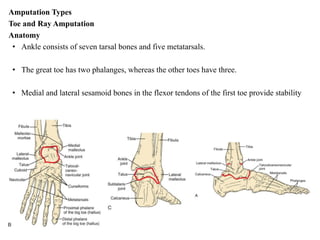
Anatomy
• Ankle consists of seven tarsal bones and five metatarsals.
• The great toe has two phalanges, whereas the other toes have three.
• Medial and lateral sesamoid bones in the flexor tendons of the first toe provide stability
Technique: Toe Amputation
• Racket shape incision
• The tendinous attachments are divided at the same level as the skin incision and the bone is
trimmed back.
• #15 blade is inserted into the joint capsule.
• Cartilage is excised with a rongeur and the bone edges are filed smooth
Technique: Ray Amputation
• Includes resection of the digit and the metatarsal head.
• A racket incision with the “handle” or vertical portion extending proximal to the
metatarsal head
• The sesamoid bones are excised
• Flexor tendons are placed on tension and transected, and residual tendon is allowed
to retract.
• Care should be taken to avoid injury to adjacent digital arteries and nerves
Transmetatarsal Amputation
Anatomy
• The proximal metatarsals articulate with three cuneiform bones and the cuboid laterally.
• Tarsometatarsal (Lisfranc) joint connects the midfoot and forefoot
Technique
• Appropriate for wounds involving the entire forefoot or when multiple ray amputations are
considered.
• Offers the ability to wear standard footwear with near-normal ambulation.
• Contraindicated in cases of severe bony deformity of the midfoot and hindfoot which would
lead to structural instability.
Midfoot and Hindfoot Amputations
• Three proximal foot amputations
• Lisfranc tarsometatarsal disarticulation
• Chopart midfoot amputation
• Syme amputation
• Two rarely performed hindfoot amputations are the Boyd and Pirogoff amputations.
• Hindfoot amputations are performed primarily in children to preserve length and growth
centers.
Lisfranc and Chopart Amputations
Lisfranc
• The first, third, fourth, and fifth
tarsometatarsal joints are disarticulated.
• The second metatarsal is divided 1 to 2 cm
distal to the medial cuneiform
• The Achilles tendon is released by either
transection or Z-plasty.
• The plantar fascia on the flap is
approximated to the dorsal periosteum with
absorbable sutures.
Chopart
• Performed through the talocalcaneonavicular joint and the calcaneocuboid joint.
• An Achilles tenectomy is recommended.
• The extensor hallucis longus and the tibialis anterior tendons may be reattached to the
talar neck.
• The extensor digitorum longus may be reattached to the calcaneus.
Postoperative Considerations
• A short-leg plaster cast is used over the sterile dressings.
• The cast must be molded to ensure that the talus is slightly dorsiflexed in relation to the
tibia and that the calcaneal tuberosity is parallel to the long axis of the tibia.
• The cast is changed weekly to check wound healing.
• Weight bearing is allowed after 6 weeks.
Syme Amputation
• The anterior incision extends across the ankle just distal to the tip of each malleolus,
• Posterior incision extends from the malleoli vertically down and across the sole of the
foot
• The extensor tendons are divided at the level of the skin incision.
• Next the dorsalis pedis artery is ligated and divided.
• The ankle joint capsule is incised while plantar flexing the foot before dividing the
medial and lateral ankle ligaments.
• The tendons of the posterior tibialis and flexor hallucis longus are transected, taking care
to avoid injury to the posterior tibial artery.
• Next, the heel fat pad is carefully dissected by staying close to the calcaneus to avoid
buttonholing.
• In a one-stage amputation the malleoli are divided with a saw at the level of the articular
surface of the tibia
 Holes are drilled in the medial, anterior, and lateral parts of the distal tibia and fibula to
secure the heel pad directly under the tibia
Postoperative Considerations
• Advantage of the Syme amputation
• Preservation of limb length
• This may obviate the need for a prosthesis during brief periods of weight bearing.
• Disadvantages
• Slight leg-length discrepancy
• Prosthesis is typically bulky at the ankle and less cosmetically appealing than a
conventional below-knee prosthesis.
Transtibial (Below-Knee) Amputation
Anatomy
Technique
Posterior Flap
• The posterior-based flap described by Burgess et al is the most commonly used.
• Division of the tibia should be at minimum 12 to 15 cm (approximately four
fingerbreadths) distal to the tibial tuberosity.
• To fashion flaps a twothirds/ one-third technique based on leg circumference .
• The anterior incision of the amputation should be approximately two-thirds the leg's
circumference.
• The length of the posterior flap is one-third the leg circumference and should be shaped in
a gentle curve to reduce dog ears.
Sagittal Flap
• If creation of a long posterior flap is not possible, sagittal or skew flaps may be used.
• In the sagittal flap equal-length medial and lateral myocutaneous flaps are developed
•
• A myoplasty is performed to cover the tibia by suturing the anterior and lateral compartment
muscles to the medial component of the gastrocnemius and soleus.
• A randomized comparison of sagittal versus posterior flaps showedno significant difference
in outcome
Skew Flap
• In the skew technique, equal anteromedial and posterolateral fasciocutaneous flaps are
created .
• The posterior muscle flap is identical to the conventional long posterior flap based on
the gastrocnemius muscle.
• The skew technique may be of particular benefit when there is inadequate skin to create
a conventional long posterior flap.
Fish-Mouth Flap
• Before the development of the long posterior flap the creation of equal anterior and
posterior flaps was the most common technique.
• The chief disadvantage was vulnerability of the anterior flap to ischemia.
Ertl Procedure
• Tibiofibular bone bridging known as the Ertl procedure
• It provides better transmission of energy from the distal femur to the prosthesis.
• Provide a more stable weight bearing surface.
• Bone graft -- fibula harvested from the amputation specimen.
• Equal length skin flaps are created.
• The superiority of this technique over traditional transtibial amputation has not been
proven
• One series of 32 patients receiving bone bridging of the distal tibia and fibula showed an
improved quality of life with improved ambulation and decreased patient frustration.
Postoperative Considerations
• Primary healing fails in 20% to 30% patients.
• 55% of transtibial amputations completely healed at 100 days
• Increasing to 83% at 200 days.
• 20% of patients undergoing transtibial amputation needed a higher level amputation.
Through-Knee Amputation
Anatomy
 Through-knee amputation requires the removal of the tibia, fibula, and articular surface
of the distal femur.
 Patellar ligament (also known as the patellar tendon), cruciate ligaments, and tendons of
the hamstring muscles are sutured to each other in a through-knee amputation.
 The patellar ligament is an extension of the quadriceps tendon
 The hamstring tendons collectively are derived from the semitendinosus,
semimembranosus, and biceps femoris muscles
 In patients with good rehabilitation potential who are not suitable candidates for
transtibial amputation a through-knee amputation may be an alternative.
 Through-knee amputation offers higher rates of successful ambulation when compared
with transfemoral amputation.
 10% to 15% of patients undergoing through-knee amputation will require a higher level
of amputation.
Transfemoral (Above-Knee) Amputation
Anatomy
Hip Disarticulation
Anatomy
 Anterior to the hip joint are the rectus femoris, iliopsoas, and pectineus muscles.
 Anterior to these muscles are the tensor fascia lata and sartorius.
 Posterior to the joint are the piriformis muscle, obturator internus and externus,
superior and inferior gemelli, and quadratus femoris.
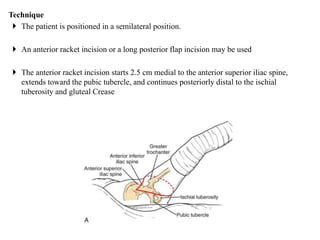
Technique
 The patient is positioned in a semilateral position.
 An anterior racket incision or a long posterior flap incision may be used
 The anterior racket incision starts 2.5 cm medial to the anterior superior iliac spine,
extends toward the pubic tubercle, and continues posteriorly distal to the ischial
tuberosity and gluteal Crease
• The skin and soft tissues are incised down to the external oblique aponeurosis.
• The femoral vessels are suture ligated and the femoral nerve transected.
• Muscles of the hip joint are divided
• Sartorius at its origin and iliopsoas at its insertion site.
• Pectineus at its origin on the superior pubic ramus.
• Gracilis muscle and three adductors are divided at their origins on the pubic rami.
• The obturator neurovascular bundle is divided
• Obturator externus muscle is divided from its insertion to the trochanteric fossa.
• The hamstrings are transected at the ischial tuberosity before dividing the tensor fasciae
latae, gluteus maximus, and rectus femoris before dividing the remaining muscles
attached to the greater trochanter.
• The ligamentous attachments and capsule of the hip joint are divided
• The posterior quadratus femoris is sutured to the anterior iliopsoas
• Lateral gluteus medius is sutured to the medial obturator externus
Principles of Postoperative Care
1) Operative Mortality
 30-day operative mortality ranges from 6% to 13% for major lower extremity
amputations.
 For minor amputations operative mortality drops to 2% to 4%
 The most common causes of death following lower extremity amputation are
• Cardiac complications (46%)
• Sepsis (14%)
• Pneumonia (11%).
 Overall 30-day mortality in a large retrospective analysis was 12.8% after AKA and
6.5% after BKA
• In AKA 30-day mortality was more often associated with the following risk factors, in
decreasing order:
– Hemodialysis dependence
– Thrombocytopenia
– Total dependent functional status
– Age > 80 years
– Steroid use
– Congestive heart failure
– Preoperative sepsis
– Body mass index < 18.5 kg/m2
– Dyspnea
• Guillotine amputation for sepsis associated with a 14.3% mortality v/s 7.8% in elective
amputation
2) Long-Term Survival
 1-year survival following BKA is 65% to 80% v/s 50% following AKA
 Diabetic patients' post amputations median time to death is 27.2 months versus 46.7 in
non diabetics
 Dialysis patienyts had a 1-year survival of 51.9% v/s non–dialysisdependent patients had
a 1-year survival rate of 75.4%.
Reamputation
 Following an initial toe amputation 50% of patients eventually undergo additional
ipsilateral or contralateral amputations.
 Following foot or ankle amputation 35% of patients progress to a higher-level
amputation within 1 year.
 Wound problems develop in 20% to 30% of patients following transtibial amputation
 It has also been reported that 9.4% to 17% of transtibial amputees undergo contralateral
major amputation within as little as 12 months
Complications
A) Local
1) Bleeding
 3% to 8% in major lower extremity amputations
/2) Infection
 13% to 40%.
 Associated with
• Diabetes
• Preoperative wound infection
• Malnutrition
• Malignancy
• Advanced age
• Lack of insurance
• Wound hematoma
• Prior prosthetic bypass grafts
 A recent study reported wound infection or disruption in healing to be 10.4% after BKA and
7.2% after AKA.
3) Contracture
 Flexion contractures at the hip and knee joint develop in 3% to 5%.
 A fixed flexion contracture at the knee that exceeds 15 degrees prohibits effective
prosthetic ambulation.
 An aggressive postoperative knee exercise program should be initiated as soon as
possible.
 Hip flexion contracture may be limited by positioning the patient in the prone position
for brief periods.
B) Systemic
1) Cardiac
 MI (3.4%) remains the most common cause of death following lower extremity
amputation.
 Antiplatelet agents and statins should be continued perioperatively.
2) Venous Thromboembolism
• The risk of DVT is up to 50%.
• LMWH administered prophylactically lowers this risk to 10%.
• Unfractionated heparin is preferred in patients with severe renal impairment or weight
less than 45 kg.
3) Renal Failure
 New-onset renal failure following amputation ranges from 0.6% to 2.6%.
4) Stroke
 The incidence of stroke after major amputation ranges from 0.28% to 1.4%.
5) Psychiatric
 Posttraumatic stress disorder is common (20%-22%) after amputations
 For vascular amputations the incidence is less than 5%.
 Risk factors for major depressive disorder
• Young age
• Pain
• Neurotic personality
• Unhealthy lifestyle
• Poor coping
6) Pain
 Chronic pain is reported by up to 95% of amputees.
 Chronic ischemic stump pain is confirmed by a transcutaneous oxygen tension < 20 mm
Hg.
 Neuroma can develop at the site of transection of virtually any peripheral nerve.
 Pressure points that develop over bone spurs or pathologic bone formation should be
eliminated.
 True phantom pain is a complex poorly understood pain syndrome.
• The incidence is 5% to 85%.
• Gabapentin has not been consistently effective in the treatment of phantom pain.
• Multimodality pain management is the cornerstone of a successful amputation
rehabilitation program
Thank you!

Amputations pdf

  • 1.
    Lower Extremity Amputations Epidemiology,Procedure Selection, Rehabilitation and Surgical Technique Dr. Asad Moosa
  • 2.
     Amputations willremain an important issue facing patients and surgeons for the foreseeable future. ◦ Increased life expectancy of the population ◦ Epidemics of diabetes and peripheral artery disease  The goal of amputation ◦ Remove all infected, gangrenous, and ischemic tissue ◦ Provide the patient with the longest functional limb.  25% to 90% of all amputations are associated with diabetes  Factors other than medical issues may affect amputation rates ◦ Physician experience plays a key role in the selection of amputation. ◦ Surgeon caseload and hospital volume (low volumes associated with higher amputation rates in CLI) ◦ Availability of Vascular Surgeon (A 0.30/10,000 increase associated with a 1.6% reduction in Amputations) ◦ Timely referral, treatment, and intervention
  • 3.
    • Mayo Clinicreported a 50% reduction in amputation rates over 10 years • Increased rates of lower extremity revascularization • Other factors contributing to lower rates of amputation • Greater awareness of PAD • Clear guidelines for medical management of atherosclerosis • Risk factor modification • Improved wound care methods.
  • 4.
    Indications for Amputation •Acute limb ischemia • Irreversible ischemia • No revascularization options • Unsuccessful attempts at revascularization.  Chronic ischemia ◦ Failure of revascularization ◦ Lack of suitable conduit or target arteries ◦ Severe patient comorbidities ◦ Poor functional status ◦ Extensive gangrene or infection such that foot salvage is not possible  Severe traumatic injury  Skeletal or soft tissue malignancies • Diabetics • Overall incidence 60%.
  • 5.
    Primary Amputation VersusRevascularization • The most important decision in treating CLTI • There is a growing awareness primary amputation may be the best approach. • The ratio of major primary amputation to revascularization may vary because of surgeon experience and practice protocols. • Predictors of treatment with amputation • Diabetes mellitus • End-stage renal disease • Tissue loss • Poor functional status • In a good-risk patient with minimal pedal tissue loss revascularization should be undertaken.  A study of CLI patients with comorbidities treated with PTA showed ◦ Higher Mortality rates ◦ Advantage in ambulation and independent living lasted only 12 and 3 months
  • 6.
    Perioperative Evaluation • Ateam approach • Patient • Family • Surgeon • Physio therapist • Rehabilitation medicine specialist • Prosthetist • Nurse • Social worker • Psychologist • Peer support group • Case manager. • The common goal should be maximum recovery and rehabilitation in12- to 18- month
  • 7.
    Perioperative Stages • Fivestages in the treatment of the amputation patient have been described A)Stage 1:  Preoperative stage (difficult decision to be made of amputation). • This stage includes an assessment of the vascular status, duration and severity of limb ischemia, extent of tissue loss, presence of wound infection, and anatomic considerations.  The surgeon is the team leader B) Stage 2:  Time spends in the hospital after the amputation until discharge (3 to 10 days).  Transition of care to the appropriate rehabilitation experts C) Stage 3:  Begins with hospital discharge and extends 4 to 8 weeks after surgery.  This is the time of recovery from surgery, a time of wound healing, and a time of early rehabilitation
  • 8.
    D) Stage 4: Time of transition from a postoperative strategy to the first formal prosthetic device.  Most rapid changes in limb volume occur  Begins with the completed healing of the wound and extends 4 to 6 months E) Stage 5:  Defined as a period of relative limb stabilization.  The newer prosthesis will still require occasional adjustments  Visits to the prosthetist are frequent until after the first year of prosthetic use.  Patient should move toward social reintegration and higher functional training
  • 9.
    Perioperative Risk &Its Reduction • Overall mortality for major amputations is approximately 8%. • Predictors of mortality • Renal insufficiency • Cardiac issues • Preoperative sepsis • COPD • Steroid use • Increased patient age. • The overall perioperative complication rate 34.4%. • Local stump complications occurrs in nearly 10% of patients. • Incidence of cardiopulmonary, venous thromboembolic, and cerebrovascular events (0.5% to 2.1%).
  • 10.
     Antiplatelet andstatin medications can be safely continued  The timing of hemodialysis in relation to operation is important in managing fluids and electrolytes.  An aggressive approach to normalize glucose levels (ensure proper wound healing).  VTE prophylaxis with either subcutaneous unfractionated heparin or LMW heparin. – Up to 17% of all amputation-related deaths are caused by pulmonary emboli  Aggressive control of infection with separating the source and adjunctive intravenous antibiotics • The two-stage approach of guillotine amputation followed by formal amputation several days later has a lower complication rate
  • 11.
    • Another optionin patients who are moribund is a physiologic cryoamputation, which can be performed safely at the bedside. • The materials needed to perform cryoamputation are dry ice, a large plastic bag, an umbilical tape to use as a tourniquet, towels, blankets, adhesive tape, and a heating pad
  • 12.
    Amputation Level Selection •The goals of amputation • To eliminate all infected, necrotic, and painful tissue • To achieve uncomplicated wound healing • To have an appropriate remnant stump that can accommodate a prosthesis. • Prosthetic use following major amputation puts an increased energy demand on the patient. • Unilateral BKA require a 10% to 40% increase in energy expenditure for ambulation • AKA require 50% to 70% more energy to ambulate. • This differential may explain why the successful rehabilitation rate is much lower following AKA than BKA.
  • 13.
    Objective Testing andClinical Judgment • To maximize limb length in amputees and to minimize the need for revisions. 1) Physical Findings. • The extent of gangrene and infection. • Dependent rubor should be considered analogous to gangrene. • The presence of pulses 2) Skin Temperature Measurements • Direct skin temperature measurement may predict amputation healing with an accuracy of 80% to 90%. 3) Ankle and Toe Pressure Measurements • Absolute ankle pressures > 60 mm Hg can predict the healing of BKAs with an accuracy of 50% to 90%.. • ABI less <0.5% - 28% and 34% of limbs required amputation at 6 and 12 months v/s 10% and 15% with >0.5
  • 14.
    • The useof toe pressures predicts of forefoot amputation healing. • Failure of minor amputations observed in patients with diabetes and toe pressures < 38 mm Hg 4) Arteriography • Correlation between arteriographic findings and healing potential has been poor. 5) Radioisotope Scans, Scintigraphy, and Skin Perfusion Pressure • Perfusion evaluated preoperatively based on the Tc 99m sestamibi uptake pattern. • Skin perfusion pressure is another physiologic test to determine amputation level • Intracutaneous iodine 123 is injected at different amputation levels. • External pressure is applied, and by measuring the washout of isotope, the skin perfusion pressure is determined. • < 20 mm Hg predictive of wound failure in 89% of amputations, and > 20 mm Hg predicted healing in 99%
  • 15.
    • Skin fluorescenceuses a Wood or ultraviolet light following the intravenous injection of fluorescein dye. – Success rates in predicting healing have ranged from 86% to 100%.. 6) Transcutaneous Oxygen Measurements • A small sensor is placed on the skin in the area of interest. • By heating the sensor and skin to 44°C, local skin hyperemia results in decreased flow resistance and arteriolarization of capillary blood. • Transcutaneous oxygen levels have an accuracy of 87% to 100% in predicting wound healing. • No amputation failures reported in patients with tcPO2 >20 mm Hg and universal failure when tcPO2 < 20 mm Hg  tcPO2 readings >40 mm Hg are associated with healing and <20 mm Hg are associated with failure  TcPO2 has been the most accurate predictor of wound healing
  • 16.
    Rehabilitation Considerations • Ingeneral, the goal is the preservation of maximal limb length. • Optimize the patient's overall condition.  Addressing comorbidities.  Pain management  All patients should be encouraged to exercise daily to improve their performance of activities of daily living.
  • 17.
    Functional Outcome • Factorsthat influence functional outcome are • Age • Preoperative functional status • Comorbidities • Mental status • Amputation level • Stump healing status • Unilateral versus bilateral amputation • Postoperative rehabilitation. • Success defined in relation to a individual's mobility prior to the development of their limb impairment.
  • 18.
    Depression After Amputation •15- 35% of amputees with diabetes lose their remaining leg within 5 years. • Renal Failure is a particularly poor prognostic indicator of second limb Amputation • The loss of a limb has been compared with the loss of a spouse. • Positive outcomes should continually be stressed, and clinical screening with appropriate medical therapy for depression should be considered • The psychological impact of the loss of independence may be minimized by aggressive, focused rehabilitation. • Requires the participation of • Psychologists • Nurses • Geriatric and rehabilitation.
  • 19.
  • 21.
    Amputation Types Toe andRay Amputation Anatomy • Ankle consists of seven tarsal bones and five metatarsals. • The great toe has two phalanges, whereas the other toes have three. • Medial and lateral sesamoid bones in the flexor tendons of the first toe provide stability
  • 22.
    Technique: Toe Amputation •Racket shape incision • The tendinous attachments are divided at the same level as the skin incision and the bone is trimmed back. • #15 blade is inserted into the joint capsule. • Cartilage is excised with a rongeur and the bone edges are filed smooth
  • 23.
    Technique: Ray Amputation •Includes resection of the digit and the metatarsal head. • A racket incision with the “handle” or vertical portion extending proximal to the metatarsal head • The sesamoid bones are excised • Flexor tendons are placed on tension and transected, and residual tendon is allowed to retract. • Care should be taken to avoid injury to adjacent digital arteries and nerves
  • 25.
    Transmetatarsal Amputation Anatomy • Theproximal metatarsals articulate with three cuneiform bones and the cuboid laterally. • Tarsometatarsal (Lisfranc) joint connects the midfoot and forefoot Technique • Appropriate for wounds involving the entire forefoot or when multiple ray amputations are considered. • Offers the ability to wear standard footwear with near-normal ambulation. • Contraindicated in cases of severe bony deformity of the midfoot and hindfoot which would lead to structural instability.
  • 27.
    Midfoot and HindfootAmputations • Three proximal foot amputations • Lisfranc tarsometatarsal disarticulation • Chopart midfoot amputation • Syme amputation • Two rarely performed hindfoot amputations are the Boyd and Pirogoff amputations. • Hindfoot amputations are performed primarily in children to preserve length and growth centers.
  • 29.
    Lisfranc and ChopartAmputations Lisfranc • The first, third, fourth, and fifth tarsometatarsal joints are disarticulated. • The second metatarsal is divided 1 to 2 cm distal to the medial cuneiform • The Achilles tendon is released by either transection or Z-plasty. • The plantar fascia on the flap is approximated to the dorsal periosteum with absorbable sutures.
  • 30.
    Chopart • Performed throughthe talocalcaneonavicular joint and the calcaneocuboid joint. • An Achilles tenectomy is recommended. • The extensor hallucis longus and the tibialis anterior tendons may be reattached to the talar neck. • The extensor digitorum longus may be reattached to the calcaneus.
  • 31.
    Postoperative Considerations • Ashort-leg plaster cast is used over the sterile dressings. • The cast must be molded to ensure that the talus is slightly dorsiflexed in relation to the tibia and that the calcaneal tuberosity is parallel to the long axis of the tibia. • The cast is changed weekly to check wound healing. • Weight bearing is allowed after 6 weeks.
  • 32.
    Syme Amputation • Theanterior incision extends across the ankle just distal to the tip of each malleolus, • Posterior incision extends from the malleoli vertically down and across the sole of the foot • The extensor tendons are divided at the level of the skin incision. • Next the dorsalis pedis artery is ligated and divided. • The ankle joint capsule is incised while plantar flexing the foot before dividing the medial and lateral ankle ligaments.
  • 33.
    • The tendonsof the posterior tibialis and flexor hallucis longus are transected, taking care to avoid injury to the posterior tibial artery. • Next, the heel fat pad is carefully dissected by staying close to the calcaneus to avoid buttonholing. • In a one-stage amputation the malleoli are divided with a saw at the level of the articular surface of the tibia
  • 34.
     Holes aredrilled in the medial, anterior, and lateral parts of the distal tibia and fibula to secure the heel pad directly under the tibia Postoperative Considerations • Advantage of the Syme amputation • Preservation of limb length • This may obviate the need for a prosthesis during brief periods of weight bearing. • Disadvantages • Slight leg-length discrepancy • Prosthesis is typically bulky at the ankle and less cosmetically appealing than a conventional below-knee prosthesis.
  • 35.
  • 36.
    Technique Posterior Flap • Theposterior-based flap described by Burgess et al is the most commonly used. • Division of the tibia should be at minimum 12 to 15 cm (approximately four fingerbreadths) distal to the tibial tuberosity. • To fashion flaps a twothirds/ one-third technique based on leg circumference . • The anterior incision of the amputation should be approximately two-thirds the leg's circumference. • The length of the posterior flap is one-third the leg circumference and should be shaped in a gentle curve to reduce dog ears.
  • 38.
    Sagittal Flap • Ifcreation of a long posterior flap is not possible, sagittal or skew flaps may be used. • In the sagittal flap equal-length medial and lateral myocutaneous flaps are developed • • A myoplasty is performed to cover the tibia by suturing the anterior and lateral compartment muscles to the medial component of the gastrocnemius and soleus. • A randomized comparison of sagittal versus posterior flaps showedno significant difference in outcome
  • 39.
    Skew Flap • Inthe skew technique, equal anteromedial and posterolateral fasciocutaneous flaps are created . • The posterior muscle flap is identical to the conventional long posterior flap based on the gastrocnemius muscle. • The skew technique may be of particular benefit when there is inadequate skin to create a conventional long posterior flap.
  • 41.
    Fish-Mouth Flap • Beforethe development of the long posterior flap the creation of equal anterior and posterior flaps was the most common technique. • The chief disadvantage was vulnerability of the anterior flap to ischemia.
  • 42.
    Ertl Procedure • Tibiofibularbone bridging known as the Ertl procedure • It provides better transmission of energy from the distal femur to the prosthesis. • Provide a more stable weight bearing surface. • Bone graft -- fibula harvested from the amputation specimen. • Equal length skin flaps are created.
  • 43.
    • The superiorityof this technique over traditional transtibial amputation has not been proven • One series of 32 patients receiving bone bridging of the distal tibia and fibula showed an improved quality of life with improved ambulation and decreased patient frustration. Postoperative Considerations • Primary healing fails in 20% to 30% patients. • 55% of transtibial amputations completely healed at 100 days • Increasing to 83% at 200 days. • 20% of patients undergoing transtibial amputation needed a higher level amputation.
  • 44.
    Through-Knee Amputation Anatomy  Through-kneeamputation requires the removal of the tibia, fibula, and articular surface of the distal femur.  Patellar ligament (also known as the patellar tendon), cruciate ligaments, and tendons of the hamstring muscles are sutured to each other in a through-knee amputation.  The patellar ligament is an extension of the quadriceps tendon  The hamstring tendons collectively are derived from the semitendinosus, semimembranosus, and biceps femoris muscles
  • 45.
     In patientswith good rehabilitation potential who are not suitable candidates for transtibial amputation a through-knee amputation may be an alternative.  Through-knee amputation offers higher rates of successful ambulation when compared with transfemoral amputation.  10% to 15% of patients undergoing through-knee amputation will require a higher level of amputation.
  • 46.
  • 48.
    Hip Disarticulation Anatomy  Anteriorto the hip joint are the rectus femoris, iliopsoas, and pectineus muscles.  Anterior to these muscles are the tensor fascia lata and sartorius.  Posterior to the joint are the piriformis muscle, obturator internus and externus, superior and inferior gemelli, and quadratus femoris.
  • 49.
    Technique  The patientis positioned in a semilateral position.  An anterior racket incision or a long posterior flap incision may be used  The anterior racket incision starts 2.5 cm medial to the anterior superior iliac spine, extends toward the pubic tubercle, and continues posteriorly distal to the ischial tuberosity and gluteal Crease
  • 50.
    • The skinand soft tissues are incised down to the external oblique aponeurosis. • The femoral vessels are suture ligated and the femoral nerve transected. • Muscles of the hip joint are divided • Sartorius at its origin and iliopsoas at its insertion site. • Pectineus at its origin on the superior pubic ramus. • Gracilis muscle and three adductors are divided at their origins on the pubic rami. • The obturator neurovascular bundle is divided • Obturator externus muscle is divided from its insertion to the trochanteric fossa. • The hamstrings are transected at the ischial tuberosity before dividing the tensor fasciae latae, gluteus maximus, and rectus femoris before dividing the remaining muscles attached to the greater trochanter. • The ligamentous attachments and capsule of the hip joint are divided
  • 51.
    • The posteriorquadratus femoris is sutured to the anterior iliopsoas • Lateral gluteus medius is sutured to the medial obturator externus
  • 52.
    Principles of PostoperativeCare 1) Operative Mortality  30-day operative mortality ranges from 6% to 13% for major lower extremity amputations.  For minor amputations operative mortality drops to 2% to 4%  The most common causes of death following lower extremity amputation are • Cardiac complications (46%) • Sepsis (14%) • Pneumonia (11%).  Overall 30-day mortality in a large retrospective analysis was 12.8% after AKA and 6.5% after BKA
  • 53.
    • In AKA30-day mortality was more often associated with the following risk factors, in decreasing order: – Hemodialysis dependence – Thrombocytopenia – Total dependent functional status – Age > 80 years – Steroid use – Congestive heart failure – Preoperative sepsis – Body mass index < 18.5 kg/m2 – Dyspnea • Guillotine amputation for sepsis associated with a 14.3% mortality v/s 7.8% in elective amputation
  • 54.
    2) Long-Term Survival 1-year survival following BKA is 65% to 80% v/s 50% following AKA  Diabetic patients' post amputations median time to death is 27.2 months versus 46.7 in non diabetics  Dialysis patienyts had a 1-year survival of 51.9% v/s non–dialysisdependent patients had a 1-year survival rate of 75.4%.
  • 55.
    Reamputation  Following aninitial toe amputation 50% of patients eventually undergo additional ipsilateral or contralateral amputations.  Following foot or ankle amputation 35% of patients progress to a higher-level amputation within 1 year.  Wound problems develop in 20% to 30% of patients following transtibial amputation  It has also been reported that 9.4% to 17% of transtibial amputees undergo contralateral major amputation within as little as 12 months
  • 56.
    Complications A) Local 1) Bleeding 3% to 8% in major lower extremity amputations /2) Infection  13% to 40%.  Associated with • Diabetes • Preoperative wound infection • Malnutrition • Malignancy • Advanced age • Lack of insurance • Wound hematoma • Prior prosthetic bypass grafts  A recent study reported wound infection or disruption in healing to be 10.4% after BKA and 7.2% after AKA.
  • 57.
    3) Contracture  Flexioncontractures at the hip and knee joint develop in 3% to 5%.  A fixed flexion contracture at the knee that exceeds 15 degrees prohibits effective prosthetic ambulation.  An aggressive postoperative knee exercise program should be initiated as soon as possible.  Hip flexion contracture may be limited by positioning the patient in the prone position for brief periods.
  • 58.
    B) Systemic 1) Cardiac MI (3.4%) remains the most common cause of death following lower extremity amputation.  Antiplatelet agents and statins should be continued perioperatively. 2) Venous Thromboembolism • The risk of DVT is up to 50%. • LMWH administered prophylactically lowers this risk to 10%. • Unfractionated heparin is preferred in patients with severe renal impairment or weight less than 45 kg. 3) Renal Failure  New-onset renal failure following amputation ranges from 0.6% to 2.6%.
  • 59.
    4) Stroke  Theincidence of stroke after major amputation ranges from 0.28% to 1.4%. 5) Psychiatric  Posttraumatic stress disorder is common (20%-22%) after amputations  For vascular amputations the incidence is less than 5%.  Risk factors for major depressive disorder • Young age • Pain • Neurotic personality • Unhealthy lifestyle • Poor coping
  • 60.
    6) Pain  Chronicpain is reported by up to 95% of amputees.  Chronic ischemic stump pain is confirmed by a transcutaneous oxygen tension < 20 mm Hg.  Neuroma can develop at the site of transection of virtually any peripheral nerve.  Pressure points that develop over bone spurs or pathologic bone formation should be eliminated.  True phantom pain is a complex poorly understood pain syndrome. • The incidence is 5% to 85%. • Gabapentin has not been consistently effective in the treatment of phantom pain. • Multimodality pain management is the cornerstone of a successful amputation rehabilitation program
  • 61.