1
TOTAL HIP REPLACEMENT
REHABILITATION
Dr Joe Antony
Physical Medicine and Rehabilitation
King George Medical University
Prehabilitation
3
Prehabilitation
• Patient Education
• Disease process
• Procedure, expectations, and
complications of THA
• Expected functional recovery
• Expected return to sports
• Expected rehab protocol
• Healthy lifestyle guidelines
• Physical activity
• Weight management
• Smoking and alcohol cessation
4
HIP
SPECIFIC
PREPARATION
• Achieving maximum ROM
possible
• Hip musculature and trunk
strengthening
• Balance training
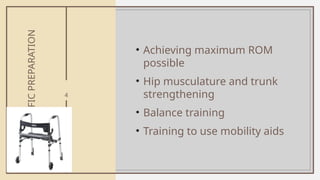
• Training to use mobility aids
Peri-operative
rehabilitation
6
PERI-OPERATIVE
REHABILITATION
Goals
• Prevent hazards of bed rest (DVT,PE, Pressure
ulcer)
• Assist patient with adequate and functional
ROM
• Strengthen hip musculature and trunk
• Assist patient in achieving functional
independence
• Achieve independent ambulation with an
assistive device
7
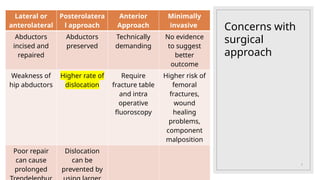
Concerns with
surgical
approach
Lateral or
anterolateral
Posterolatera
l approach
Anterior
Approach
Minimally
invasive
Abductors
incised and
repaired
Abductors
preserved
Technically
demanding
No evidence
to suggest
better
outcome
Weakness of
hip abductors
Higher rate of
dislocation
Require
fracture table
and intra
operative
fluoroscopy
Higher risk of
femoral
fractures,
wound
healing
problems,
component
malposition
Poor repair
can cause
prolonged
Dislocation
can be
prevented by
8
Hip Precautions
◦ Precautions to prevent dislocation- especially in posterolateral approach
◦ Dislocation happen when hip is adducted past midline
◦ Abduction pillow- between knee while in bed
◦ Between thighs while sitting
◦ In revisions or non compliant patients
◦ Knee immobilizers and Abduction Braces
◦ For 6 to 12 weeks post operatively
◦ After anterolateral Approach
◦ Extreme external rotation, adduction, and extention
9
Weight bearing
◦ Non-weight bearing- Not recommended- muscle forces acting to
maintain level pelvis is greater than TTWB
◦ Toe Touch Weight Bearing (TTWB)- More than 10% of body
weight. Preferred initial weight-bearing method
◦ Partial weight bearing (PWB)- more than 30% body weight
◦ Full Weight-bearing
10
Assistive devices
◦ Walkers – first choice- wide base, better stability
◦ Reduce the freedom of both hands- self care activites more challengning
◦ Occasionally wont fit through door ways
◦ Rolling walker- Better patient selected speeds, poorer stability compared to
standard walker
◦ Axillary crutches or forearm crutches- better suited for younger
patients, less stability
◦ Canes- used on contralateral side- offload 10-20% weight
◦ Only used in fully weight bearing
11
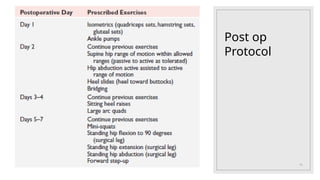
Post op
Protocol
12
Home Discharge criteria
◦Independent ambulation more than 150feet
◦Adherence to hip precautions
◦Achieving Basic functional activities of daily living
13
Out Patient Protocol
◦ Achieving full, allowed active ROM at the hip by the end of the sixth postoperative week.
◦ For example: hip flexion 90 degrees, hip abduction 40 degrees for the patient who has had a
posterior approach surgery
◦ Additional ROM may be restored through stretching exercises once the physician’s
postoperative precautions have been lifted.
◦ Progress functional strengthening; including closed kinetic chain and balance exercises.
◦ Independent ambulation by week 12 (and without the use of an assistive device for those who
did not require their utilization preoperatively).
◦ Patient able to drive by the end of the sixth postoperative week.
◦ Patient able to assume side-lying on operative hip by the end of the sixth postoperative week.
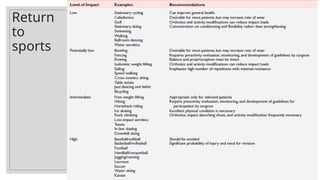
◦ Return to most recreational/sports pursuits by the end of the twelfth week postoperative
14
Return
to
sports
15
COMMON PROBLEMS
16
Trendelenburg Gait
◦ Concentrate on hip abduction exercises to strengthen abductors.
• Evaluate leg-length discrepancy.
• Have patient stand on involved leg while flexing opposite (uninvolved) knee
30 degrees. If opposite hip drops, have patient try to lift and hold in an effort
to re-educate and work gluteus medius muscle (hip abductor).
• Walk stance weight shifts: In a walk stance position patient should shift
weight forward over the involved hip until unable to control hip/pelvic drop
and then shift back, progressing to full weight shift and weightbearing on
involved limb over time as the hip abductor strength improves.
• Manual or pulley resistance at the pelvis with lateral walking.
17
Flexion contracture of hip
◦ AVOID placing pillows under the knee aftersurgery.
◦ Walking backward helps stretch flexion contracture.
◦ Perform a Thomas stretch of 30 stretchesa day (five
stretches six times per day). Pull the uninvolved knee to
the chest while supine. Push the involved (postoperative)
leg into extension against the bed. This stretches the
anterior capsule and hip flexors of the involved leg.
18
GAIT DEVIATIONS
AND MANAGEMENT
19
◦ Most gait faults either are caused by or contribute to
flexion deformities at the hip.
◦ These faults generally are attributable to the patient’s
attempts to avoid extension of the involved hip because
such extension causes an uncomfortable stretching
sensation in the groin.
20
Asymmetric steps
◦ Large step with involved side – to avoid extension on
involved side
◦ Auditory cues while gait training to have symmetric steps
21
Early heel off and knee flexion in late
stance
◦To avoid hip extention
◦Auditory cues during gait training to keep heel on
ground during late stance
22
Trunk flexion in late stance
◦ To correct this, teach the patient to thrust the pelvis
forward and the shoulders backward during mid and late
stance phase of gait
Thank you
References
1. Orthopedic rehabilitation, 4th
edition, Brotzman
2. IAPMR textbook of PMR

Total hip replacement rehabilitation (THR)

  • 1.
    1 TOTAL HIP REPLACEMENT REHABILITATION DrJoe Antony Physical Medicine and Rehabilitation King George Medical University
  • 2.
  • 3.
    3 Prehabilitation • Patient Education •Disease process • Procedure, expectations, and complications of THA • Expected functional recovery • Expected return to sports • Expected rehab protocol • Healthy lifestyle guidelines • Physical activity • Weight management • Smoking and alcohol cessation
  • 4.
    4 HIP SPECIFIC PREPARATION • Achieving maximumROM possible • Hip musculature and trunk strengthening • Balance training • Training to use mobility aids
  • 5.
  • 6.
    6 PERI-OPERATIVE REHABILITATION Goals • Prevent hazardsof bed rest (DVT,PE, Pressure ulcer) • Assist patient with adequate and functional ROM • Strengthen hip musculature and trunk • Assist patient in achieving functional independence • Achieve independent ambulation with an assistive device
  • 7.
    7 Concerns with surgical approach Lateral or anterolateral Posterolatera lapproach Anterior Approach Minimally invasive Abductors incised and repaired Abductors preserved Technically demanding No evidence to suggest better outcome Weakness of hip abductors Higher rate of dislocation Require fracture table and intra operative fluoroscopy Higher risk of femoral fractures, wound healing problems, component malposition Poor repair can cause prolonged Dislocation can be prevented by
  • 8.
    8 Hip Precautions ◦ Precautionsto prevent dislocation- especially in posterolateral approach ◦ Dislocation happen when hip is adducted past midline ◦ Abduction pillow- between knee while in bed ◦ Between thighs while sitting ◦ In revisions or non compliant patients ◦ Knee immobilizers and Abduction Braces ◦ For 6 to 12 weeks post operatively ◦ After anterolateral Approach ◦ Extreme external rotation, adduction, and extention
  • 9.
    9 Weight bearing ◦ Non-weightbearing- Not recommended- muscle forces acting to maintain level pelvis is greater than TTWB ◦ Toe Touch Weight Bearing (TTWB)- More than 10% of body weight. Preferred initial weight-bearing method ◦ Partial weight bearing (PWB)- more than 30% body weight ◦ Full Weight-bearing
  • 10.
    10 Assistive devices ◦ Walkers– first choice- wide base, better stability ◦ Reduce the freedom of both hands- self care activites more challengning ◦ Occasionally wont fit through door ways ◦ Rolling walker- Better patient selected speeds, poorer stability compared to standard walker ◦ Axillary crutches or forearm crutches- better suited for younger patients, less stability ◦ Canes- used on contralateral side- offload 10-20% weight ◦ Only used in fully weight bearing
  • 11.
  • 12.
    12 Home Discharge criteria ◦Independentambulation more than 150feet ◦Adherence to hip precautions ◦Achieving Basic functional activities of daily living
  • 13.
    13 Out Patient Protocol ◦Achieving full, allowed active ROM at the hip by the end of the sixth postoperative week. ◦ For example: hip flexion 90 degrees, hip abduction 40 degrees for the patient who has had a posterior approach surgery ◦ Additional ROM may be restored through stretching exercises once the physician’s postoperative precautions have been lifted. ◦ Progress functional strengthening; including closed kinetic chain and balance exercises. ◦ Independent ambulation by week 12 (and without the use of an assistive device for those who did not require their utilization preoperatively). ◦ Patient able to drive by the end of the sixth postoperative week. ◦ Patient able to assume side-lying on operative hip by the end of the sixth postoperative week. ◦ Return to most recreational/sports pursuits by the end of the twelfth week postoperative
  • 14.
  • 15.
  • 16.
    16 Trendelenburg Gait ◦ Concentrateon hip abduction exercises to strengthen abductors. • Evaluate leg-length discrepancy. • Have patient stand on involved leg while flexing opposite (uninvolved) knee 30 degrees. If opposite hip drops, have patient try to lift and hold in an effort to re-educate and work gluteus medius muscle (hip abductor). • Walk stance weight shifts: In a walk stance position patient should shift weight forward over the involved hip until unable to control hip/pelvic drop and then shift back, progressing to full weight shift and weightbearing on involved limb over time as the hip abductor strength improves. • Manual or pulley resistance at the pelvis with lateral walking.
  • 17.
    17 Flexion contracture ofhip ◦ AVOID placing pillows under the knee aftersurgery. ◦ Walking backward helps stretch flexion contracture. ◦ Perform a Thomas stretch of 30 stretchesa day (five stretches six times per day). Pull the uninvolved knee to the chest while supine. Push the involved (postoperative) leg into extension against the bed. This stretches the anterior capsule and hip flexors of the involved leg.
  • 18.
  • 19.
    19 ◦ Most gaitfaults either are caused by or contribute to flexion deformities at the hip. ◦ These faults generally are attributable to the patient’s attempts to avoid extension of the involved hip because such extension causes an uncomfortable stretching sensation in the groin.
  • 20.
    20 Asymmetric steps ◦ Largestep with involved side – to avoid extension on involved side ◦ Auditory cues while gait training to have symmetric steps
  • 21.
    21 Early heel offand knee flexion in late stance ◦To avoid hip extention ◦Auditory cues during gait training to keep heel on ground during late stance
  • 22.
    22 Trunk flexion inlate stance ◦ To correct this, teach the patient to thrust the pelvis forward and the shoulders backward during mid and late stance phase of gait
  • 23.
    Thank you References 1. Orthopedicrehabilitation, 4th edition, Brotzman 2. IAPMR textbook of PMR