ORTHOTICS SCIENCE
ORTHOTICS SCIENCE 1
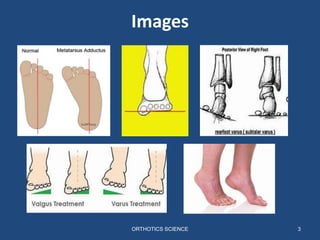
Abnormalities in 3 planes
Coronal (frontal) plane
• Rearfoot/hindfoot varus & valgus
• Forefoot varus & valgus
Sagittal plane
• Ankle equinus & calcaneus
• 1st Ray plantarflexion or elevation
Transverse plane
• Forefoot/Metatarsus adductus
ORTHOTICS SCIENCE 2
Images
ORTHOTICS SCIENCE 3
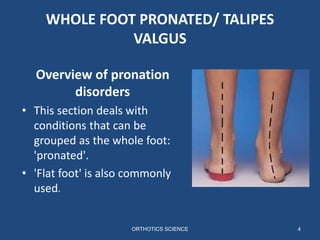
WHOLE FOOT PRONATED/ TALIPES
VALGUS
Overview of pronation
disorders
• This section deals with
conditions that can be
grouped as the whole foot:
'pronated'.
• 'Flat foot' is also commonly
used.
ORTHOTICS SCIENCE 4
Key features of a pronated foot
ORTHOTICS SCIENCE 5
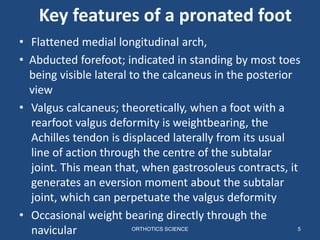
• Flattened medial longitudinal arch,
• Abducted forefoot; indicated in standing by most toes
being visible lateral to the calcaneus in the posterior
view
• Valgus calcaneus; theoretically, when a foot with a
rearfoot valgus deformity is weightbearing, the
Achilles tendon is displaced laterally from its usual
line of action through the centre of the subtalar
joint. This mean that, when gastrosoleus contracts, it
generates an eversion moment about the subtalar
joint, which can perpetuate the valgus deformity
• Occasional weight bearing directly through the
navicular
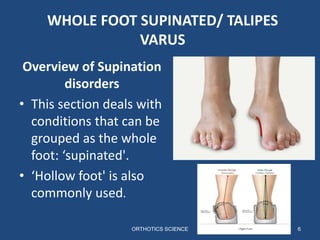
WHOLE FOOT SUPINATED/ TALIPES
VARUS
Overview of Supination
disorders
• This section deals with
conditions that can be
grouped as the whole
foot: ‘supinated'.
• ‘Hollow foot' is also
commonly used.
ORTHOTICS SCIENCE 6
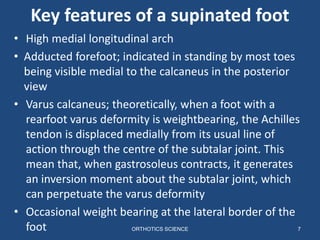
Key features of a supinated foot
• High medial longitudinal arch
• Adducted forefoot; indicated in standing by most toes
being visible medial to the calcaneus in the posterior
view
• Varus calcaneus; theoretically, when a foot with a
rearfoot varus deformity is weightbearing, the Achilles
tendon is displaced medially from its usual line of
action through the centre of the subtalar joint. This
mean that, when gastrosoleus contracts, it generates
an inversion moment about the subtalar joint, which
can perpetuate the varus deformity
• Occasional weight bearing at the lateral border of the
foot ORTHOTICS SCIENCE 7
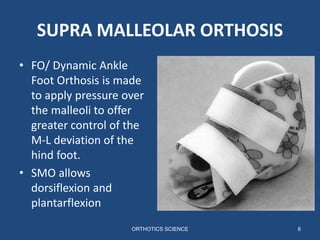
SUPRA MALLEOLAR ORTHOSIS
• FO/ Dynamic Ankle
Foot Orthosis is made
to apply pressure over
the malleoli to offer
greater control of the
M-L deviation of the
hind foot.
• SMO allows
dorsiflexion and
plantarflexion
ORTHOTICS SCIENCE 8
9
ANKLE FOOT ORTHOSIS
• There are various types of AFO’s that differ
not only in design but in functional controls on
the ankle as well.
• Before deciding on what type of AFO to
prescribe, the Orthotist must conduct a
detailed subjective and objective examination
of the patient.
ORTHOTICS SCIENCE
10
Ankle Foot Orthoses
• AFOs are manufactured from a wide variety of
materials and have several designs, to achieve
various functions
• Many causes of disability that require orthotic
devices come from problems with nervous system
• A strong understanding is needed on nervous system
pathologies and how it works
ORTHOTICS SCIENCE
11
Ankle Foot Orthoses
When prescribing AFO’s, it is really important to;
• Understand the pathology of the patient and what
are the deficits; Muscle strength tests, range of
motion tests and some special tests like Silfverskoild
test and others.
• It is also important to make some biomechanical
goals. Thus, is my AFO going to;
a. To block a movement
b. To limit a movement
c. To enhance or assist in a movement
ORTHOTICS SCIENCE
Bracing Complications:
• Pressure sores
• Bulky
• Hot
• Heavy
• Stiffness (limits motion)
• Muscle atrophy
• Frequent Maintenance needed
• Poor cosmesis
ORTHOTICS SCIENCE
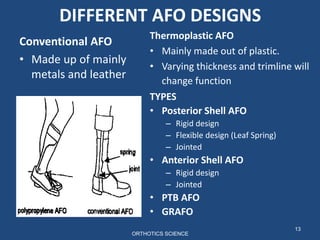
DIFFERENT AFO DESIGNS
Conventional AFO
• Made up of mainly
metals and leather
Thermoplastic AFO
• Mainly made out of plastic.
• Varying thickness and trimline will
change function
TYPES
• Posterior Shell AFO
– Rigid design
– Flexible design (Leaf Spring)
– Jointed
• Anterior Shell AFO
– Rigid design
– Jointed
• PTB AFO
• GRAFO
ORTHOTICS SCIENCE
13
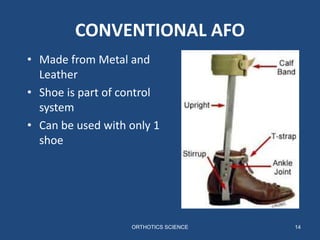
CONVENTIONAL AFO
• Made from Metal and
Leather
• Shoe is part of control
system
• Can be used with only 1
shoe
ORTHOTICS SCIENCE 14
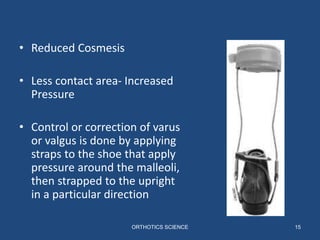
• Reduced Cosmesis
• Less contact area- Increased
Pressure
• Control or correction of varus
or valgus is done by applying
straps to the shoe that apply
pressure around the malleoli,
then strapped to the upright
in a particular direction
ORTHOTICS SCIENCE 15
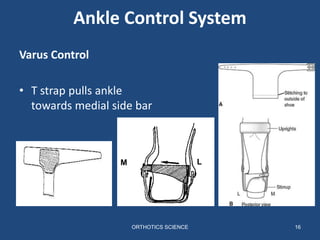
Ankle Control System
Varus Control
• T strap pulls ankle
towards medial side bar
M L
ORTHOTICS SCIENCE 16
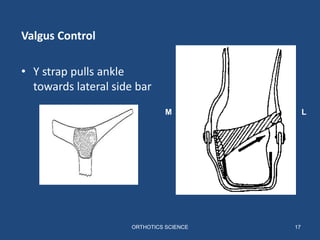
Valgus Control
• Y strap pulls ankle
towards lateral side bar
M L
ORTHOTICS SCIENCE 17
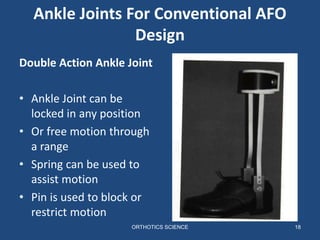
Ankle Joints For Conventional AFO
Design
Double Action Ankle Joint
• Ankle Joint can be
locked in any position
• Or free motion through
a range
• Spring can be used to
assist motion
• Pin is used to block or
restrict motion
ORTHOTICS SCIENCE 18
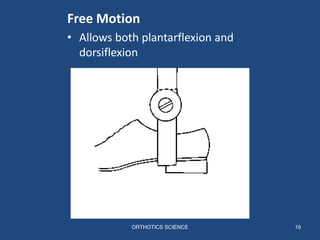
Free Motion
• Allows both plantarflexion and
dorsiflexion
ORTHOTICS SCIENCE 19
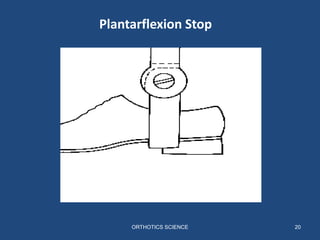
Plantarflexion Stop
ORTHOTICS SCIENCE 20
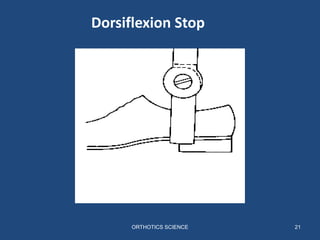
Dorsiflexion Stop
ORTHOTICS SCIENCE 21
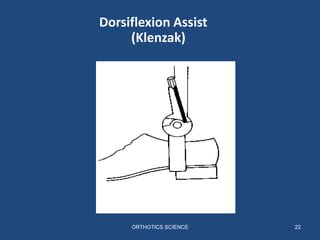
Dorsiflexion Assist
(Klenzak)
ORTHOTICS SCIENCE 22
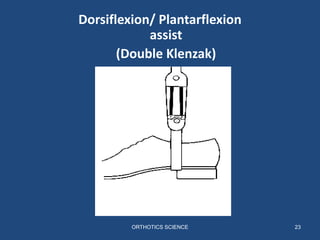
Dorsiflexion/ Plantarflexion
assist
(Double Klenzak)
ORTHOTICS SCIENCE 23
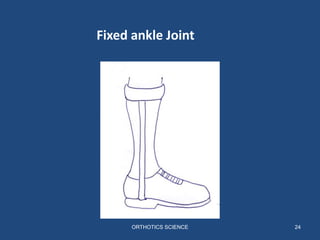
Fixed ankle Joint
ORTHOTICS SCIENCE 24
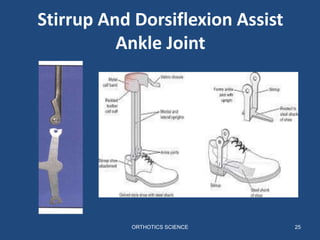
Stirrup And Dorsiflexion Assist
Ankle Joint
ORTHOTICS SCIENCE 25
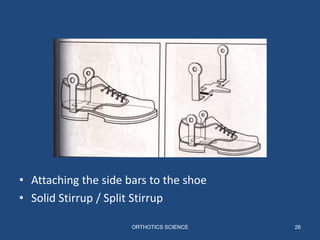
• Attaching the side bars to the shoe
• Solid Stirrup / Split Stirrup
ORTHOTICS SCIENCE 26

Orthotics Science edited AFOs (Conventional).ppt

  • 1.
  • 2.
    Abnormalities in 3planes Coronal (frontal) plane • Rearfoot/hindfoot varus & valgus • Forefoot varus & valgus Sagittal plane • Ankle equinus & calcaneus • 1st Ray plantarflexion or elevation Transverse plane • Forefoot/Metatarsus adductus ORTHOTICS SCIENCE 2
  • 3.
  • 4.
    WHOLE FOOT PRONATED/TALIPES VALGUS Overview of pronation disorders • This section deals with conditions that can be grouped as the whole foot: 'pronated'. • 'Flat foot' is also commonly used. ORTHOTICS SCIENCE 4
  • 5.
    Key features ofa pronated foot ORTHOTICS SCIENCE 5 • Flattened medial longitudinal arch, • Abducted forefoot; indicated in standing by most toes being visible lateral to the calcaneus in the posterior view • Valgus calcaneus; theoretically, when a foot with a rearfoot valgus deformity is weightbearing, the Achilles tendon is displaced laterally from its usual line of action through the centre of the subtalar joint. This mean that, when gastrosoleus contracts, it generates an eversion moment about the subtalar joint, which can perpetuate the valgus deformity • Occasional weight bearing directly through the navicular
  • 6.
    WHOLE FOOT SUPINATED/TALIPES VARUS Overview of Supination disorders • This section deals with conditions that can be grouped as the whole foot: ‘supinated'. • ‘Hollow foot' is also commonly used. ORTHOTICS SCIENCE 6
  • 7.
    Key features ofa supinated foot • High medial longitudinal arch • Adducted forefoot; indicated in standing by most toes being visible medial to the calcaneus in the posterior view • Varus calcaneus; theoretically, when a foot with a rearfoot varus deformity is weightbearing, the Achilles tendon is displaced medially from its usual line of action through the centre of the subtalar joint. This mean that, when gastrosoleus contracts, it generates an inversion moment about the subtalar joint, which can perpetuate the varus deformity • Occasional weight bearing at the lateral border of the foot ORTHOTICS SCIENCE 7
  • 8.
    SUPRA MALLEOLAR ORTHOSIS •FO/ Dynamic Ankle Foot Orthosis is made to apply pressure over the malleoli to offer greater control of the M-L deviation of the hind foot. • SMO allows dorsiflexion and plantarflexion ORTHOTICS SCIENCE 8
  • 9.
    9 ANKLE FOOT ORTHOSIS •There are various types of AFO’s that differ not only in design but in functional controls on the ankle as well. • Before deciding on what type of AFO to prescribe, the Orthotist must conduct a detailed subjective and objective examination of the patient. ORTHOTICS SCIENCE
  • 10.
    10 Ankle Foot Orthoses •AFOs are manufactured from a wide variety of materials and have several designs, to achieve various functions • Many causes of disability that require orthotic devices come from problems with nervous system • A strong understanding is needed on nervous system pathologies and how it works ORTHOTICS SCIENCE
  • 11.
    11 Ankle Foot Orthoses Whenprescribing AFO’s, it is really important to; • Understand the pathology of the patient and what are the deficits; Muscle strength tests, range of motion tests and some special tests like Silfverskoild test and others. • It is also important to make some biomechanical goals. Thus, is my AFO going to; a. To block a movement b. To limit a movement c. To enhance or assist in a movement ORTHOTICS SCIENCE
  • 12.
    Bracing Complications: • Pressuresores • Bulky • Hot • Heavy • Stiffness (limits motion) • Muscle atrophy • Frequent Maintenance needed • Poor cosmesis ORTHOTICS SCIENCE
  • 13.
    DIFFERENT AFO DESIGNS ConventionalAFO • Made up of mainly metals and leather Thermoplastic AFO • Mainly made out of plastic. • Varying thickness and trimline will change function TYPES • Posterior Shell AFO – Rigid design – Flexible design (Leaf Spring) – Jointed • Anterior Shell AFO – Rigid design – Jointed • PTB AFO • GRAFO ORTHOTICS SCIENCE 13
  • 14.
    CONVENTIONAL AFO • Madefrom Metal and Leather • Shoe is part of control system • Can be used with only 1 shoe ORTHOTICS SCIENCE 14
  • 15.
    • Reduced Cosmesis •Less contact area- Increased Pressure • Control or correction of varus or valgus is done by applying straps to the shoe that apply pressure around the malleoli, then strapped to the upright in a particular direction ORTHOTICS SCIENCE 15
  • 16.
    Ankle Control System VarusControl • T strap pulls ankle towards medial side bar M L ORTHOTICS SCIENCE 16
  • 17.
    Valgus Control • Ystrap pulls ankle towards lateral side bar M L ORTHOTICS SCIENCE 17
  • 18.
    Ankle Joints ForConventional AFO Design Double Action Ankle Joint • Ankle Joint can be locked in any position • Or free motion through a range • Spring can be used to assist motion • Pin is used to block or restrict motion ORTHOTICS SCIENCE 18
  • 19.
    Free Motion • Allowsboth plantarflexion and dorsiflexion ORTHOTICS SCIENCE 19
  • 20.
  • 21.
  • 22.
  • 23.
  • 24.
  • 25.
    Stirrup And DorsiflexionAssist Ankle Joint ORTHOTICS SCIENCE 25
  • 26.
    • Attaching theside bars to the shoe • Solid Stirrup / Split Stirrup ORTHOTICS SCIENCE 26