Welcome
to our
presentation
Presented By_
Razia sultana Jemim
14109054
Asha Nur
141090**
Trina
141090**
Objectives:
1.) toexplainand understandtheprocess ofOsmosis;
2.) to differentiate hypertonic, hypotonic and isotonic
solutions;
3.) enumerate some importantapplicationsofOsmosis;
MENU
(Topicsto be discussed)
• What is Osmosis?
• Osmosis vs. Diffusion
• Terms used inOsmosis
• Applicationsof Osmosis
• Osmotic Pressure
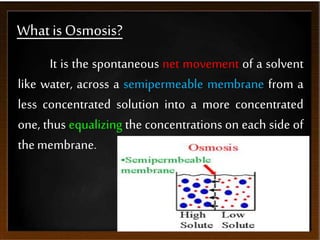
What is Osmosis?
It is the spontaneous net movement of a solvent
like water, across a semipermeable membrane from a
less concentrated solution into a more concentrated
one, thus equalizing the concentrations on each side of
themembrane.
Both are processes that equalize the concentration of
two solutions but both differ in their nature and process.
Diffusion involves solvent and solute particles to move
to equalize concentrations from lower to higher
concentrations. But no semi-permeable membrane is involved.
It mainly occurs in gaseous state or within gas molecules and
liquid molecules and usually does not need water for
movement.
How does osmosis differ from diffusion?
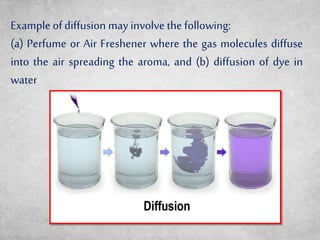
Example of diffusion may involve the following:
(a) Perfume or Air Freshener where the gas molecules diffuse
into the air spreading the aroma, and (b) diffusion of dye in
water
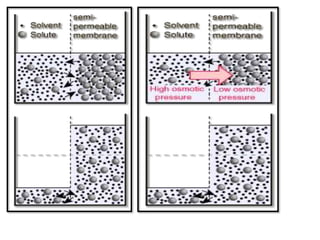
On the other hand, in osmosis, only solvent particles
move. Solute particles tend not to move and the movement is
through the semi-permeable membrane. It may require liquids
for movement and a semi-permeable membrane.
Terms usedin Osmosis
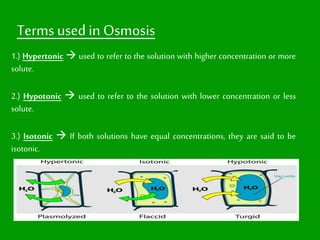
1.) Hypertonic  used to refer to the solution with higher concentration or more
solute.
2.) Hypotonic  used to refer to the solution with lower concentration or less
solute.
3.) Isotonic  If both solutions have equal concentrations, they are said to be
isotonic.
Applicationsof Osmosis
So where can we usually use osmosis?How can human
andother living organisms benefit from the concept of
osmosis?
1. It assistsplants in receiving water.
2. It helps in the preservation of fruit andmeat.
3. It is used inkidney dialysis.
4. It can be reversed to remove saltandother impurities from
water.
5. Osmotic generation of power.
Factors
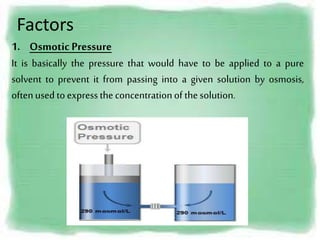
1. Osmotic Pressure
It is basically the pressure that would have to be applied to a pure
solvent to prevent it from passing into a given solution by osmosis,
oftenusedtoexpresstheconcentrationofthesolution.
Factors
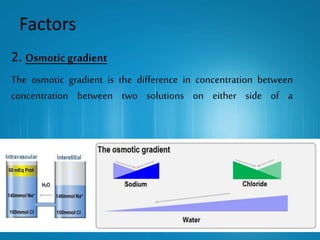
2. Osmotic gradient
The osmotic gradient is the difference in concentration between
concentration between two solutions on either side of a
Variation
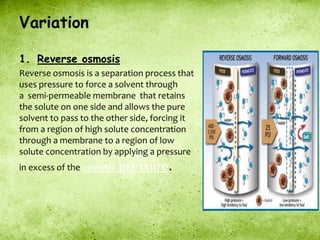
1. Reverse osmosis
Reverse osmosis is a separation process that
uses pressure to force a solvent through
a semi-permeable membrane that retains
the solute on one side and allows the pure
solvent to pass to the other side, forcing it
from a region of high solute concentration
through a membrane to a region of low
solute concentration by applying a pressure
in excess of the osmotic pressure.
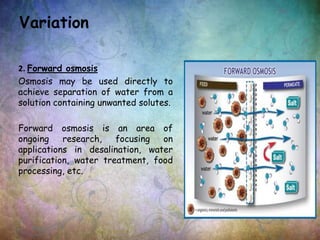
2. Forward osmosis
Osmosis may be used directly to
achieve separation of water from a
solution containing unwanted solutes.
Forward osmosis is an area of
ongoing research, focusing on
applications in desalination, water
purification, water treatment, food
processing, etc.
Variation
Conclusion
Osmosis is the diffusion of water molecules through a selectively
permeable membrane. The molecules move from an area of high
concentration to an area of low concentration and vice-veca.
Osmosis is important to plants because it is the way the plant gets
water through its leaves and root hair cells
Process of osmosis net movement of water into a cell percentage,
Water was 90% inside the cell and 95% outside the cell
Osmosis

Osmosis

  • 1.
  • 2.
    Presented By_ Razia sultanaJemim 14109054 Asha Nur 141090** Trina 141090**
  • 3.
    Objectives: 1.) toexplainand understandtheprocessofOsmosis; 2.) to differentiate hypertonic, hypotonic and isotonic solutions; 3.) enumerate some importantapplicationsofOsmosis;
  • 4.
    MENU (Topicsto be discussed) •What is Osmosis? • Osmosis vs. Diffusion • Terms used inOsmosis • Applicationsof Osmosis • Osmotic Pressure
  • 5.
    What is Osmosis? Itis the spontaneous net movement of a solvent like water, across a semipermeable membrane from a less concentrated solution into a more concentrated one, thus equalizing the concentrations on each side of themembrane.
  • 6.
    Both are processesthat equalize the concentration of two solutions but both differ in their nature and process. Diffusion involves solvent and solute particles to move to equalize concentrations from lower to higher concentrations. But no semi-permeable membrane is involved. It mainly occurs in gaseous state or within gas molecules and liquid molecules and usually does not need water for movement. How does osmosis differ from diffusion?
  • 7.
    Example of diffusionmay involve the following: (a) Perfume or Air Freshener where the gas molecules diffuse into the air spreading the aroma, and (b) diffusion of dye in water
  • 8.
    On the otherhand, in osmosis, only solvent particles move. Solute particles tend not to move and the movement is through the semi-permeable membrane. It may require liquids for movement and a semi-permeable membrane.
  • 10.
    Terms usedin Osmosis 1.)Hypertonic  used to refer to the solution with higher concentration or more solute. 2.) Hypotonic  used to refer to the solution with lower concentration or less solute. 3.) Isotonic  If both solutions have equal concentrations, they are said to be isotonic.
  • 11.
    Applicationsof Osmosis So wherecan we usually use osmosis?How can human andother living organisms benefit from the concept of osmosis? 1. It assistsplants in receiving water. 2. It helps in the preservation of fruit andmeat. 3. It is used inkidney dialysis. 4. It can be reversed to remove saltandother impurities from water. 5. Osmotic generation of power.
  • 12.
    Factors 1. Osmotic Pressure Itis basically the pressure that would have to be applied to a pure solvent to prevent it from passing into a given solution by osmosis, oftenusedtoexpresstheconcentrationofthesolution.
  • 13.
    Factors 2. Osmotic gradient Theosmotic gradient is the difference in concentration between concentration between two solutions on either side of a
  • 14.
    Variation 1. Reverse osmosis Reverseosmosis is a separation process that uses pressure to force a solvent through a semi-permeable membrane that retains the solute on one side and allows the pure solvent to pass to the other side, forcing it from a region of high solute concentration through a membrane to a region of low solute concentration by applying a pressure in excess of the osmotic pressure.
  • 15.
    2. Forward osmosis Osmosismay be used directly to achieve separation of water from a solution containing unwanted solutes. Forward osmosis is an area of ongoing research, focusing on applications in desalination, water purification, water treatment, food processing, etc. Variation
  • 16.
    Conclusion Osmosis is thediffusion of water molecules through a selectively permeable membrane. The molecules move from an area of high concentration to an area of low concentration and vice-veca. Osmosis is important to plants because it is the way the plant gets water through its leaves and root hair cells Process of osmosis net movement of water into a cell percentage, Water was 90% inside the cell and 95% outside the cell