Diffusion and Osmosis
TSWBAT identify the process of osmosis and
diffusion via the gummi bear lab
-analyze diffusion through a sand baggie and
apply the concepts of hypotonic, hypertonic, and
isotonic to the activity
• On a blank sheet of paper
– Write the equation for cellular respiration.
– Where does cellular respiration occur in the
cell?
– List the organelles that help to make proteins
– What is the difference between the rough and
the smooth endoplasmic reticulum?
Diffusion
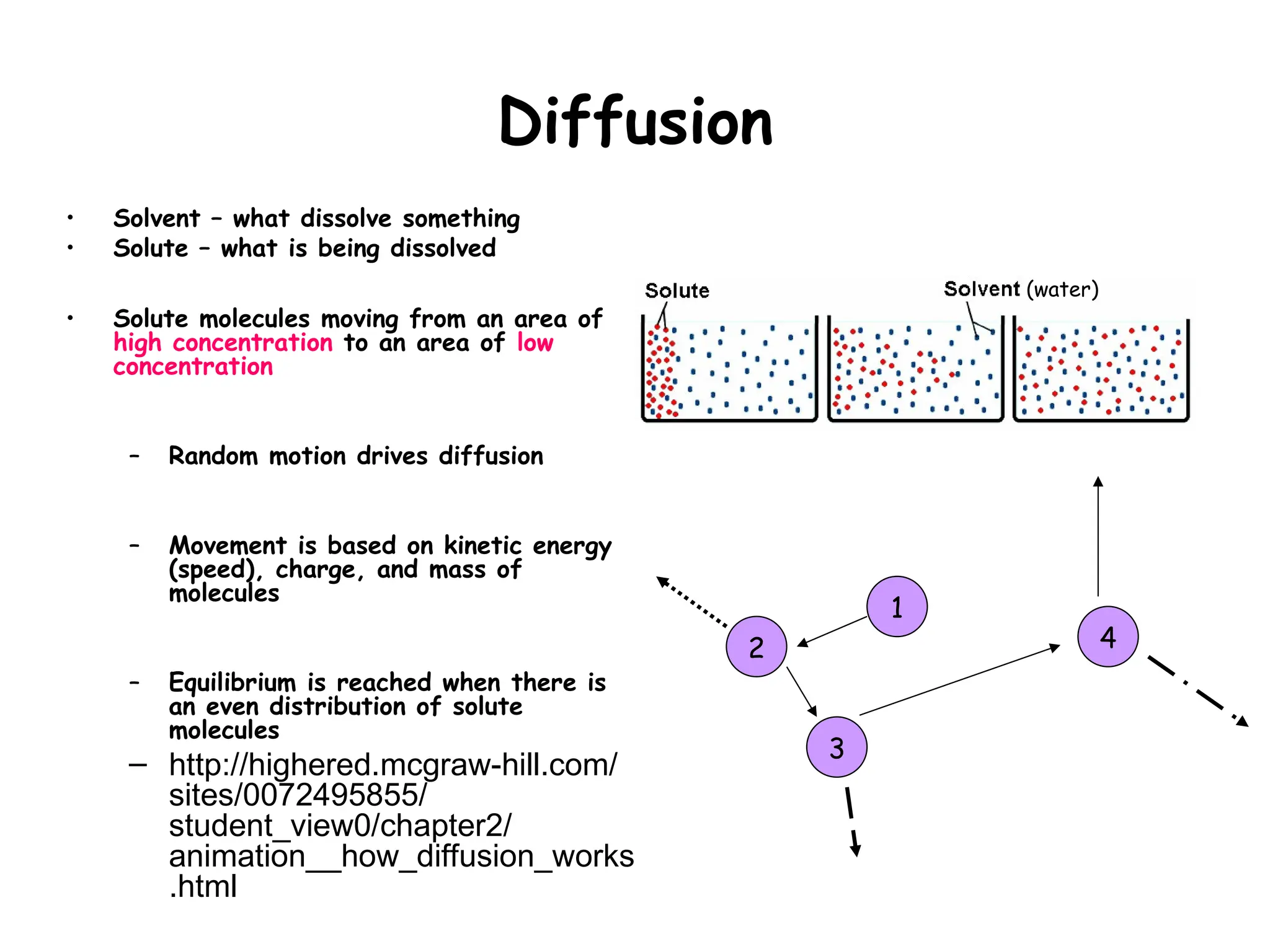
• Solvent – what dissolve something
• Solute – what is being dissolved
• Solute molecules moving from an area of
high concentration to an area of low
concentration
– Random motion drives diffusion
– Movement is based on kinetic energy
(speed), charge, and mass of
molecules
– Equilibrium is reached when there is
an even distribution of solute
molecules
– http://highered.mcgraw-hill.com/
sites/0072495855/
student_view0/chapter2/
animation__how_diffusion_works
.html
2
3
1
4
(water)
Osmosis
• Diffusion of water through a semi-
permeable membrane
– Semi-permeable: permeable to
solvents (WATER), but not to
large molecules
– High [water] to low [water]
• Dissolved molecules (i.e. glucose,
starch) are called solutes
• REMEMBER:
Water = solvent
Glucose, Starch = solutes
http://highered.mcgrawhill.com/sites/0072495855/student_view0/
chapter2/animation__how_osmosis_works.html
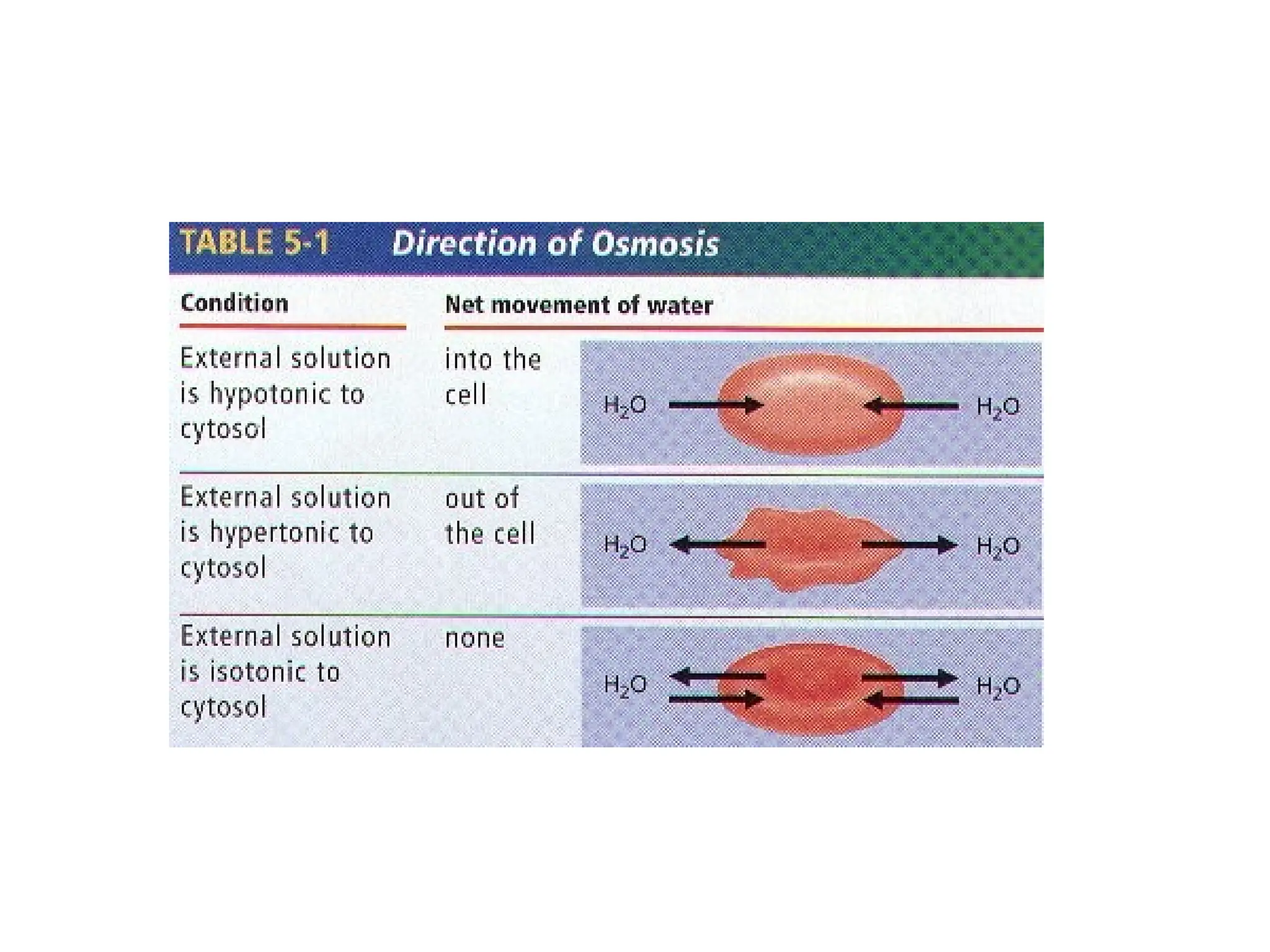
Effect of Water on Cells
• Hypertonic Environment
– High [solute], low [water]
– The cell will shrink
– Plasmolysis – cell death
Hypotonic Environment
– High [water], low [solute]
– Plants – turgor pressure – plant
like this!!
– Animals – cytolysis – cell
bursting
• Isotonic Environment
– [water] = [solute]
Isotonic
Hypotonic
Hypertonic
Part 3 pg. 85
Osmosis in Living Cells
Cellulose in
cell wall
Osmosis in Red Blood Cells
Isotonic
Hypotonic
Hypertonic
•
0.9% saline
10% NaCl
Distilled water
Predictions?
Plasmolysis
Osmosis in Plant Cells
•.
10% NaCl
Distilled water
Hypertonic
Hypotonic
Predictions?
Plasmolysis
Animations
Dialysis Bag Experiment
• http://ccollege.hccs.cc.tx.us/instru/Biology/
AllStudyPages/Diffusion_Osmosis/Baggif.swf
Elodea Cell
• http://ccollege.hccs.cc.tx.us/instru/Biology/
AllStudyPages/Diffusion_Osmosis/Elodeagif.swf
Osmosis
• http://ull.chemistry.uakron.edu/genobc/animations/
osmosis.mov
Transportation of Molecules
• Passive Transport
-Movement of molecules across a
semi-permeable membrane
- no energy required
• Active Transport
-Movement of molecules across a
semi-permeable membrane against a
concentration gradient with a
protein
- ENERGY – ATP
• Facilitated Diffusion
-Movement of molecules across a
semi-permeable membrane with a
protein
- no energy required
Effect of Water on RBC
diffusion-and-osmosis a simple introduction.ppt

diffusion-and-osmosis a simple introduction.ppt

  • 1.
  • 2.
    TSWBAT identify theprocess of osmosis and diffusion via the gummi bear lab -analyze diffusion through a sand baggie and apply the concepts of hypotonic, hypertonic, and isotonic to the activity • On a blank sheet of paper – Write the equation for cellular respiration. – Where does cellular respiration occur in the cell? – List the organelles that help to make proteins – What is the difference between the rough and the smooth endoplasmic reticulum?
  • 3.
    Diffusion • Solvent –what dissolve something • Solute – what is being dissolved • Solute molecules moving from an area of high concentration to an area of low concentration – Random motion drives diffusion – Movement is based on kinetic energy (speed), charge, and mass of molecules – Equilibrium is reached when there is an even distribution of solute molecules – http://highered.mcgraw-hill.com/ sites/0072495855/ student_view0/chapter2/ animation__how_diffusion_works .html 2 3 1 4 (water)
  • 4.
    Osmosis • Diffusion ofwater through a semi- permeable membrane – Semi-permeable: permeable to solvents (WATER), but not to large molecules – High [water] to low [water] • Dissolved molecules (i.e. glucose, starch) are called solutes • REMEMBER: Water = solvent Glucose, Starch = solutes http://highered.mcgrawhill.com/sites/0072495855/student_view0/ chapter2/animation__how_osmosis_works.html
  • 5.
    Effect of Wateron Cells • Hypertonic Environment – High [solute], low [water] – The cell will shrink – Plasmolysis – cell death Hypotonic Environment – High [water], low [solute] – Plants – turgor pressure – plant like this!! – Animals – cytolysis – cell bursting • Isotonic Environment – [water] = [solute] Isotonic Hypotonic Hypertonic Part 3 pg. 85
  • 6.
    Osmosis in LivingCells Cellulose in cell wall
  • 7.
    Osmosis in RedBlood Cells Isotonic Hypotonic Hypertonic • 0.9% saline 10% NaCl Distilled water Predictions? Plasmolysis
  • 8.
    Osmosis in PlantCells •. 10% NaCl Distilled water Hypertonic Hypotonic Predictions? Plasmolysis
  • 9.
    Animations Dialysis Bag Experiment •http://ccollege.hccs.cc.tx.us/instru/Biology/ AllStudyPages/Diffusion_Osmosis/Baggif.swf Elodea Cell • http://ccollege.hccs.cc.tx.us/instru/Biology/ AllStudyPages/Diffusion_Osmosis/Elodeagif.swf Osmosis • http://ull.chemistry.uakron.edu/genobc/animations/ osmosis.mov
  • 10.
    Transportation of Molecules •Passive Transport -Movement of molecules across a semi-permeable membrane - no energy required • Active Transport -Movement of molecules across a semi-permeable membrane against a concentration gradient with a protein - ENERGY – ATP • Facilitated Diffusion -Movement of molecules across a semi-permeable membrane with a protein - no energy required
  • 11.