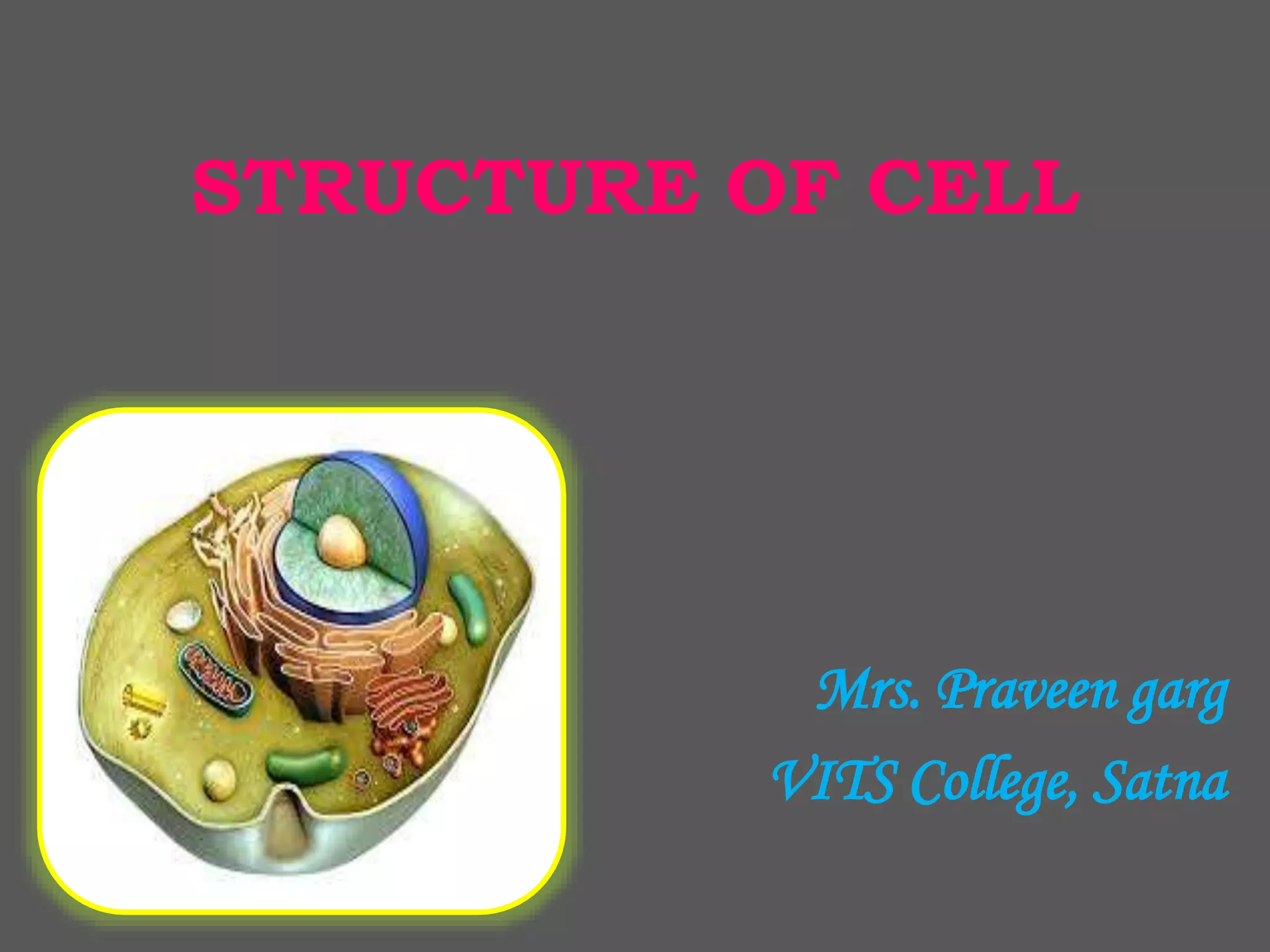
STRUCTURE OF CELL
Mrs. Praveen garg
VITS College, Satna
INTRODUCTION
Definition:
 “Cells are the fundamental unit of life.”
or
 “A cell is defined as the smallest, basic unit of life that
is responsible for all of life’s processes.”
or
 “Cell is the structural, functional and biological unit of
life.”
 They are known as the building blocks of life.
 Cell tissue tissue system organ
organ system body
• Each cell contains a fluid called the cytoplasm, which is
enclosed by a membrane.
• In the cytoplasm, several biomolecules are present like
proteins, nucleic acids and lipids.
• Cellular structures called cell organelles are suspended
in the cytoplasm.
• The study of cells from its basic structure to the
functions of every cell organelles is called Cell Biology.
• All organisms are made up of cells. They may be made
up of a single cell (unicellular), or many cells
(multicellular).
HISTORY
• Robert Hooke discovered the cell in 1665. He observed
the cell as small room.
• Hooke concluded that these were non-living entities.
• Anton Van Leeuwenhoek observed cells under another
compound microscope with higher magnification. This
time, he observed that the cells exhibited some form of
movement (motility).
• In 1883, Robert Brown, a botanist, provided the very first
insights into the cell structure. He was able to describe
the nucleus present in the cells of orchids.
CHARACTERISTICS OF CELLS
• Cells provide structure and support to the body of an
organism.
• The cell organized into different individual organelles
surrounded by a separate membrane.
• The nucleus holds genetic information necessary for
reproduction and cell growth.
• Every cell has one nucleus and membrane-bound organelles
in the cytoplasm.
• Mitochondria, is mainly responsible for the energy
transactions.
• Lysosomes digest unwanted materials in the cell.
• Endoplasmic reticulum plays a role in synthesising selective
molecules and processing, directing and sorting them to their
appropriate locations.
• Each living cells consist of living matter called
protoplasm.
• Protoplasm consist of 70% water, protein, carbohydrate,
fats.
• Protoplasm:
Cell membrane
Cytoplasm
Nucleus
TYPES OF CELLS
• Based on cellular structure, there are two types of cells:
• Prokaryotes: primitive nucleus
Ex. Bacteria, Eubacteria, Archebacteria, Mycoplasma,
Virus etc.
• Eukaryotes: mature nucleus
• Ex. Plants, Animals, Fungi, etc.
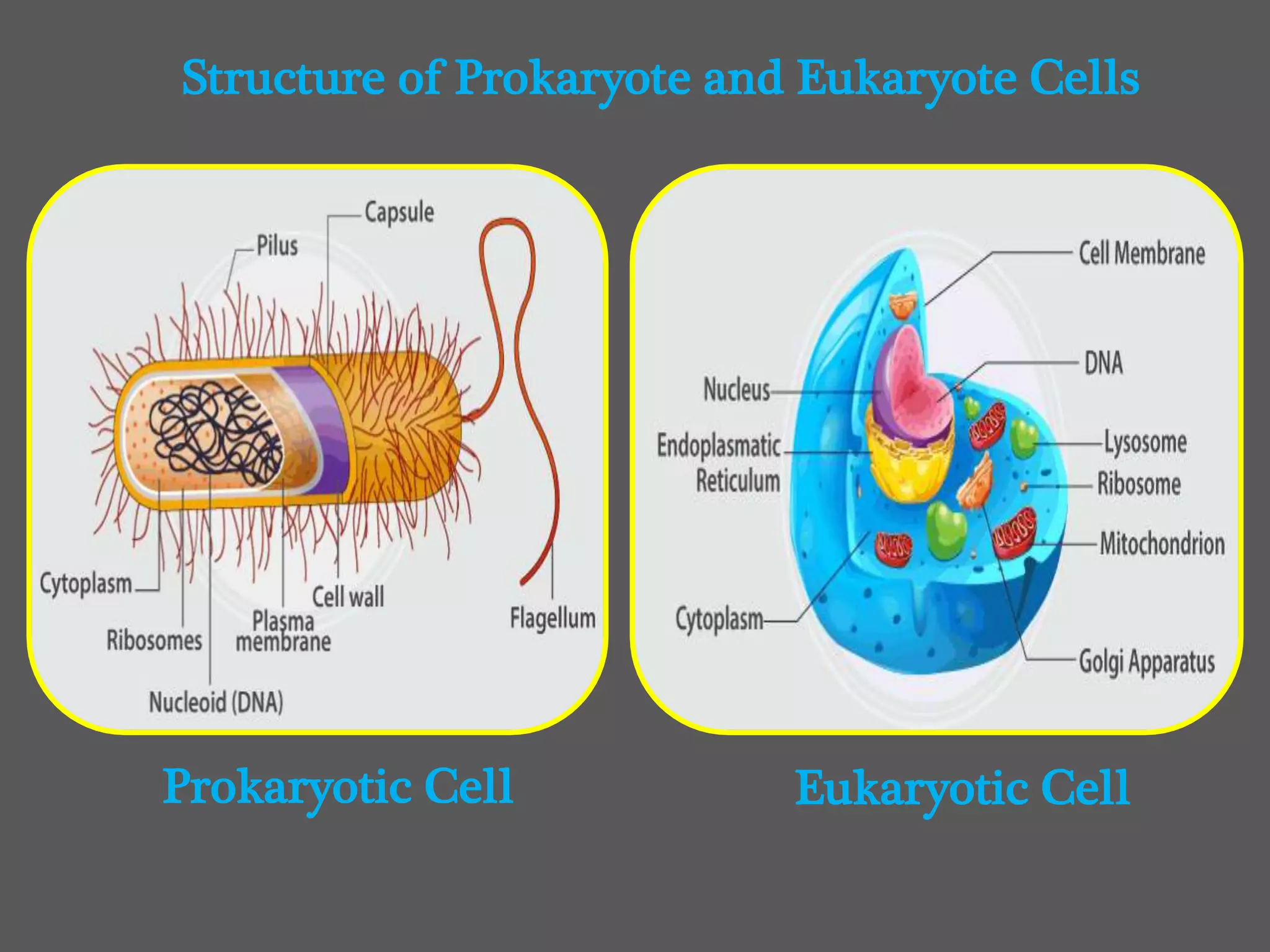
Prokaryotic Cell Eukaryotic Cell
Structure of Prokaryote and Eukaryote Cells
PROKARYOTES
• Nucleoid: A central region of the cell that contains its DNA.
• Ribosome: Ribosomes are responsible for protein synthesis (70s).
• Cell wall: The cell wall provides structure and protection from the
outside environment. Most bacteria have a rigid cell wall made from
carbohydrates and proteins called peptidoglycans.
• Cell membrane: Every prokaryote has a cell membrane, also known
as the plasma membrane, that separates the cell from the outside
environment.
• Capsule: Some bacteria have a layer of carbohydrates that surrounds
the cell wall called the capsule. The capsule helps the bacterium
attach to surfaces.
• Fimbriae: Fimbriae are thin, hair-like structures that help with
cellular attachment.
• Pili: Pili are rod-shaped structures involved in multiple roles,
including attachment and DNA transfer.
• Flagella: Flagella are thin, tail-like structures that assist in movement.
• Within a eukaryotic cell, each membrane-bound structure carries
out specific cellular functions.
• Nucleus: The nucleus stores the genetic information in chromatin
form.
• Plasma membrane: The plasma membrane is a phospholipid
bilayer that surrounds the entire cell and encompasses the
organelles within.
• Ribosomes: Ribosomes are responsible for protein synthesis (80s).
• Mitochondria: Mitochondria, also known as the powerhouses of
the cell, are responsible for energy production.
• Endoplasmic reticulum: The endoplasmic reticulum is an
organelle dedicated to protein maturation and transportation.
• Vesicles and vacuoles: Vesicles and vacuoles are membrane-bound
sacs involved in transportation and storage.
EUKARYOTES
CELL THEORY
• Cell Theory was proposed by the German
scientists, Theodor Schwann, Matthias Schleiden, and
Rudolf Virchow.
• The cell theory states that:
• All living species on Earth are composed of cells.
• A cell is the basic unit of life.
• All cells arise from pre-existing cells.
• A modern version of the cell theory contains the following
postulates:
• Energy flows within the cells.
• Genetic information is passed on from one cell to the other.
• The chemical composition of all the cells is the same.
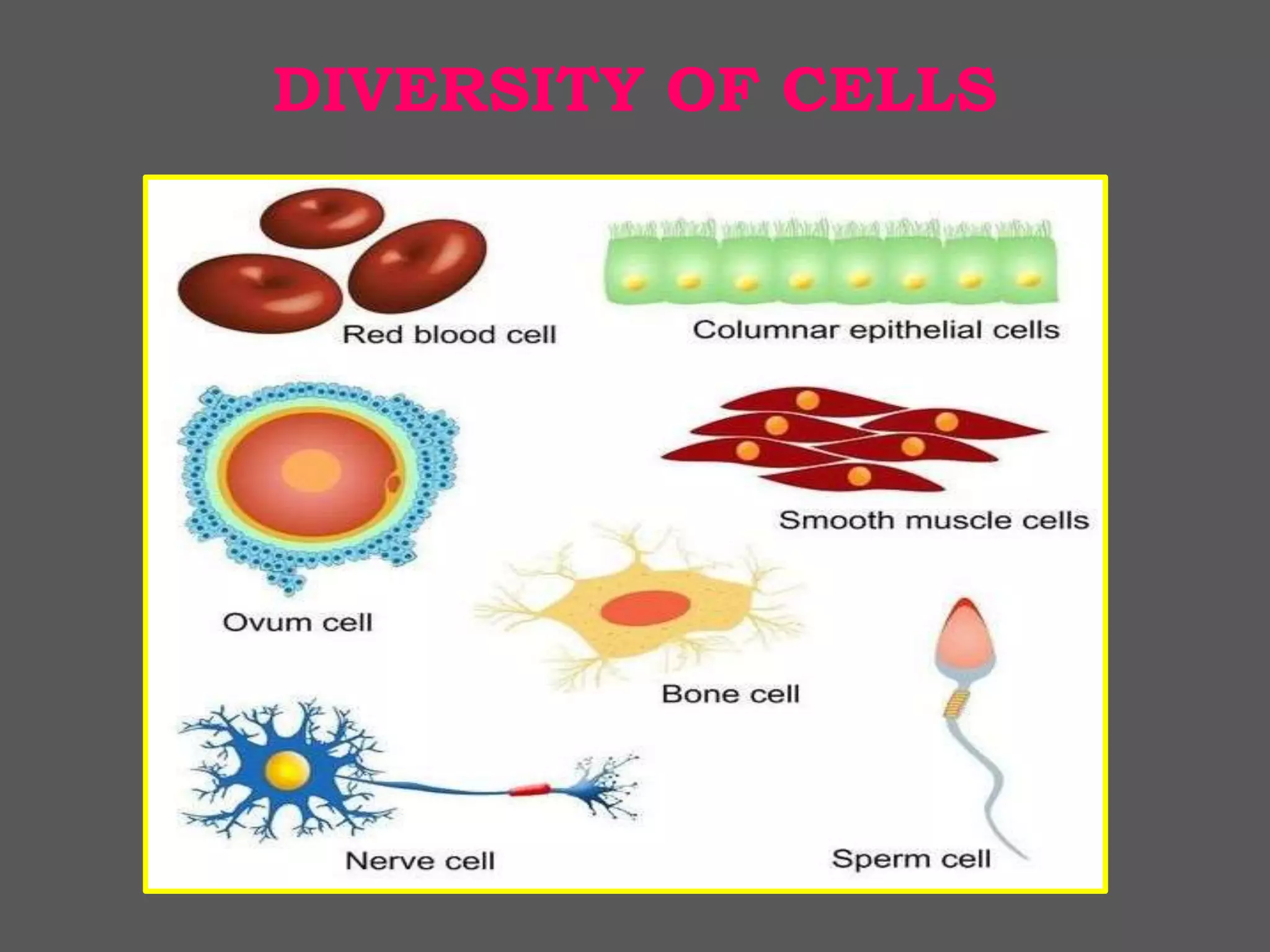
DIVERSITY OF CELLS
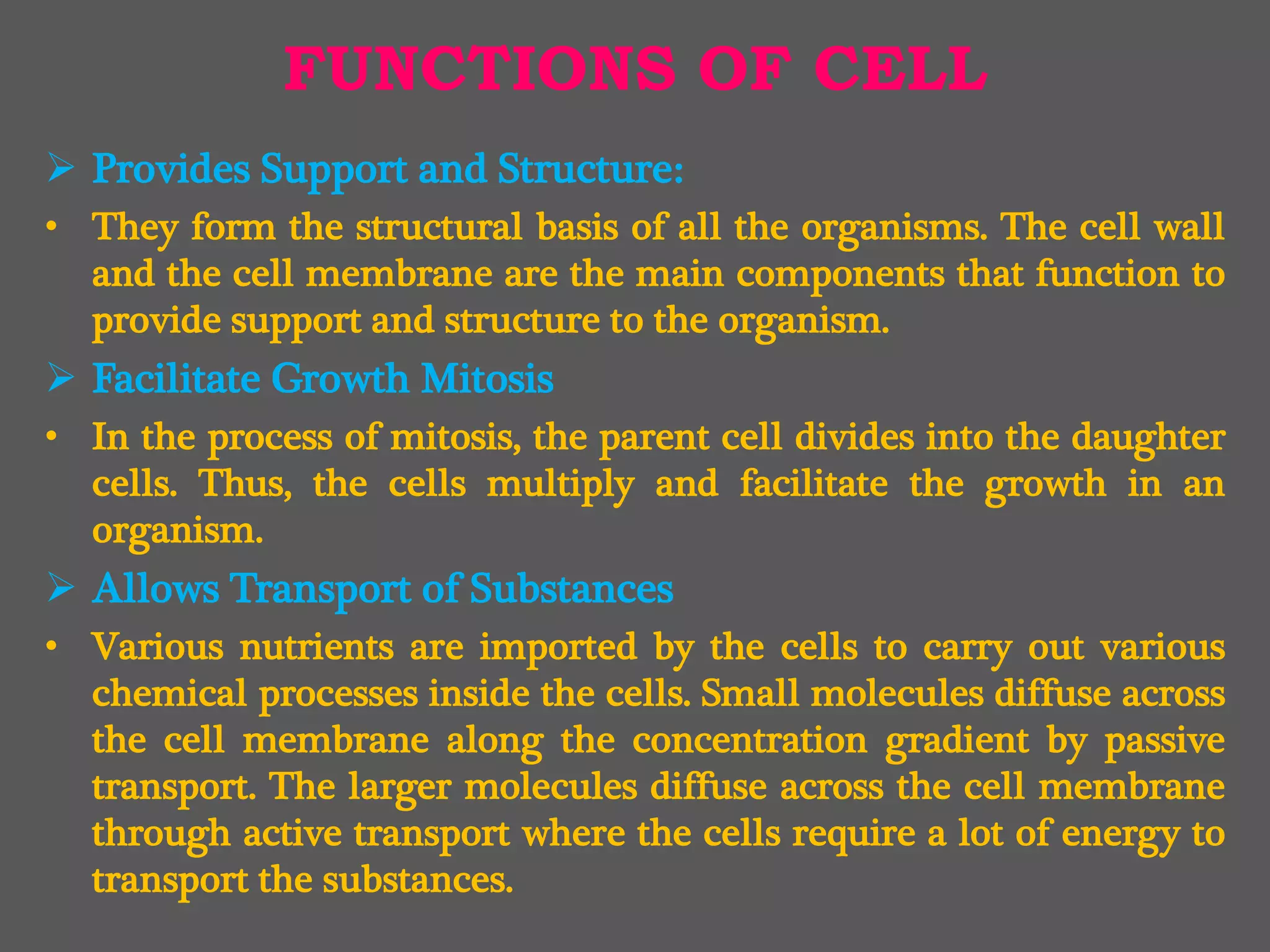
FUNCTIONS OF CELL
 Provides Support and Structure:
• They form the structural basis of all the organisms. The cell wall
and the cell membrane are the main components that function to
provide support and structure to the organism.
 Facilitate Growth Mitosis
• In the process of mitosis, the parent cell divides into the daughter
cells. Thus, the cells multiply and facilitate the growth in an
organism.
 Allows Transport of Substances
• Various nutrients are imported by the cells to carry out various
chemical processes inside the cells. Small molecules diffuse across
the cell membrane along the concentration gradient by passive
transport. The larger molecules diffuse across the cell membrane
through active transport where the cells require a lot of energy to
transport the substances.
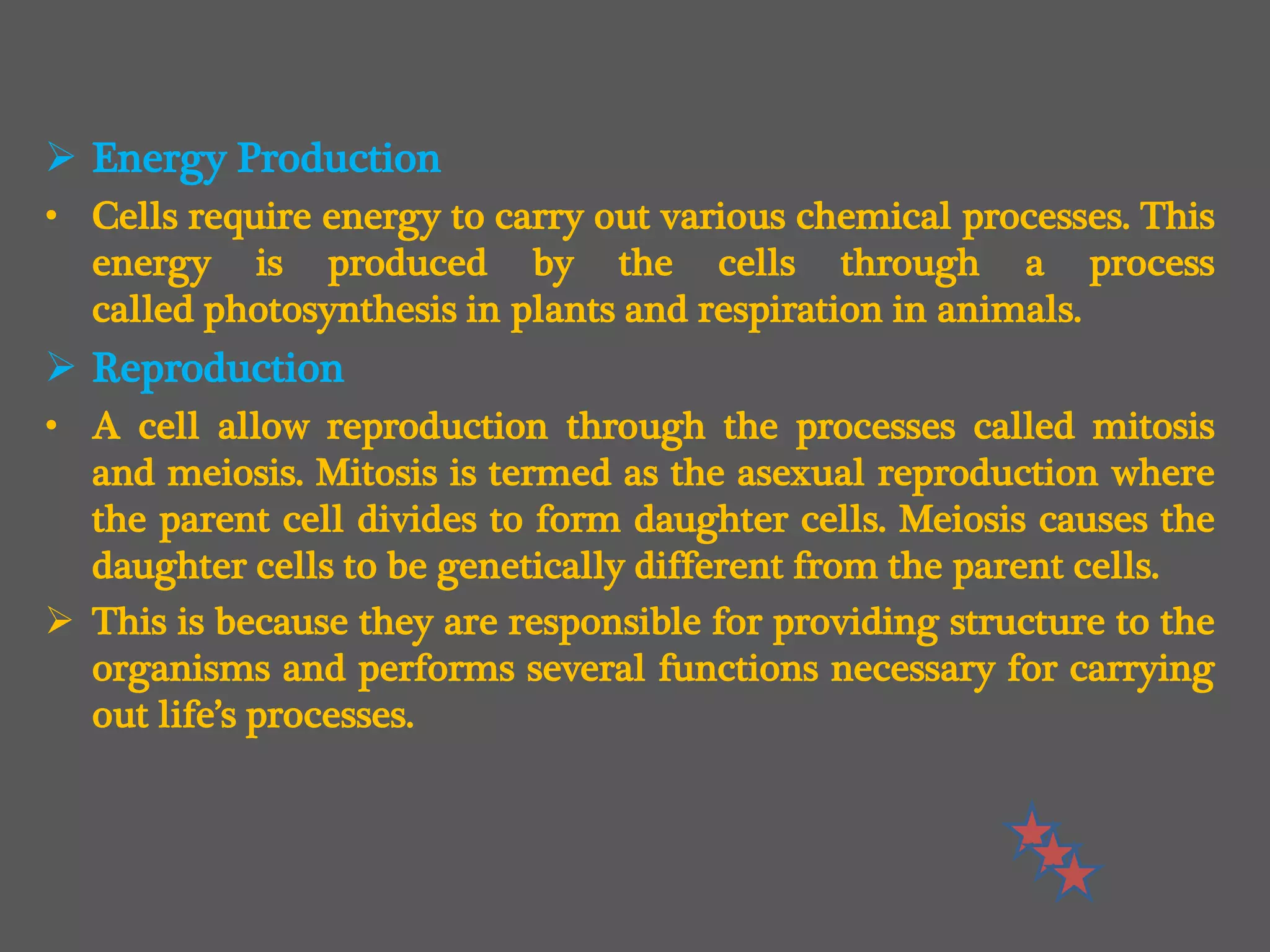
 Energy Production
• Cells require energy to carry out various chemical processes. This
energy is produced by the cells through a process
called photosynthesis in plants and respiration in animals.
 Reproduction
• A cell allow reproduction through the processes called mitosis
and meiosis. Mitosis is termed as the asexual reproduction where
the parent cell divides to form daughter cells. Meiosis causes the
daughter cells to be genetically different from the parent cells.
 This is because they are responsible for providing structure to the
organisms and performs several functions necessary for carrying
out life’s processes.

Structure of cell

  • 1.
    STRUCTURE OF CELL Mrs.Praveen garg VITS College, Satna
  • 2.
    INTRODUCTION Definition:  “Cells arethe fundamental unit of life.” or  “A cell is defined as the smallest, basic unit of life that is responsible for all of life’s processes.” or  “Cell is the structural, functional and biological unit of life.”  They are known as the building blocks of life.  Cell tissue tissue system organ organ system body
  • 3.
    • Each cellcontains a fluid called the cytoplasm, which is enclosed by a membrane. • In the cytoplasm, several biomolecules are present like proteins, nucleic acids and lipids. • Cellular structures called cell organelles are suspended in the cytoplasm. • The study of cells from its basic structure to the functions of every cell organelles is called Cell Biology. • All organisms are made up of cells. They may be made up of a single cell (unicellular), or many cells (multicellular).
  • 4.
    HISTORY • Robert Hookediscovered the cell in 1665. He observed the cell as small room. • Hooke concluded that these were non-living entities. • Anton Van Leeuwenhoek observed cells under another compound microscope with higher magnification. This time, he observed that the cells exhibited some form of movement (motility). • In 1883, Robert Brown, a botanist, provided the very first insights into the cell structure. He was able to describe the nucleus present in the cells of orchids.
  • 5.
    CHARACTERISTICS OF CELLS •Cells provide structure and support to the body of an organism. • The cell organized into different individual organelles surrounded by a separate membrane. • The nucleus holds genetic information necessary for reproduction and cell growth. • Every cell has one nucleus and membrane-bound organelles in the cytoplasm. • Mitochondria, is mainly responsible for the energy transactions. • Lysosomes digest unwanted materials in the cell. • Endoplasmic reticulum plays a role in synthesising selective molecules and processing, directing and sorting them to their appropriate locations.
  • 6.
    • Each livingcells consist of living matter called protoplasm. • Protoplasm consist of 70% water, protein, carbohydrate, fats. • Protoplasm: Cell membrane Cytoplasm Nucleus
  • 7.
    TYPES OF CELLS •Based on cellular structure, there are two types of cells: • Prokaryotes: primitive nucleus Ex. Bacteria, Eubacteria, Archebacteria, Mycoplasma, Virus etc. • Eukaryotes: mature nucleus • Ex. Plants, Animals, Fungi, etc.
  • 8.
    Prokaryotic Cell EukaryoticCell Structure of Prokaryote and Eukaryote Cells
  • 9.
    PROKARYOTES • Nucleoid: Acentral region of the cell that contains its DNA. • Ribosome: Ribosomes are responsible for protein synthesis (70s). • Cell wall: The cell wall provides structure and protection from the outside environment. Most bacteria have a rigid cell wall made from carbohydrates and proteins called peptidoglycans. • Cell membrane: Every prokaryote has a cell membrane, also known as the plasma membrane, that separates the cell from the outside environment. • Capsule: Some bacteria have a layer of carbohydrates that surrounds the cell wall called the capsule. The capsule helps the bacterium attach to surfaces. • Fimbriae: Fimbriae are thin, hair-like structures that help with cellular attachment. • Pili: Pili are rod-shaped structures involved in multiple roles, including attachment and DNA transfer. • Flagella: Flagella are thin, tail-like structures that assist in movement.
  • 10.
    • Within aeukaryotic cell, each membrane-bound structure carries out specific cellular functions. • Nucleus: The nucleus stores the genetic information in chromatin form. • Plasma membrane: The plasma membrane is a phospholipid bilayer that surrounds the entire cell and encompasses the organelles within. • Ribosomes: Ribosomes are responsible for protein synthesis (80s). • Mitochondria: Mitochondria, also known as the powerhouses of the cell, are responsible for energy production. • Endoplasmic reticulum: The endoplasmic reticulum is an organelle dedicated to protein maturation and transportation. • Vesicles and vacuoles: Vesicles and vacuoles are membrane-bound sacs involved in transportation and storage. EUKARYOTES
  • 11.
    CELL THEORY • CellTheory was proposed by the German scientists, Theodor Schwann, Matthias Schleiden, and Rudolf Virchow. • The cell theory states that: • All living species on Earth are composed of cells. • A cell is the basic unit of life. • All cells arise from pre-existing cells. • A modern version of the cell theory contains the following postulates: • Energy flows within the cells. • Genetic information is passed on from one cell to the other. • The chemical composition of all the cells is the same.
  • 12.
  • 13.
    FUNCTIONS OF CELL Provides Support and Structure: • They form the structural basis of all the organisms. The cell wall and the cell membrane are the main components that function to provide support and structure to the organism.  Facilitate Growth Mitosis • In the process of mitosis, the parent cell divides into the daughter cells. Thus, the cells multiply and facilitate the growth in an organism.  Allows Transport of Substances • Various nutrients are imported by the cells to carry out various chemical processes inside the cells. Small molecules diffuse across the cell membrane along the concentration gradient by passive transport. The larger molecules diffuse across the cell membrane through active transport where the cells require a lot of energy to transport the substances.
  • 14.
     Energy Production •Cells require energy to carry out various chemical processes. This energy is produced by the cells through a process called photosynthesis in plants and respiration in animals.  Reproduction • A cell allow reproduction through the processes called mitosis and meiosis. Mitosis is termed as the asexual reproduction where the parent cell divides to form daughter cells. Meiosis causes the daughter cells to be genetically different from the parent cells.  This is because they are responsible for providing structure to the organisms and performs several functions necessary for carrying out life’s processes.