

PRESSURE RETARDED OSMOSIS
By: Matthew Fenech
Subject: Alternative Power Generation
Lecturer: Ing.T. Darmanin
Ocean
Technology
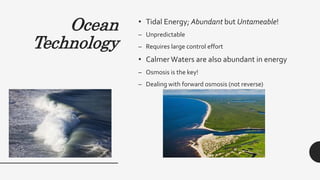
• Tidal Energy; Abundant but Untameable!
– Unpredictable
– Requires large control effort
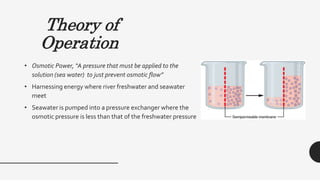
• CalmerWaters are also abundant in energy
– Osmosis is the key!
– Dealing with forward osmosis (not reverse)
Theory of
Operation
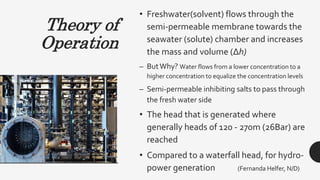
• Osmotic Power, “A pressure that must be applied to the
solution (sea water) to just prevent osmotic flow”
• Harnessing energy where river freshwater and seawater
meet
• Seawater is pumped into a pressure exchanger where the
osmotic pressure is less than that of the freshwater pressure
Theory of
Operation
• Freshwater(solvent) flows through the
semi-permeable membrane towards the
seawater (solute) chamber and increases
the mass and volume (Δh)
– ButWhy? Water flows from a lower concentration to a
higher concentration to equalize the concentration levels
– Semi-permeable inhibiting salts to pass through
the fresh water side
• The head that is generated where
generally heads of 120 - 270m (26Bar) are
reached
• Compared to a waterfall head, for hydro-
power generation (Fernanda Helfer, N/D)
History of
Pressure
Retarded
Osmosis
• 1954, Pattle published free-energy acquisition
via freshwater and saltwater mixing
• 1973, interest in technology reemerged due to
oil crisis
• 1975, PRO was first invented by Prof. Sidney
Loeb & Osmotic Heat Engine
• 2006, Starkraft (Norway) developed the first
PRO powerplant generating 10KW
(Andrea Achilli, 2010)
Pressure
Retarded
Osmosis
Technology
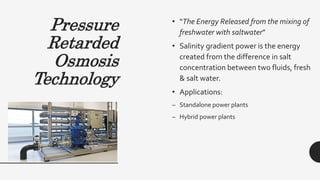
• “The Energy Released from the mixing of
freshwater with saltwater”
• Salinity gradient power is the energy
created from the difference in salt
concentration between two fluids, fresh
& salt water.
• Applications:
– Standalone power plants
– Hybrid power plants
Pressure
Retarded
Osmosis
Technology
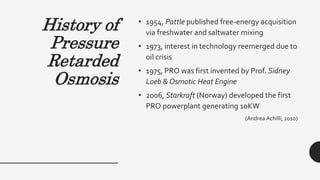
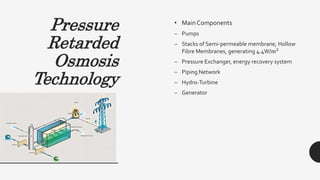
• Main Components
– Pumps
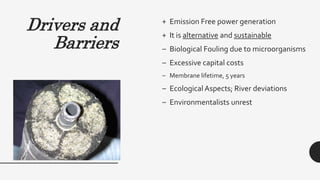
– Stacks of Semi-permeable membrane, Hollow
Fibre Membranes, generating 4.4W/m2
– Pressure Exchanger, energy recovery system
– Piping Network
– Hydro-Turbine
– Generator
Geographical
Power
Generation
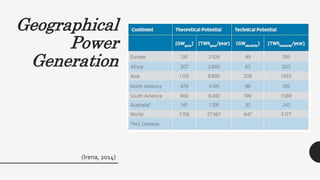
(Irena, 2014)
Economics • Membranes account up to 80% of capital costs
– EUR10/m2
-> EUR30/m2
– To be competitive (with other renewables) must be dropped
down to EUR2/m2 -> EUR5/m2
• For a 2MW plant, 2million m2 of membranes are
required
• Cost projections for 2020 EUR0.08/KWh to
EUR0.15/KWhr
(Irena, 2014)
Drivers and
Barriers
+ Emission Free power generation
+ It is alternative and sustainable
‒ Biological Fouling due to microorganisms
‒ Excessive capital costs
‒ Membrane lifetime, 5 years
‒ Ecological Aspects; River deviations
‒ Environmentalists unrest
Conclusion
• Infant technology
• Other SalinityGradientTechnology
– Reversed Electro Dialysis (RED)
– Osmotic Heat Engine
• Future trends…
Questions?
References
• Andrea Achilli, A. E. (2010). Pressure retarded osmosis: From the vision of Sidney
Loeb to the first prototype. Nevada: Elsevier.
• Fernanda Helfer, C. L. (N/D). Osmotic Power with Pressure Retarded Osmosis:
Theory, Performance and Trends – a Review. Southport.
• Irena. (2014). Salinity Gradient Energy, Technology Brief. IRENA (International
Renewable Energy Agency).

Pressure Retarded Osmosis

  • 1.
    PRESSURE RETARDED OSMOSIS By:Matthew Fenech Subject: Alternative Power Generation Lecturer: Ing.T. Darmanin
  • 2.
    Ocean Technology • Tidal Energy;Abundant but Untameable! – Unpredictable – Requires large control effort • CalmerWaters are also abundant in energy – Osmosis is the key! – Dealing with forward osmosis (not reverse)
  • 3.
    Theory of Operation • OsmoticPower, “A pressure that must be applied to the solution (sea water) to just prevent osmotic flow” • Harnessing energy where river freshwater and seawater meet • Seawater is pumped into a pressure exchanger where the osmotic pressure is less than that of the freshwater pressure
  • 4.
    Theory of Operation • Freshwater(solvent)flows through the semi-permeable membrane towards the seawater (solute) chamber and increases the mass and volume (Δh) – ButWhy? Water flows from a lower concentration to a higher concentration to equalize the concentration levels – Semi-permeable inhibiting salts to pass through the fresh water side • The head that is generated where generally heads of 120 - 270m (26Bar) are reached • Compared to a waterfall head, for hydro- power generation (Fernanda Helfer, N/D)
  • 5.
    History of Pressure Retarded Osmosis • 1954,Pattle published free-energy acquisition via freshwater and saltwater mixing • 1973, interest in technology reemerged due to oil crisis • 1975, PRO was first invented by Prof. Sidney Loeb & Osmotic Heat Engine • 2006, Starkraft (Norway) developed the first PRO powerplant generating 10KW (Andrea Achilli, 2010)
  • 6.
    Pressure Retarded Osmosis Technology • “The EnergyReleased from the mixing of freshwater with saltwater” • Salinity gradient power is the energy created from the difference in salt concentration between two fluids, fresh & salt water. • Applications: – Standalone power plants – Hybrid power plants
  • 7.
    Pressure Retarded Osmosis Technology • Main Components –Pumps – Stacks of Semi-permeable membrane, Hollow Fibre Membranes, generating 4.4W/m2 – Pressure Exchanger, energy recovery system – Piping Network – Hydro-Turbine – Generator
  • 8.
  • 9.
    Economics • Membranesaccount up to 80% of capital costs – EUR10/m2 -> EUR30/m2 – To be competitive (with other renewables) must be dropped down to EUR2/m2 -> EUR5/m2 • For a 2MW plant, 2million m2 of membranes are required • Cost projections for 2020 EUR0.08/KWh to EUR0.15/KWhr (Irena, 2014)
  • 10.
    Drivers and Barriers + EmissionFree power generation + It is alternative and sustainable ‒ Biological Fouling due to microorganisms ‒ Excessive capital costs ‒ Membrane lifetime, 5 years ‒ Ecological Aspects; River deviations ‒ Environmentalists unrest
  • 11.
    Conclusion • Infant technology •Other SalinityGradientTechnology – Reversed Electro Dialysis (RED) – Osmotic Heat Engine • Future trends…
  • 12.
  • 13.
    References • Andrea Achilli,A. E. (2010). Pressure retarded osmosis: From the vision of Sidney Loeb to the first prototype. Nevada: Elsevier. • Fernanda Helfer, C. L. (N/D). Osmotic Power with Pressure Retarded Osmosis: Theory, Performance and Trends – a Review. Southport. • Irena. (2014). Salinity Gradient Energy, Technology Brief. IRENA (International Renewable Energy Agency).

Editor's Notes

  • #3 Current renewable technologies in oceans make use of tidal energy generations; although it is abundant unfortunately it is untameable because we do not have an idea of the frequencies of operation that the waves offer Calmer waters, specifically near river mouths (where the river water goes into sea water) also have something to offer by making use of the concept of osmosis
  • #4 A very infant technology Osmotic Power by definition is the pressure that must be applied to the solution in our case seawater to just prevent osmotic flow We harness the energy where river freshwater and seawater meet by pumping the seawater into a pressure exchanger; the osmotic pressure is less than that of the freshwater To explain the concept of osmosis we have this diagram and two different concentrations of water are separated by a semi-permeable membrane. What happens is that the substance having the higher concentration of water (solvent) will flow through the membrane and into the lower water concentration mixture A change in liquid level will be evident and we know that a change in height will generate a head.
  • #5 In our case, freshwater flows through the semi permeable membrane towards the seawater which is the solute and increases the mass and volume hence as said a change in pressure. The semi-permeable membrane will only allow water to pass not salt Head generated can reach up between 120 to 270m comparable to a waterfall
  • #6 A brief history of this technology The concept was proposed in 1954 but it was in 1973 that it had been re-viewed due to the global oil crisis and later in 1975; PRO was invented by Sidney Loeb But it was in 2006 that a minor scale was used by Starkraft, Norway able to generate 10kW. Demonstrating on an electric kettle
  • #7 What can we expect from a PRO power plant As mentioned it produces electricity by the mixing of freshwater with saltwater; the salinity gradient present will create the energy from the difference in concentration of salts between the two fluids Plants may be standalone, located near river mouths Or else hybrid plants making use of the brine waste that factories outpout
  • #8 A typical plant is set up from Pumps; pumping the waters into the mixing chambers and pressure exchangers. The pressure exchanger is similar to the one we saw at Radisson used to compensate by using some of the output pressure and give it to the input freshwater Stacks of semi-permeable membranes which are similar to the ones used in Ros Piping network, hydo turbine (since large flow rates we can expect Kaplan or Francis Turbines and of course a generator to produce electricity
  • #9 Expected economics as proposed by the Institute of Renewable Energy Agency
  • #10 The most expensive part of this installation is the membranes themselves which account to 80% of the capital costs Currently they are about 10EUR to 30EUR per m2 but for them to be competitive with other renewables they must drop down to 2EUR to 5EUR so material and process technology must advance To give a rough idea a 2MW plant requires 2million m2 as proposed by IRENA so they would sum up roughly to 60Million Euros in membranes themselves
  • #11 Of course like any other system there are pros and cons First off we have an emission free power plant (excluding the pumping energy) It is alternative and sustainable