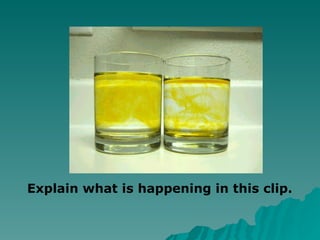
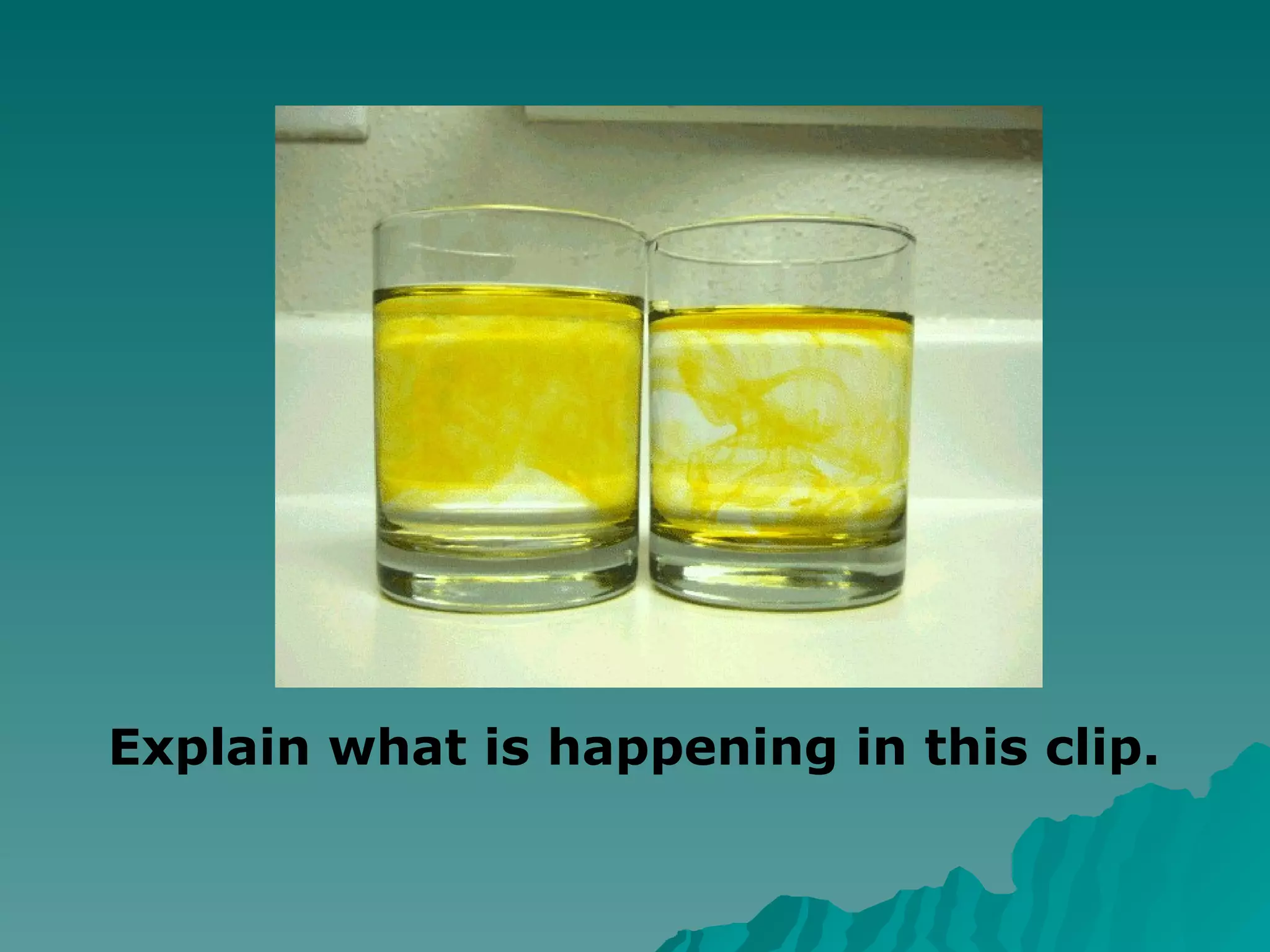
Explain what is happening in this clip.
Objective:   You will be able to explain how molecules move across a semi-permeable membrane due to a concentration gradient. Diffusion & Osmosis
Diffusion The movement of molecules from an area in which they are highly concentrated to an area in which they are less concentrated.
See an animation of diffusion here: http://lewis.eeb.uconn.edu/lewishome/applets/Diffusion/diffusion.html
How did the gummy bear lab illustrate diffusion?  Explain or draw a diagram
Osmosis The diffusion of  water  across a selectively permeable  membrane .
Did the gummy bear lab illustrate diffusion or osmosis?  Explain your answer
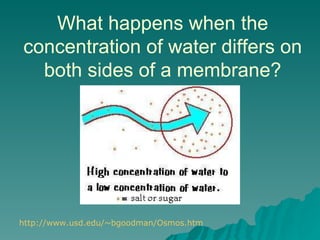
Osmosis    Water moves from a high concentration of water (less salt or sugar dissolved in it) to a low concentration of water (more salt or sugar dissolved in it).  This means that water would cross a selectively permeable membrane from a dilute solution (less dissolved in it) to a concentrated solution (more dissolved in it).
http://www.usd.edu/~bgoodman/Osmos.htm   What happens when the concentration of water differs on both sides of a membrane?
See an animation of osmosis here: http://lewis.eeb.uconn.edu/lewishome/applets/Osmosis/osmosis.html
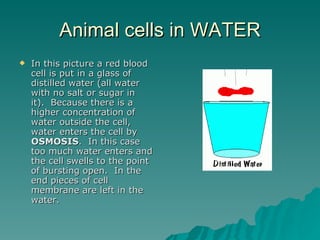
Animal cells in WATER In this picture a red blood cell is put in a glass of distilled water (all water with no salt or sugar in it).  Because there is a higher concentration of water outside the cell, water enters the cell by  OSMOSIS .  In this case too much water enters and the cell swells to the point of bursting open.  In the end pieces of cell membrane are left in the water.
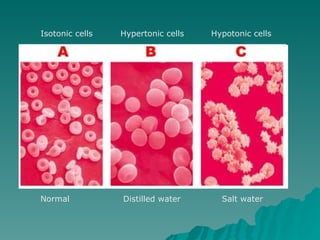
Normal Distilled water Salt water Isotonic cells Hypotonic cells Hypertonic cells
Define selectively permeable membrane
Selectively permeable membrane A membrane that allows only certain materials to cross it  Materials pass through  pores  in the membrane
For more information on diffusion & osmosis, click here: http://edtech.clas.pdx.edu/osmosis_tutorial/default.html
Why are osmosis & diffusion important?
Why are osmosis & diffusion important? All living things have certain requirements they must satisfy in order to remain alive – maintain  homeostasis These include exchanging gases (usually CO2 and O2), taking in water, minerals, and food, and eliminating wastes.  These tasks happen at the cellular level. Molecules move through the cell membrane by diffusion
Why are osmosis & diffusion important? All living things have certain requirements they must satisfy in order to remain alive. These include exchanging gases (usually CO2 and O2), taking in water, minerals, and food, and eliminating wastes. These tasks ultimately occur at the cellular level, and require that molecules move through the membrane that surrounds the cell.
Why are osmosis & diffusion important? This membrane is a complex structure that is responsible for separating the contents of the cell from its surroundings, for controlling the movement of materials into and out of the cell, and for interacting with the environment surrounding the cell.

Diffusion Osmosis

  • 1.
    Explain what ishappening in this clip.
  • 2.
    Objective: You will be able to explain how molecules move across a semi-permeable membrane due to a concentration gradient. Diffusion & Osmosis
  • 3.
    Diffusion The movementof molecules from an area in which they are highly concentrated to an area in which they are less concentrated.
  • 4.
    See an animationof diffusion here: http://lewis.eeb.uconn.edu/lewishome/applets/Diffusion/diffusion.html
  • 5.
    How did thegummy bear lab illustrate diffusion? Explain or draw a diagram
  • 6.
    Osmosis The diffusionof water across a selectively permeable membrane .
  • 7.
    Did the gummybear lab illustrate diffusion or osmosis? Explain your answer
  • 8.
    Osmosis   Water moves from a high concentration of water (less salt or sugar dissolved in it) to a low concentration of water (more salt or sugar dissolved in it).  This means that water would cross a selectively permeable membrane from a dilute solution (less dissolved in it) to a concentrated solution (more dissolved in it).
  • 9.
    http://www.usd.edu/~bgoodman/Osmos.htm What happens when the concentration of water differs on both sides of a membrane?
  • 10.
    See an animationof osmosis here: http://lewis.eeb.uconn.edu/lewishome/applets/Osmosis/osmosis.html
  • 11.
    Animal cells inWATER In this picture a red blood cell is put in a glass of distilled water (all water with no salt or sugar in it).  Because there is a higher concentration of water outside the cell, water enters the cell by OSMOSIS .  In this case too much water enters and the cell swells to the point of bursting open.  In the end pieces of cell membrane are left in the water.
  • 12.
    Normal Distilled waterSalt water Isotonic cells Hypotonic cells Hypertonic cells
  • 13.
  • 14.
    Selectively permeable membraneA membrane that allows only certain materials to cross it Materials pass through pores in the membrane
  • 15.
    For more informationon diffusion & osmosis, click here: http://edtech.clas.pdx.edu/osmosis_tutorial/default.html
  • 16.
    Why are osmosis& diffusion important?
  • 17.
    Why are osmosis& diffusion important? All living things have certain requirements they must satisfy in order to remain alive – maintain homeostasis These include exchanging gases (usually CO2 and O2), taking in water, minerals, and food, and eliminating wastes. These tasks happen at the cellular level. Molecules move through the cell membrane by diffusion
  • 18.
    Why are osmosis& diffusion important? All living things have certain requirements they must satisfy in order to remain alive. These include exchanging gases (usually CO2 and O2), taking in water, minerals, and food, and eliminating wastes. These tasks ultimately occur at the cellular level, and require that molecules move through the membrane that surrounds the cell.
  • 19.
    Why are osmosis& diffusion important? This membrane is a complex structure that is responsible for separating the contents of the cell from its surroundings, for controlling the movement of materials into and out of the cell, and for interacting with the environment surrounding the cell.