Reportedby:
Mr.JoeyC.Ajera
MAT–GenSci
Objectives:
1.) toexplainand understandtheprocess ofOsmosis;
2.) to differentiate hypertonic, hypotonic and isotonic
solutions;
3.) enumerate some importantapplicationsofOsmosis;
MENU
(Topicsto be discussed)
• What is Osmosis?
• Osmosis vs. Diffusion
• Terms used inOsmosis
• Applicationsof Osmosis
• Osmotic Pressure
What is Osmosis?
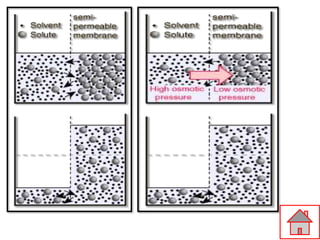
It is the spontaneous net movement of a solvent
like water, across a semipermeable membrane from a
less concentrated solution into a more concentrated
one, thus equalizing the concentrations on each side of
themembrane.
Both are processes that equalize the concentration of
two solutions but both differ in their nature and process.
Diffusion involves solvent and solute particles to move
to equalize concentrations from lower to higher
concentrations. But no semi-permeable membrane is involved.
It mainly occurs in gaseous state or within gas molecules and
liquid molecules and usually does not need water for
movement.
How does osmosis differ from diffusion?
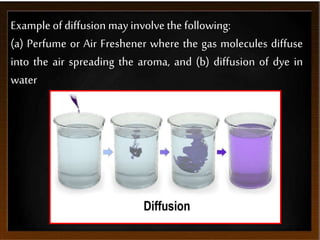
Example of diffusion may involve the following:
(a) Perfume or Air Freshener where the gas molecules diffuse
into the air spreading the aroma, and (b) diffusion of dye in
water
On the other hand, in osmosis, only solvent particles
move. Solute particles tend not to move and the movement is
through the semi-permeable membrane. It may require liquids
for movement and a semi-permeable membrane.
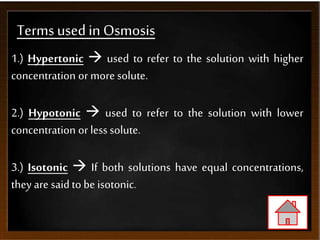
Terms usedin Osmosis
1.) Hypertonic  used to refer to the solution with higher
concentration or more solute.
2.) Hypotonic  used to refer to the solution with lower
concentration or less solute.
3.) Isotonic  If both solutions have equal concentrations,
they are saidto be isotonic.
Applicationsof Osmosis
So where can we usually use osmosis?How can human
andother living organisms benefit from the concept of
osmosis?
1. It assistsplants in receiving water.
2. It helps in the preservation of fruit andmeat.
3. It is used inkidney dialysis.
4. It can be reversed to remove saltandother impurities from
water.
5. Osmotic generation of power.
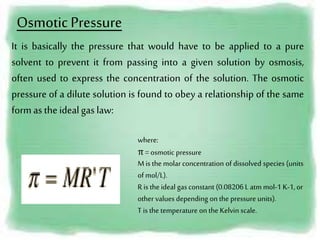
Osmotic Pressure
It is basically the pressure that would have to be applied to a pure
solvent to prevent it from passing into a given solution by osmosis,
often used to express the concentration of the solution. The osmotic
pressure of a dilute solution is found to obey a relationship of the same
formastheidealgas law:
where:
π = osmotic pressure
M is the molar concentration of dissolved species (units
of mol/L).
R is the ideal gasconstant (0.08206 L atm mol-1 K-1, or
other values depending on the pressure units).
T is the temperature on the Kelvin scale.
Problem 1:
What is the osmotic pressure of a solution
prepared by adding 13.65 g of sucrose
(C12H22O11) to enough water to make 250 mL of
solution at 25 °C?
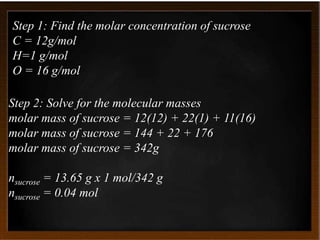
Step 1: Find the molar concentration of sucrose
C = 12g/mol
H=1 g/mol
O = 16 g/mol
Step 2: Solve for the molecular masses
molar mass of sucrose = 12(12) + 22(1) + 11(16)
molar mass of sucrose = 144 + 22 + 176
molar mass of sucrose = 342g
nsucrose = 13.65 g x 1 mol/342 g
nsucrose = 0.04 mol
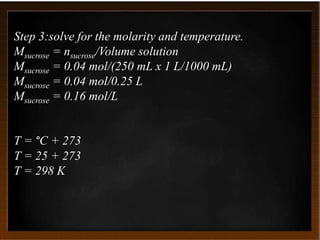
Step 3:solve for the molarity and temperature.
Msucrose = nsucrose/Volume solution
Msucrose = 0.04 mol/(250 mL x 1 L/1000 mL)
Msucrose = 0.04 mol/0.25 L
Msucrose = 0.16 mol/L
T = °C + 273
T = 25 + 273
T = 298 K
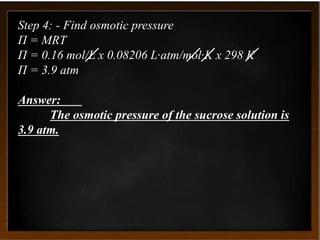
Step 4: - Find osmotic pressure
Π = MRT
Π = 0.16 mol/L x 0.08206 L·atm/mol·K x 298 K
Π = 3.9 atm
Answer:
The osmotic pressure of the sucrose solution is
3.9 atm.
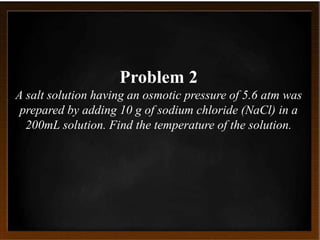
Problem 2
A salt solution having an osmotic pressure of 5.6 atm was
prepared by adding 10 g of sodium chloride (NaCl) in a
200mL solution. Find the temperature of the solution.
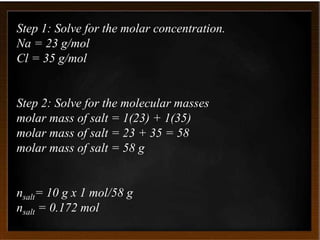
Step 1: Solve for the molar concentration.
Na = 23 g/mol
Cl = 35 g/mol
Step 2: Solve for the molecular masses
molar mass of salt = 1(23) + 1(35)
molar mass of salt = 23 + 35 = 58
molar mass of salt = 58 g
nsalt= 10 g x 1 mol/58 g
nsalt = 0.172 mol
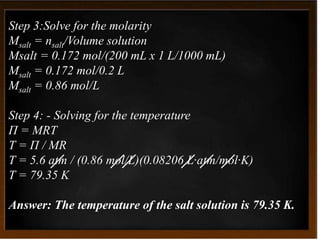
Step 3:Solve for the molarity
Msalt = nsalt/Volume solution
Msalt = 0.172 mol/(200 mL x 1 L/1000 mL)
Msalt = 0.172 mol/0.2 L
Msalt = 0.86 mol/L
Step 4: - Solving for the temperature
Π = MRT
T = Π / MR
T = 5.6 atm / (0.86 mol/L)(0.08206 L·atm/mol·K)
T = 79.35 K
Answer: The temperature of the salt solution is 79.35 K.
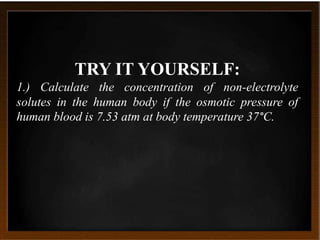
TRY IT YOURSELF:
1.) Calculate the concentration of non-electrolyte
solutes in the human body if the osmotic pressure of
human blood is 7.53 atm at body temperature 37°C.
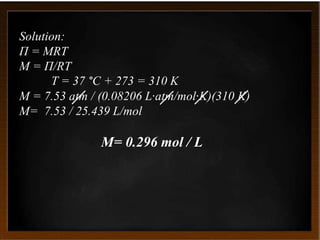
Solution:
Π = MRT
M = Π/RT
T = 37 °C + 273 = 310 K
M = 7.53 atm / (0.08206 L·atm/mol·K)(310 K)
M= 7.53 / 25.439 L/mol
M= 0.296 mol / L
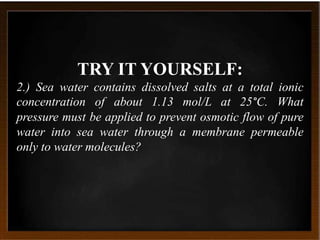
TRY IT YOURSELF:
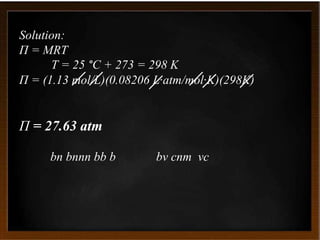
2.) Sea water contains dissolved salts at a total ionic
concentration of about 1.13 mol/L at 25°C. What
pressure must be applied to prevent osmotic flow of pure
water into sea water through a membrane permeable
only to water molecules?
Solution:
Π = MRT
T = 25 °C + 273 = 298 K
Π = (1.13 mol/L)(0.08206 L·atm/mol·K)(298K)
Π = 27.63 atm
bn bnnn bb b bv cnm vc

About Osmosis

  • 1.
  • 2.
    Objectives: 1.) toexplainand understandtheprocessofOsmosis; 2.) to differentiate hypertonic, hypotonic and isotonic solutions; 3.) enumerate some importantapplicationsofOsmosis;
  • 3.
    MENU (Topicsto be discussed) •What is Osmosis? • Osmosis vs. Diffusion • Terms used inOsmosis • Applicationsof Osmosis • Osmotic Pressure
  • 4.
    What is Osmosis? Itis the spontaneous net movement of a solvent like water, across a semipermeable membrane from a less concentrated solution into a more concentrated one, thus equalizing the concentrations on each side of themembrane.
  • 5.
    Both are processesthat equalize the concentration of two solutions but both differ in their nature and process. Diffusion involves solvent and solute particles to move to equalize concentrations from lower to higher concentrations. But no semi-permeable membrane is involved. It mainly occurs in gaseous state or within gas molecules and liquid molecules and usually does not need water for movement. How does osmosis differ from diffusion?
  • 6.
    Example of diffusionmay involve the following: (a) Perfume or Air Freshener where the gas molecules diffuse into the air spreading the aroma, and (b) diffusion of dye in water
  • 7.
    On the otherhand, in osmosis, only solvent particles move. Solute particles tend not to move and the movement is through the semi-permeable membrane. It may require liquids for movement and a semi-permeable membrane.
  • 9.
    Terms usedin Osmosis 1.)Hypertonic  used to refer to the solution with higher concentration or more solute. 2.) Hypotonic  used to refer to the solution with lower concentration or less solute. 3.) Isotonic  If both solutions have equal concentrations, they are saidto be isotonic.
  • 10.
    Applicationsof Osmosis So wherecan we usually use osmosis?How can human andother living organisms benefit from the concept of osmosis? 1. It assistsplants in receiving water. 2. It helps in the preservation of fruit andmeat. 3. It is used inkidney dialysis. 4. It can be reversed to remove saltandother impurities from water. 5. Osmotic generation of power.
  • 11.
    Osmotic Pressure It isbasically the pressure that would have to be applied to a pure solvent to prevent it from passing into a given solution by osmosis, often used to express the concentration of the solution. The osmotic pressure of a dilute solution is found to obey a relationship of the same formastheidealgas law: where: π = osmotic pressure M is the molar concentration of dissolved species (units of mol/L). R is the ideal gasconstant (0.08206 L atm mol-1 K-1, or other values depending on the pressure units). T is the temperature on the Kelvin scale.
  • 12.
    Problem 1: What isthe osmotic pressure of a solution prepared by adding 13.65 g of sucrose (C12H22O11) to enough water to make 250 mL of solution at 25 °C?
  • 13.
    Step 1: Findthe molar concentration of sucrose C = 12g/mol H=1 g/mol O = 16 g/mol Step 2: Solve for the molecular masses molar mass of sucrose = 12(12) + 22(1) + 11(16) molar mass of sucrose = 144 + 22 + 176 molar mass of sucrose = 342g nsucrose = 13.65 g x 1 mol/342 g nsucrose = 0.04 mol
  • 14.
    Step 3:solve forthe molarity and temperature. Msucrose = nsucrose/Volume solution Msucrose = 0.04 mol/(250 mL x 1 L/1000 mL) Msucrose = 0.04 mol/0.25 L Msucrose = 0.16 mol/L T = °C + 273 T = 25 + 273 T = 298 K
  • 15.
    Step 4: -Find osmotic pressure Π = MRT Π = 0.16 mol/L x 0.08206 L·atm/mol·K x 298 K Π = 3.9 atm Answer: The osmotic pressure of the sucrose solution is 3.9 atm.
  • 16.
    Problem 2 A saltsolution having an osmotic pressure of 5.6 atm was prepared by adding 10 g of sodium chloride (NaCl) in a 200mL solution. Find the temperature of the solution.
  • 17.
    Step 1: Solvefor the molar concentration. Na = 23 g/mol Cl = 35 g/mol Step 2: Solve for the molecular masses molar mass of salt = 1(23) + 1(35) molar mass of salt = 23 + 35 = 58 molar mass of salt = 58 g nsalt= 10 g x 1 mol/58 g nsalt = 0.172 mol
  • 18.
    Step 3:Solve forthe molarity Msalt = nsalt/Volume solution Msalt = 0.172 mol/(200 mL x 1 L/1000 mL) Msalt = 0.172 mol/0.2 L Msalt = 0.86 mol/L Step 4: - Solving for the temperature Π = MRT T = Π / MR T = 5.6 atm / (0.86 mol/L)(0.08206 L·atm/mol·K) T = 79.35 K Answer: The temperature of the salt solution is 79.35 K.
  • 19.
    TRY IT YOURSELF: 1.)Calculate the concentration of non-electrolyte solutes in the human body if the osmotic pressure of human blood is 7.53 atm at body temperature 37°C.
  • 20.
    Solution: Π = MRT M= Π/RT T = 37 °C + 273 = 310 K M = 7.53 atm / (0.08206 L·atm/mol·K)(310 K) M= 7.53 / 25.439 L/mol M= 0.296 mol / L
  • 21.
    TRY IT YOURSELF: 2.)Sea water contains dissolved salts at a total ionic concentration of about 1.13 mol/L at 25°C. What pressure must be applied to prevent osmotic flow of pure water into sea water through a membrane permeable only to water molecules?
  • 22.
    Solution: Π = MRT T= 25 °C + 273 = 298 K Π = (1.13 mol/L)(0.08206 L·atm/mol·K)(298K) Π = 27.63 atm bn bnnn bb b bv cnm vc