OSMOTIC POWER
Professor: Eth Oudaya
Group 01: I4GEE-EE_01
Students:
CHAN Hangthong
CHEA Kimsairng
CHHAY Lyheang
CHHIN Piden
2015-2016 1
Power consumption has been increased enormously across the
world so the power generation should be increased. There are
many ways of power generation.
Some of them leads to environment pollution. So, non
conventional power plants must be encouraged.
2
HYDRO
WINDGEOTHERMAL
SOLAR
SOME TYPE OF NON CONVENTIONAL POWER PLANTS
3
All power plants shown above are effected by the climatic conditions.
Cannot be operated through out year
A new type of power plant which is non conventional and can be operated 24/7 is
OSMOTIC POWER PLANT.
4
What is osmotic power?
Osmotic power is generated by exploiting the pressure difference created
across the semi permeable membrane when two solutions of different
solute concentration are separated by the same.
5
PRINCIPLE OF OSMOSIS:
Pressure retarded osmosis
Osmosis means passages of water from a region of high water concentration (often
freshwater) through a semi permeable membrane to a region of low water
concentration ( often Nacl).
The membrane only lets water molecules pass. Salt molecules, sand, slit and other
contaminants are prevented to do so.
6
PLANT LOCATION OSMOTIC POWER PLANT
• Osmotic power plant is build where theirs is abundant supply of fresh and salt water
– The river delta.
• Almost all major cities if the world are located at the banks of river delta. Hence unlike
other renewable sources like Hydroelectric power, the osmotic plant will be situated
very near to the load centers.
River Fresh Water and Salt water mixing Osmotic Power Plant
7
OSMOTIC POWER PROTOTYPE
The Osmotic Power prototype
located at Norway
8
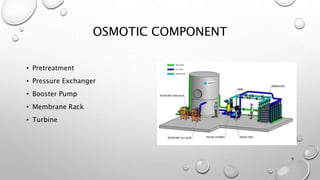
OSMOTIC COMPONENT
• Pretreatment
• Pressure Exchanger
• Booster Pump
• Membrane Rack
• Turbine
9
10
WORKING
When a semi permeable membrane kept between the reservoirs containing fresh
water and sea water respectively, a net flow of water to salt water side is observed
because of osmosis. If salt water compartment has fixed volume, the pressure will
rise to a theoretical maximum of 26 bars of pressure that equals to about 270
meters of water column.
11
12
PLANT CAPACITY
By practical experience it is observed that in order to achieve 1MW of energy one
cubic meters of fresh water(per second) is mixed with two cubic meters of sea
water 12 bars. The initial pressure is provided by the pressure exchanger that
connects the outlet and the sea water inlet.
13
POWER GENERATION POTENTIAL.
• The global potential is estimated to be 1,600-1,700 Twh – equivalent to 50% of
EU’s total annual power generation today. In Norway alone, it would be able to
generate 12 Twh per year –equivalent to around 10% of our total power
consumption. Osmotic power can become an important contributor to the
generation of clean, renewable energy.
• According to osmotic power, the power will be available to you if you maintain a
salt gradient between waters no matter what the topography is.
14
ADVANTAGES OF OSMOTIC POWER
It is renewable.
There‘s no risk of running out of salt because of osmotic power produced.
 There is no carbon dioxide or no greenhouse gases emission
It is very ‘clean’ process.
If there‘s a salt gradient then power will be
It produces electricity reliably
High efficiency 15
DISADVANTAGES
Osmotic energy is high upfront costs.
You will need to find a way to connect the electricity to the grid.
The average salinity inside the basin decreases, also affecting the ecosystem.
Effects on marine life during construction phases.
 Hard to find location.
It needs energy to generate
16
CONCLUSION
Osmotic power plants can be constructed anywhere freshwater flows out
into the sea, provided that the salt concentration is sufficiently high. Unlike solar
power and wind power, osmotic power plants are not affected by fluctuations in the
weather and will produce continuous and predictable electricity. Most river outlets
around the world represent a potential location for a plant, even though some rivers
need more cleaning of the water than others.
17
18
19

Omotic

  • 1.
    OSMOTIC POWER Professor: EthOudaya Group 01: I4GEE-EE_01 Students: CHAN Hangthong CHEA Kimsairng CHHAY Lyheang CHHIN Piden 2015-2016 1
  • 2.
    Power consumption hasbeen increased enormously across the world so the power generation should be increased. There are many ways of power generation. Some of them leads to environment pollution. So, non conventional power plants must be encouraged. 2
  • 3.
    HYDRO WINDGEOTHERMAL SOLAR SOME TYPE OFNON CONVENTIONAL POWER PLANTS 3
  • 4.
    All power plantsshown above are effected by the climatic conditions. Cannot be operated through out year A new type of power plant which is non conventional and can be operated 24/7 is OSMOTIC POWER PLANT. 4
  • 5.
    What is osmoticpower? Osmotic power is generated by exploiting the pressure difference created across the semi permeable membrane when two solutions of different solute concentration are separated by the same. 5
  • 6.
    PRINCIPLE OF OSMOSIS: Pressureretarded osmosis Osmosis means passages of water from a region of high water concentration (often freshwater) through a semi permeable membrane to a region of low water concentration ( often Nacl). The membrane only lets water molecules pass. Salt molecules, sand, slit and other contaminants are prevented to do so. 6
  • 7.
    PLANT LOCATION OSMOTICPOWER PLANT • Osmotic power plant is build where theirs is abundant supply of fresh and salt water – The river delta. • Almost all major cities if the world are located at the banks of river delta. Hence unlike other renewable sources like Hydroelectric power, the osmotic plant will be situated very near to the load centers. River Fresh Water and Salt water mixing Osmotic Power Plant 7
  • 8.
    OSMOTIC POWER PROTOTYPE TheOsmotic Power prototype located at Norway 8
  • 9.
    OSMOTIC COMPONENT • Pretreatment •Pressure Exchanger • Booster Pump • Membrane Rack • Turbine 9
  • 10.
  • 11.
    WORKING When a semipermeable membrane kept between the reservoirs containing fresh water and sea water respectively, a net flow of water to salt water side is observed because of osmosis. If salt water compartment has fixed volume, the pressure will rise to a theoretical maximum of 26 bars of pressure that equals to about 270 meters of water column. 11
  • 12.
  • 13.
    PLANT CAPACITY By practicalexperience it is observed that in order to achieve 1MW of energy one cubic meters of fresh water(per second) is mixed with two cubic meters of sea water 12 bars. The initial pressure is provided by the pressure exchanger that connects the outlet and the sea water inlet. 13
  • 14.
    POWER GENERATION POTENTIAL. •The global potential is estimated to be 1,600-1,700 Twh – equivalent to 50% of EU’s total annual power generation today. In Norway alone, it would be able to generate 12 Twh per year –equivalent to around 10% of our total power consumption. Osmotic power can become an important contributor to the generation of clean, renewable energy. • According to osmotic power, the power will be available to you if you maintain a salt gradient between waters no matter what the topography is. 14
  • 15.
    ADVANTAGES OF OSMOTICPOWER It is renewable. There‘s no risk of running out of salt because of osmotic power produced.  There is no carbon dioxide or no greenhouse gases emission It is very ‘clean’ process. If there‘s a salt gradient then power will be It produces electricity reliably High efficiency 15
  • 16.
    DISADVANTAGES Osmotic energy ishigh upfront costs. You will need to find a way to connect the electricity to the grid. The average salinity inside the basin decreases, also affecting the ecosystem. Effects on marine life during construction phases.  Hard to find location. It needs energy to generate 16
  • 17.
    CONCLUSION Osmotic power plantscan be constructed anywhere freshwater flows out into the sea, provided that the salt concentration is sufficiently high. Unlike solar power and wind power, osmotic power plants are not affected by fluctuations in the weather and will produce continuous and predictable electricity. Most river outlets around the world represent a potential location for a plant, even though some rivers need more cleaning of the water than others. 17
  • 18.
  • 19.