INTRODUCTION
• Tissue engineering is the use of a combination
of cells, engineering, and materials methods, and
suitable biochemical and physico-chemical factors to
improve or replace biological tissues.
• Tissue engineering involves the use of a tissue
scaffold for the formation of new viable tissue for a
medical purpose. While it was once categorized as a
sub-field of biomaterials, having grown in scope and
importance it can be considered as a field in its own.
• For example :-
• 1- Using fibroblast in skin replacement or repair
• 2- Cartilage is repaired with living chondrocytes`.
EXAMPLES
• Regenerating a human ear using a scaffold
• In vitro meat
• Bio artificial liver device
• Artificial pancreas
• Artificial bladders
• Cartilage: lab-grown tissue was successfully used to repair
knee cartilage.
• Artificial skin constructed from human skin cells embedded
in a hydrogel, such as in the case of bioprinted constructs
for battlefield burn repairs.
• Artificial bone marrow
• Artificial bone
• Oral mucosa tissue engineering
• Foreskin
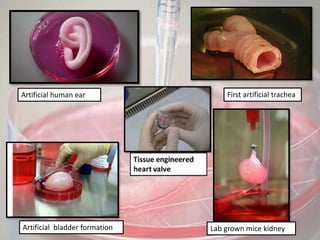
Artificial human ear First artificial trachea
Artificial bladder formation Lab grown mice kidney
Steps of tissue engineering
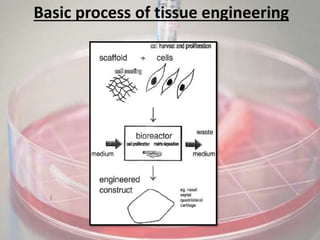
• Step 1. Get tissue sample(cells) from the
body(Biopsy)
• Step 2. Grow cells into new tissues( Cell
isolation and cultivation, scaffolds, seeding)
• Step 3. Implanting new tissues (Implantation ,
detection).
Basic process of tissue engineering
Step 1. – Getting tissue sample
• Patient own cells
• The tissue of interest are taken
• Then the researchers break the tissues
Step 2. – Growing cells into new
tissues
• After breaking the tissue into smaller units that is into cells ,
the cells need structure , nutrient and oxygen.
• The above requirements of the cell is fulfilled by Scaffold.
• Scaffold help in the regeneration process of the cells.
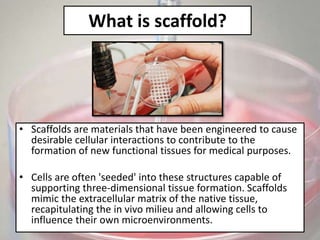
What is scaffold?
• Scaffolds are materials that have been engineered to cause
desirable cellular interactions to contribute to the
formation of new functional tissues for medical purposes.
• Cells are often 'seeded' into these structures capable of
supporting three-dimensional tissue formation. Scaffolds
mimic the extracellular matrix of the native tissue,
recapitulating the in vivo milieu and allowing cells to
influence their own microenvironments.
• Functions of scaffolds:-
• Allow cell attachment and migration
• Deliver and retain cells and biochemical factors
• Enable diffusion of vital cell nutrients and expressed
products
• Exert certain mechanical and biological influences to
modify the behaviour of the cell phase.
• Scaffolds provide mechanical and shape stability to
the tissue defect.
Different types of scaffolds
PLA scaffold
PCL scaffold
UBM scaffold PMMA scaffold
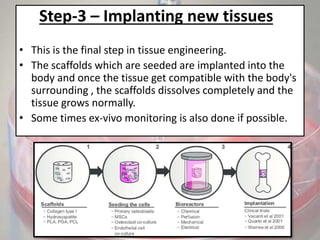
Step-3 – Implanting new tissues
• This is the final step in tissue engineering.
• The scaffolds which are seeded are implanted into the
body and once the tissue get compatible with the body's
surrounding , the scaffolds dissolves completely and the
tissue grows normally.
• Some times ex-vivo monitoring is also done if possible.
Applications of tissue engineering
• 1. Breast reconstruction
• 2.Cardio vascular system
a) Cardiac tissue engineering
b) Blood vessels
c) Heart valve
• Musculoskeletal system
a) Bone regeneration
b) Bone and cartilage reconstruction
• Artificial skin
• Artificial production of organs. Ex :- Ear, kidney , liver
etc.
Advantages
• Help to cure diseases like diseases related to
bone marrow.
• The patient don’t have to wait for the donor.
• Permanent solution.
• Success rate is high .
• A distinctive feature of tissue engineering is to
regenerate patient's own tissues and organs that
are entirely free of poor biocompatibility and low
bio functionality as well as severe immune
rejection.
Disadvantages
• It’s a time taking process.
• Expensive practice to do.
• This technique is not developed well.
• Ethical issues.
• Requires a lot of knowledge about the organs
to practice on complex organisms
• Irreversible process
• Risk in commercialization .
Ethical problems
• Role of cell bank (privacy of donor).
• Organ trafficking
• Use of human embryonic cell:-unethical to use
human embryo and aborted fetus.
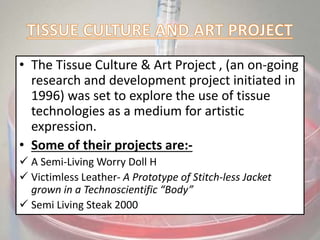
• The Tissue Culture & Art Project , (an on-going
research and development project initiated in
1996) was set to explore the use of tissue
technologies as a medium for artistic
expression.
• Some of their projects are:-
 A Semi-Living Worry Doll H
 Victimless Leather- A Prototype of Stitch-less Jacket
grown in a Technoscientific “Body”
 Semi Living Steak 2000
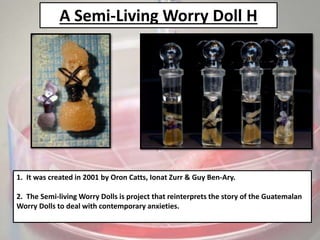
A Semi-Living Worry Doll H
1. It was created in 2001 by Oron Catts, Ionat Zurr & Guy Ben-Ary.
2. The Semi-living Worry Dolls is project that reinterprets the story of the Guatemalan
Worry Dolls to deal with contemporary anxieties.
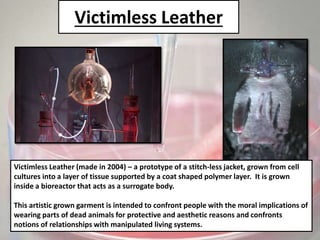
Victimless Leather
Victimless Leather (made in 2004) – a prototype of a stitch-less jacket, grown from cell
cultures into a layer of tissue supported by a coat shaped polymer layer. It is grown
inside a bioreactor that acts as a surrogate body.
This artistic grown garment is intended to confront people with the moral implications of
wearing parts of dead animals for protective and aesthetic reasons and confronts
notions of relationships with manipulated living systems.
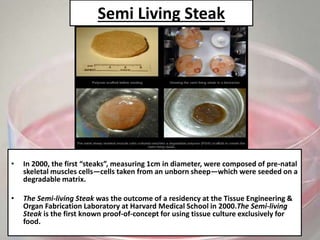
Semi Living Steak
• In 2000, the first “steaks”, measuring 1cm in diameter, were composed of pre-natal
skeletal muscles cells—cells taken from an unborn sheep—which were seeded on a
degradable matrix.
• The Semi-living Steak was the outcome of a residency at the Tissue Engineering &
Organ Fabrication Laboratory at Harvard Medical School in 2000.The Semi-living
Steak is the first known proof-of-concept for using tissue culture exclusively for
food.
Organ and tissue engineering,examples,

Organ and tissue engineering,examples,

  • 2.
    INTRODUCTION • Tissue engineeringis the use of a combination of cells, engineering, and materials methods, and suitable biochemical and physico-chemical factors to improve or replace biological tissues. • Tissue engineering involves the use of a tissue scaffold for the formation of new viable tissue for a medical purpose. While it was once categorized as a sub-field of biomaterials, having grown in scope and importance it can be considered as a field in its own. • For example :- • 1- Using fibroblast in skin replacement or repair • 2- Cartilage is repaired with living chondrocytes`.
  • 3.
    EXAMPLES • Regenerating ahuman ear using a scaffold • In vitro meat • Bio artificial liver device • Artificial pancreas • Artificial bladders • Cartilage: lab-grown tissue was successfully used to repair knee cartilage. • Artificial skin constructed from human skin cells embedded in a hydrogel, such as in the case of bioprinted constructs for battlefield burn repairs. • Artificial bone marrow • Artificial bone • Oral mucosa tissue engineering • Foreskin
  • 4.
    Artificial human earFirst artificial trachea Artificial bladder formation Lab grown mice kidney
  • 5.
    Steps of tissueengineering • Step 1. Get tissue sample(cells) from the body(Biopsy) • Step 2. Grow cells into new tissues( Cell isolation and cultivation, scaffolds, seeding) • Step 3. Implanting new tissues (Implantation , detection).
  • 6.
    Basic process oftissue engineering
  • 7.
    Step 1. –Getting tissue sample • Patient own cells • The tissue of interest are taken • Then the researchers break the tissues Step 2. – Growing cells into new tissues • After breaking the tissue into smaller units that is into cells , the cells need structure , nutrient and oxygen. • The above requirements of the cell is fulfilled by Scaffold. • Scaffold help in the regeneration process of the cells.
  • 8.
    What is scaffold? •Scaffolds are materials that have been engineered to cause desirable cellular interactions to contribute to the formation of new functional tissues for medical purposes. • Cells are often 'seeded' into these structures capable of supporting three-dimensional tissue formation. Scaffolds mimic the extracellular matrix of the native tissue, recapitulating the in vivo milieu and allowing cells to influence their own microenvironments.
  • 9.
    • Functions ofscaffolds:- • Allow cell attachment and migration • Deliver and retain cells and biochemical factors • Enable diffusion of vital cell nutrients and expressed products • Exert certain mechanical and biological influences to modify the behaviour of the cell phase. • Scaffolds provide mechanical and shape stability to the tissue defect.
  • 10.
    Different types ofscaffolds PLA scaffold PCL scaffold UBM scaffold PMMA scaffold
  • 11.
    Step-3 – Implantingnew tissues • This is the final step in tissue engineering. • The scaffolds which are seeded are implanted into the body and once the tissue get compatible with the body's surrounding , the scaffolds dissolves completely and the tissue grows normally. • Some times ex-vivo monitoring is also done if possible.
  • 12.
    Applications of tissueengineering • 1. Breast reconstruction • 2.Cardio vascular system a) Cardiac tissue engineering b) Blood vessels c) Heart valve • Musculoskeletal system a) Bone regeneration b) Bone and cartilage reconstruction • Artificial skin • Artificial production of organs. Ex :- Ear, kidney , liver etc.
  • 13.
    Advantages • Help tocure diseases like diseases related to bone marrow. • The patient don’t have to wait for the donor. • Permanent solution. • Success rate is high . • A distinctive feature of tissue engineering is to regenerate patient's own tissues and organs that are entirely free of poor biocompatibility and low bio functionality as well as severe immune rejection.
  • 14.
    Disadvantages • It’s atime taking process. • Expensive practice to do. • This technique is not developed well. • Ethical issues. • Requires a lot of knowledge about the organs to practice on complex organisms • Irreversible process • Risk in commercialization .
  • 15.
    Ethical problems • Roleof cell bank (privacy of donor). • Organ trafficking • Use of human embryonic cell:-unethical to use human embryo and aborted fetus.
  • 17.
    • The TissueCulture & Art Project , (an on-going research and development project initiated in 1996) was set to explore the use of tissue technologies as a medium for artistic expression. • Some of their projects are:-  A Semi-Living Worry Doll H  Victimless Leather- A Prototype of Stitch-less Jacket grown in a Technoscientific “Body”  Semi Living Steak 2000
  • 18.
    A Semi-Living WorryDoll H 1. It was created in 2001 by Oron Catts, Ionat Zurr & Guy Ben-Ary. 2. The Semi-living Worry Dolls is project that reinterprets the story of the Guatemalan Worry Dolls to deal with contemporary anxieties.
  • 19.
    Victimless Leather Victimless Leather(made in 2004) – a prototype of a stitch-less jacket, grown from cell cultures into a layer of tissue supported by a coat shaped polymer layer. It is grown inside a bioreactor that acts as a surrogate body. This artistic grown garment is intended to confront people with the moral implications of wearing parts of dead animals for protective and aesthetic reasons and confronts notions of relationships with manipulated living systems.
  • 20.
    Semi Living Steak •In 2000, the first “steaks”, measuring 1cm in diameter, were composed of pre-natal skeletal muscles cells—cells taken from an unborn sheep—which were seeded on a degradable matrix. • The Semi-living Steak was the outcome of a residency at the Tissue Engineering & Organ Fabrication Laboratory at Harvard Medical School in 2000.The Semi-living Steak is the first known proof-of-concept for using tissue culture exclusively for food.