Course Work seminar
On
Tissue Engineering: Scaffold Materials
Presented by:
Sweta Naik
Roll no-17312004
Ph.D. Scholar
Supervisor:
Dr J Satya Eswari
Introduction
“Tissue engineering is an emerging interdisciplinary field that applies the principles of
biology and engineering to the development of viable substitutes that restore, maintain
or improve the function of human tissues.”
An interdisciplinary field that applies the principles of engineering and life sciences
toward the development of biological substitutes that restore, maintain, or improve
tissue function or a whole organ.
OR
Tissue engineering and Regenerative Medicine
1.Regenerative medicine - Innovative medical therapies that will enable the body to
repair, replace, restore and regenerate damaged or diseased cells, tissues and organs.
2.Tools and Procedures for Regenerative medicine
• Tissue engineering : Tissue Repair/Replacement and Lab Grown Organs
• Technologies:
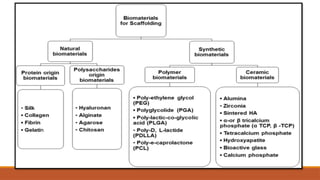
 Natural and Synthetic Scaffolds
 Stem cell therapy
 3-D Printing and Chip Technologies
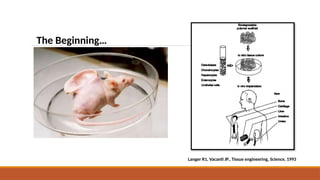
Langer R1, Vacanti JP., Tissue engineering, Science, 1993
The Beginning…
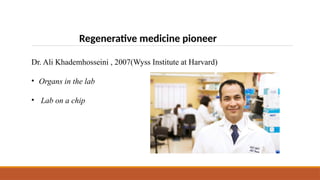
Regenerative medicine pioneer
Dr. Ali Khademhosseini , 2007(Wyss Institute at Harvard)
• Organs in the lab
• Lab on a chip
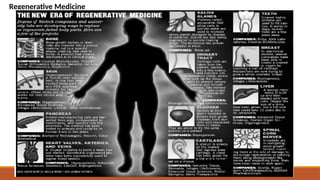
Regenerative Medicine
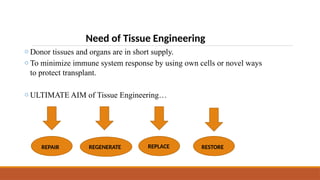
Need of Tissue Engineering
o Donor tissues and organs are in short supply.
o To minimize immune system response by using own cells or novel ways
to protect transplant.
o ULTIMATE AIM of Tissue Engineering…
REPAIR REGENERATE REPLACE RESTORE
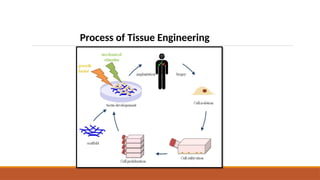
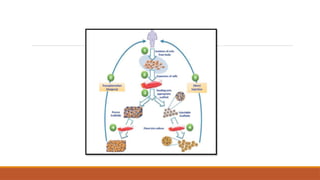
Process of Tissue Engineering
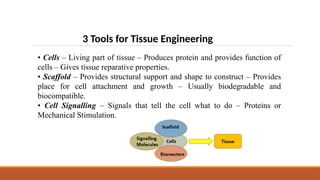
3 Tools for Tissue Engineering
• Cells – Living part of tissue – Produces protein and provides function of
cells – Gives tissue reparative properties.
• Scaffold – Provides structural support and shape to construct – Provides
place for cell attachment and growth – Usually biodegradable and
biocompatible.
• Cell Signalling – Signals that tell the cell what to do – Proteins or
Mechanical Stimulation.
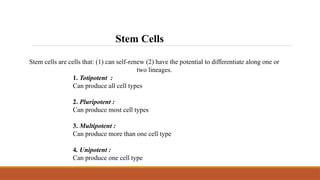
Stem Cells
Stem cells are cells that: (1) can self-renew (2) have the potential to differentiate along one or
two lineages.
1. Totipotent :
Can produce all cell types
2. Pluripotent :
Can produce most cell types
3. Multipotent :
Can produce more than one cell type
4. Unipotent :
Can produce one cell type
Current Clinical Status
Patients are mainly treated surgically by grafting methods, by three ways- Autograft, allograft and xenograft.
Grafting
method
Meaning Remark/ Drawbacks
Autograft To move tissue from one site to
another in the body
Patient is already suffering from disease, thus
grafting in the same body will be very painful and
might lead to graft failure.
In old age patients, the grafted cells/ tissues might
not regenerate after harvest.
Allograft From another person (same
species)
This method suffers from issues like, Donor scarcity
and immune rejection.
The donor should be disease free.
Xenograft Tissue/organ taken from other
species
Problems like biocompatibility and immune rejection
are common in this method. Moreover animal tissues
are more prone to contamination than human tissues,
so after grafting the chances of infection persist.
Scaffold: Concept and functions
 Definition: It is a synthetic support material used to replace part of a living
system or to function in contact with living tissue.
 Materials for Biomedical Application
 Scaffolds are 3D platforms for tissue engineering
 Used clinically or experimentally in implantable electronic devices, drug
delivery systems, hybrid artificial organs, bone substitutes, ligament and tendon
replacements, etc.
Role of Engineered Scaffolds
• Allow cell attachment and migration
• Deliver and retain cells & biochemical factors
• Enable diffusion of vital cell nutrients and expressed products
• Exert certain mechanical and biological influences to modify the behaviour of
the cell phase
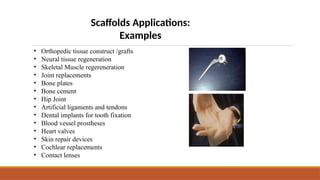
Scaffolds Applications:
Examples
• Orthopedic tissue construct /grafts
• Neural tissue regeneration
• Skeletal Muscle regereneration
• Joint replacements
• Bone plates
• Bone cement
• Hip Joint
• Artificial ligaments and tendons
• Dental implants for tooth fixation
• Blood vessel prostheses
• Heart valves
• Skin repair devices
• Cochlear replacements
• Contact lenses
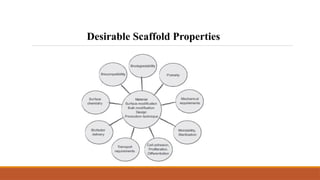
Desirable Scaffold Properties
Scaffold Fabrication Techniques
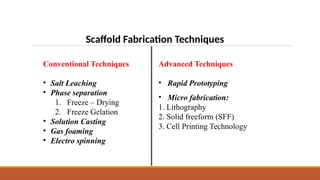
Conventional Techniques
• Salt Leaching
• Phase separation
1. Freeze – Drying
2. Freeze Gelation
• Solution Casting
• Gas foaming
• Electro spinning
Advanced Techniques
• Rapid Prototyping
• Micro fabrication:
1. Lithography
2. Solid freeform (SFF)
3. Cell Printing Technology
Conclusion
• Engineered tissue replacements combine cells & biomaterials to replace a
subset of tissue functions
• Biomaterials are natural or synthetic
• Convergence of cell biology, medicine, and engineering is advancing the
field
References
• HollanderAP, Hatton PV. Biopolymer methods in tissue engineering: Springer; 2004.
• Shoichet MS, Hubbell JA. Polymers for tissue engineering. Journal of Biomaterials Science,
Polymer Edition. 1998;9(5):405-6.
• Yang S, Leong K-F, Du Z, Chua C-K. The design of scaffolds for use in tissue engineering. Part I.
Traditional factors.Tissue engineering. 2001;7(6):679-89.
• Shoichet MS. Polymer scaffolds for biomaterials applications. Macromolecules. 2009;43(2):58191.
• Araci IE, Brisk P. Recent developments in microfluidic large scale integration. Current opinion in
biotechnology. 2014;25:60-8.
• Coluccino L, Stagnaro P, Vassalli M, Scaglione S. Bioactive TGF-β1/HAalginate-based scaffolds for
osteochondral tissue repair: design, realization and multilevel characterization. Journal of applied
biomaterials & functional materials. 2016;14(1)
• Washington University in St. Louis, 3-D printer creates transformative device for heart treatment:
https://news.wustl.edu/news/Pages/26554.aspx
• Norbert Pallua, Christoph V. Suscheck, Tissue Engineering From Lab to Clinic, 2011, Springer
THANK YOU

tissue engineering,tissue engineering ppt

  • 1.
    Course Work seminar On TissueEngineering: Scaffold Materials Presented by: Sweta Naik Roll no-17312004 Ph.D. Scholar Supervisor: Dr J Satya Eswari
  • 2.
    Introduction “Tissue engineering isan emerging interdisciplinary field that applies the principles of biology and engineering to the development of viable substitutes that restore, maintain or improve the function of human tissues.” An interdisciplinary field that applies the principles of engineering and life sciences toward the development of biological substitutes that restore, maintain, or improve tissue function or a whole organ. OR
  • 3.
    Tissue engineering andRegenerative Medicine 1.Regenerative medicine - Innovative medical therapies that will enable the body to repair, replace, restore and regenerate damaged or diseased cells, tissues and organs. 2.Tools and Procedures for Regenerative medicine • Tissue engineering : Tissue Repair/Replacement and Lab Grown Organs • Technologies:  Natural and Synthetic Scaffolds  Stem cell therapy  3-D Printing and Chip Technologies
  • 4.
    Langer R1, VacantiJP., Tissue engineering, Science, 1993 The Beginning…
  • 5.
    Regenerative medicine pioneer Dr.Ali Khademhosseini , 2007(Wyss Institute at Harvard) • Organs in the lab • Lab on a chip
  • 6.
  • 7.
    Need of TissueEngineering o Donor tissues and organs are in short supply. o To minimize immune system response by using own cells or novel ways to protect transplant. o ULTIMATE AIM of Tissue Engineering… REPAIR REGENERATE REPLACE RESTORE
  • 8.
    Process of TissueEngineering
  • 9.
    3 Tools forTissue Engineering • Cells – Living part of tissue – Produces protein and provides function of cells – Gives tissue reparative properties. • Scaffold – Provides structural support and shape to construct – Provides place for cell attachment and growth – Usually biodegradable and biocompatible. • Cell Signalling – Signals that tell the cell what to do – Proteins or Mechanical Stimulation.
  • 10.
    Stem Cells Stem cellsare cells that: (1) can self-renew (2) have the potential to differentiate along one or two lineages. 1. Totipotent : Can produce all cell types 2. Pluripotent : Can produce most cell types 3. Multipotent : Can produce more than one cell type 4. Unipotent : Can produce one cell type
  • 11.
    Current Clinical Status Patientsare mainly treated surgically by grafting methods, by three ways- Autograft, allograft and xenograft. Grafting method Meaning Remark/ Drawbacks Autograft To move tissue from one site to another in the body Patient is already suffering from disease, thus grafting in the same body will be very painful and might lead to graft failure. In old age patients, the grafted cells/ tissues might not regenerate after harvest. Allograft From another person (same species) This method suffers from issues like, Donor scarcity and immune rejection. The donor should be disease free. Xenograft Tissue/organ taken from other species Problems like biocompatibility and immune rejection are common in this method. Moreover animal tissues are more prone to contamination than human tissues, so after grafting the chances of infection persist.
  • 12.
    Scaffold: Concept andfunctions  Definition: It is a synthetic support material used to replace part of a living system or to function in contact with living tissue.  Materials for Biomedical Application  Scaffolds are 3D platforms for tissue engineering  Used clinically or experimentally in implantable electronic devices, drug delivery systems, hybrid artificial organs, bone substitutes, ligament and tendon replacements, etc.
  • 13.
    Role of EngineeredScaffolds • Allow cell attachment and migration • Deliver and retain cells & biochemical factors • Enable diffusion of vital cell nutrients and expressed products • Exert certain mechanical and biological influences to modify the behaviour of the cell phase
  • 14.
    Scaffolds Applications: Examples • Orthopedictissue construct /grafts • Neural tissue regeneration • Skeletal Muscle regereneration • Joint replacements • Bone plates • Bone cement • Hip Joint • Artificial ligaments and tendons • Dental implants for tooth fixation • Blood vessel prostheses • Heart valves • Skin repair devices • Cochlear replacements • Contact lenses
  • 15.
  • 18.
    Scaffold Fabrication Techniques ConventionalTechniques • Salt Leaching • Phase separation 1. Freeze – Drying 2. Freeze Gelation • Solution Casting • Gas foaming • Electro spinning Advanced Techniques • Rapid Prototyping • Micro fabrication: 1. Lithography 2. Solid freeform (SFF) 3. Cell Printing Technology
  • 19.
    Conclusion • Engineered tissuereplacements combine cells & biomaterials to replace a subset of tissue functions • Biomaterials are natural or synthetic • Convergence of cell biology, medicine, and engineering is advancing the field
  • 20.
    References • HollanderAP, HattonPV. Biopolymer methods in tissue engineering: Springer; 2004. • Shoichet MS, Hubbell JA. Polymers for tissue engineering. Journal of Biomaterials Science, Polymer Edition. 1998;9(5):405-6. • Yang S, Leong K-F, Du Z, Chua C-K. The design of scaffolds for use in tissue engineering. Part I. Traditional factors.Tissue engineering. 2001;7(6):679-89. • Shoichet MS. Polymer scaffolds for biomaterials applications. Macromolecules. 2009;43(2):58191. • Araci IE, Brisk P. Recent developments in microfluidic large scale integration. Current opinion in biotechnology. 2014;25:60-8. • Coluccino L, Stagnaro P, Vassalli M, Scaglione S. Bioactive TGF-β1/HAalginate-based scaffolds for osteochondral tissue repair: design, realization and multilevel characterization. Journal of applied biomaterials & functional materials. 2016;14(1) • Washington University in St. Louis, 3-D printer creates transformative device for heart treatment: https://news.wustl.edu/news/Pages/26554.aspx • Norbert Pallua, Christoph V. Suscheck, Tissue Engineering From Lab to Clinic, 2011, Springer
  • 21.