Topic:
“BIOSENSORS IN
ENVIRONMENTAL
MONITORING"
Presenter:
BUSHRA UMER
BS III, Biotechnology, Jinnah
University For Women
1
Biosensors- A Brief Insight:
• A biosensor is defined by the IUPAC as a self-contained integrated device that is
capable of providing specific quantitative or semi-quantitative analytical information
using a biological recognition element (biochemical receptor), which is retained in
contact direct spatial with a transduction element.
• Biological element or material can be enzymes, tissues, microorganisms, cells, acids, etc.
• Environmental biosensors detect the contaminants in the abiotic components of the
nature like air, water and soil (even if they are in trace amounts ! ).
2
• ChE biosensors are of fastidious interest in the area of universal toxicity monitoring
because Cholinesterase (ChE) enzymes can be inhibited by several toxic chemicals
such as organophosphates and pesticides, heavy metals, and toxins.
• Silicon and thick-film technologies are the strongest candidates for low cost,
disposable biosensors, ,particularly for field uses, and are proven in the medical
sector.
• Optical technologies offer good prospects for high accuracy sensors by virtue of the
use of highly sensitive phenomena such as SPR and interferometry.
3
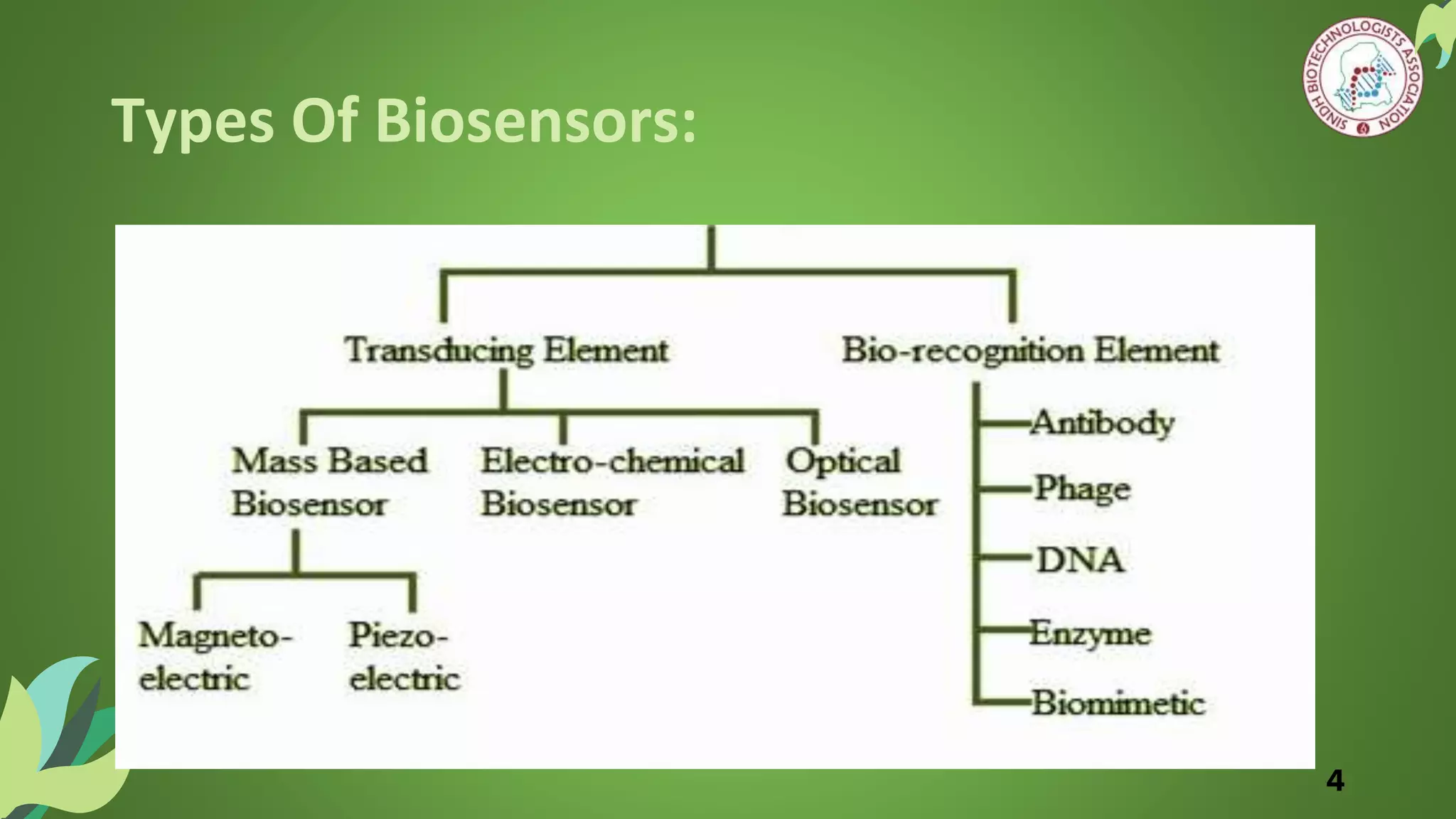
Types Of Biosensors:
4
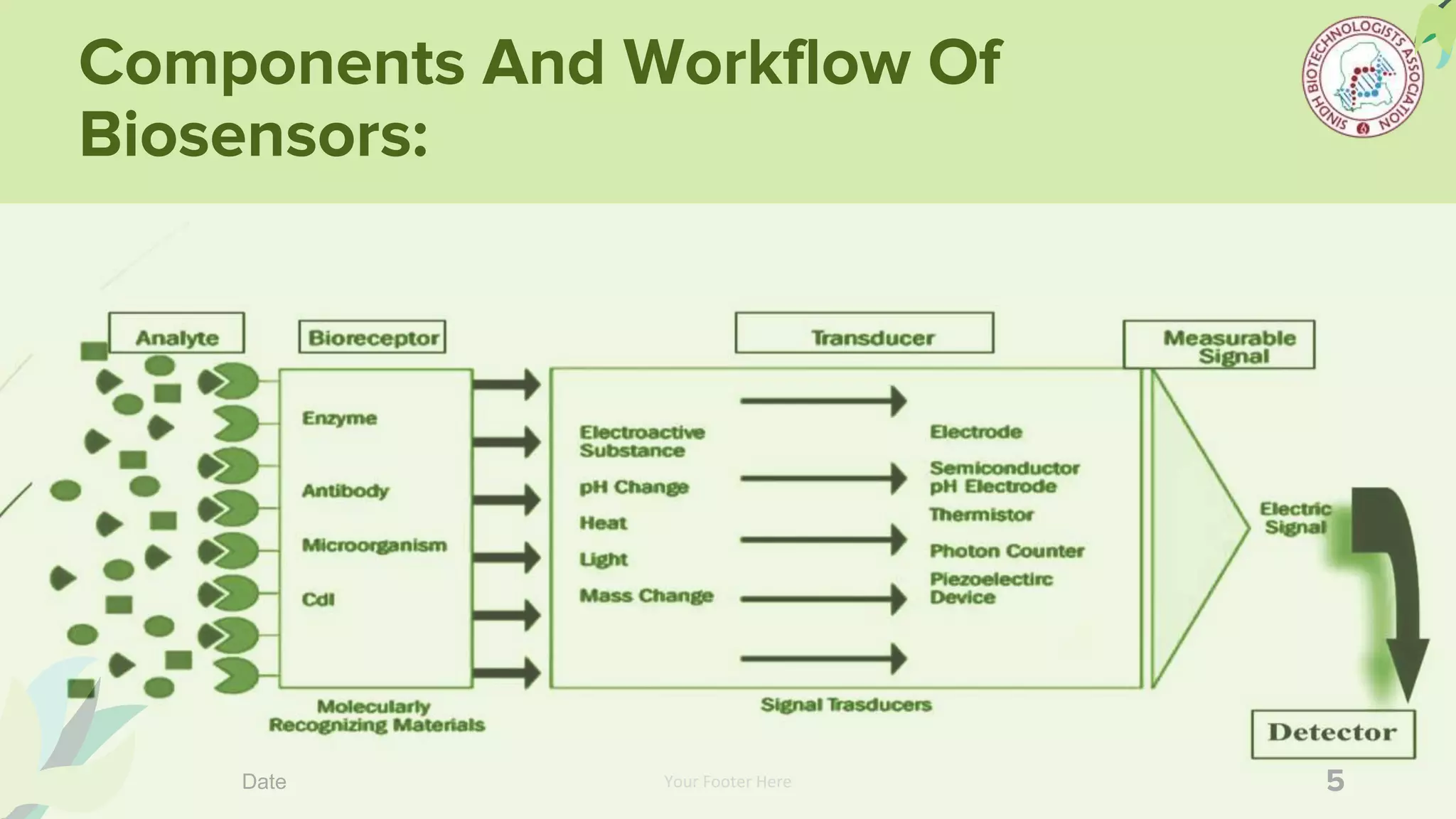
Components And Workflow Of
Biosensors:
Date Your Footer Here 5
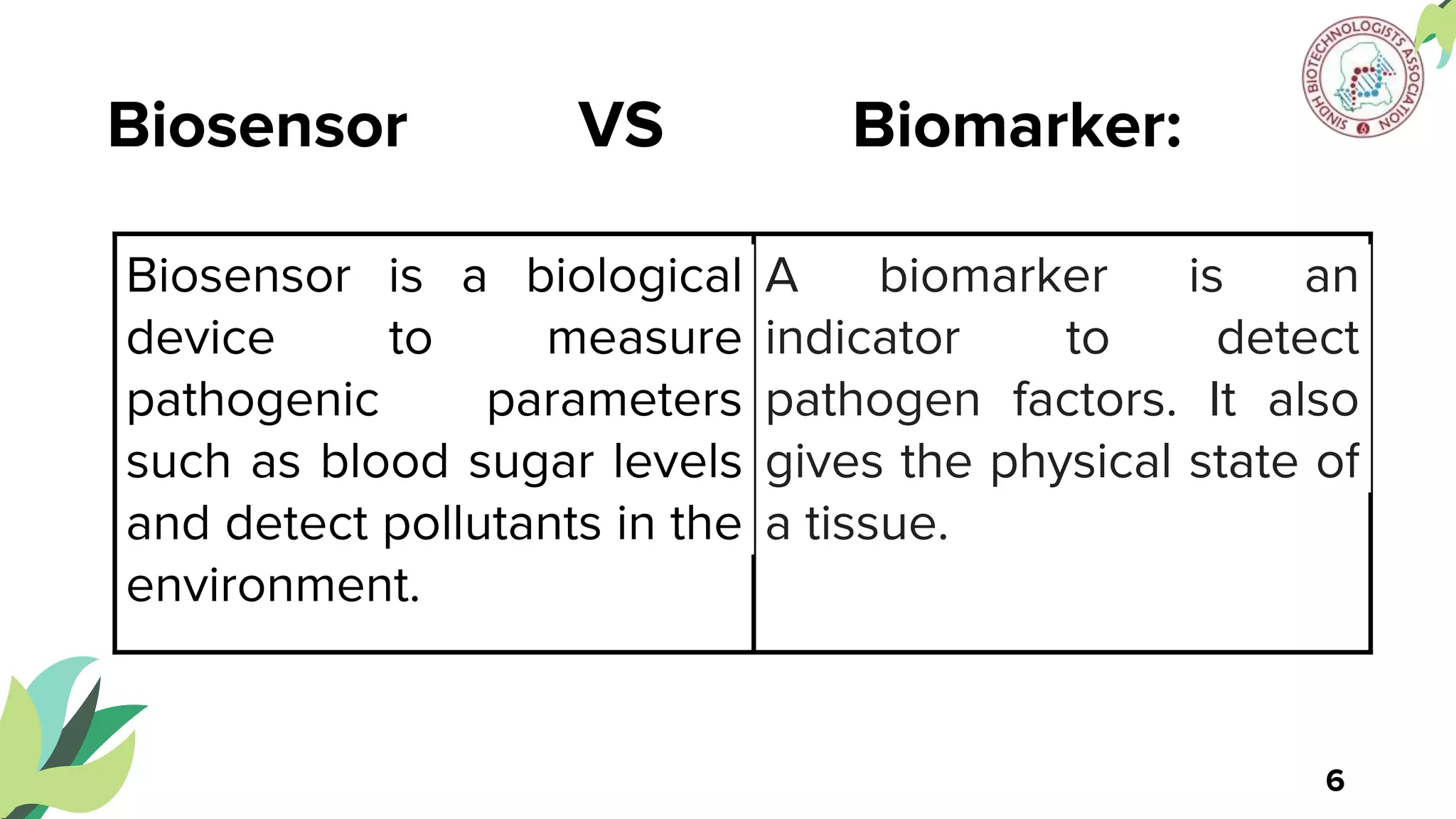
Biosensor VS Biomarker:
6
Biosensor is a biological
device to measure
pathogenic parameters
such as blood sugar levels
and detect pollutants in the
environment.
A biomarker is an
indicator to detect
pathogen factors. It also
gives the physical state of
a tissue.
Environmental Contaminants That
Can Be Monitored By Biosensors:
• Heavy metals,
• Nitrogenous compounds,
• Phenolic compounds’ detection,
• PAH (Polycyclic Aromatic Hydrocarbons), and
• Organophosphorus compounds (such as those in pesticides and
herbicides).
7
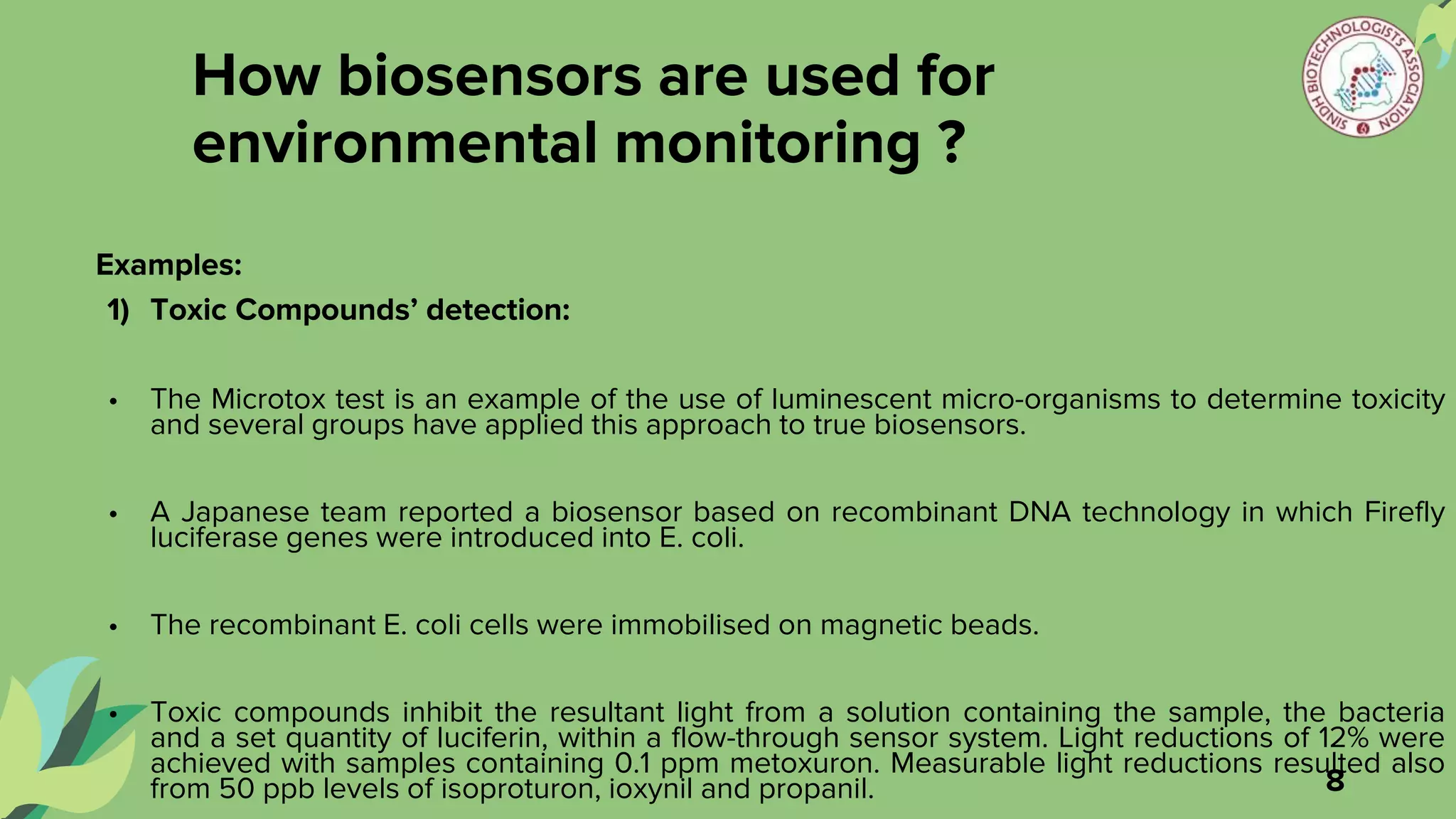
How biosensors are used for
environmental monitoring ?
Examples:
1) Toxic Compounds’ detection:
• The Microtox test is an example of the use of luminescent micro-organisms to determine toxicity
and several groups have applied this approach to true biosensors.
• A Japanese team reported a biosensor based on recombinant DNA technology in which Firefly
luciferase genes were introduced into E. coli.
• The recombinant E. coli cells were immobilised on magnetic beads.
• Toxic compounds inhibit the resultant light from a solution containing the sample, the bacteria
and a set quantity of luciferin, within a flow-through sensor system. Light reductions of 12% were
achieved with samples containing 0.1 ppm metoxuron. Measurable light reductions resulted also
from 50 ppb levels of isoproturon, ioxynil and propanil. 8
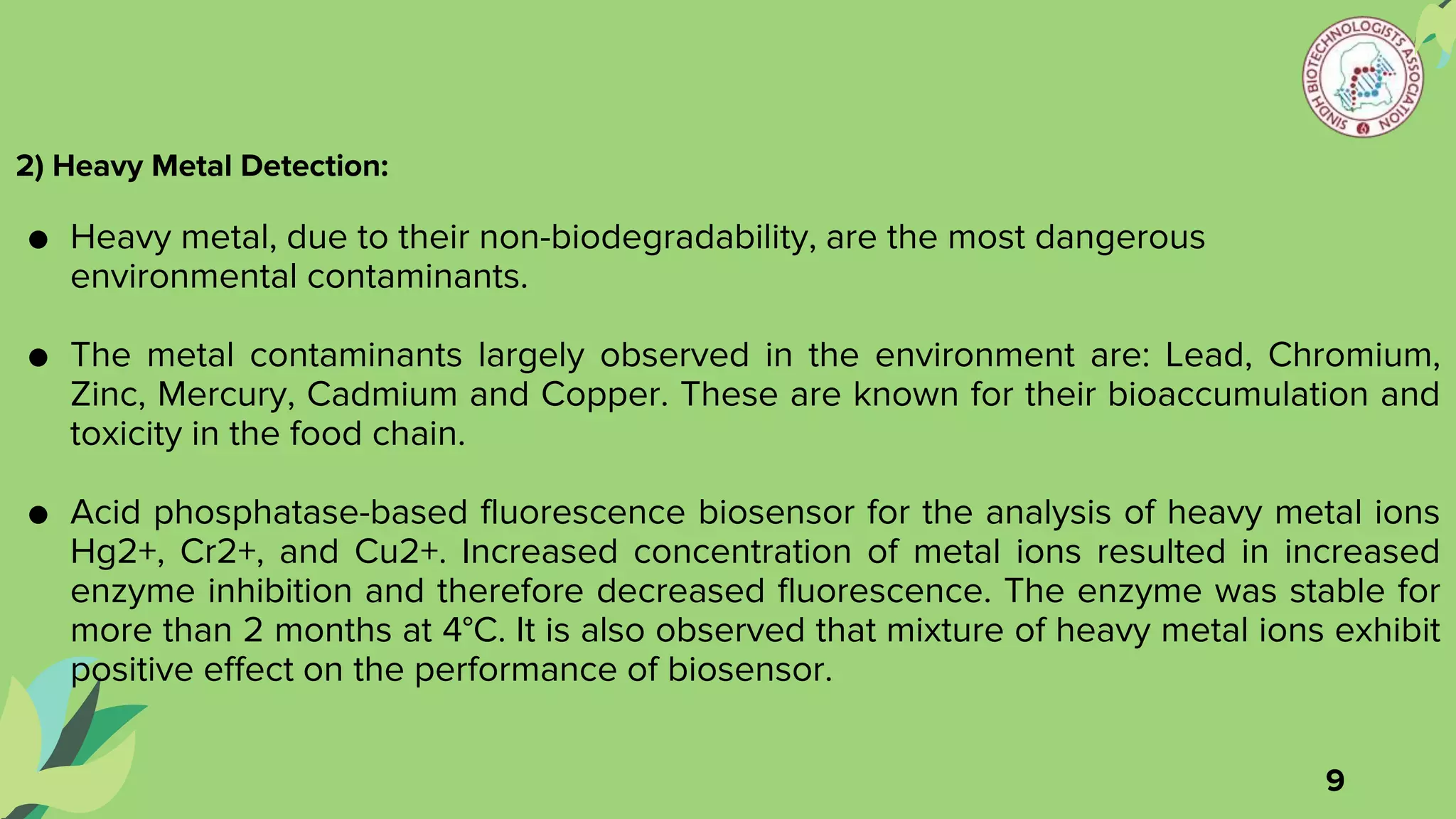
2) Heavy Metal Detection:
● Heavy metal, due to their non-biodegradability, are the most dangerous
environmental contaminants.
● The metal contaminants largely observed in the environment are: Lead, Chromium,
Zinc, Mercury, Cadmium and Copper. These are known for their bioaccumulation and
toxicity in the food chain.
● Acid phosphatase-based fluorescence biosensor for the analysis of heavy metal ions
Hg2+, Cr2+, and Cu2+. Increased concentration of metal ions resulted in increased
enzyme inhibition and therefore decreased fluorescence. The enzyme was stable for
more than 2 months at 4°C. It is also observed that mixture of heavy metal ions exhibit
positive effect on the performance of biosensor.
9
3) Nitrogen compounds (Nitrites’ detection):
• Nitrites are commonly used for soil fertilization or treatment of various plants in order
to protect. They are not safe for human health and have negative influence on human
hemoglobin and could lead to irreversible consequences.
• Biosensors have been developed with an amperometric measurement method for
recording various doses of nitrite using cytochrome C protein for biosensitive element,
which reacts with nitrite (ccNiR).
• The biosensor shows rapid reaction with nitrite 5 seconds, there is a linear
dependence between the concentrations of nitrite 0.015 and 2.35 µM and the
detection limit of 4 nM. This biosensor is highly sensitive, rapid and stable.
10
4) Phenolic Compounds:
• Phenolic compounds are produced by plants and microorganisms, and can be synthesized
industrially also. A great number of organic pollutants in the environment, have phenolic
structures.
• Phenols and their derivatives, coming from the activities related to production of pulp, paper,
plastics, dyes, drugs, polymers, oil refinery etc. Most of these compounds have toxic effects in
plants, animals and, humans. Even at concentrations less then one part per million, phenolic
compounds affect the taste of drinking water and fish .
• The toxic phenolic compounds in water usually interact with Deoxyribonucleic acid (DNA). These
interactions can be used in electrochemical DNA biosensors, to generate a response signal.
Based on this operation, a number of electrochemical DNA sensors for phenolic compounds
monitoring have been created. One of them is disposable electrochemical DNA biosensor made
by immobilizing double stranded DNA onto the surface of a disposable carbon screenprinted
electrode
11
Why to choose Environmental biosensors
over conventional monitoring systems ?
Biosensors used for environmental monitoring have
several advantages over conventional systems and
methods, some of which are:
(i) Their ability for portability,
(ii) Miniaturization,
(iii) Measurement of a pollutant with minimal samples,
and
iv) High specificity and sensitivity.
12
Summary:
The modern environmental requires sensitive and accurate detection of
the analyte. The growing field of the biosensors represents an answer to
this demand. In biosensor development studies, suitable bio-receptor
molecule, suitable immobilization method and transducer should be
selected firstly. Knowledge in biology, biochemistry, chemistry,
electrochemistry, physics, kinetics and mass transfer is required for this
study. And the outlook of such biosensors is promising for industrial use
of multichannel application in different scientific and technological fields.
13
14
REFERENCES:
● https://www.turito.com/learn/biology/biosensors-grade-9
● https://www.ncbi.nlm.nih.gov/pmc/articles/PMC5750672/p
df/sensors-17-02918.pdf
● https://www.intechopen.com/chapters/43558
● file:///C:/Users/MComputer/Desktop/20002381.pdf
● https://www.intechopen.com/chapters/66031
● https://www.ijcmas.com/9-10-
2020/Haleema%20Bano,%20et%20al.pdf
● https://www.slideshare.net/asertseminar/biosensor-ppt
● https://www.rfwireless-world.com/Articles/Biosensor-
basics-and-Biosensor-types.html
● https://www.ijser.org/researchpaper/APPLICATION-OF-
BIOSENSORS-IN-ENVIRONMENTAL-POLLUTION-AND-
MEDICINE.pdf
Thank You!
Date: 7 August 2023 15

Biosensors in Environmental Monitoring

  • 1.
    Topic: “BIOSENSORS IN ENVIRONMENTAL MONITORING" Presenter: BUSHRA UMER BSIII, Biotechnology, Jinnah University For Women 1
  • 2.
    Biosensors- A BriefInsight: • A biosensor is defined by the IUPAC as a self-contained integrated device that is capable of providing specific quantitative or semi-quantitative analytical information using a biological recognition element (biochemical receptor), which is retained in contact direct spatial with a transduction element. • Biological element or material can be enzymes, tissues, microorganisms, cells, acids, etc. • Environmental biosensors detect the contaminants in the abiotic components of the nature like air, water and soil (even if they are in trace amounts ! ). 2
  • 3.
    • ChE biosensorsare of fastidious interest in the area of universal toxicity monitoring because Cholinesterase (ChE) enzymes can be inhibited by several toxic chemicals such as organophosphates and pesticides, heavy metals, and toxins. • Silicon and thick-film technologies are the strongest candidates for low cost, disposable biosensors, ,particularly for field uses, and are proven in the medical sector. • Optical technologies offer good prospects for high accuracy sensors by virtue of the use of highly sensitive phenomena such as SPR and interferometry. 3
  • 4.
  • 5.
    Components And WorkflowOf Biosensors: Date Your Footer Here 5
  • 6.
    Biosensor VS Biomarker: 6 Biosensoris a biological device to measure pathogenic parameters such as blood sugar levels and detect pollutants in the environment. A biomarker is an indicator to detect pathogen factors. It also gives the physical state of a tissue.
  • 7.
    Environmental Contaminants That CanBe Monitored By Biosensors: • Heavy metals, • Nitrogenous compounds, • Phenolic compounds’ detection, • PAH (Polycyclic Aromatic Hydrocarbons), and • Organophosphorus compounds (such as those in pesticides and herbicides). 7
  • 8.
    How biosensors areused for environmental monitoring ? Examples: 1) Toxic Compounds’ detection: • The Microtox test is an example of the use of luminescent micro-organisms to determine toxicity and several groups have applied this approach to true biosensors. • A Japanese team reported a biosensor based on recombinant DNA technology in which Firefly luciferase genes were introduced into E. coli. • The recombinant E. coli cells were immobilised on magnetic beads. • Toxic compounds inhibit the resultant light from a solution containing the sample, the bacteria and a set quantity of luciferin, within a flow-through sensor system. Light reductions of 12% were achieved with samples containing 0.1 ppm metoxuron. Measurable light reductions resulted also from 50 ppb levels of isoproturon, ioxynil and propanil. 8
  • 9.
    2) Heavy MetalDetection: ● Heavy metal, due to their non-biodegradability, are the most dangerous environmental contaminants. ● The metal contaminants largely observed in the environment are: Lead, Chromium, Zinc, Mercury, Cadmium and Copper. These are known for their bioaccumulation and toxicity in the food chain. ● Acid phosphatase-based fluorescence biosensor for the analysis of heavy metal ions Hg2+, Cr2+, and Cu2+. Increased concentration of metal ions resulted in increased enzyme inhibition and therefore decreased fluorescence. The enzyme was stable for more than 2 months at 4°C. It is also observed that mixture of heavy metal ions exhibit positive effect on the performance of biosensor. 9
  • 10.
    3) Nitrogen compounds(Nitrites’ detection): • Nitrites are commonly used for soil fertilization or treatment of various plants in order to protect. They are not safe for human health and have negative influence on human hemoglobin and could lead to irreversible consequences. • Biosensors have been developed with an amperometric measurement method for recording various doses of nitrite using cytochrome C protein for biosensitive element, which reacts with nitrite (ccNiR). • The biosensor shows rapid reaction with nitrite 5 seconds, there is a linear dependence between the concentrations of nitrite 0.015 and 2.35 µM and the detection limit of 4 nM. This biosensor is highly sensitive, rapid and stable. 10
  • 11.
    4) Phenolic Compounds: •Phenolic compounds are produced by plants and microorganisms, and can be synthesized industrially also. A great number of organic pollutants in the environment, have phenolic structures. • Phenols and their derivatives, coming from the activities related to production of pulp, paper, plastics, dyes, drugs, polymers, oil refinery etc. Most of these compounds have toxic effects in plants, animals and, humans. Even at concentrations less then one part per million, phenolic compounds affect the taste of drinking water and fish . • The toxic phenolic compounds in water usually interact with Deoxyribonucleic acid (DNA). These interactions can be used in electrochemical DNA biosensors, to generate a response signal. Based on this operation, a number of electrochemical DNA sensors for phenolic compounds monitoring have been created. One of them is disposable electrochemical DNA biosensor made by immobilizing double stranded DNA onto the surface of a disposable carbon screenprinted electrode 11
  • 12.
    Why to chooseEnvironmental biosensors over conventional monitoring systems ? Biosensors used for environmental monitoring have several advantages over conventional systems and methods, some of which are: (i) Their ability for portability, (ii) Miniaturization, (iii) Measurement of a pollutant with minimal samples, and iv) High specificity and sensitivity. 12
  • 13.
    Summary: The modern environmentalrequires sensitive and accurate detection of the analyte. The growing field of the biosensors represents an answer to this demand. In biosensor development studies, suitable bio-receptor molecule, suitable immobilization method and transducer should be selected firstly. Knowledge in biology, biochemistry, chemistry, electrochemistry, physics, kinetics and mass transfer is required for this study. And the outlook of such biosensors is promising for industrial use of multichannel application in different scientific and technological fields. 13
  • 14.
    14 REFERENCES: ● https://www.turito.com/learn/biology/biosensors-grade-9 ● https://www.ncbi.nlm.nih.gov/pmc/articles/PMC5750672/p df/sensors-17-02918.pdf ●https://www.intechopen.com/chapters/43558 ● file:///C:/Users/MComputer/Desktop/20002381.pdf ● https://www.intechopen.com/chapters/66031 ● https://www.ijcmas.com/9-10- 2020/Haleema%20Bano,%20et%20al.pdf ● https://www.slideshare.net/asertseminar/biosensor-ppt ● https://www.rfwireless-world.com/Articles/Biosensor- basics-and-Biosensor-types.html ● https://www.ijser.org/researchpaper/APPLICATION-OF- BIOSENSORS-IN-ENVIRONMENTAL-POLLUTION-AND- MEDICINE.pdf
  • 15.
    Thank You! Date: 7August 2023 15