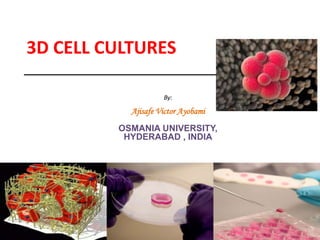
3D CELL CULTURES
By:
Ajisafe Victor Ayobami
OSMANIA UNIVERSITY,
HYDERABAD , INDIA
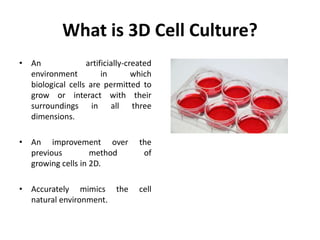
What is 3D Cell Culture?
• An artificially-created
environment in which
biological cells are permitted to
grow or interact with their
surroundings in all three
dimensions.
• An improvement over the
previous method of
growing cells in 2D.
• Accurately mimics the cell
natural environment.
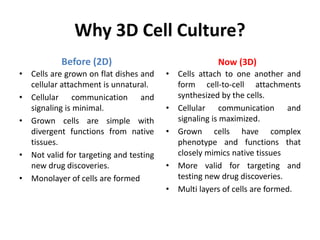
Why 3D Cell Culture?
• Cells are grown on flat dishes and
cellular attachment is unnatural.
• Cellular communication and
signaling is minimal.
• Grown cells are simple with
divergent functions from native
tissues.
• Not valid for targeting and testing
new drug discoveries.
• Monolayer of cells are formed
• Cells attach to one another and
form cell-to-cell attachments
synthesized by the cells.
• Cellular communication and
signaling is maximized.
• Grown cells have complex
phenotype and functions that
closely mimics native tissues
• More valid for targeting and
testing new drug discoveries.
• Multi layers of cells are formed.
Now (3D)Before (2D)
2D vs 3D Cell Cultures
3D Cell Culture Techniques
a) Scaffold Based
 Polymeric Hard Scaffolds
 Biologic Scaffolds
 Micropatterned Surface
Microplates
b) Non Scaffold Based
 Hanging Drop Microplates
 Spheroid Microplates
containing Ultra-Low
Attachment (ULA) coating
 Microfluidic 3D cell culture
c) Bioreactors
a) Gels
3D Cell culture Bioreactor
3D Cell Culture Gels
Non Scaffold Based
Scaffold Based
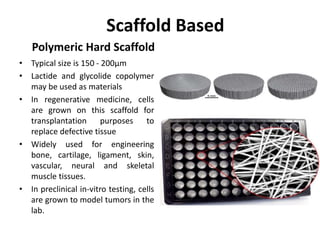
Polymeric Hard Scaffold
• Typical size is 150 - 200µm
• Lactide and glycolide copolymer
may be used as materials
• In regenerative medicine, cells
are grown on this scaffold for
transplantation purposes to
replace defective tissue
• Widely used for engineering
bone, cartilage, ligament, skin,
vascular, neural and skeletal
muscle tissues.
• In preclinical in-vitro testing, cells
are grown to model tumors in the
lab.
Scaffold Based
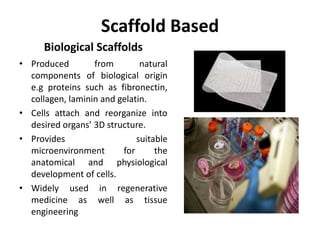
Biological Scaffolds
• Produced from natural
components of biological origin
e.g proteins such as fibronectin,
collagen, laminin and gelatin.
• Cells attach and reorganize into
desired organs’ 3D structure.
• Provides suitable
microenvironment for the
anatomical and physiological
development of cells.
• Widely used in regenerative
medicine as well as tissue
engineering
Scaffold Based
Micropatterned Surface Microplates
• Each plate contains
micrometer sized
compartments arrayed on the
bottom.
• Usually coated to create a low
adhesion surface.
• Bottom is thin and transparent
for microscopic imaging.
• Used in drug testing, cell
biology analysis at the
molecular level
Round Square Slit pattern
Scaffold Based
Hanging Drop Microplates
• Cells can self assemble into 3D
spheroid structure in the
absence of a scaffold.
• Spheroid size is controlled by
the number of cells dispensed
into each drop.
• Suitable for long term culturing
by transfer of culture onto
another plate of larger media
or buffer volumes
• Suitable for use as primary cell-
based tissue models and tumor
models that include
immortalized cancer cell lines
Top view Bottom view
Non Scaffold Based
Spheroid Microplate
• Used to create round multi
cell tissue or tumor models.
• Wells are shaped to a depth
of SBS 96 – 384-well
microplate.
• Widely used for experimental
purposes.
• ULA is used to coat the
bottom to minimize cell
adherence for spheroid
formation
Non Scaffold Based
Microfluidic
• Used to create 3D architecture of in-vivo
tissues and tumors
• To create heterogeneous models.
• Permits the continuously supply necessary
nutrients and growth requirements as well
as waste removal through culture medium.
• Contains physical barriers that are made up
of glass or silicon, polymers such as
polycarbonate (PC), polystyrene (PS), and
chromatographic or filter paper.
• Cells may be combined with matrix to
encourage cell-ECM interaction for the
assembly of 3D structures.
• Suitable for stem cells, primary and cancer
cells
Non Scaffold Based
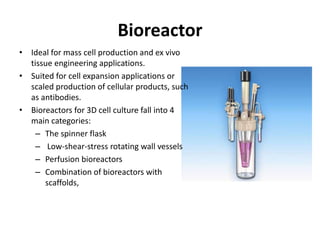
Bioreactor
• Ideal for mass cell production and ex vivo
tissue engineering applications.
• Suited for cell expansion applications or
scaled production of cellular products, such
as antibodies.
• Bioreactors for 3D cell culture fall into 4
main categories:
– The spinner flask
– Low-shear-stress rotating wall vessels
– Perfusion bioreactors
– Combination of bioreactors with
scaffolds,
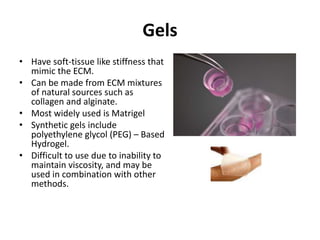
Gels
• Have soft-tissue like stiffness that
mimic the ECM.
• Can be made from ECM mixtures
of natural sources such as
collagen and alginate.
• Most widely used is Matrigel
• Synthetic gels include
polyethylene glycol (PEG) – Based
Hydrogel.
• Difficult to use due to inability to
maintain viscosity, and may be
used in combination with other
methods.
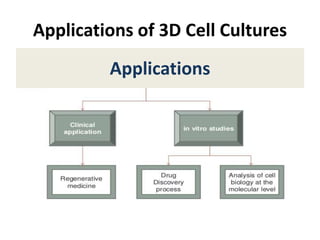
Applications of 3D Cell Cultures
Applications
Consideration in 3D Cell Cultures
• There are many methods
available to create in-vivo
cellular environments
• Some are amenable for
re-creating in-vitro barrier
models.
• others are more suitable
for mimicking cancerous
tumors or tissues.
CONCLUSSION
3D cell cultures

3D cell cultures

  • 1.
    3D CELL CULTURES By: AjisafeVictor Ayobami OSMANIA UNIVERSITY, HYDERABAD , INDIA
  • 2.
    What is 3DCell Culture? • An artificially-created environment in which biological cells are permitted to grow or interact with their surroundings in all three dimensions. • An improvement over the previous method of growing cells in 2D. • Accurately mimics the cell natural environment.
  • 3.
    Why 3D CellCulture? • Cells are grown on flat dishes and cellular attachment is unnatural. • Cellular communication and signaling is minimal. • Grown cells are simple with divergent functions from native tissues. • Not valid for targeting and testing new drug discoveries. • Monolayer of cells are formed • Cells attach to one another and form cell-to-cell attachments synthesized by the cells. • Cellular communication and signaling is maximized. • Grown cells have complex phenotype and functions that closely mimics native tissues • More valid for targeting and testing new drug discoveries. • Multi layers of cells are formed. Now (3D)Before (2D)
  • 4.
    2D vs 3DCell Cultures
  • 5.
    3D Cell CultureTechniques a) Scaffold Based  Polymeric Hard Scaffolds  Biologic Scaffolds  Micropatterned Surface Microplates b) Non Scaffold Based  Hanging Drop Microplates  Spheroid Microplates containing Ultra-Low Attachment (ULA) coating  Microfluidic 3D cell culture c) Bioreactors a) Gels 3D Cell culture Bioreactor 3D Cell Culture Gels Non Scaffold Based Scaffold Based
  • 6.
    Polymeric Hard Scaffold •Typical size is 150 - 200µm • Lactide and glycolide copolymer may be used as materials • In regenerative medicine, cells are grown on this scaffold for transplantation purposes to replace defective tissue • Widely used for engineering bone, cartilage, ligament, skin, vascular, neural and skeletal muscle tissues. • In preclinical in-vitro testing, cells are grown to model tumors in the lab. Scaffold Based
  • 7.
    Biological Scaffolds • Producedfrom natural components of biological origin e.g proteins such as fibronectin, collagen, laminin and gelatin. • Cells attach and reorganize into desired organs’ 3D structure. • Provides suitable microenvironment for the anatomical and physiological development of cells. • Widely used in regenerative medicine as well as tissue engineering Scaffold Based
  • 8.
    Micropatterned Surface Microplates •Each plate contains micrometer sized compartments arrayed on the bottom. • Usually coated to create a low adhesion surface. • Bottom is thin and transparent for microscopic imaging. • Used in drug testing, cell biology analysis at the molecular level Round Square Slit pattern Scaffold Based
  • 9.
    Hanging Drop Microplates •Cells can self assemble into 3D spheroid structure in the absence of a scaffold. • Spheroid size is controlled by the number of cells dispensed into each drop. • Suitable for long term culturing by transfer of culture onto another plate of larger media or buffer volumes • Suitable for use as primary cell- based tissue models and tumor models that include immortalized cancer cell lines Top view Bottom view Non Scaffold Based
  • 10.
    Spheroid Microplate • Usedto create round multi cell tissue or tumor models. • Wells are shaped to a depth of SBS 96 – 384-well microplate. • Widely used for experimental purposes. • ULA is used to coat the bottom to minimize cell adherence for spheroid formation Non Scaffold Based
  • 11.
    Microfluidic • Used tocreate 3D architecture of in-vivo tissues and tumors • To create heterogeneous models. • Permits the continuously supply necessary nutrients and growth requirements as well as waste removal through culture medium. • Contains physical barriers that are made up of glass or silicon, polymers such as polycarbonate (PC), polystyrene (PS), and chromatographic or filter paper. • Cells may be combined with matrix to encourage cell-ECM interaction for the assembly of 3D structures. • Suitable for stem cells, primary and cancer cells Non Scaffold Based
  • 12.
    Bioreactor • Ideal formass cell production and ex vivo tissue engineering applications. • Suited for cell expansion applications or scaled production of cellular products, such as antibodies. • Bioreactors for 3D cell culture fall into 4 main categories: – The spinner flask – Low-shear-stress rotating wall vessels – Perfusion bioreactors – Combination of bioreactors with scaffolds,
  • 13.
    Gels • Have soft-tissuelike stiffness that mimic the ECM. • Can be made from ECM mixtures of natural sources such as collagen and alginate. • Most widely used is Matrigel • Synthetic gels include polyethylene glycol (PEG) – Based Hydrogel. • Difficult to use due to inability to maintain viscosity, and may be used in combination with other methods.
  • 14.
    Applications of 3DCell Cultures Applications
  • 15.
    Consideration in 3DCell Cultures • There are many methods available to create in-vivo cellular environments • Some are amenable for re-creating in-vitro barrier models. • others are more suitable for mimicking cancerous tumors or tissues. CONCLUSSION

Editor's Notes

  • #3 Ajisafe Victor Ayobami 3D Cell Culturea