Introduction to TissueEngineering
Tissue engineering is an interdisciplinary field that utilizes cells,
biomaterials, biochemical (e.g., growth factors) and physical (e.g.,
mechanical loading) signals, as well as their combinations to
generate tissue-like structures [1].
The goal of tissue engineering is to provide biological substitutes that
can maintain, restore, or improve the function of damaged tissues
[2].
Although the first tissue-engineered skin products were introduced
in the late 1970s and early 1980s giving rise to modern tissue
engineering, the term “tissue engineering” was coined only in 1987
[3–6].
3.
Introduction to TissueEngineering
Applications of stem cells in tissue engineering continue to grow
and their use has found its way to the clinic.
Although adult mesenchymal stem cells remain the dominant stem
cell type used in tissue engineering, embryonic stem cells are also
being used and have started to find their way into the market [27].
Tissue engineering is a young field that utilizes cells, biomaterials,
physical signals (e.g., mechanical stimulation), biochemical signals
(e.g., growth factors and cytokines), and their combinations, to
engineer tissues.
The ultimate goal of tissue engineering is to bridge the constantly
growing gap between organ demand and availability by
producing complete organs [157].
4.
Introduction to TissueEngineering
Consequently, the aforementioned advancements have led to an
increased demand for tissues and organs.
The ultimate goal of tissue engineering is to bridge the constantly growing
gap between organ demand and availability by producing complete
organs .
Future bioreactors will be able to perform complex combinatorial tasks in
order to engineer full organs.
For example, bioreactors can be designed to deliver varying oxygen levels
to varying parts of the engineered tissue or different mechanical
stimulation regimes, or to deliver growth factors and at predefined time
points during culture.
Finally, bioreactors may be made to be used on site (e.g., in the hospital)
to minimize contamination risks and reduce the surgery time.
5.
Introduction to TissueEngineering
Future efforts will focus on developing novel biomaterials for the
different tissue engineering and regenerative medicine applications.
The structure and mechanical properties of the biomaterials will be
engineered to better suit the tissue of interest.
These biomaterials should be capable of addressing the current
major limitations of the field, especially mass transport.
A combination of immune-transparent cells with an off-the-shelf
scaffold cultured in a complex bioreactor that delivers tailored signals
for the target tissue is probably expected to become possible in the
future.
However, reaching the stage of clinically relevant off-the-shelf body
parts still requires significant basic and applied scientific research.
6.
Introduction to TissueEngineering
Biomaterials with muscle-adhesive proteins and other gluing
interfaces may be investigated, or using covalent bonding based
on natural residues of tissues and engineered residues on the
scaffold.
Future research will also focus on cell manipulation (e.g.,
transfection and silencing) to induce better repair or regeneration.
Further understanding at the basic science level of cell behavior,
both in vitro and in vivo, in tissue engineering systems including cell–
cell interactions and cell–scaffold interactions will be required.
7.
Clinical Need forTissue Engineering
and Regenerative Medicine
The limited donor availability and rejection of the grafts by the
immune system drove the concept of in vitro grown tissues.
The success in tissue engineering of skin grafts boosted the interest in
applying similar concepts to other tissues and organs [9].
The main goal of tissue engineering is the development of functional
substitutes for damaged tissues [2].
It is estimated that the majority of tissue engineering products are used
for the treatment of injuries and congenital defects, while tissue
engineering products used for the treatment of diseases are less.
Tissue engineering and regenerative medicine solutions can also be
applied for any tissue, although the levels of complexity would differ
between targets.
9.
Recent Advances inTissue
Engineering
Advances in Cell Sourcing and Cell Manipulation
A major breakthrough in cell sourcing was the recent discovery by
Shinya Yamanaka that adult differentiated cells could be induced to
become pluripotent stem cells [32].
The discovery of induced pluripotent stem cells (iPSCs), for which
Yamanaka was awarded the Nobel Prize in Physiology and Medicine
in 2012, has opened unprecedented opportunities in the tissue
engineering field by providing a new, large source of autologous cells.
10.
Recent Advances inTissue
Engineering
Advances in Biomaterials and Scaffold Production
Current research is focused on developing “smart biomaterials”
capable of directing cell functions and/or enhancing cellular
performance [33].
The role of the scaffold is to provide structural support and proper
signaling cues for cells so that they can replace the scaffold with their
own synthesized matrix.
Synthesis of new matrix by the cells and degradation of the scaffold
should be synchronized so that one process is not faster than the other.
11.
Recent Advances inTissue
Engineering
Advances in Biomaterials and Scaffold Production
Scaffolds can be prepared with good control over the chemical
composition, allowing cells to spread and proliferate (e.g., collagen,
gelatin) or inhibiting cell spreading (e.g., alginate, poly(ethylene
glycol)).
Scaffolds can be made to provide cells with adhesion sequences
for cell attachment (e.g., RGD, GFOGER, IKVAV) and matrix
metalloproteinase (MMP)-sensitive sequences for scaffold
degradation [42–47].
12.
Recent Advances inTissue
Engineering
Advances in Biomaterials and Scaffold Production
Modifying scaffolds with small molecules, such as phosphate groups
and sulfate groups, among others, has been also shown to have
strong effects on cell proliferation and stem cell differentiation [48,
49].
All these studies are necessary to identify the ideal scaffolds for
each individual tissue engineering application.
13.
Recent Advances inTissue
Engineering
Advances in Cell Signaling Research and Bioreactor Development
After providing cells with a growing substrate or scaffold, cells require
certain signals to survive and synthesize their own matrix that will
eventually replace the carrying scaffold.
The most important signals sensed by cells involve oxygen levels,
mechanical stimulation, growth factors, ECM molecules, and other
small molecule
14.
Recent Advances inTissue
Engineering
Advances in Cell Signaling Research and Bioreactor Development
It has been shown, as expected, that different tissues require
different combinations of signals, and even the same tissue might
require different signals at different depths or different maturation
stages.
For example, cells used to engineer articular cartilage, which is a
relatively simple tissue known to be avascular, require relatively low
oxygen levels (below 5%) for the synthesis of type II collagen (the
major ECM component of articular cartilage), which in nature is
synthesized in high quantities in the deeper cartilage layers.
15.
Recent Advances inTissue
Engineering
Advances in Cell Signaling Research and Bioreactor Development
Moreover, physiologic tensile strain [51] and surface motion [52] are
believed to promote superficial zone protein synthesis, while
mechanical compression [53] and hydrostatic pressure [54, 55] have
been shown to increase type II collagen synthesis (Figure 1.4).
Excessive mechanical loading leads to the production of
metalloproteinases and aggrecanases that degrade ECM proteins
[56].
16.
Recent Advances inTissue
Engineering
Engineering Complex Tissues and Organs
Tissue engineering holds strong promise of providing substitutes for
damaged tissues and organs.
Tissue engineering has found initial success with the production of
simple tissues such as skin [5, 78] and cartilage [22].
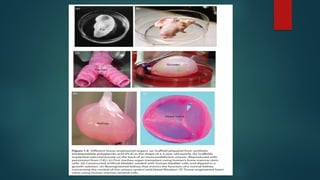
Over the past few years, more complex multicellular tissues and
organs have been engineered, including urethras [79], tracheas
[80], blood vessels [81, 82], airways [85], and bladders [9, 86].
17.
Recent Advances inTissue
Engineering
Engineering Complex Tissues and Organs
So far, tissues were mainly engineered using membranes with one
cell type cultured on each side; therefore, they were based on 2D
culture techniques. However, engineering of more complex 3D
tissues is still limited by several factors affected by all elements of the
tissue engineering triad.
The most important challenge facing the development of 3D
complex tissues is mass transport that governs access of nutrients
and secretion of wastes in engineered tissues [87, 88].
Circulation of nutrients and wastes in natural tissues in vivo is
controlled by blood vessels.
18.
Recent Advances inTissue
Engineering
Engineering Complex Tissues and Organs
In tissue-engineered structures, mass transport can be achieved by
using bioreactors, as mentioned previously, or by inducing the
formation of new blood vessels.
Efforts have focused on developing scaffolds with certain patterns
or coatings to induce neovascularization, cell manipulation to
induce differentiation, or secretion of vascular endothelial growth
factors (VEGF) and proper signaling such as the addition of growth
factors.
20.
Fundamentals of TissueEngineering
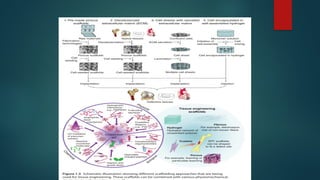
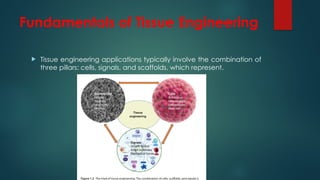
Tissue engineering applications typically involve the combination of
three pillars: cells, signals, and scaffolds, which represent.
21.
Fundamentals of TissueEngineering
The need for cell sources in tissue engineering was a major limiting
factor in the advancement of the field.
This shortage of cell sources ignited the use of renewable cells such
as stem cells and progenitors, leading to the term “regenerative
medicine.”
22.
Approaches in TissueEngineering
The most common approach is the use of a pre-
made porous scaffold. Using raw materials – which
can be either natural or synthetic – a porous
scaffold is created through one of the different
fabrication technologies currently available.
The diverse possibilities of biomaterials to use and
the ability to design the scaffold in a way to control
its physicochemical properties make this method
especially advantageous.
23.
Approaches in TissueEngineering
Another method that can be used for scaffolding is the
decellularization of the extracellular matrix (ECM) from either
allogeneic or xenogenic tissues.
The ECM is a natural scaffold that allows cell attachment,
proliferation, and differentiation.
When seeded with the proper cells, it can produce an autologuous
construct without the need for extracting tissues from the patient
him/herself [25].
24.
Approaches in TissueEngineering
The advantages of this method are that it is biocompatible and
presents the closest natural mechanical and biological properties
needed in the body.
The main disadvantage of these systems is the limited supply of
autologous tissues and immune responses to non-autologous tissues.
Additionally, some minor problems still exist such as inhomogeneous
distribution of the seeded cells and the difficulty of removing all
immune-provoking material [23].
This technique has proven useful in skin, bladder, and heart valve
repair
25.
Approaches in TissueEngineering
A final approach is the use of cell sheets prepared using
temperature-responsive culture dishes, in a technique known as cell
sheet engineering.
This method avoids the problems caused by transplanting
engineered tissues based on fabricated scaffolds; in fact, after the
scaffold degrades in the body, it is often replaced by autologous
ECM, which can cause fibrosis.
26.
Bioengineering Processing
The processdiffers based on the specific tissue system as well as any
difference in the tissue engineering strategy adopted. The 8 step
process of bioengineering 3D artificial tissue involves
8 Step process for tissue fabrication
1. Cell sourcing
2. Biomaterial synthesis
3. Genetic manipulation
4. Scaffold cellularization
5.Sensor Technology
6.Bioreactors for guidance
7. Vascularization
8 In Vitro assessment
27.
Cell sourcing
Cellsprovide the functional components of artificial tissue
Important steps in cell sourcing include, identification, isolation,
purification, expansion and characterization of the suitable cell
source
Cells can also be obtained from animal sources
28.
. Biomaterial synthesis
Provide structural support during 3D tissue fabrication and
extracellular matrix.
During this stage of tissue fabrication process, biomaterial sysnthesi
and characterization are important variables that require rigorous
optimation.
29.
Genetic manipulation
Specificgenes can be manipulated to reduce apoptosis or
increase the expression of specific integrins to increase cell to matrix
interactions.
In addition, functional genes can be up regulated( eg myosin
heavy chain for heart muscle) to increase the functional
performance of 3D artificial tissue.
30.
Scaffold cellularization
Refersto the process by which isolated cells are seeded within a 3D
scaffold
An important variable during the scaffold cellularization process is
coupling isolated cells with the scaffold to promote functional
integration at cell to cell and cell-material interface.
Cellularization strategy needs to be optimized to ensure uniformity in
cell distribution throughout t.he scaffold
31.
Sensor Technology
Sensorsare necessary to monitor the overall health of the artificial
tissue during the formation, development and maturation stage of
the tissue fabrication.
Monitoring of cell behavior, cell to cell interactions, cell to matrix
interaction and tissue formation and function is critical during the
tissue fabrication process.
32.
Bioreactors for guidance
Are designed to deliver physiological signals to 3D artificial tissue,
which in turn provides guidance to drive tissue development and
maturation.
33.
Vascularization
Incorporation ofblood vessels as an integrated component of
artificial tissue is critical requirement, to support 3D artificial tissue
34.
In Vitro assessment
Once functional 3D artificial tissue has been fabricated, the final
step in the process is in vivo testing
In this case, the effectiveness of the tissue graft to repair, replace,
and/or augment the function of damaged or diseased tissue is
assessed
35.
Functional Assessment
Performancemetrics need to accurately reflect critical functional
variables.
It need to be carefully defined and must accurately assess the
function of artificial tissue.
There are 3 categories designed to assess artificial 3D tissue
Functional
Biological
Histological
Histological Assessment
Histologicalmetrics refers to the localization of specific proteins,
ether in the ECM or intracellular protein.
Histological tools allow visualization of the cells relative to the ECM.
This in turn provides information about cellular organization and
tissue level architecture.
3D imaging.
39.
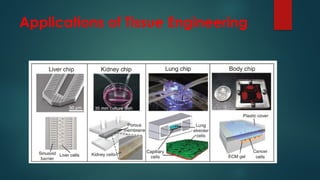
Applications of TissueEngineering
The most common application of tissue engineering is to create
tissues that can be used to repair or replace tissues in the body
suffering partial or complete loss of function.
However, tissue engineering has started to find new applications
such as the development of extracorporeal life support units (e.g.,
bioartificial liver and kidney), in vitro disease models, tissues for drug
screening, smart diagnosis, and personalized medicine.
Applications of TissueEngineering
Implantable Tissues and Organs
In Vitro Models for Disease Studies
Smart Diagnosis and Personalized Medicine
Gene therapy
Protein therapy
Cell therapy
42.
Design Challenges inTissue
Engineering
Finally, a major challenge is still present, namely mass production
and commercialization of the engineered tissues.
Specific manufacturing conditions and quality control strategies
need to be ensured.
The major challenge for stem cells, whether induced, embryonic, or
adult, is to achieve commitment to the desired lineages.
Another important challenge in tissue engineering is related to the
transportation of nutrients and waste secretion in the engineered
tissue.
43.
Design Challenges inTissue
Engineering
Despite all the advances in the field of tissue engineering, many
challenges persist, which are related to three elements of cells,
scaffold, and signals.
In fact, autologous, allogeneic, and xenogeneic cells are all
potential sources, and each of these can be subdivided into stem
cells (adult or embryonic) or differentiated cells.
The choice of scaffold biomaterials is not an easier task either.
Another important challenge in tissue engineering is related to the
transportation of nutrients and waste secretion in the engineered
tissue.
44.
Design Challenges inTissue
Engineering
The use of allogeneic or xenogeneic sources is, though, still
associated with major obstacles, such as immune-rejection,
transmission of diseases, mismatch between donor and recipient
cellular microenvironment, and ethical considerations, which limit
their widespread adoption in clinical applications.
A major challenge remains in establishing standardized protocols to
induce the differentiation and commitment of differentiated adult,
induced, or embryonic stem cells toward the desired lineages.

![Introduction to Tissue Engineering
Tissue engineering is an interdisciplinary field that utilizes cells,
biomaterials, biochemical (e.g., growth factors) and physical (e.g.,
mechanical loading) signals, as well as their combinations to
generate tissue-like structures [1].
The goal of tissue engineering is to provide biological substitutes that
can maintain, restore, or improve the function of damaged tissues
[2].
Although the first tissue-engineered skin products were introduced
in the late 1970s and early 1980s giving rise to modern tissue
engineering, the term “tissue engineering” was coined only in 1987
[3–6].](https://image.slidesharecdn.com/ebe3201tissueengineering-250306065816-eb5ce06b/85/EBE-3201-Tissue-Engineering-part3-2-pptx-2-320.jpg)
![Introduction to Tissue Engineering
Applications of stem cells in tissue engineering continue to grow
and their use has found its way to the clinic.
Although adult mesenchymal stem cells remain the dominant stem
cell type used in tissue engineering, embryonic stem cells are also
being used and have started to find their way into the market [27].
Tissue engineering is a young field that utilizes cells, biomaterials,
physical signals (e.g., mechanical stimulation), biochemical signals
(e.g., growth factors and cytokines), and their combinations, to
engineer tissues.
The ultimate goal of tissue engineering is to bridge the constantly
growing gap between organ demand and availability by
producing complete organs [157].](https://image.slidesharecdn.com/ebe3201tissueengineering-250306065816-eb5ce06b/85/EBE-3201-Tissue-Engineering-part3-2-pptx-3-320.jpg)
![Clinical Need for Tissue Engineering
and Regenerative Medicine
The limited donor availability and rejection of the grafts by the
immune system drove the concept of in vitro grown tissues.
The success in tissue engineering of skin grafts boosted the interest in
applying similar concepts to other tissues and organs [9].
The main goal of tissue engineering is the development of functional
substitutes for damaged tissues [2].
It is estimated that the majority of tissue engineering products are used
for the treatment of injuries and congenital defects, while tissue
engineering products used for the treatment of diseases are less.
Tissue engineering and regenerative medicine solutions can also be
applied for any tissue, although the levels of complexity would differ
between targets.](https://image.slidesharecdn.com/ebe3201tissueengineering-250306065816-eb5ce06b/85/EBE-3201-Tissue-Engineering-part3-2-pptx-7-320.jpg)
![Recent Advances in Tissue
Engineering
Advances in Cell Sourcing and Cell Manipulation
A major breakthrough in cell sourcing was the recent discovery by
Shinya Yamanaka that adult differentiated cells could be induced to
become pluripotent stem cells [32].
The discovery of induced pluripotent stem cells (iPSCs), for which
Yamanaka was awarded the Nobel Prize in Physiology and Medicine
in 2012, has opened unprecedented opportunities in the tissue
engineering field by providing a new, large source of autologous cells.](https://image.slidesharecdn.com/ebe3201tissueengineering-250306065816-eb5ce06b/85/EBE-3201-Tissue-Engineering-part3-2-pptx-9-320.jpg)
![Recent Advances in Tissue
Engineering
Advances in Biomaterials and Scaffold Production
Current research is focused on developing “smart biomaterials”
capable of directing cell functions and/or enhancing cellular
performance [33].
The role of the scaffold is to provide structural support and proper
signaling cues for cells so that they can replace the scaffold with their
own synthesized matrix.
Synthesis of new matrix by the cells and degradation of the scaffold
should be synchronized so that one process is not faster than the other.](https://image.slidesharecdn.com/ebe3201tissueengineering-250306065816-eb5ce06b/85/EBE-3201-Tissue-Engineering-part3-2-pptx-10-320.jpg)
![Recent Advances in Tissue
Engineering
Advances in Biomaterials and Scaffold Production
Scaffolds can be prepared with good control over the chemical
composition, allowing cells to spread and proliferate (e.g., collagen,
gelatin) or inhibiting cell spreading (e.g., alginate, poly(ethylene
glycol)).
Scaffolds can be made to provide cells with adhesion sequences
for cell attachment (e.g., RGD, GFOGER, IKVAV) and matrix
metalloproteinase (MMP)-sensitive sequences for scaffold
degradation [42–47].](https://image.slidesharecdn.com/ebe3201tissueengineering-250306065816-eb5ce06b/85/EBE-3201-Tissue-Engineering-part3-2-pptx-11-320.jpg)
![Recent Advances in Tissue
Engineering
Advances in Biomaterials and Scaffold Production
Modifying scaffolds with small molecules, such as phosphate groups
and sulfate groups, among others, has been also shown to have
strong effects on cell proliferation and stem cell differentiation [48,
49].
All these studies are necessary to identify the ideal scaffolds for
each individual tissue engineering application.](https://image.slidesharecdn.com/ebe3201tissueengineering-250306065816-eb5ce06b/85/EBE-3201-Tissue-Engineering-part3-2-pptx-12-320.jpg)
![Recent Advances in Tissue
Engineering
Advances in Cell Signaling Research and Bioreactor Development
Moreover, physiologic tensile strain [51] and surface motion [52] are
believed to promote superficial zone protein synthesis, while
mechanical compression [53] and hydrostatic pressure [54, 55] have
been shown to increase type II collagen synthesis (Figure 1.4).
Excessive mechanical loading leads to the production of
metalloproteinases and aggrecanases that degrade ECM proteins
[56].](https://image.slidesharecdn.com/ebe3201tissueengineering-250306065816-eb5ce06b/85/EBE-3201-Tissue-Engineering-part3-2-pptx-15-320.jpg)
![Recent Advances in Tissue
Engineering
Engineering Complex Tissues and Organs
Tissue engineering holds strong promise of providing substitutes for
damaged tissues and organs.
Tissue engineering has found initial success with the production of
simple tissues such as skin [5, 78] and cartilage [22].
Over the past few years, more complex multicellular tissues and
organs have been engineered, including urethras [79], tracheas
[80], blood vessels [81, 82], airways [85], and bladders [9, 86].](https://image.slidesharecdn.com/ebe3201tissueengineering-250306065816-eb5ce06b/85/EBE-3201-Tissue-Engineering-part3-2-pptx-16-320.jpg)
![Recent Advances in Tissue
Engineering
Engineering Complex Tissues and Organs
So far, tissues were mainly engineered using membranes with one
cell type cultured on each side; therefore, they were based on 2D
culture techniques. However, engineering of more complex 3D
tissues is still limited by several factors affected by all elements of the
tissue engineering triad.
The most important challenge facing the development of 3D
complex tissues is mass transport that governs access of nutrients
and secretion of wastes in engineered tissues [87, 88].
Circulation of nutrients and wastes in natural tissues in vivo is
controlled by blood vessels.](https://image.slidesharecdn.com/ebe3201tissueengineering-250306065816-eb5ce06b/85/EBE-3201-Tissue-Engineering-part3-2-pptx-17-320.jpg)
![Approaches in Tissue Engineering
Another method that can be used for scaffolding is the
decellularization of the extracellular matrix (ECM) from either
allogeneic or xenogenic tissues.
The ECM is a natural scaffold that allows cell attachment,
proliferation, and differentiation.
When seeded with the proper cells, it can produce an autologuous
construct without the need for extracting tissues from the patient
him/herself [25].](https://image.slidesharecdn.com/ebe3201tissueengineering-250306065816-eb5ce06b/85/EBE-3201-Tissue-Engineering-part3-2-pptx-23-320.jpg)
![Approaches in Tissue Engineering
The advantages of this method are that it is biocompatible and
presents the closest natural mechanical and biological properties
needed in the body.
The main disadvantage of these systems is the limited supply of
autologous tissues and immune responses to non-autologous tissues.
Additionally, some minor problems still exist such as inhomogeneous
distribution of the seeded cells and the difficulty of removing all
immune-provoking material [23].
This technique has proven useful in skin, bladder, and heart valve
repair](https://image.slidesharecdn.com/ebe3201tissueengineering-250306065816-eb5ce06b/85/EBE-3201-Tissue-Engineering-part3-2-pptx-24-320.jpg)