Unit-2
SYNOPSIS
 Introduction
 Process involved
 Stem cells
 Scaffolds
 Materials used
 Methods for synthesis ofTE scaffolds
 Applications
 Advantage of TE
 Disadvantage of TE
INTRODUCTION
 Tissue engineering is the use of a
combination of cells, engineering and
materials methods, and suitable biochemical
and physicochemical factors to improve or
replace biological functions.
 The term has also been applied to efforts to
perform specific biochemical functions using
cells within an artificially-created support
system (e.g. an artificial pancreas, or a bio
artificial liver).
examples
 Bio artificial windpipe
 Bio artificial liver device
 Artificial pancreas
 Cartilage
 DorisTaylor ‘s heart in a jar
 Tissue engineered airway
 Tissue engineered vessels
 Artificial skin
 Artificial bone marrow
 Artificial bone
 Oral mucosa tissue engineering
 Foreskin
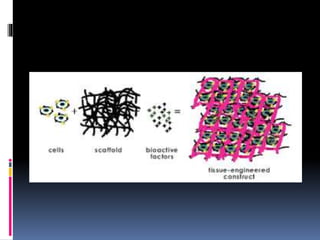
PROCESS OF TISSUE ENGINEERING
 Start building material (e.g., extracellular matrix,
biodegradable polymer).
 Shape it as needed.
 Seed it with living cells .
 Bathe it with growth factors.
 Cells multiply & fill up the scaffold & grow into
three-dimensional tissue.
 Implanted in the body.
 Cells recreate their intended tissue functions.
 Blood vessels attach themselves to the new tissue.
 The scaffold dissolves.
 The newly grown tissue eventually blends in with
its surroundings.
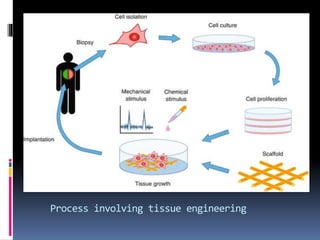
Process involving tissue engineering
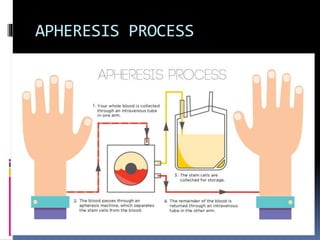
EXTRACTION OF CELLS
 From fluid tissues such as blood, cells are
extracted by bulk methods, usually
centrifugation or apheresis.
 From solid tissues, extraction is more
difficult. Usually the tissue is minced, and
then digested with the enzymes trypsin or
collagenase to remove the extracellular
matrix (ECM) that holds the cells. After that,
the cells are free floating, and extracted using
centrifugation or apheresis.
APHERESIS PROCESS
Stem cells cells
 Stem cells are undifferentiated cells with the
ability to divide in culture and give rise to
different forms of specialized cells.
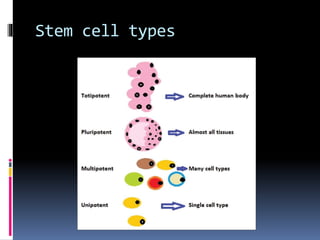
 According to their source stem cells are
divided
 multipotent
 pluripotent
 totipotent
 unipotent
Stem cell types
SCAFFOLDS
 Cells are often implanted or 'seeded' into an
artificial structure capable of supporting
three-dimensional tissue formation.These
structures, typically called scaffolds
 Scaffolds usually serve at least one of the
following purposes:
• Allow cell attachment and migration
• Deliver and retain cells and biochemical factors
• Enable diffusion of vital cell nutrients and
expressed products
• Exert certain mechanical and biological influences
to modify the behavior of the cell phase
MATERIALS USED
 Many different materials (natural and
synthetic, biodegradable and permanent)
have been investigated. Examples of the
materials are collagen and some polyesters.
 New biomaterials have been engineered to
have ideal properties and functional
customization: injectability, synthetic
manufacture, biocompatibility, non-
immunogenicity, transparency, nano-scale
fibers, low concentration, resorption rates,
etc.
 Proteic materials, such as collagen or fibrin,
and polysaccharidic materials, like chitosan or
glycosaminoglycans (GAGs), have all proved
suitable in terms of cell compatibility, but
some issues with potential immunogenicity
still remains.
METHODS FOR SYNTHESIS OF TISSUE
ENGINEERED SCAFFOLDS
 Nano fiber Self-Assembly
 Textile technologies
 Solvent Casting & Particulate Leaching
(SCPL)
 Gas Foaming
 Emulsification/Freeze-drying
 Thermally Induced Phase Separation (TIPS)
 CAD/CAMTechnologies
 Laser-assisted Bio Printing (LaBP)
APPLICATION
 Tissue engineering covers a broad range of
applications, in practice the term has come to
represent applications that repair or replace
structural tissues (i.e., bone, cartilage, blood
vessels, bladder, etc).
 A closely related (and older) field is cell
transplantation.This field is concerned with the
transplantation of cells that perform a specific
biochemical function (e.g., an artificial pancreas,
or an artificial liver).
 Tissue engineering solves problems by using
living cells as engineering materials.
 Tissue engineered heart valves offer a promising
alternative for the replacement of diseased heart
valves avoiding the limitations faced with
currently available bio prosthetic and mechanical
heart valves.
 Tissue-engineered skin is a significant advance in
the field of wound healing and was developed
due to limitations associated with the use of
autografts.
ADVANTAGE OF TISSUE
ENGINEERING
DISADVANTAGE OF TISSUE
ENGINEERING
Tissue engineering

Tissue engineering

  • 1.
  • 2.
    SYNOPSIS  Introduction  Processinvolved  Stem cells  Scaffolds  Materials used  Methods for synthesis ofTE scaffolds  Applications  Advantage of TE  Disadvantage of TE
  • 3.
    INTRODUCTION  Tissue engineeringis the use of a combination of cells, engineering and materials methods, and suitable biochemical and physicochemical factors to improve or replace biological functions.  The term has also been applied to efforts to perform specific biochemical functions using cells within an artificially-created support system (e.g. an artificial pancreas, or a bio artificial liver).
  • 4.
    examples  Bio artificialwindpipe  Bio artificial liver device  Artificial pancreas  Cartilage  DorisTaylor ‘s heart in a jar  Tissue engineered airway  Tissue engineered vessels  Artificial skin  Artificial bone marrow  Artificial bone  Oral mucosa tissue engineering  Foreskin
  • 5.
    PROCESS OF TISSUEENGINEERING  Start building material (e.g., extracellular matrix, biodegradable polymer).  Shape it as needed.  Seed it with living cells .  Bathe it with growth factors.  Cells multiply & fill up the scaffold & grow into three-dimensional tissue.  Implanted in the body.  Cells recreate their intended tissue functions.  Blood vessels attach themselves to the new tissue.  The scaffold dissolves.  The newly grown tissue eventually blends in with its surroundings.
  • 6.
  • 7.
    EXTRACTION OF CELLS From fluid tissues such as blood, cells are extracted by bulk methods, usually centrifugation or apheresis.  From solid tissues, extraction is more difficult. Usually the tissue is minced, and then digested with the enzymes trypsin or collagenase to remove the extracellular matrix (ECM) that holds the cells. After that, the cells are free floating, and extracted using centrifugation or apheresis.
  • 8.
  • 9.
    Stem cells cells Stem cells are undifferentiated cells with the ability to divide in culture and give rise to different forms of specialized cells.  According to their source stem cells are divided  multipotent  pluripotent  totipotent  unipotent
  • 10.
  • 11.
    SCAFFOLDS  Cells areoften implanted or 'seeded' into an artificial structure capable of supporting three-dimensional tissue formation.These structures, typically called scaffolds  Scaffolds usually serve at least one of the following purposes: • Allow cell attachment and migration • Deliver and retain cells and biochemical factors • Enable diffusion of vital cell nutrients and expressed products • Exert certain mechanical and biological influences to modify the behavior of the cell phase
  • 13.
    MATERIALS USED  Manydifferent materials (natural and synthetic, biodegradable and permanent) have been investigated. Examples of the materials are collagen and some polyesters.  New biomaterials have been engineered to have ideal properties and functional customization: injectability, synthetic manufacture, biocompatibility, non- immunogenicity, transparency, nano-scale fibers, low concentration, resorption rates, etc.
  • 14.
     Proteic materials,such as collagen or fibrin, and polysaccharidic materials, like chitosan or glycosaminoglycans (GAGs), have all proved suitable in terms of cell compatibility, but some issues with potential immunogenicity still remains.
  • 15.
    METHODS FOR SYNTHESISOF TISSUE ENGINEERED SCAFFOLDS  Nano fiber Self-Assembly  Textile technologies  Solvent Casting & Particulate Leaching (SCPL)  Gas Foaming  Emulsification/Freeze-drying  Thermally Induced Phase Separation (TIPS)  CAD/CAMTechnologies  Laser-assisted Bio Printing (LaBP)
  • 16.
    APPLICATION  Tissue engineeringcovers a broad range of applications, in practice the term has come to represent applications that repair or replace structural tissues (i.e., bone, cartilage, blood vessels, bladder, etc).  A closely related (and older) field is cell transplantation.This field is concerned with the transplantation of cells that perform a specific biochemical function (e.g., an artificial pancreas, or an artificial liver).  Tissue engineering solves problems by using living cells as engineering materials.
  • 17.
     Tissue engineeredheart valves offer a promising alternative for the replacement of diseased heart valves avoiding the limitations faced with currently available bio prosthetic and mechanical heart valves.  Tissue-engineered skin is a significant advance in the field of wound healing and was developed due to limitations associated with the use of autografts.
  • 18.
  • 19.