BIOT – 852
Tissue
Engineering……….Pluripotent
stem cell applications
ADVANCED
TECHNIQUES IN CELL
CULTURE
TOPIC
Sir Muhammad Aqeel
Bhutto
OUT LINES OF PRESENTATION
Introduction 11
Benefits of tissue
engineering
22
Aims And Objects 33
Procedure 44
Potential of stem
cells in tissue
engineering
55
Stem cells applications 66
Features of tissue
engineering
77
INTRODUCTION
TISSUEENGINEERING
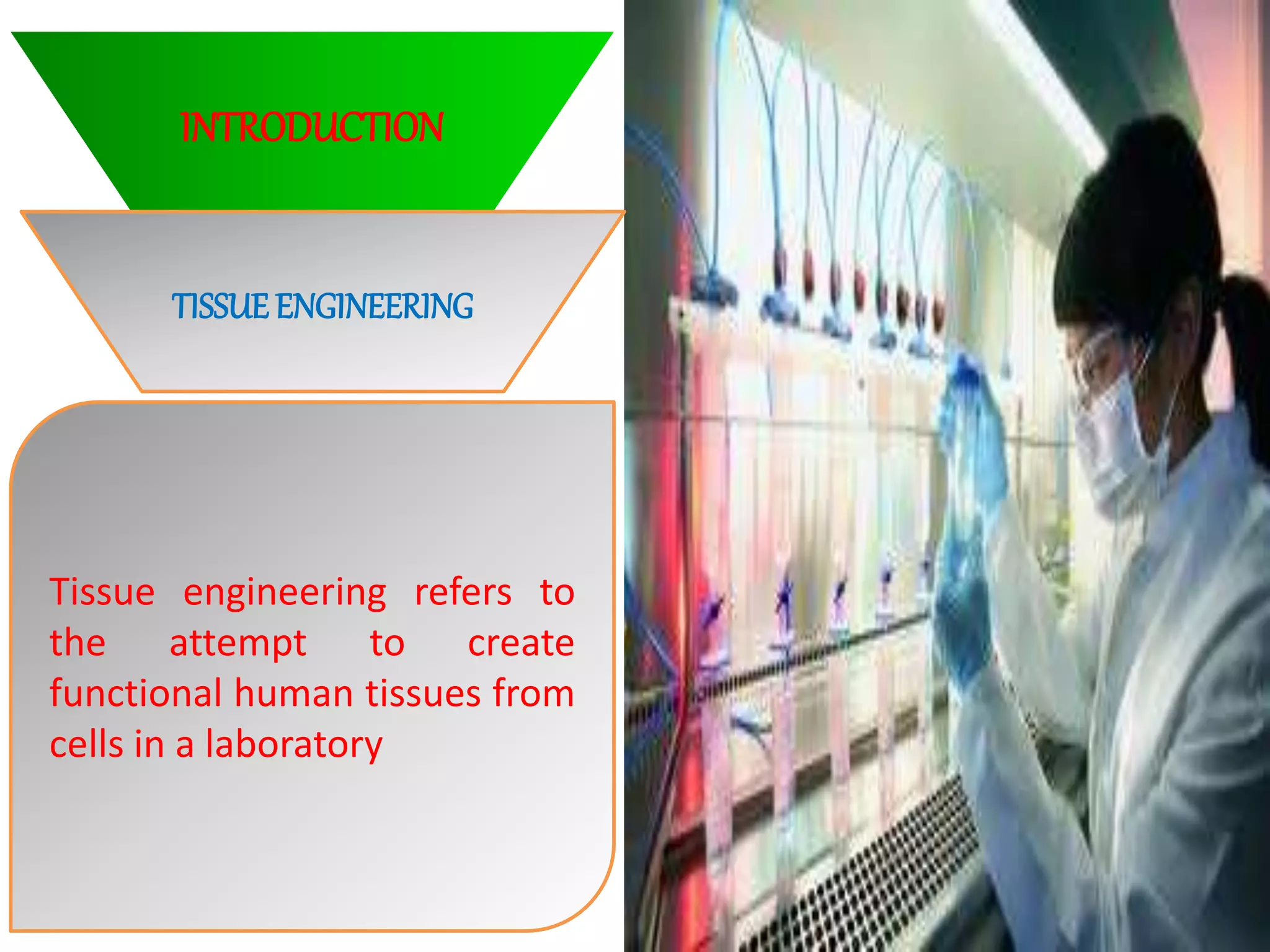
Tissue engineering refers to
the attempt to create
functional human tissues from
cells in a laboratory
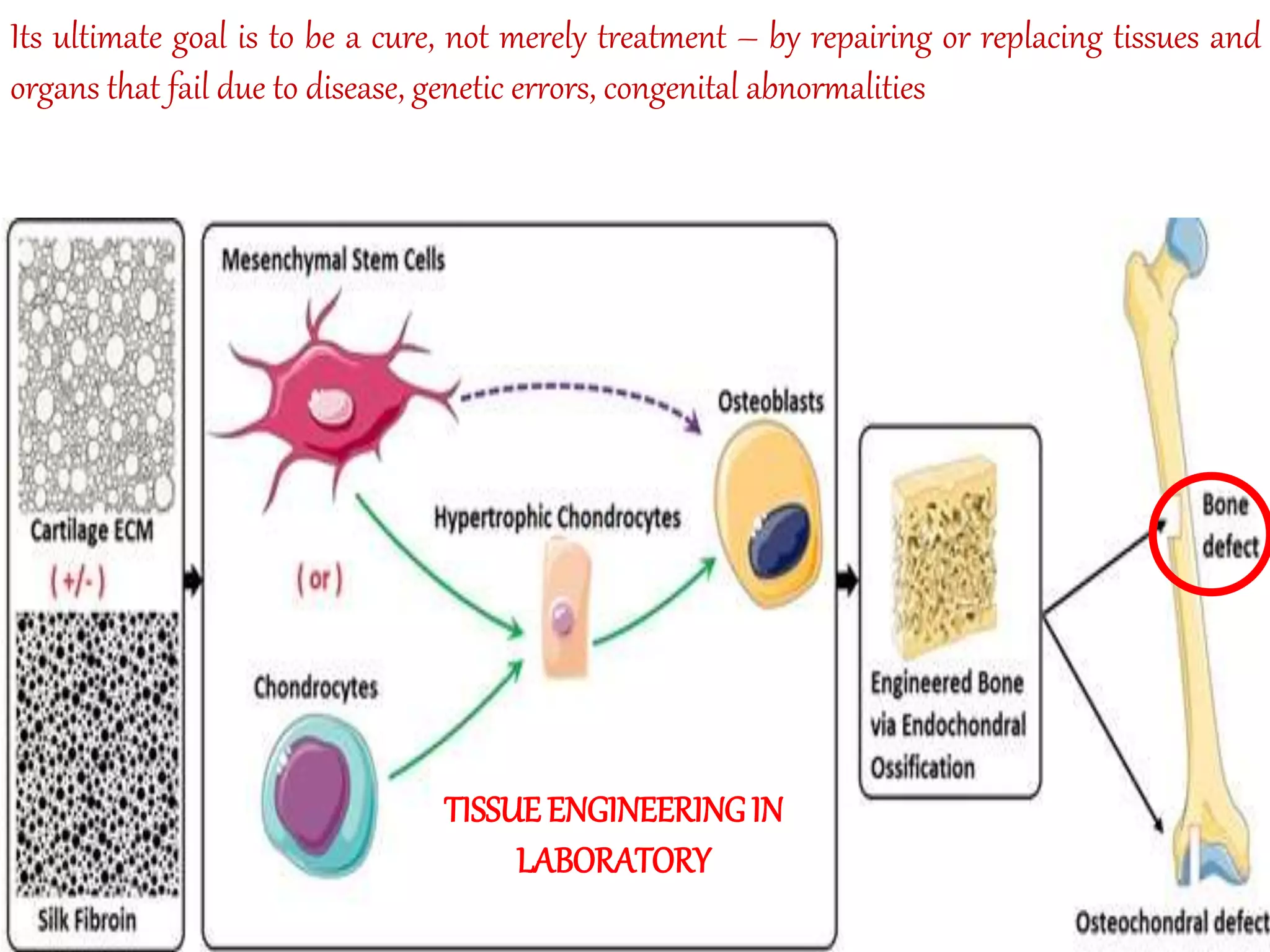
Its ultimate goal is to be a cure, not merely treatment – by repairing or replacing tissues and
organs that fail due to disease, genetic errors, congenital abnormalities
TISSUEENGINEERINGIN
LABORATORY
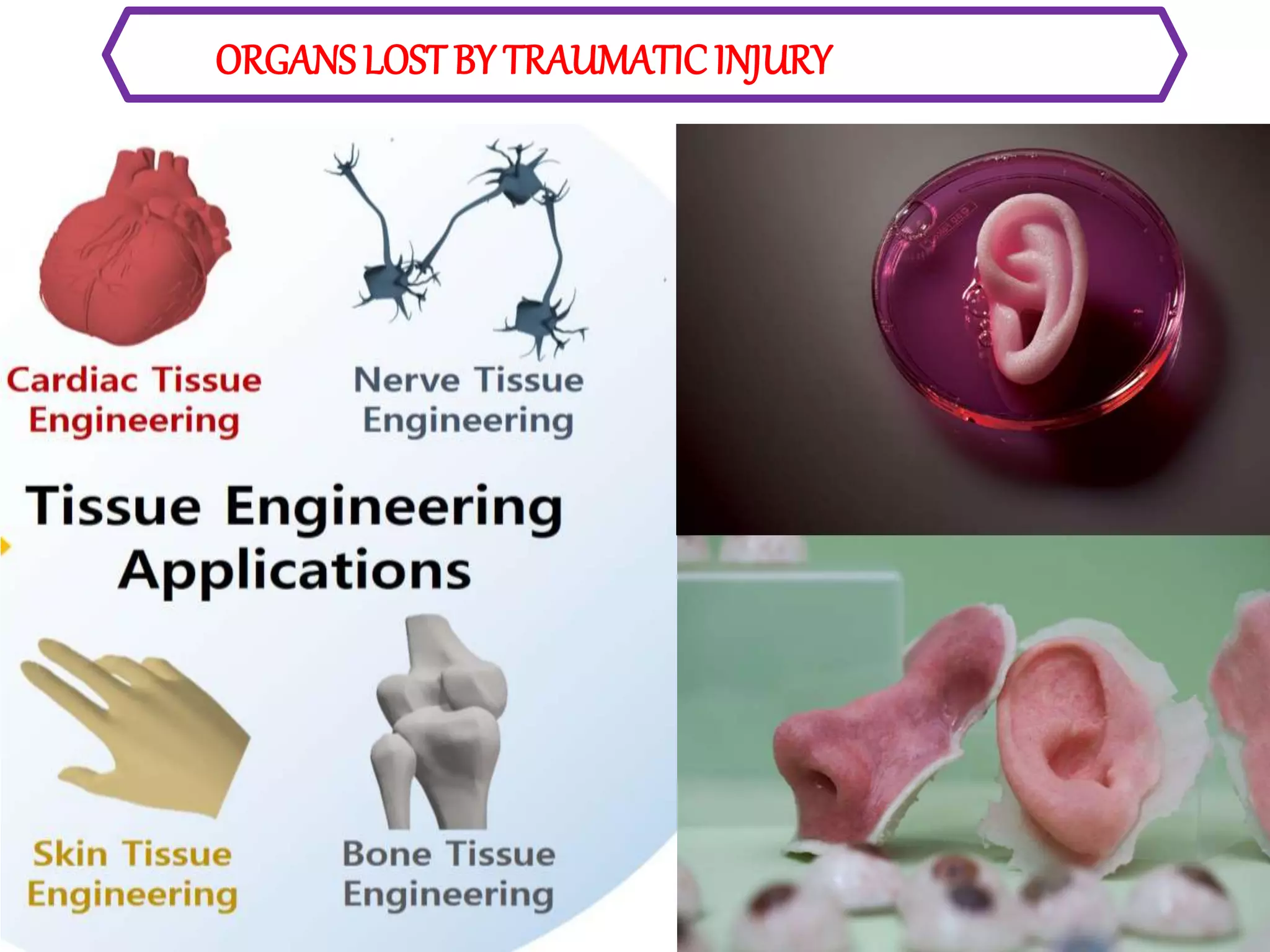
ORGANSLOST BY TRAUMATICINJURY
For example Tissue engineering is the field of biomedical
engineering that’s goal is to create new cells
that helps heal organs and if need be, to
create an entirely new organ.
Tissue engineering
Step by step
Benefits of tissue
engineering
The mainpoint of tissueengineeringis to
makeit easierbasicallyreproduce organs
in order to makepeople’s lives better.
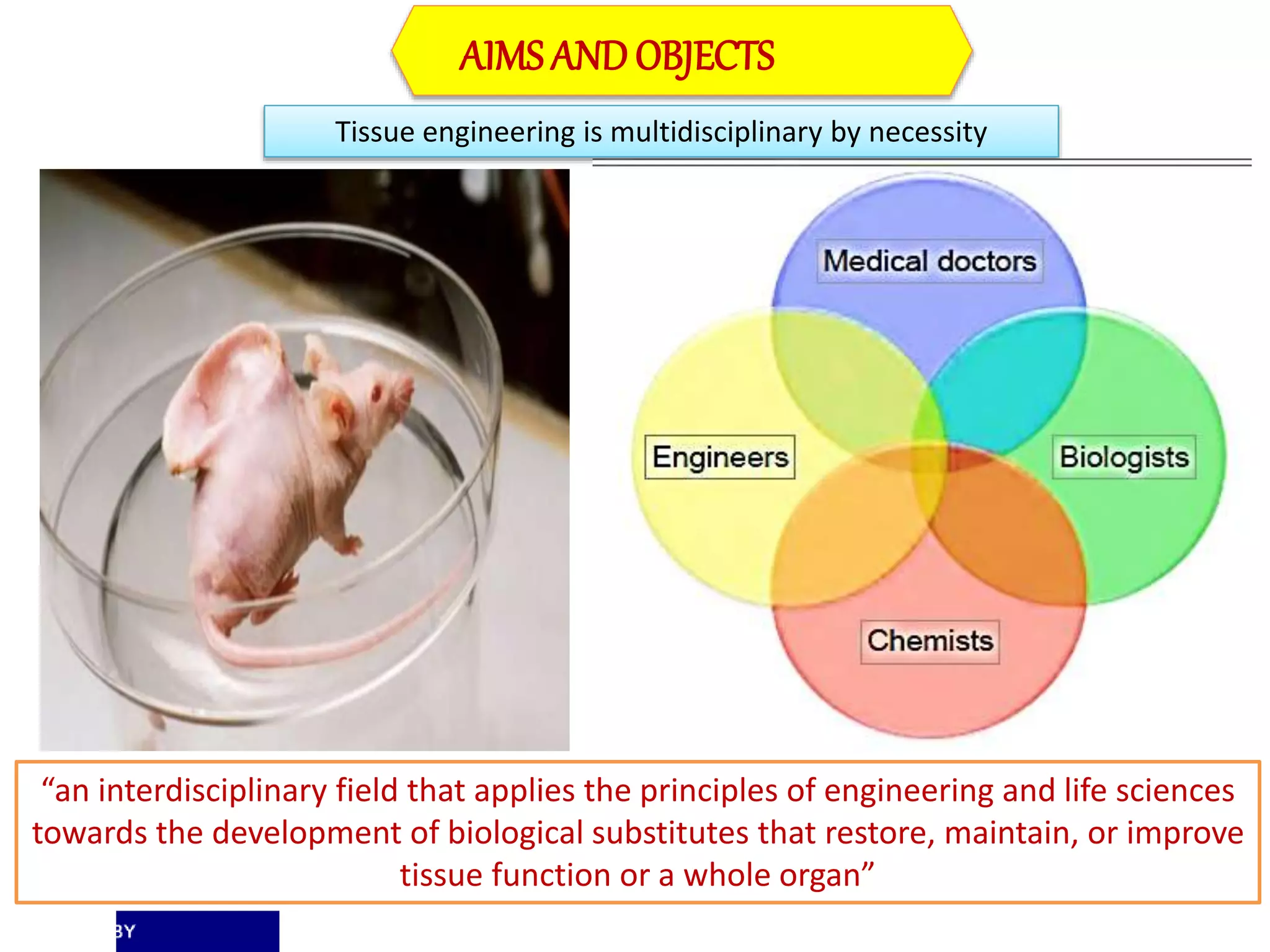
AIMS AND OBJECTS
Tissue engineering is multidisciplinary by necessity
“an interdisciplinary field that applies the principles of engineering and life sciences
towards the development of biological substitutes that restore, maintain, or improve
tissue function or a whole organ”
Procedure
Procedure
There are five basic steps in tissue engineering.
1st step is actually
getting the base cells
to work with, from
patient.
2nd Expending cells3rd Seed onto an
appropriate scaffold with
suitable growth factors
and cytokines.
4th step is putting the altered
cells into a scaffold in order
to incubate the cell
5th The final step is to put the
newly created cells or organ
into use
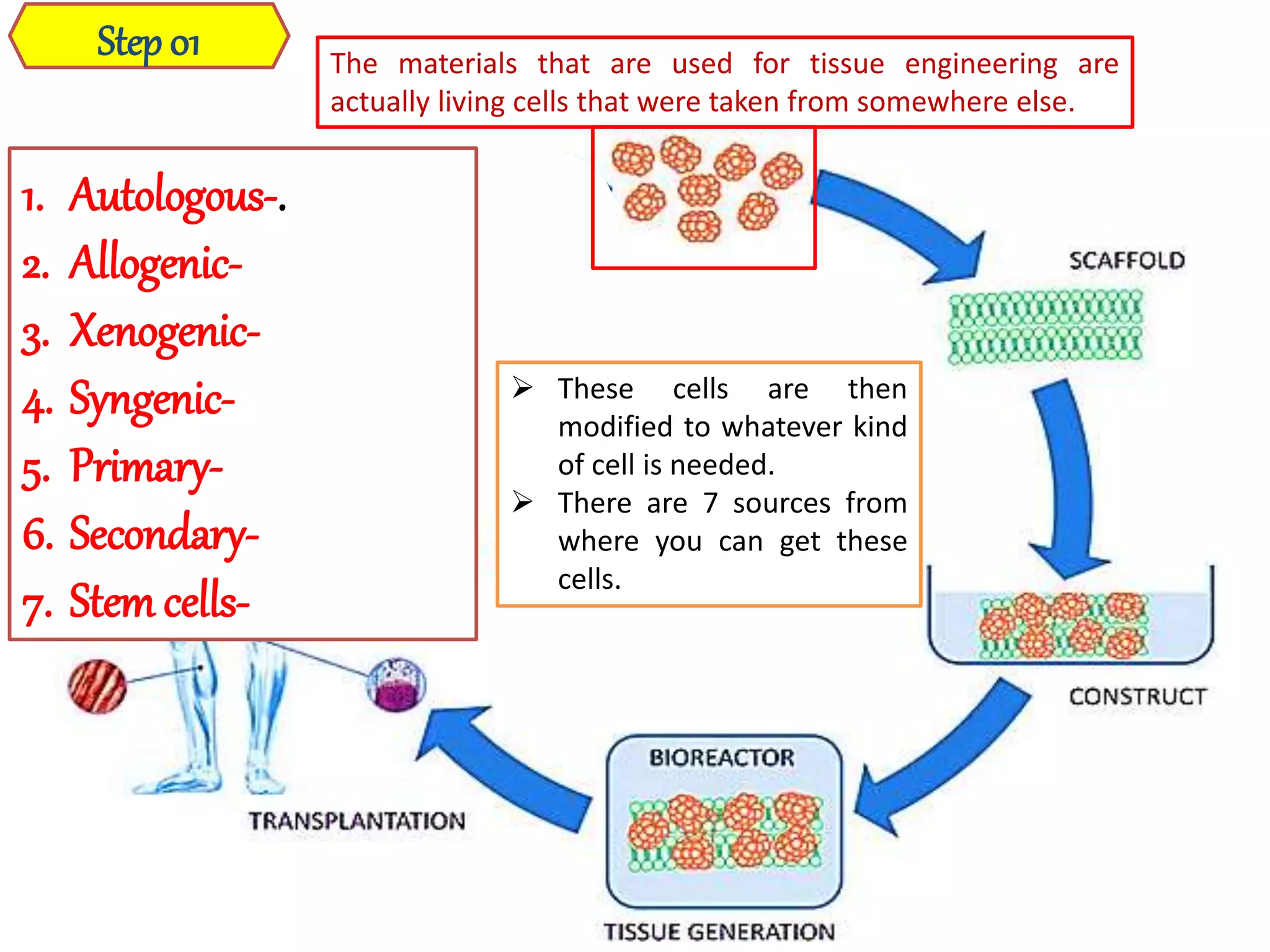
Step 01
 These cells are then
modified to whatever kind
of cell is needed.
 There are 7 sources from
where you can get these
cells.
The materials that are used for tissue engineering are
actually living cells that were taken from somewhere else.
1. Autologous-.
2. Allogenic-
3. Xenogenic-
4. Syngenic-
5. Primary-
6. Secondary-
7. Stemcells-
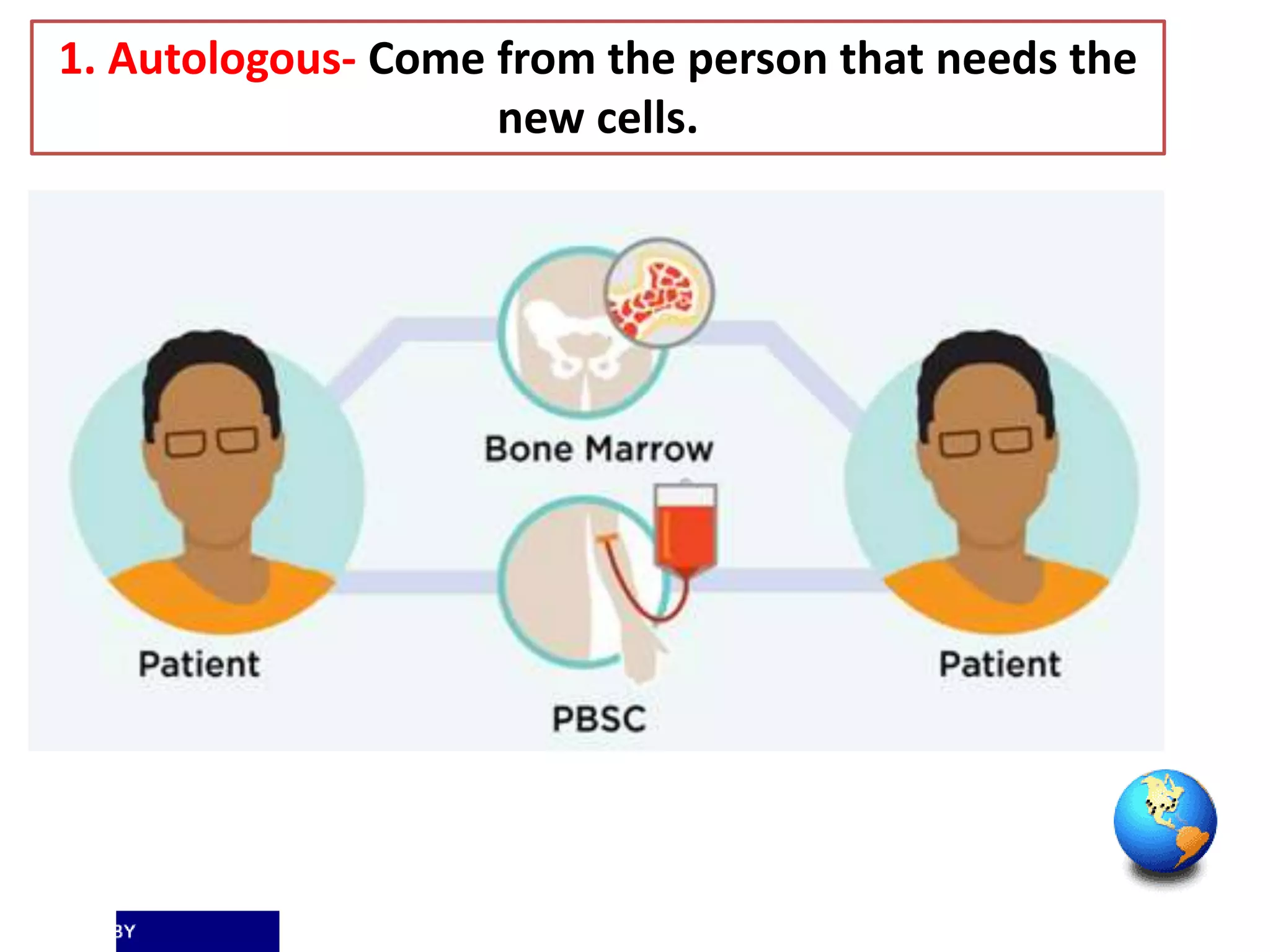
1. Autologous- Come from the person that needs the
new cells.
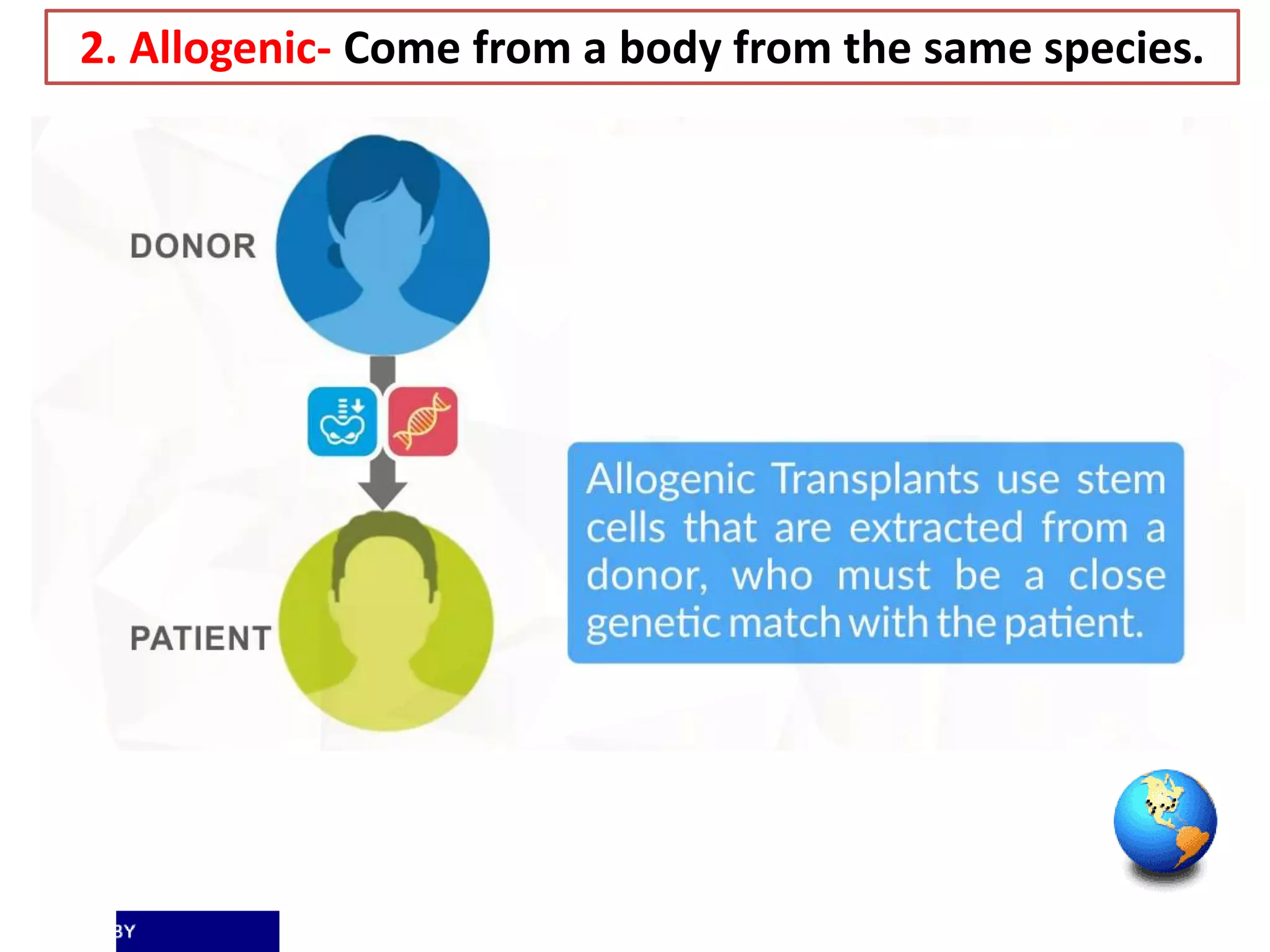
2. Allogenic- Come from a body from the same species.
3. Xenogenic- Come from a different species then the
organism they’re going into.
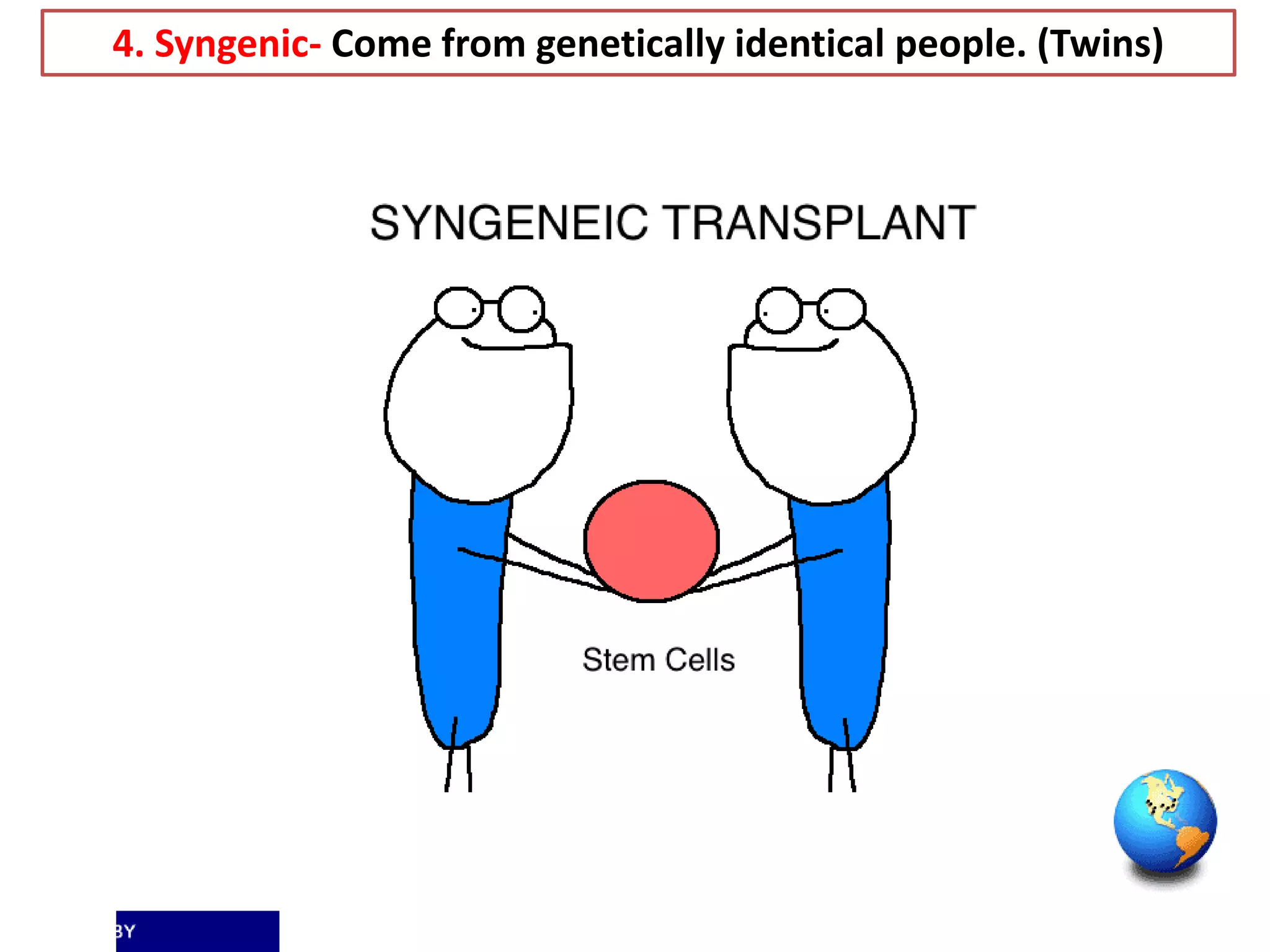
4. Syngenic- Come from genetically identical people. (Twins)
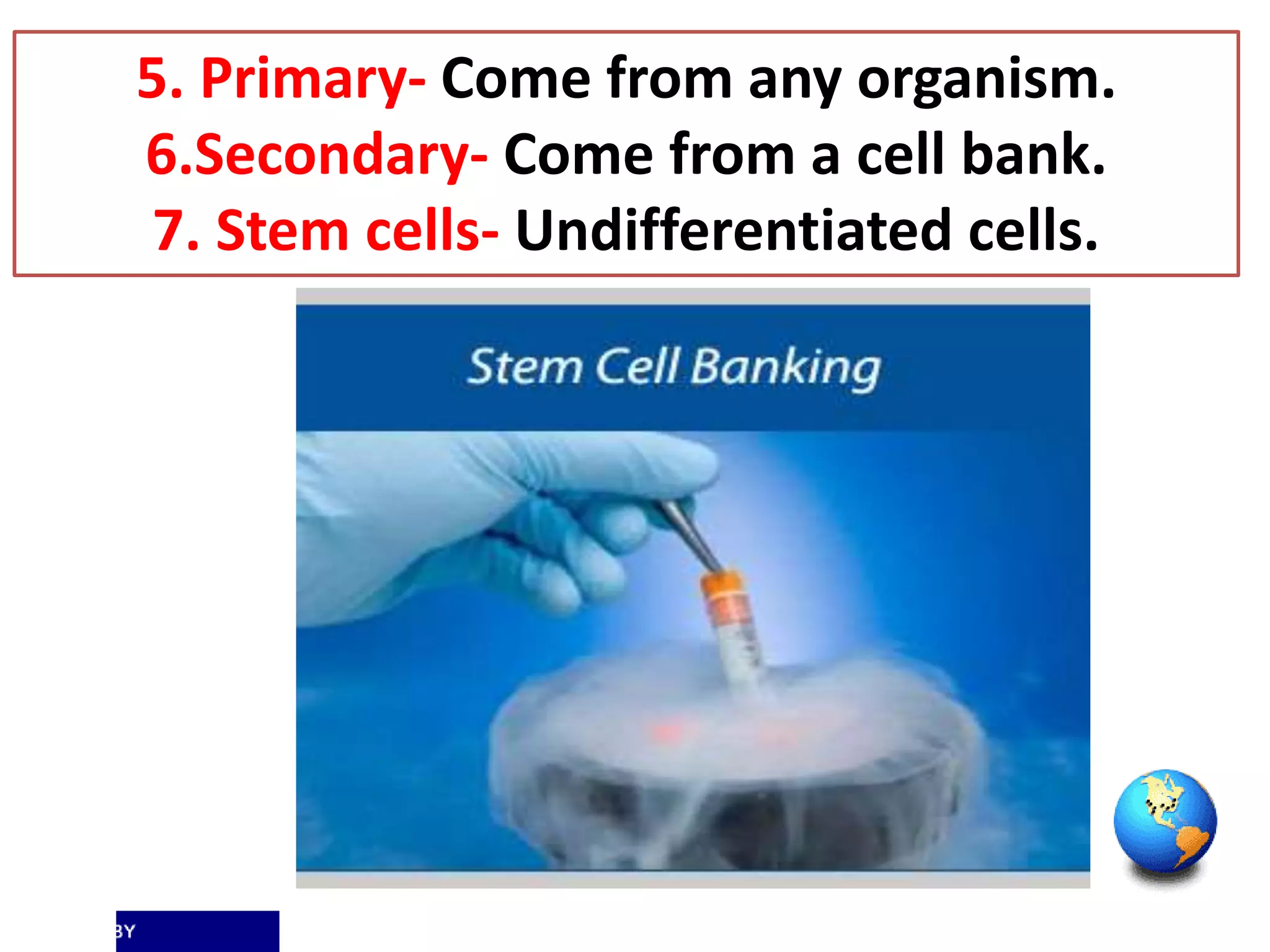
5. Primary- Come from any organism.
6.Secondary- Come from a cell bank.
7. Stem cells- Undifferentiated cells.
Bioreactors are used
in an attempt to
recreate realistic
physiological
environments so that
the cells can grow in
a natural manner.
Step 02
Expending cells in laboratory
Step 03 and 04
Once the cells are obtained, they are then put
into a scaffold to let the cells grow into their
new forms.
Scaffolds are materials that have been
engineered to cause desirable cellular
interactions to contribute to the formation of
new functional tissues for medical purposes.
Cells are often 'seeded' into these structures
capable of supporting three-dimensional tissue
formation.
Capillary Culture Units:
The original problem with creating new organs
was that they would die before they could get
placed into the organism that needed them.
This problem has been solved with the recent
developments in 3D printers, which allows for
blood vessels to be put into the new organ.
that delivers nutrients and removes products
of cellular metabolism.
The capillary culture unit (CCU)
consists of a network of artificial
capillaries that simulates the in vivo
vascular matrix.
Step 05
This step obviously is when the newly created cells are put into use.
Whether they are being used to create a new organ via the 3D Organ
Printer, or they are being used as new skin.
POTENTIAL OF STEM CELLS IN TISSUE ENGINEERING
 Capable of self-renewal-- can divide and renew themselves for long periods
 Unspecialized cells that can differentiate into other types of cells
Pluripotent: Embryonic stem cells:
Can become any cell type in the body
 Enormous potential
 Self-renewal
Multipotent: Adult stem cells.
Can become multiple but limited number
of cell types.
 Derived From Patient
 Reduced Risk Of Immune Rejection
 It is renewable source of
replacement cells and tissues to
replace need for donors.
 potential to treat diseases or
injuries that affect tissues that
cannot regenerate
CURRENT RESEARCH APPLICATIONS:
 Cardiovascular disease:
 Diabetes,
 Osteoarthritis,
 Spinal cord injury,
 Alzheimer’s,
 Strokes,
 Burns,
 Drug discovery,...
STEM CELL APPLICATIONS:
FEATURESOF TISSUEENGINEERING
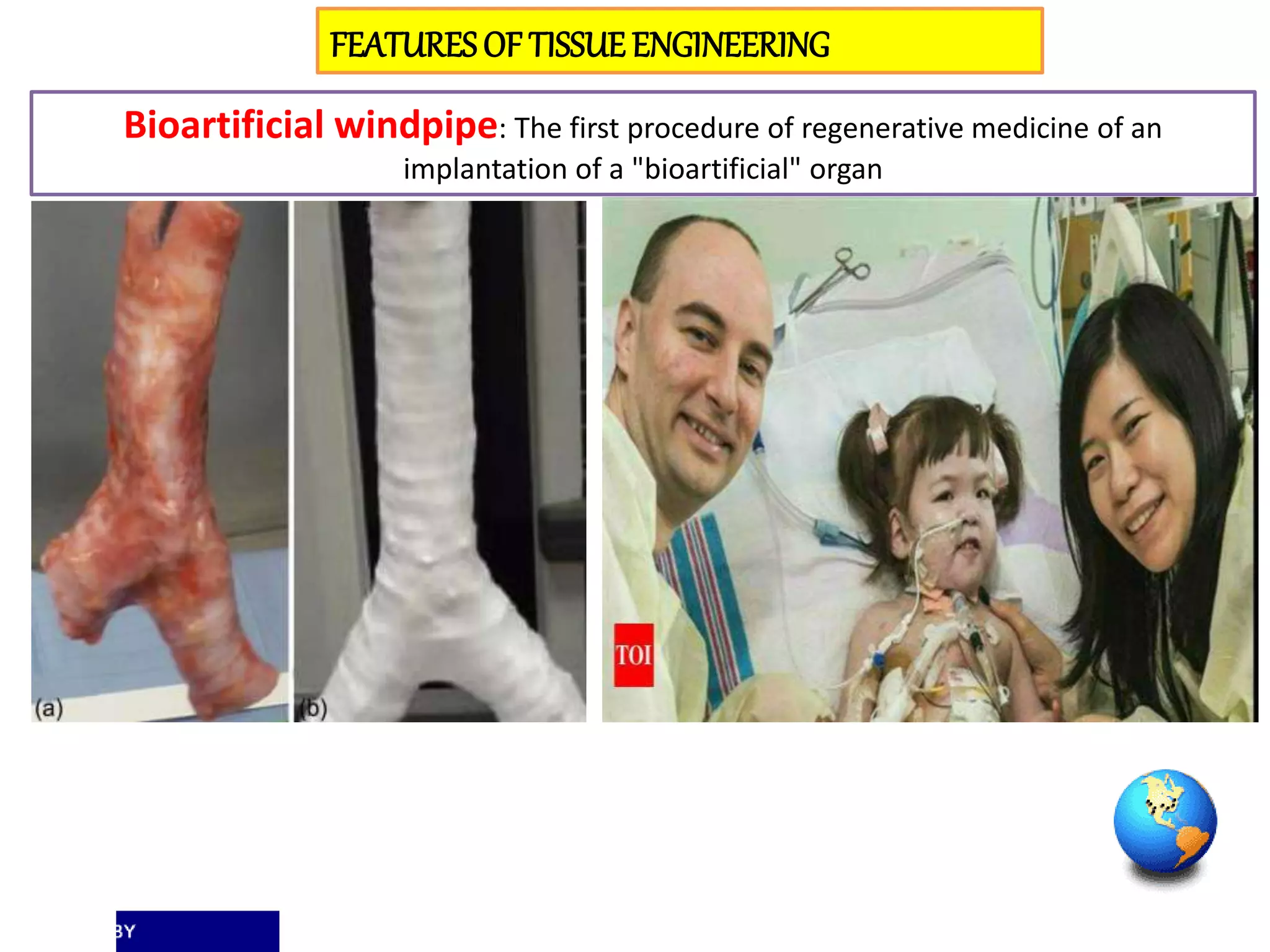
Bioartificial windpipe: The first procedure of regenerative medicine of an
implantation of a "bioartificial" organ
FEATURESOF TISSUEENGINEERING
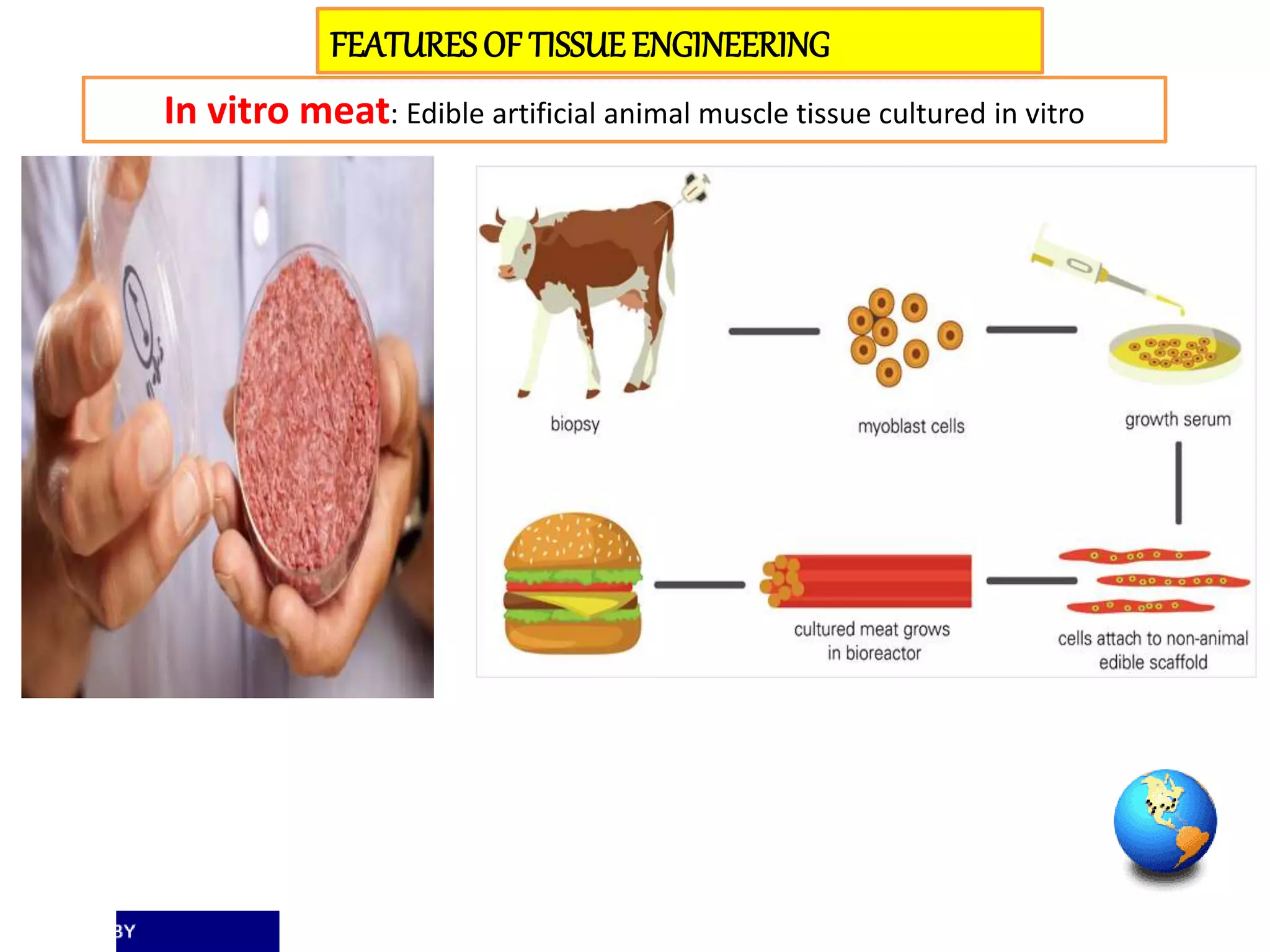
In vitro meat: Edible artificial animal muscle tissue cultured in vitro
FEATURESOF TISSUEENGINEERING
Bioartificial liver device: several research efforts have produced hepatic assist
devices utilizing living hepatocytes
FEATURESOF TISSUEENGINEERING
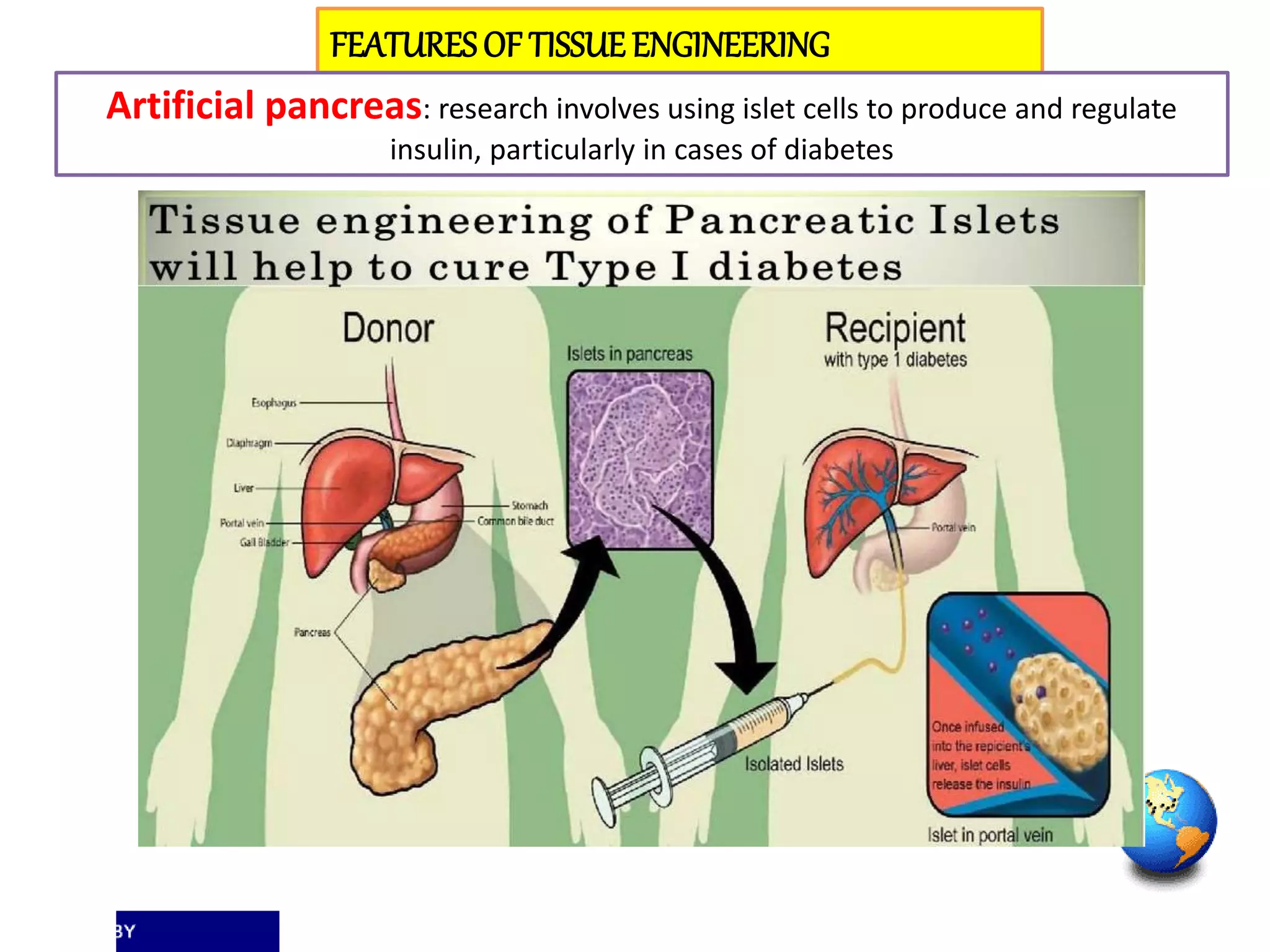
Artificial pancreas: research involves using islet cells to produce and regulate
insulin, particularly in cases of diabetes
FEATURESOF TISSUEENGINEERING
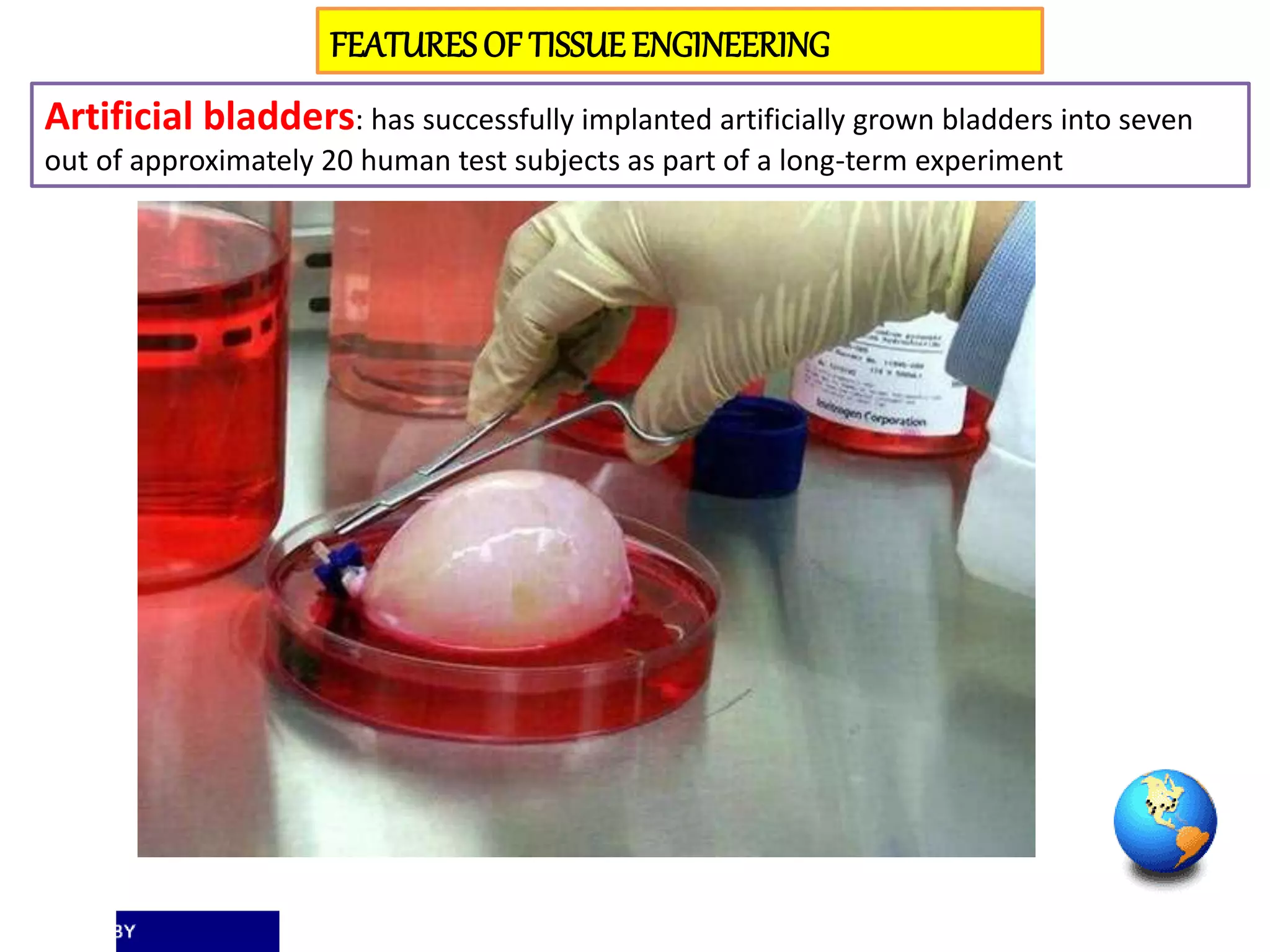
Artificial bladders: has successfully implanted artificially grown bladders into seven
out of approximately 20 human test subjects as part of a long-term experiment
FEATURESOF TISSUEENGINEERING
Cartilage: lab-grown tissue was successfully used to repair knee cartilage
FEATURESOF TISSUEENGINEERING
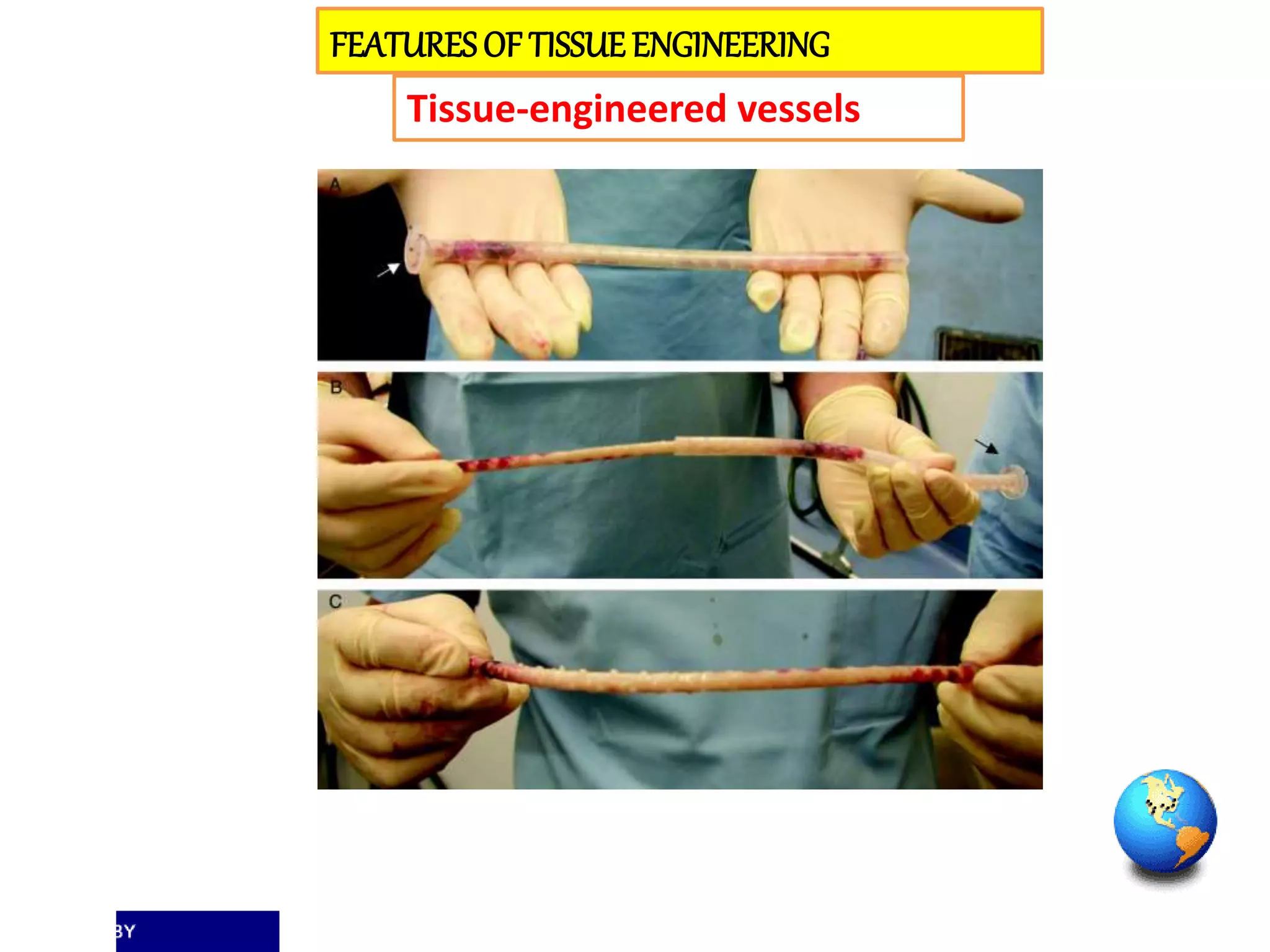
Tissue-engineered vessels
FEATURESOF TISSUEENGINEERING
Artificial skin constructed from human skin cells embedded in a hydrogel, such as in the
case of bioprinted constructs for battlefield burn repairs
FEATURESOF TISSUEENGINEERING
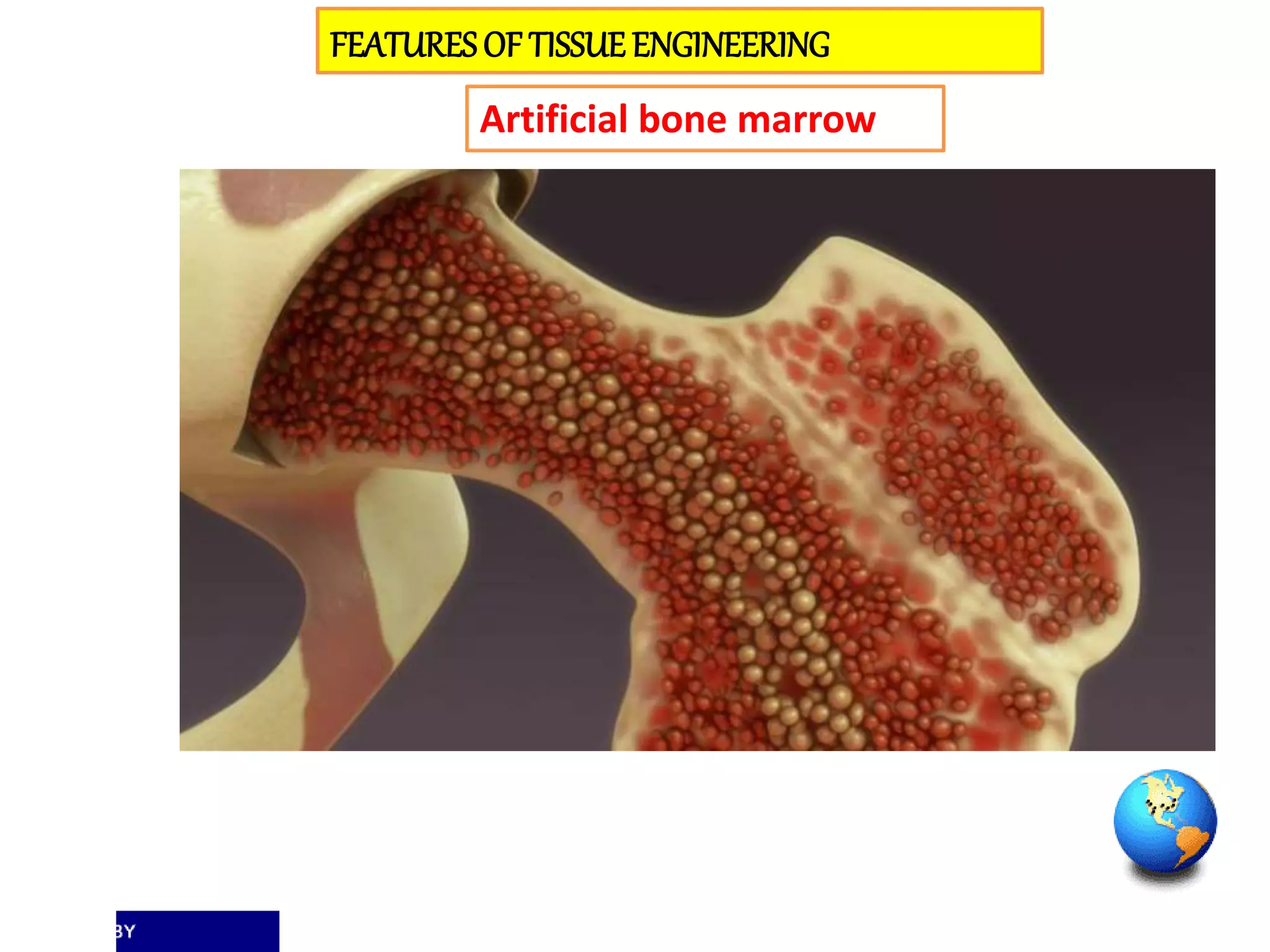
Artificial bone marrow
FEATURESOF TISSUEENGINEERING
Other Human organs like ear
 I see tissue engineering as a very promising field in Biomedical engineering. It provide
us a wide view of advantages of advanced bioengineering.
 It can solve many of the problems that people experience today. Like:-
 This field has developed great hope for the peoples who suffer of liver ailments by
generating artificial liver.
 It has reawaked hope in the diabetic patients by producing artificial pancreatic Beta
cells of Iselets of Langhans for insuline.
 Tissue engineering is a exciting, interesting and valuable field where is Pakistan lot of
work is needed specially in research and development. No doubt developed countries
are more advanced in this field, and I am confident in future it would be most great
business of world, to sell and purchase human synthetic organs, people would never
talk to purchase Japanese original cars, Taiwan original mobile or other non living
devices but they would talk I have new original kidney from xy lab or country, I have to
buy a new liver ……..
DISCUSSION
 As a researcher our up coming decade would give us more challenges, by giving exiting
research topics in tissue engineering. Emphasis is still placed on the optimal cell
sources, growth factors, scaffold design and fabrication , and the development of
microfibrication technology to create vascularized tissues and organs.
DISCUSSION
Thanks

Tissue ingineering biot

  • 2.
    BIOT – 852 Tissue Engineering……….Pluripotent stemcell applications ADVANCED TECHNIQUES IN CELL CULTURE TOPIC Sir Muhammad Aqeel Bhutto
  • 3.
    OUT LINES OFPRESENTATION Introduction 11 Benefits of tissue engineering 22 Aims And Objects 33 Procedure 44 Potential of stem cells in tissue engineering 55 Stem cells applications 66 Features of tissue engineering 77
  • 4.
    INTRODUCTION TISSUEENGINEERING Tissue engineering refersto the attempt to create functional human tissues from cells in a laboratory
  • 5.
    Its ultimate goalis to be a cure, not merely treatment – by repairing or replacing tissues and organs that fail due to disease, genetic errors, congenital abnormalities TISSUEENGINEERINGIN LABORATORY
  • 6.
  • 7.
    For example Tissueengineering is the field of biomedical engineering that’s goal is to create new cells that helps heal organs and if need be, to create an entirely new organ.
  • 8.
  • 9.
    Benefits of tissue engineering Themainpoint of tissueengineeringis to makeit easierbasicallyreproduce organs in order to makepeople’s lives better.
  • 10.
    AIMS AND OBJECTS Tissueengineering is multidisciplinary by necessity “an interdisciplinary field that applies the principles of engineering and life sciences towards the development of biological substitutes that restore, maintain, or improve tissue function or a whole organ”
  • 11.
  • 12.
    Procedure There are fivebasic steps in tissue engineering. 1st step is actually getting the base cells to work with, from patient. 2nd Expending cells3rd Seed onto an appropriate scaffold with suitable growth factors and cytokines. 4th step is putting the altered cells into a scaffold in order to incubate the cell 5th The final step is to put the newly created cells or organ into use
  • 13.
    Step 01  Thesecells are then modified to whatever kind of cell is needed.  There are 7 sources from where you can get these cells. The materials that are used for tissue engineering are actually living cells that were taken from somewhere else. 1. Autologous-. 2. Allogenic- 3. Xenogenic- 4. Syngenic- 5. Primary- 6. Secondary- 7. Stemcells-
  • 14.
    1. Autologous- Comefrom the person that needs the new cells.
  • 15.
    2. Allogenic- Comefrom a body from the same species.
  • 16.
    3. Xenogenic- Comefrom a different species then the organism they’re going into.
  • 17.
    4. Syngenic- Comefrom genetically identical people. (Twins)
  • 18.
    5. Primary- Comefrom any organism. 6.Secondary- Come from a cell bank. 7. Stem cells- Undifferentiated cells.
  • 19.
    Bioreactors are used inan attempt to recreate realistic physiological environments so that the cells can grow in a natural manner. Step 02 Expending cells in laboratory
  • 20.
    Step 03 and04 Once the cells are obtained, they are then put into a scaffold to let the cells grow into their new forms. Scaffolds are materials that have been engineered to cause desirable cellular interactions to contribute to the formation of new functional tissues for medical purposes. Cells are often 'seeded' into these structures capable of supporting three-dimensional tissue formation. Capillary Culture Units: The original problem with creating new organs was that they would die before they could get placed into the organism that needed them. This problem has been solved with the recent developments in 3D printers, which allows for blood vessels to be put into the new organ. that delivers nutrients and removes products of cellular metabolism. The capillary culture unit (CCU) consists of a network of artificial capillaries that simulates the in vivo vascular matrix.
  • 21.
    Step 05 This stepobviously is when the newly created cells are put into use. Whether they are being used to create a new organ via the 3D Organ Printer, or they are being used as new skin.
  • 22.
    POTENTIAL OF STEMCELLS IN TISSUE ENGINEERING  Capable of self-renewal-- can divide and renew themselves for long periods  Unspecialized cells that can differentiate into other types of cells
  • 23.
    Pluripotent: Embryonic stemcells: Can become any cell type in the body  Enormous potential  Self-renewal Multipotent: Adult stem cells. Can become multiple but limited number of cell types.  Derived From Patient  Reduced Risk Of Immune Rejection
  • 24.
     It isrenewable source of replacement cells and tissues to replace need for donors.  potential to treat diseases or injuries that affect tissues that cannot regenerate CURRENT RESEARCH APPLICATIONS:  Cardiovascular disease:  Diabetes,  Osteoarthritis,  Spinal cord injury,  Alzheimer’s,  Strokes,  Burns,  Drug discovery,... STEM CELL APPLICATIONS:
  • 25.
    FEATURESOF TISSUEENGINEERING Bioartificial windpipe:The first procedure of regenerative medicine of an implantation of a "bioartificial" organ
  • 26.
    FEATURESOF TISSUEENGINEERING In vitromeat: Edible artificial animal muscle tissue cultured in vitro
  • 27.
    FEATURESOF TISSUEENGINEERING Bioartificial liverdevice: several research efforts have produced hepatic assist devices utilizing living hepatocytes
  • 28.
    FEATURESOF TISSUEENGINEERING Artificial pancreas:research involves using islet cells to produce and regulate insulin, particularly in cases of diabetes
  • 29.
    FEATURESOF TISSUEENGINEERING Artificial bladders:has successfully implanted artificially grown bladders into seven out of approximately 20 human test subjects as part of a long-term experiment
  • 30.
    FEATURESOF TISSUEENGINEERING Cartilage: lab-growntissue was successfully used to repair knee cartilage
  • 31.
  • 32.
    FEATURESOF TISSUEENGINEERING Artificial skinconstructed from human skin cells embedded in a hydrogel, such as in the case of bioprinted constructs for battlefield burn repairs
  • 33.
  • 34.
  • 35.
     I seetissue engineering as a very promising field in Biomedical engineering. It provide us a wide view of advantages of advanced bioengineering.  It can solve many of the problems that people experience today. Like:-  This field has developed great hope for the peoples who suffer of liver ailments by generating artificial liver.  It has reawaked hope in the diabetic patients by producing artificial pancreatic Beta cells of Iselets of Langhans for insuline.  Tissue engineering is a exciting, interesting and valuable field where is Pakistan lot of work is needed specially in research and development. No doubt developed countries are more advanced in this field, and I am confident in future it would be most great business of world, to sell and purchase human synthetic organs, people would never talk to purchase Japanese original cars, Taiwan original mobile or other non living devices but they would talk I have new original kidney from xy lab or country, I have to buy a new liver …….. DISCUSSION
  • 36.
     As aresearcher our up coming decade would give us more challenges, by giving exiting research topics in tissue engineering. Emphasis is still placed on the optimal cell sources, growth factors, scaffold design and fabrication , and the development of microfibrication technology to create vascularized tissues and organs. DISCUSSION Thanks